
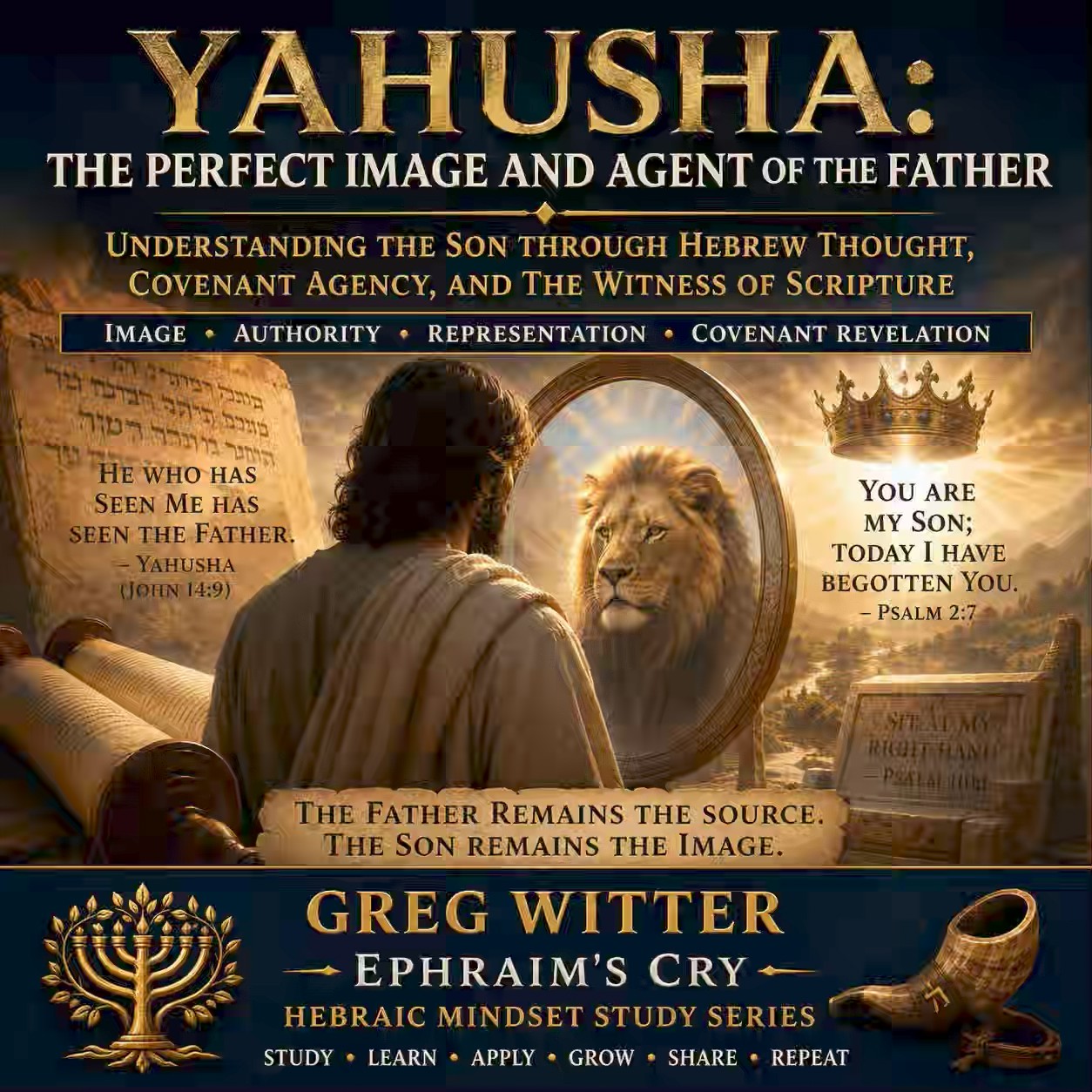
Yahusha: The Perfect Image and Agent of the Father
Understanding the Son Through Hebrew Thought, Covenant Agency, and the Witness of Scripture
Image • Authority • Representation • Covenant Revelation
Greg Witter
Ephraim’s Cry
Hebraic Mindset Study Series
Study • Learn • Apply • Grow • Share • Repeat
Before we begin, it has become apparent that many people continue to struggle with understanding the relationship between the Father and the Son because they are attempting to interpret the Scriptures through later theological systems, philosophical categories, and doctrinal traditions rather than through the covenant framework of the Scriptures themselves. For that reason, this teaching is another attempt to explain this subject from a Hebraic mindset and understanding, allowing Torah, the Prophets, the Writings, and the Apostolic Witnesses to speak for themselves. The goal is not to defend a denominational position, a creed, or a theological tradition. The goal is to understand how Scripture defines the relationship between Yahuah and Yahusha, how the Hebrew concepts of image, sonship, agency, authority, inheritance, and representation function throughout the biblical narrative, and how these witnesses work together in harmony. As with every doctrine, teaching, and interpretation, this subject must be tested by the whole counsel of Elohim and established by the agreement of the Four Witnesses: Torah, the Prophets, the Writings, and the Apostolic Witnesses. When we allow Scripture to define its own terms and interpret its own patterns, many of the apparent contradictions disappear, and the beauty, order, and consistency of Yahuah’s design become visible.
One of the greatest errors in modern theology is the tendency to explain Yahusha through Greek philosophical categories rather than through the Hebrew covenant framework of Scripture. As a result, people often find themselves asking questions the biblical writers were not asking and demanding answers the Scriptures were not attempting to provide.
The question is often framed this way:
“If Yahusha is not the Father, then must He be of the same nature as the Father?”
At first glance, that appears to be a reasonable question. The problem is that the phrase “same nature” often comes loaded with centuries of theological assumptions. Before we answer the question, we must first define our terms according to Scripture rather than according to later traditions.
The Scriptures reveal Yahusha as the Son of Yahuah, the image of the invisible Elohim, the appointed King, the heir of all things, the mediator of the covenant, the one sent by the Father, and the one through whom the Father reveals Himself to creation. Yet the Scriptures never confuse the Father and the Son as the same person.
The Father sends.
The Son is sent.
The Father commands.
The Son obeys.
The Father gives authority.
The Son receives authority.
The Father exalts.
The Son is exalted.
The Father remains the source.
The Son remains the image.
These distinctions are not contradictions. They are covenant order.
The modern Western mind often struggles with this because it thinks primarily in terms of abstract categories. The Hebrew mind thinks in terms of function, relationship, authority, representation, inheritance, and covenant purpose.
To understand Yahusha properly, we must begin where Scripture begins.
The Pattern Established in Creation
Genesis 2 records the creation of Eve from Adam. Most English translations tell us that Eve was taken from Adam’s rib. While technically not incorrect, the translation often causes readers to miss the larger picture.
The Hebrew word used is צֵלָע (tsela).
This word appears dozens of times throughout Scripture and frequently refers to a side, flank, side chamber, side structure, or corresponding side of something.
In the Tabernacle, the same word is used for the side chambers.
In Temple descriptions, the same word is used for sides of structures.
The emphasis is not the removal of a bone.
The emphasis is the removal of a side.
Eve is taken from Adam’s side.
She comes from him.
She corresponds to him.
She reflects him.
She is distinct from him.
She is not Adam.
Yet she reveals Adam.
This is why Adam immediately declares:
“This is now bone of my bones and flesh of my flesh.”
Adam sees himself reflected in another.
Not the same person.
Not a clone.
Not an unrelated being.
Not a separate species.
A corresponding image.
A covenant counterpart.
An opposite side.
A visible reflection.
The Paleo-Hebrew Insight
The Hebrew word tsela is written:
𐤑𐤋𐤏
Tsade – Lamed – Ayin
Tsade carries the picture of pursuit, the path, the righteous trail, the one following after a goal.
Lamed carries the picture of authority, instruction, leadership, and the shepherd’s staff.
Ayin carries the picture of sight, perception, understanding, and revelation.
Together they present a remarkable prophetic picture.
The side becomes a place of revelation.
The side becomes a place of visible representation.
The side becomes a place where authority is seen and understood.
The side becomes a place where what was previously hidden is now revealed.
Eve was taken from Adam’s side and became the visible counterpart through whom Adam’s humanity could be seen more fully.
She reflected him.
She revealed him.
She corresponded to him.
Yet she remained distinct from him.
This pattern becomes important because it helps us understand the relationship between the Father and the Son.
The Image of the Invisible Elohim
Paul writes in Colossians 1:15 that Yahusha is:
“The image of the invisible Elohim.”
The Greek word translated image is eikon.
The Hebrew concept behind image is found in Genesis 1:26-27 through the word צֶלֶם (tselem).
Tselem does not merely refer to appearance.
It refers to representation.
Authority.
Function.
Dominion.
Visibility.
A king would place his image throughout his kingdom as a visible representation of his authority.
The image represented the king.
The image was not the king.
The image revealed the king.
Likewise, mankind was created as the image of Elohim upon the earth.
Not because mankind is Elohim.
But because mankind was designed to represent Elohim.
Yahusha fulfills this perfectly.
What Adam failed to do, Yahusha accomplishes perfectly.
He is the perfect image.
The perfect representative.
The perfect revelation.
The perfect expression of the Father.
This is why Yahusha could say:
“He who has seen Me has seen the Father.”
Notice carefully what He did not say.
He did not say:
“I am the Father.”
He said:
“He who has seen Me has seen the Father.”
Why?
Because Yahusha reveals the Father perfectly.
Everything the Father desires to communicate is seen through the Son.
The Son speaks the Father’s words.
The Son performs the Father’s works.
The Son reveals the Father’s character.
The Son manifests the Father’s authority.
The Son carries the Father’s Name.
The Son demonstrates the Father’s will.
The Son is the visible image of the invisible Elohim.
The Principle of Agency
One of the most neglected concepts in modern theology is biblical agency.
Throughout Scripture, an agent acts on behalf of another.
The one sent carries the authority of the sender.
The one sent speaks for the sender.
The one sent represents the sender.
The Hebrew concept later became known as the shaliach principle.
The sender remains the sender.
The agent remains the agent.
Yet the authority of the sender is fully invested in the one sent.
This principle appears throughout Scripture.
No example illustrates this more clearly than Joseph.
Joseph and Pharaoh
Genesis 41 records Pharaoh elevating Joseph over all Egypt.
Pharaoh removes his signet ring.
Places it upon Joseph.
Clothes him in royal garments.
Places him in the second chariot.
Commands the people to obey him.
Then Pharaoh says:
“You shall be over my house, and according to your word all my people shall be ruled; only in the throne will I be greater than you.”
This is one of the clearest pictures of agency in all of Scripture.
Joseph was not Pharaoh.
Joseph did not become Pharaoh.
Joseph did not replace Pharaoh.
Joseph remained distinct from Pharaoh.
Yet Joseph possessed Pharaoh’s authority.
When Joseph spoke, Egypt obeyed.
When Joseph commanded, Egypt moved.
When Joseph administered grain, he did so with Pharaoh’s authority.
To reject Joseph’s authority was to reject Pharaoh’s authority.
To honor Joseph’s authority was to honor Pharaoh’s authority.
Yet the distinction remained.
“Only in the throne will I be greater than you.”
This is not identity.
This is agency.
This is representation.
This is delegated authority.
Joseph becomes a prophetic shadow of Yahusha.
Yahusha is infinitely greater than Joseph.
Yet the pattern remains.
The Father appoints.
The Son administers.
The Father sends.
The Son carries out the mission.
The Father grants authority.
The Son exercises authority.
The Father remains the ultimate source.
The Son remains the appointed ruler.
The Witness of Yahusha Himself
The strongest evidence comes from Yahusha’s own words.
Again and again He distinguishes Himself from the Father.
“I can do none at all of Myself.”
“My teaching is not Mine.”
“I came not to do My own desire but the desire of Him who sent Me.”
“The Father who dwells in Me does His works.”
“The words that I speak I do not speak from Myself.”
These are not the words of a separate competing deity.
These are not the words of an independent authority.
These are the words of the perfect Son.
The perfect image.
The perfect representative.
The perfect agent.
The perfect King.
The perfect servant.
The perfect revelation of the Father.
Psalm 2 and the Son
Psalm 2 declares:
“You are My Son.”
The Son receives inheritance.
The Son receives authority.
The nations are given to the Son.
The Kingdom is given to the Son.
The Son is appointed by Yahuah.
The Son rules on behalf of Yahuah.
The Father remains the giver.
The Son remains the recipient.
The distinction remains intact.
Psalm 110 and the Right Hand
Psalm 110 states:
“Yahuah said to my Master, Sit at My right hand.”
Notice the distinction.
Yahuah speaks.
The Master listens.
Yahuah invites.
The Master is seated.
Yahuah grants authority.
The Master receives authority.
The text preserves both distinction and exaltation.
The Son is exalted.
Yet the Son is not the Father.
Daniel 7 and the Ancient of Days
Daniel sees the Son of Man coming before the Ancient of Days.
The Son of Man receives dominion.
Receives authority.
Receives a Kingdom.
Receives honor.
Receives glory.
The Son receives.
The Ancient of Days grants.
The distinction remains.
The Son is not the Ancient of Days.
The Ancient of Days is not the Son.
Yet both operate together within the divine Kingdom plan.
John 17 and Covenant Unity
John 17 may be the most powerful chapter in Scripture regarding this relationship.
Yahusha prays to the Father.
He speaks of the glory given to Him by the Father.
He speaks of the words given to Him by the Father.
He speaks of being sent by the Father.
He speaks of returning to the Father.
He speaks of disciples given to Him by the Father.
The entire chapter preserves distinction while revealing perfect unity.
Not unity of person.
Unity of purpose.
Unity of will.
Unity of mission.
Unity of covenant.
Unity of authority.
Unity of love.
Unity of Kingdom purpose.
The Final Kingdom
Perhaps the clearest passage of all appears in 1 Corinthians 15.
Paul explains that Yahusha reigns until all enemies are placed under His feet.
Then the Son delivers the Kingdom to Elohim.
Then the Son subjects Himself to the Father.
Why?
“So that Elohim may be all in all.”
That passage alone destroys every attempt to erase the distinction between Father and Son.
The Son reigns.
The Son conquers.
The Son delivers the Kingdom.
The Father remains the ultimate source.
The Son remains the appointed King.
The distinction remains forever.
The Perfect Image and Agent
This is the biblical picture.
Yahusha is not merely another prophet.
He is not merely another messenger.
He is not merely another king.
He is the image of the invisible Elohim.
He is the Son.
He is the appointed heir.
He is the mediator.
He is the one through whom the Father reveals Himself.
He is the one through whom redemption comes.
He is the one through whom the Kingdom is administered.
He is the one who bears the Father’s Name.
He is the one who perfectly represents the Father.
He is the one who perfectly reveals the Father.
He is the one who perfectly obeys the Father.
He is the one who perfectly carries the Father’s authority.
To see Him is to see the Father revealed.
To honor Him is to honor the Father who sent Him.
To reject Him is to reject the Father who sent Him.
The Son reveals the Father so perfectly that He becomes the visible image of the invisible Elohim.
Yet the Father remains the Father.
The Son remains the Son.
The Father sends.
The Son comes.
The Father commands.
The Son obeys.
The Father grants authority.
The Son exercises authority.
The Father remains the source.
The Son remains the image.
That is not contradiction.
That is covenant order.
That is biblical agency.
That is the testimony of Torah, the Prophets, the Writings, and the Apostolic Witnesses.
Greg Witter
Ephraim’s Cry
Hebraic Mindset Study Series
Study • Learn • Apply • Grow • Share • Repeat
#EphraimsCry#GregWitter#HebraicMindsetStudySeries#Yahuah#Yahusha#Torah#Covenant#Kingdom#BiblicalAgency
#ImageOfElohim#SonOfElohim#Colossians115#Hebrews13#Psalm2#Psalm110#Daniel7#John17#FirstCorinthians15
#KingdomAuthority#GospelOfTheKingdom#BiblicalTruth#TestEveryDoctrine#ReturnToTheAncientPaths

2 Responses
Thank you for this teaching and understanding. It has greatly enlightened me. Thank you.
All praise to the most high Yahuah!!!
Thank you for your kind words and appreciation. All Glory to Yahuah. Please be sure to check out a complete teaching on the ephraimscry.com under the Blog heading. I hope you will find many teachings of your interests there.