
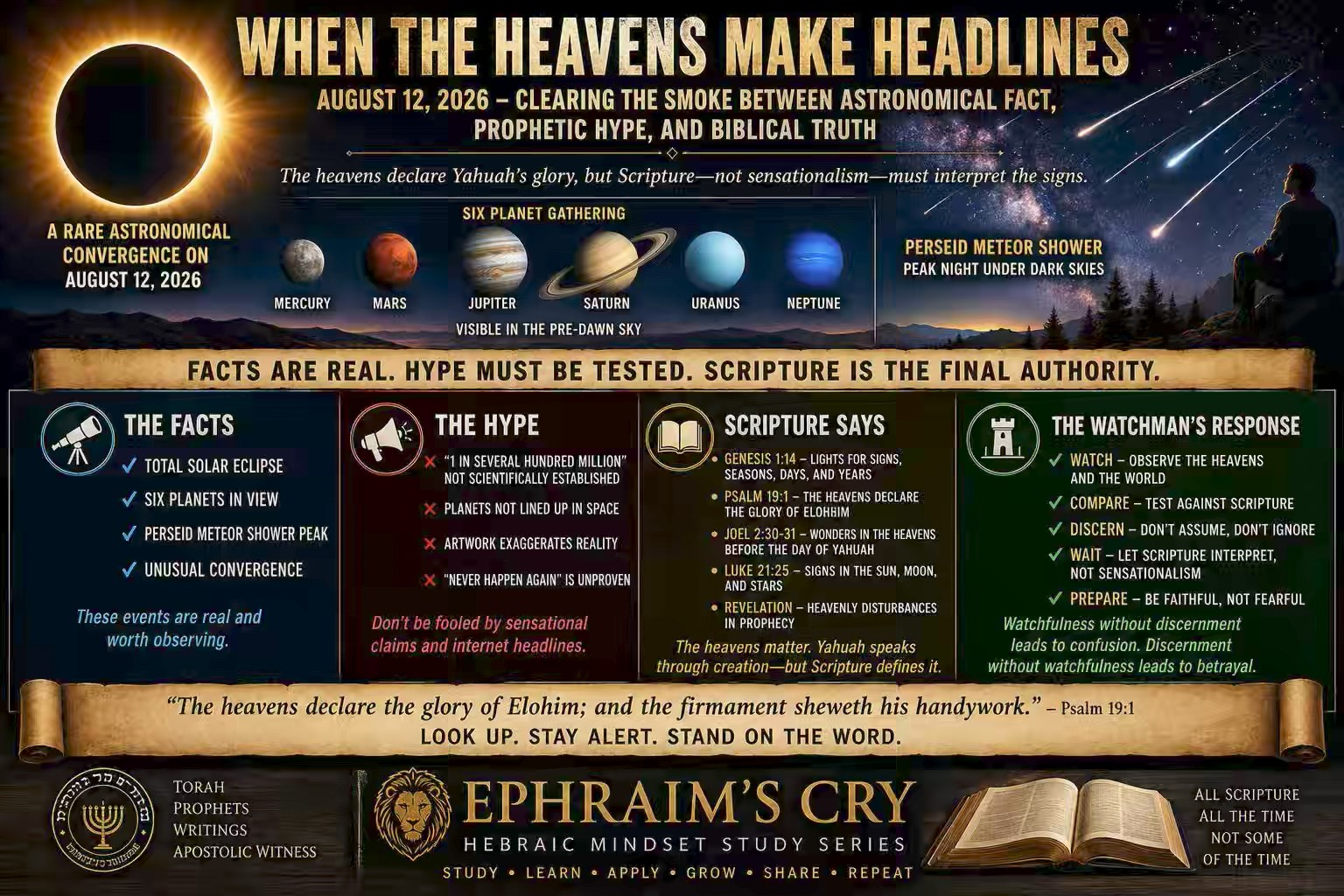
WHEN THE HEAVENS MAKE HEADLINES
August 12, 2026 — Clearing the Smoke Between Astronomical Fact, Prophetic Hype, and Biblical Truth
Greg Witter | Ephraim’s Cry
Hebraic Mindset Study Series
Study • Learn • Apply • Grow • Share • Repeat
The heavens declare Yahuah’s glory, but Scripture—not sensationalism—must interpret the signs.
There is a tremendous amount of hype building around August 12, 2026. Social-media graphics are calling it a “one in several hundred million” convergence. Headlines claim that a total solar eclipse, a six-planet gathering, and the peak of the Perseid meteor shower will converge on the same date in a combination so rare that it will supposedly “never happen again.” Some are already moving beyond astronomy and beginning to ask whether this must be a prophetic sign.
This is exactly where biblical discernment is required. A watchman does not dismiss everything simply because sensationalists exaggerate it. Neither does a watchman swallow every dramatic headline simply because something unusual is occurring. We examine the facts, separate legitimate observation from hype, and then test every proposed prophetic implication against the whole counsel of Scripture.
The first thing we need to establish is that there really is an unusual astronomical convergence occurring around August 12. There will be a total solar eclipse. The Perseid meteor shower will be at or near its annual peak under particularly favorable dark-sky conditions because of the new moon. There will also be a gathering of six planets—Mercury, Mars, Jupiter, Saturn, Uranus, and Neptune—spread across the morning sky along the ecliptic.
So the astronomical events themselves are not fabricated. Something interesting is happening. Something unusual is occurring. It is worth observing. But that does not mean every statement surrounding the event is equally trustworthy.
The popular graphic circulating online gives an exaggerated impression of what observers will actually see. The planets will not appear as enormous colored spheres hanging together above the horizon. A “planet parade” does not mean six planets have physically lined themselves up shoulder-to-shoulder in space. Because the planets orbit the sun in roughly the same plane, they naturally appear along the ecliptic from our perspective on Earth. Some will be much easier to observe than others, and Uranus and Neptune ordinarily require optical assistance.
So there is a difference between an astronomical event and the artwork being used to promote it. The artwork is designed to capture attention. It should not be mistaken for an accurate representation of the sky.
Then there is the claim that the convergence represents odds of “one in several hundred million.” That claim should be treated cautiously. I have seen no credible astronomical analysis establishing that probability as a scientific fact. There is also a fundamental problem with treating these as three completely independent random events. Solar eclipses necessarily occur during a new moon. The Perseids occur every year during approximately the same portion of August. Planetary gatherings develop across periods of time rather than appearing for one isolated moment. Without an actual orbital and probability analysis, the dramatic number is little more than sensational mathematics.
Likewise, saying the event will “never happen again” goes much farther than the available evidence justifies. It may be extraordinarily uncommon for precisely the same combination of circumstances to occur, but “never again” is an enormous claim. A watchman should not repeat something simply because it makes a dramatic headline.
That brings us to the far more important question: DOES SCRIPTURE TEACH THAT EVENTS IN THE HEAVENS CAN HAVE SIGNIFICANCE?
Absolutely.
Genesis 1:14 establishes the foundation: “And Elohim said, Let there be lights in the firmament of the heaven to divide the day from the night; and let them be for signs, and for seasons, and for days, and years.”
The heavenly lights were created by Yahuah. Their movements are not meaningless. They mark days, years, appointed times, and signs. Psalm 19:1 reinforces this truth: “The heavens declare the glory of Elohim; and the firmament sheweth his handywork.”
Therefore, the biblical position cannot be that everything happening in the heavens is spiritually meaningless. Scripture will not allow us to take that position.
The Prophets go even farther. Joel 2:30–31 declares, “I will shew wonders in the heavens and in the earth… The sun shall be turned into darkness, and the moon into blood, before the great and the terrible day of Yahuah come.” Isaiah repeatedly uses cosmic disturbances in connection with judgment and the Day of Yahuah.
Yahusha continues this prophetic framework. Luke 21:25 declares, “There shall be signs in the sun, and in the moon, and in the stars.” Revelation likewise contains repeated heavenly disturbances associated with judgment and the culmination of the age.
So Scripture clearly teaches that signs in the heavens can accompany prophetic events.
But now comes the boundary that must not be crossed.
Genesis 1:14 does not give anyone permission to invent meanings for every eclipse, meteor shower, comet, conjunction, or planetary gathering. Scripture saying that there will be heavenly signs is NOT the same thing as Scripture saying that every unusual heavenly event is a specific prophetic fulfillment.
There is no verse saying, “When six planets gather during the Perseid meteor shower while a solar eclipse occurs on August 12, 2026, then this particular prophecy will be fulfilled.”
That verse does not exist.
Therefore, anybody declaring with certainty that this particular convergence fulfills a specific prophecy is going beyond what is written.
There is a profound difference between saying, “This deserves our attention,” and saying, “Yahuah has revealed exactly what this means.”
The first statement is watchfulness.
The second requires biblical evidence.
This is where prophecy teaching repeatedly goes wrong. People begin with a dramatic headline and then search the Bible until they find a verse that sounds similar. That is backwards. Prophecy must interpret events. Events must never be forced into prophecy.
We begin with Scripture. We establish what Scripture actually says will happen. Then we observe history and determine whether the biblical conditions are being fulfilled. Otherwise every eclipse, earthquake, war, election, comet, economic crisis, and military conflict becomes the latest supposed prophetic fulfillment.
That is not discernment. That is headline-driven theology.
There is another boundary we must recognize. Biblical observation of the heavens must never be confused with astrology.
Deuteronomy 4:19 warns Yisra’el against being drawn into worshiping or serving the sun, moon, and stars. Isaiah 47 exposes astrologers and prognosticators who claimed to determine human destiny through celestial movements.
Biblical astronomy recognizes that Yahuah created and governs the heavens. Astrology assigns independent spiritual authority or predictive power to celestial bodies.
Those are radically different things.
The heavens point toward their Creator. They are not an independent prophetic codebook through which mankind can manufacture revelation.
Luke 21 deserves particular attention because Yahusha specifically tells us there will be signs in the sun, moon, and stars. But the context must remain intact. Yahusha also speaks about deception, wars, commotions, earthquakes, famines, pestilences, persecution, Jerusalem, distress among nations, fear, and ultimately the coming of the Son of Man.
The heavenly signs are part of a MUCH LARGER prophetic convergence.
That means we should not isolate one eclipse and announce, “Luke 21 has been fulfilled.” But neither should we ignore the heavens while watching everything else Yahusha instructed His disciples to watch.
The watchman’s responsibility is balance grounded in Scripture. He observes without manufacturing prophecy. He compares without forcing conclusions. He warns where Scripture warrants warning. He refuses both blind dismissal and sensational fear.
The proper response to August 12 is therefore neither, “THIS MEANS NOTHING,” nor, “THIS DEFINITELY FULFILLS END-TIME PROPHECY.”
Neither conclusion can presently be established.
The correct posture is: WATCH. DOCUMENT. COMPARE. DISCERN. TEST.
There is an important principle here: rarity does not automatically equal prophecy. Something can be extraordinarily uncommon without constituting a prophetic fulfillment. A solar eclipse remains an eclipse. A planetary gathering remains orbital mechanics. A meteor shower remains Earth encountering a debris stream.
But the existence of physical mechanisms does not remove Yahuah from the picture either. He created those mechanisms. He established the movements of the heavens. He knew every eclipse before human beings learned how to calculate them.
Physical explanation and divine sovereignty are not competing ideas.
The real question is not, “Can astronomy explain what is happening?”
Of course it can.
The real question is, “Has Yahuah told us that THIS PARTICULAR EVENT carries a PARTICULAR prophetic meaning?”
That question must be answered from Scripture.
There is also danger in sensationalism. Every failed prediction damages credibility. When believers repeatedly declare that the latest eclipse, blood moon, comet, election, war, or planetary alignment definitely fulfills prophecy, and nothing follows, people become numb. Eventually genuine warnings are ignored because too many false alarms have already been sounded.
Sensationalism also trains people to follow headlines instead of Scripture. It produces fear instead of preparation and curiosity instead of covenant faithfulness.
But there is equal danger in dismissal. Modern materialism teaches that if an event has a scientific explanation, it cannot have prophetic significance. Scripture does not support that assumption. Yahuah does not need to violate natural laws in order to accomplish His purposes through the creation He designed.
An eclipse can be astronomically predictable and still occur at a prophetically significant moment. The issue is not whether Yahuah could use such an event. He certainly could. The issue is whether Scripture gives us authority to declare that He IS doing so in this particular case.
The Four Witnesses give us the proper boundaries. Torah establishes that the heavenly lights serve as signs and appointed markers. The Prophets associate heavenly disturbances with judgment and the Day of Yahuah. The Writings declare that the heavens testify to the glory of Elohim. The Apostolic Witness records Yahusha warning of future signs in the sun, moon, and stars.
That establishes the biblical PRINCIPLE.
But none of the Four Witnesses specifically identifies the August 12, 2026 convergence.
Therefore, we stop exactly where Scripture stops.
That is disciplined biblical interpretation.
So what can we legitimately say?
We can say that August 12 presents a genuine and noteworthy astronomical convergence. We can say Scripture teaches that the heavens have meaning within Yahuah’s created order. We can say Scripture foretells heavenly signs associated with major prophetic events. We can say Yahusha specifically commanded His followers to remain alert to what is happening in the heavens and upon the earth.
But we cannot presently say, “This specific convergence fulfills prophecy X.”
That conclusion remains unproven.
Could this still become significant within a larger prophetic convergence? Certainly. We should remain open and observant. But openness is not the same thing as declaring revelation.
A watchman knows the difference.
So when August 12 arrives, look up.
Observe the heavens. Observe the nations. Observe Yisra’el. Observe Jerusalem. Observe deception. Observe lawlessness. Observe warfare. Observe economic and political developments. Observe the increasing pressure toward centralized systems of control.
But above all, observe Scripture.
The heavens may indeed be speaking in the sense that they declare the glory, order, sovereignty, and appointed purposes of Yahuah.
But we must never put words into their mouth that Yahuah has not given us.
That is how we clear the smoke.
That is how we reject hype without becoming spiritually blind.
That is how we remain watchful without becoming sensational.
And that is how the watchman stands faithfully upon the wall—with his eyes open, his Bible open, and his conclusions governed by the Word rather than the headline.
#EphraimsCry#HebraicMindset#Watchman#BiblicalDiscernment#SignsInTheHeavens#August12#SolarEclipse
#PerseidMeteorShower#PlanetParade#Genesis114#Psalm19#Joel2#Luke21#Prophecy#EndTimes#Torah#Yahuah#Yahusha
#KingdomPreparation#WatchAndPray
