
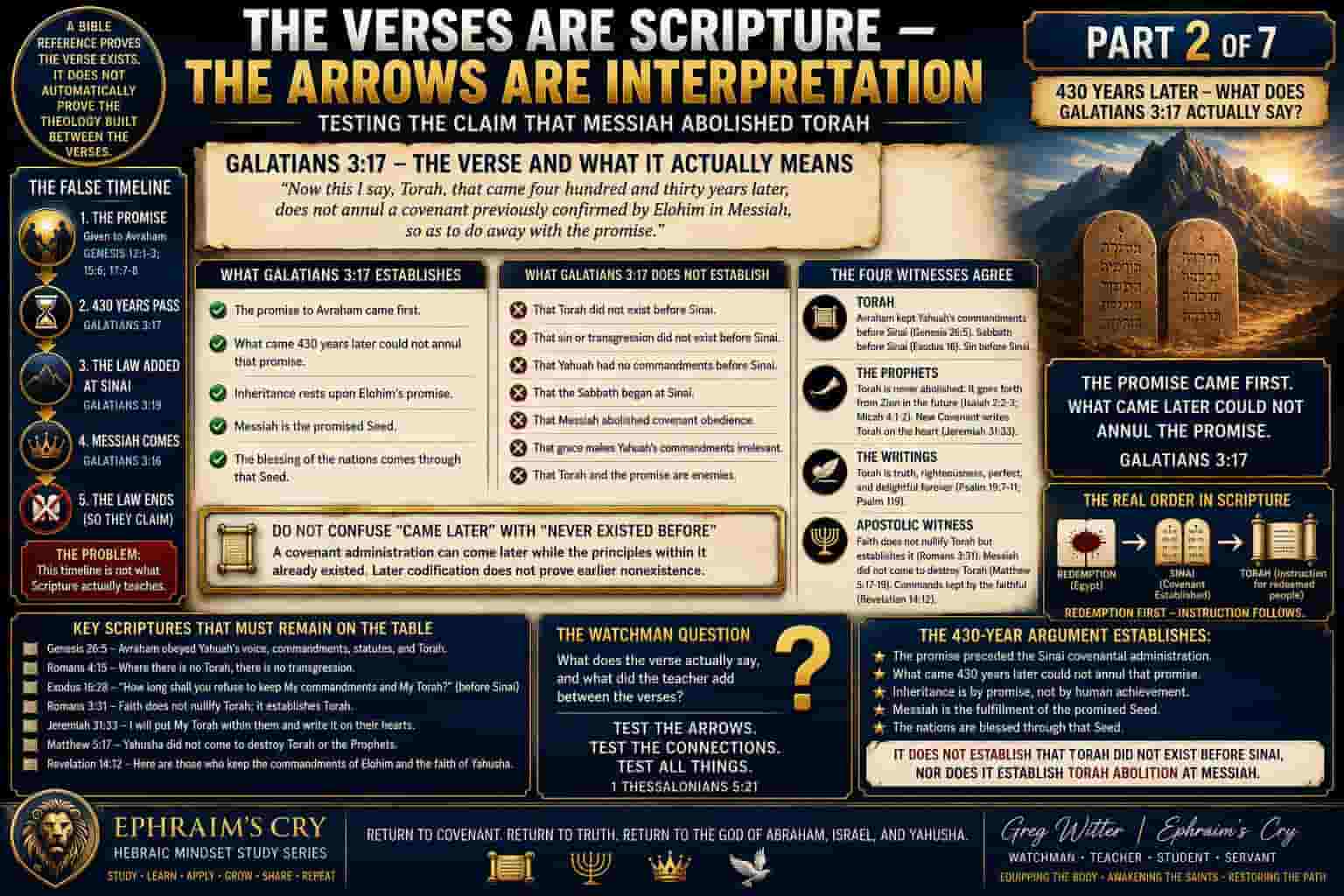
THE VERSES ARE SCRIPTURE — THE ARROWS ARE INTERPRETATION
PART 2 — 430 YEARS LATER — WHAT DOES GALATIANS 3:17 ACTUALLY SAY?
Greg Witter | Ephraim’s Cry
Hebraic Mindset Study Series
Study • Learn • Apply • Grow • Share ☆ Repeat
The Promise to Avraham, Sinai, and the Covenant That Could Not Be Annulled
The timeline matters. But the interpretation placed upon the timeline matters even more.
Part 1 established something that must remain firmly in place before we move another step forward: Yahuah’s righteous standard did not suddenly come into existence at Mount Sinai.
Avraham (Abraham) obeyed Yahuah’s voice, commandments, statutes, and Torah before Sinai (Genesis 26:5). Sin existed before Sinai. Transgression existed before Sinai. Joseph understood adultery to be sin before Sinai (Genesis 39:9). The Sabbath was established at Creation and commanded in Exodus 16 before Yisra’el (Israel) reached Sinai. Sha’ul (Paul) tells us that where there is no Torah there is no transgression (Romans 4:15).
Therefore, when Galatians speaks about something coming 430 years later, we cannot simply draw an arrow from Avraham to Sinai and write:
NO TORAH → 430 YEARS → TORAH BEGINS.
That arrow has to be proven.
Now we come directly to Galatians 3:17:
«“Now this I say, Torah, that came four hundred and thirty years later, does not annul a covenant previously confirmed by Elohim in Messiah, so as to do away with the promise.”»
This verse is frequently used as though Sha’ul were answering the question:
“When did Torah first exist?”
But that is not the question Sha’ul is answering.
His argument is about something entirely different.
He is establishing the priority and permanence of the promise.
That distinction changes the entire discussion.
START WHERE SHA’UL STARTS
We cannot begin with verse 17 as though it appeared by itself.
Galatians 3 begins with the relationship between faith, promise, inheritance, Messiah, and the covenant made with Avraham.
Sha’ul reaches back to Genesis:
«“And he believed in Yahuah, and He reckoned it to him for righteousness.”
— Genesis 15:6»
Galatians 3:6 uses Avraham as the example of righteousness through faith.
That is not controversial.
Avraham was not justified because he accumulated enough works to force Elohim to declare him righteous.
He believed Yahuah.
But remember Part 1.
The same Avraham who believed Yahuah also obeyed Yahuah.
Genesis 15:6 and Genesis 26:5 are not enemies.
Faith and obedience are not competing systems.
The problem begins when someone takes justification by faith and turns it into:
“Therefore obedience is abolished.”
Scripture never makes that leap.
That is another arrow.
WHAT WAS THE PROMISE?
Galatians 3:8 reaches back to the promise given to Avraham:
«“In you all the nations shall be blessed.”»
That points us back to Genesis 12:1–3.
Yahuah called Avraham.
Yahuah promised to make him a great nation.
Yahuah promised to bless him.
Yahuah promised that through him all the families of the earth would be blessed.
The promise develops further throughout Genesis.
Genesis 15 speaks of descendants and inheritance.
Genesis 17 develops the covenantal relationship.
Genesis 22 again declares that the nations of the earth would be blessed through Avraham’s seed.
Sha’ul is not inventing a new promise.
He is interpreting the promise already given in Torah.
And then he identifies its Messianic culmination.
THE SEED
Galatians 3:16 says:
«“But the promises were spoken to Avraham, and to his Seed. He does not say, ‘And to seeds,’ as of many, but as of one, ‘And to your Seed,’ who is Messiah.”»
The promised Seed finds its ultimate fulfillment in Yahusha (Jesus) HaMashiach.
That is central to Sha’ul’s argument.
But notice something important.
The coming of the Seed fulfills the promise.
It does not retroactively erase the covenantal history through which Yahuah brought the Seed into the world.
Nor does it establish that everything Yahuah commanded between Avraham and Messiah was temporary, defective, or contrary to the promise.
Sha’ul explicitly rejects that conclusion.
THEN COMES THE 430 YEARS
Now we are prepared to read Galatians 3:17 properly.
Sha’ul says that what came 430 years afterward cannot annul the covenant previously confirmed by Elohim.
Read that again.
The central verb of the argument is not:
BEGIN.
The central issue is:
ANNUL.
Sha’ul’s concern is not primarily:
“When did Torah begin?”
His concern is:
“Could what came later cancel what Yahuah promised earlier?”
His answer is:
No.
That is the point.
The 430-year statement establishes chronological priority.
The promise came first.
What came later could not invalidate it.
THE VERSE DOES NOT SAY WHAT THE GRAPHIC SAYS
This distinction is critical.
Galatians 3:17 says:
The later Torah cannot annul the previously confirmed covenant and invalidate the promise.
The theological arrow often says:
Torah did not exist at all until 430 years after Avraham.
Those are not the same statement.
One is Scripture.
The other is interpretation.
And Genesis 26:5 has already told us that Avraham obeyed Yahuah’s commandments, statutes, and Torah.
Therefore, we cannot use Galatians 3:17 to erase Genesis 26:5.
Scripture does not cancel Scripture.
TORAH AND THE SINAI COVENANT MUST NOT BE COLLAPSED INTO ONE CATEGORY
Here is one of the most important distinctions in this entire series.
Torah and the covenant ratified at Sinai are related, but they are not identical categories.
This matters enormously.
Yahuah’s Torah expresses His instruction, righteous judgments, commandments, statutes, and way of life.
At Sinai, those instructions were formally given, codified, expanded, and administered within a national covenant made with redeemed Yisra’el.
But if we make Torah = Sinai Covenant in an absolute sense, then we immediately create contradictions.
Avraham kept Torah before the Sinai Covenant.
Sabbath existed before the Sinai Covenant.
Sin existed before the Sinai Covenant.
Murder was wrong before the Sinai Covenant.
Adultery was wrong before the Sinai Covenant.
Yahuah’s righteous character existed before the Sinai Covenant.
Therefore, we must distinguish the eternal authority of the Lawgiver from the historical covenant administration established at Sinai.
That distinction becomes even more important when we reach Hebrews 8 later in this series.
DEUTERONOMY 5 DOES NOT DISPROVE THIS
A common response points to Deuteronomy 5:2–3:
«“Yahuah our Elohim made a covenant with us in Horeb. Yahuah did not make this covenant with our fathers, but with us…”»
That is true.
But notice what the text actually says.
THIS COVENANT.
It does not say:
“Yahuah had no commandments before Horeb.”
It says a particular covenant was made with that covenant generation.
Again:
Covenant ratification is not the same question as the existence of Yahuah’s instruction.
The covenant at Horeb had a historical beginning.
That does not mean righteousness had a historical beginning at Horeb.
THE 430 YEARS CANNOT ERASE AVRAHAM’S OBEDIENCE
Suppose someone insists:
“Galatians 3:17 proves Torah came 430 years after Avraham.”
Then we must ask:
What do you mean by Torah came?
If you mean that the formal national covenant administration associated with Sinai came later, yes.
If you mean Yahuah had no commandments or Torah before that point, Genesis contradicts you.
Genesis 26:5 remains standing:
Avraham obeyed My voice, kept My charge, My commandments, My statutes, and My Torah.
You cannot erase that verse with Galatians.
You have to reconcile the witnesses.
That is what text-first study requires.
THE PROMISE WAS NEVER A LICENSE FOR LAWLESSNESS
There is another assumption hiding inside the argument.
If the promise precedes Sinai and righteousness comes through faith, some conclude that obedience must therefore be irrelevant.
But look at Avraham himself.
The man of promise is also the man Scripture describes as obedient.
Yahuah says in Genesis 22:18:
«“And in your seed all the nations of the earth shall be blessed, because you have obeyed My voice.”»
Notice how Scripture refuses our artificial division.
Promise.
Faith.
Obedience.
They stand together.
Avraham’s obedience did not purchase the promise.
But neither did receiving the promise turn obedience into rebellion or irrelevance.
Faith produced faithfulness.
That pattern continues throughout Scripture.
WHAT CAME FIRST DOES NOT AUTOMATICALLY CANCEL WHAT CAME LATER
Sha’ul’s argument is also frequently reversed.
He says the later cannot annul the earlier promise.
Some theology then turns that into:
Because the promise came first, everything later must eventually disappear.
That does not follow.
Chronological priority establishes that the later cannot cancel the earlier.
It does not establish that the earlier must eventually cancel the later.
That is another unsupported arrow.
The promise and the later covenantal administration served related purposes within Yahuah’s redemptive plan.
The existence of one does not automatically make the other an enemy.
In fact, Galatians 3:21 explicitly asks:
«“Is the Torah then against the promises of Elohim?”»
And Sha’ul answers:
«“Certainly not!”»
That answer must govern our interpretation.
TORAH IS NOT THE ENEMY OF THE PROMISE
This is one of the strongest interpretive controls in the chapter.
If our theology makes Torah opposed to the promise, Sha’ul says our theology is wrong.
If our theology makes Avrahamic faith opposed to obedience, Avraham’s own life says our theology is wrong.
If our theology makes Messiah opposed to Yahuah’s commandments, Yahusha’s own words say our theology is wrong.
The problem is not Torah versus promise.
The problem is misunderstanding the role of Torah in relation to promise, justification, transgression, covenant, inheritance, and Messiah.
Those distinctions matter.
THE INHERITANCE IS BY PROMISE
Galatians 3:18 says:
«“For if the inheritance is of Torah, it is no longer of promise, but Elohim gave it to Avraham through a promise.”»
Again, Sha’ul is discussing the basis of inheritance.
The inheritance rests upon Yahuah’s promise.
Avraham did not place Yahuah in his debt.
Yahuah promised.
Yahuah acts.
Yahuah fulfills.
That is grace.
But notice what the verse does not say:
“Because inheritance is by promise, obedience is abolished.”
That conclusion is absent.
The basis of inheritance and the expected conduct of the redeemed are two different questions.
This distinction must remain clear:
Justification answers: How is the sinner declared righteous?
Covenant obedience answers: How does the redeemed person walk?
Confuse those categories and Galatians becomes a weapon against Torah.
Keep them distinct and Sha’ul remains in harmony with the rest of Scripture.
YAHUAH REDEEMS BEFORE HE INSTRUCTS
The Exodus provides the pattern again.
Yahuah did not stand in Egypt and say:
“Keep Sinai perfectly, and then I will redeem you.”
He redeemed Yisra’el.
Then He instructed Yisra’el.
That is why Exodus 20 begins before the commandments with:
«“I am Yahuah your Elohim, who brought you out of the land of Mitsrayim, out of the house of slavery.”»
Redemption is already an accomplished reality when the covenant commandments are proclaimed.
The commandments tell a redeemed people how to live under the authority of their Redeemer.
That is not salvation by works.
That is covenant faithfulness.
THE PROPHETS PRESERVE BOTH PROMISE AND OBEDIENCE
The Prophets do not announce that Yahuah’s promise requires the destruction of Torah.
They repeatedly call Yisra’el back to Torah while simultaneously proclaiming restoration.
Isaiah 2:3 describes the future Kingdom:
«“For out of Tsiyon comes forth the Torah, and the Word of Yahuah from Yerushalayim (Jerusalem).”»
Notice where the prophetic trajectory leads.
Not away from Torah.
Toward Torah going forth to the nations.
Micah 4:2 gives the same witness.
Jeremiah announces the New Covenant and says Yahuah will put His Torah within His people and write it upon their hearts (Jeremiah 31:31–33).
The Prophets therefore do not support the timeline:
Promise → Torah → Messiah → Torah disappears.
Their restoration vision includes Torah.
YAHUSHA CONFIRMS THE CONTINUITY
Yahusha says:
«“Do not think that I came to destroy the Torah or the Prophets.”
— Matthew 5:17»
Again, those words establish a boundary.
The promised Seed does not arrive announcing war against the Father’s instruction.
He embodies perfect covenant faithfulness.
He teaches Torah correctly.
He confronts traditions that distort Yahuah’s commandments.
He calls people to repentance.
He fulfills the prophetic promises.
And He becomes the means through whom the blessing promised to Avraham reaches the nations.
The Seed fulfills the promise.
The Seed does not turn righteousness into lawlessness.
SHA’UL CONFIRMS THE SAME THING
Romans 3:31 asks:
«“Do we then nullify the Torah through faith?”»
Sha’ul answers:
«“Certainly not! On the contrary, we establish the Torah.”»
That should matter enormously when interpreting Galatians.
The same apostle wrote both letters.
If our reading of Galatians requires Sha’ul to say:
Faith abolishes Torah,
while Romans says:
Faith establishes Torah,
we have created a contradiction Sha’ul did not create.
The solution is not to choose our favorite letter.
The solution is to read both correctly.
THE NEW COVENANT PRESERVES THE SAME PATTERN
Jeremiah 31:31–33 promises a New Covenant with Yisra’el and Yahudah (Judah).
And Yahuah says:
“I will put My Torah within them and write it on their hearts.”
Hebrews 8 repeats it.
That means the fulfillment of the Avrahamic promise through Messiah cannot logically culminate in Torah abolition when the New Covenant itself contains Torah written upon the heart.
The promise reaches fulfillment.
The heart is transformed.
The relationship is restored.
The Ruach HaKodesh empowers covenant faithfulness.
Yahuah’s righteous standard is internalized.
WHAT DOES THE 430-YEAR ARGUMENT ACTUALLY PROVE?
Now we can answer the central question.
What does Galatians 3:17 actually establish?
It establishes that the promise preceded the Sinai covenantal administration.
It establishes that what came later could not annul Yahuah’s earlier promise.
It establishes that inheritance ultimately rests upon Yahuah’s promise rather than human achievement.
It establishes that Messiah is central to the fulfillment of that promise.
What does it not establish?
It does not establish that Yahuah had no commandments before Sinai.
It does not establish that sin did not exist before Sinai.
It does not establish that Sabbath began at Sinai.
It does not establish that Avraham lived without Torah.
It does not establish that Torah and promise are enemies.
It does not establish that Messiah abolished Yahuah’s righteous standard.
And it certainly does not establish that redeemed people are now free to practice what Scripture defines as sin.
Those conclusions are not in Galatians 3:17.
They are arrows drawn from it.
TEST THE ARROW AGAIN
Here is the claim:
The Torah came 430 years after the promise.
Now watch what happens.
The verse says:
Something associated with Torah came 430 years afterward and could not annul the earlier promise.
Then the theological arrow says:
Therefore Yahuah had no Torah before Sinai.
Stop.
Test the arrow.
Genesis 26:5 contradicts it.
Exodus 16 contradicts it.
The existence of pre-Sinai sin contradicts it.
Romans 4:15 contradicts it.
Then another arrow is drawn:
Because the promise came first, Torah was temporary.
Stop.
Test that arrow.
Galatians 3:21 says Torah is not against the promise.
Romans 3:31 says faith establishes Torah.
Jeremiah 31 says the New Covenant writes Torah upon the heart.
Yahusha says He did not come to destroy Torah.
The Prophets picture Torah going forth from Tsiyon.
Revelation describes the faithful keeping Elohim’s commandments and the faith of Yahusha.
The arrow does not survive the witnesses.
THE WATCHMAN WARNING
A timeline can be chronologically accurate and theologically false.
That is exactly why this series matters.
The problem is not necessarily the dates printed on the page.
The problem is what someone tells you those dates mean.
Avraham came before Sinai.
True.
The promise preceded Sinai.
True.
The Sinai covenant came later.
True.
Messiah is the promised Seed.
True.
But none of those truths automatically produces:
Therefore Torah did not exist before Sinai.
And none automatically produces:
Therefore Messiah abolished Torah afterward.
Those are theological conclusions.
They must be proven from the whole counsel of Elohim.
Never surrender discernment simply because someone has arranged Bible verses along a beautiful timeline.
Read the verses.
Read their context.
Identify what each verse actually establishes.
Then examine every theological connection placed between them.
The verses may be Scripture.
The arrows are interpretation.
WHERE PART 2 LEAVES US
Part 1 established that Yahuah’s righteous instruction, commandments, sin, and transgression existed before Sinai.
Part 2 establishes that the 430 years in Galatians 3:17 do not overturn that fact.
Sha’ul’s argument is not:
“Torah first came into existence 430 years after Avraham.”
His argument is:
“What came 430 years afterward cannot annul the promise Yahuah established beforehand.”
That is a major difference.
The promise remains.
The Seed comes.
The nations are blessed through Messiah.
Inheritance rests upon Yahuah’s promise.
And none of that requires Yahuah to abolish righteousness.
But another major claim now waits directly in front of us.
If Torah existed before Sinai, what about the Sabbath?
We are repeatedly told that the Sabbath was given only to Yisra’el at Sinai and therefore belongs exclusively to Sinai and therefore belongs exclusively to the Sinai covenant.
But is that what Scripture actually establishes?
Or have we encountered another theological arrow?
That is where the next part of this series takes us.
Before moving there, however, we need to lock down exactly what Part 2 has established, because if this foundation is lost, everything that follows will drift back into the same false either/or argument.
THE PROMISE AND TORAH ARE NOT COMPETING COVENANTS OF SALVATION
One of the deepest errors underneath this discussion is the assumption that Scripture presents two competing methods of obtaining righteousness.
The first supposedly says:
Avraham → Promise → Faith.
The second supposedly says:
Moses → Torah → Works.
Then Messiah arrives, abolishes the second system, and restores the first:
Messiah → Promise → Faith again.
That reconstruction sounds orderly.
But Scripture never establishes it.
Yahuah did not save Avraham by faith and then suddenly establish salvation by works through Moses.
Neither did He rescue Yisra’el from Egypt because they had earned redemption through Torah observance.
The Exodus itself destroys that idea.
Yahuah redeemed Yisra’el before bringing them to Sinai.
The blood of the Passover lamb preceded Sinai.
Deliverance from bondage preceded Sinai.
Crossing the sea preceded Sinai.
The destruction of Pharaoh’s army preceded Sinai.
Only afterward did Yahuah bring the redeemed nation to Himself and establish the covenant at Horeb.
Therefore, Sinai cannot properly be characterized as Yahuah replacing grace with works.
The people had already experienced grace.
They had already experienced redemption.
They had already been delivered.
Torah instructed the redeemed people how to live in covenant faithfulness before their Redeemer.
AVRAHAM HIMSELF DESTROYS THE FALSE DIVIDE
The artificial division between “faith under Avraham” and “obedience under Moses” also collapses when we simply read what Scripture says about Avraham.
Genesis 15:6 says:
Avraham believed Yahuah, and it was counted to him for righteousness.
Genesis 26:5 says:
Avraham obeyed Yahuah’s voice and kept His charge, commandments, statutes, and Torah.
Which one is true?
Both.
That is the point.
Faith did not eliminate obedience.
Obedience did not purchase justification.
Avraham believed, and Avraham obeyed.
The same man Scripture uses as the great example of justification by faith is also described as keeping Yahuah’s commandments.
Therefore, using Avraham to construct a theology in which faith eliminates obedience actually contradicts Avraham’s own life.
THE PROMISE PRODUCES A PEOPLE WHO WALK LIKE AVRAHAM
This becomes even more important when Sha’ul says:
«“Know, then, that those who are of belief are sons of Avraham.”
— Galatians 3:7»
If we are going to appeal to Avraham as our father in faith, then we should allow Scripture to tell us what Avrahamic faith looked like.
It trusted Yahuah.
It responded to Yahuah.
It left when Yahuah said leave.
It went where Yahuah said go.
It believed what Yahuah promised.
It obeyed Yahuah’s voice.
Faith was not passive intellectual agreement.
Biblical faith produced faithfulness.
That does not mean Avraham was sinless.
It means genuine trust in Yahuah produced a life oriented toward obedience.
James later makes precisely this point.
James 2:21–22 asks whether Avraham’s faith was working together with his works and concludes that through the works the faith was perfected.
Then James says:
«“You see, then, that a man is declared right by works, and not by belief alone.”
— James 2:24»
James is not contradicting Sha’ul.
James is confronting a different error.
Sha’ul rejects works as the basis for earning justification.
James rejects a claimed faith that produces no corresponding faithfulness.
Put them together and the Scriptural picture becomes clear:
Works do not purchase redemption. Genuine faith produces obedience.
THE PROMISE DOES NOT ABOLISH THE AUTHORITY OF THE PROMISER
There is another logical problem with the abolition argument.
Who gave the promise to Avraham?
Yahuah.
Who gave commandments?
Yahuah.
Who established the covenant at Sinai?
Yahuah.
Who spoke through the Prophets?
Yahuah.
Who promised the New Covenant?
Yahuah.
Who sent Yahusha?
Yahuah.
The same Elohim stands behind the entire covenantal story.
Therefore, we should immediately become suspicious of any theological system that requires Yahuah’s promise to overthrow Yahuah’s instructions.
The promise does not overthrow the authority of the One who made the promise.
Messiah does not rescue us from the authority of His Father.
Grace does not liberate us from righteousness.
Faith does not grant permission for rebellion.
The covenantal storyline is continuous because the Covenant Elohim is continuous.
WHAT CHANGED MUST BE IDENTIFIED PRECISELY
This is why language matters.
Something can change without everything changing.
A covenant administration can change.
A priesthood can change.
A sacrificial function can change.
A covenant can be renewed.
A promise can reach fulfillment.
A shadow can reach its substance.
A role can reach its intended goal.
None of those statements automatically means:
Yahuah abolished His definition of righteousness.
This distinction will become especially important later in this series when we examine the guardian, Hebrews 8, and Romans 10:4.
We cannot simply take every passage describing transition and translate it into:
“Torah ended.”
We must ask:
What specifically changed?
What specifically continued?
What does the passage actually identify?
What are we adding to the passage?
That is disciplined interpretation.
THE FOUR WITNESSES MUST AGREE
Now place Galatians 3:17 before the Four Witnesses.
Torah tells us Avraham obeyed Yahuah’s commandments, statutes, and Torah before Sinai. Torah establishes Sabbath before Sinai. Torah establishes sin before Sinai. Torah establishes redemption before the Sinai covenant.
The Prophets repeatedly call Yisra’el back to Torah and simultaneously proclaim future restoration. Isaiah 2:2–3 and Micah 4:1–2 envision the nations coming to learn Yahuah’s ways, with Torah going forth from Tsiyon. Jeremiah 31 promises Torah written upon the heart under the New Covenant.
The Writings repeatedly celebrate Torah rather than presenting it as an enemy of faith. Psalm 1 calls the person blessed whose delight is in the Torah of Yahuah. Psalm 19 calls the Torah of Yahuah perfect. Psalm 119 repeatedly describes Torah as truth, righteousness, delight, and light.
Then comes the Apostolic Witness. Yahusha says He did not come to destroy Torah or the Prophets. Sha’ul says faith does not nullify Torah but establishes it. Hebrews quotes Jeremiah’s promise of Torah written upon the heart. Revelation describes the faithful keeping the commandments of Elohim and the faith of Yahusha.
Now ask:
Where is the Four-Witness testimony for the claim:
“The promise came first, therefore Messiah abolished Torah”?
It is not there.
The theology depends upon arrows that the witnesses do not establish.
PSALM 119 CREATES ANOTHER SERIOUS PROBLEM
The Writings deserve special attention because they are frequently left out of this debate.
Psalm 119:142 declares:
«“Your righteousness is righteousness forever, and Your Torah is truth.”»
Verse 151 says:
«“All Your commands are truth.”»
Verse 160 says:
«“The sum of Your word is truth, and all Your righteous right-rulings are forever.”»
Think about what that means.
If Yahuah’s Torah expresses truth and righteousness, then the claim that Messiah came to abolish Torah raises an unavoidable question:
Did Messiah come to abolish truth and righteousness?
Certainly not.
Again, the problem is not Messiah.
The problem is the theological category being imposed upon Torah.
“430 YEARS LATER” IS ABOUT COVENANTAL SEQUENCE
We can now state the distinction more precisely.
Galatians 3:17 identifies a historical sequence:
Promise → 430 years → Sinai covenantal administration.
That sequence is real.
But the false theological sequence adds claims Scripture does not make:
No Torah → Promise → 430 years → Torah begins → Messiah → Torah ends.
Those are not equivalent timelines.
The first recognizes historical covenantal development.
The second invents an absolute beginning and ending for Yahuah’s righteous instruction.
Part 1 already demonstrated that the absolute beginning at Sinai cannot survive Scripture.
The remainder of this series will demonstrate why the supposed absolute ending at Messiah cannot survive Scripture either.
THIS IS WHY CONTEXT MATTERS
Galatians was not written as an abstract systematic theology textbook defining every possible meaning of the English word “law.”
Sha’ul is dealing with real questions involving justification, promise, inheritance, circumcision, identity, faith, and the status of those coming into Messiah.
When isolated statements are removed from that argument and placed onto theological timelines, the result can look convincing while completely changing the question Sha’ul was answering.
Galatians 3:17 does not ask:
“When did Yahuah first establish righteousness?”
It does not ask:
“When did sin first become sin?”
It does not ask:
“When did Sabbath first exist?”
It does not ask:
“When did Yahuah first give commandments?”
It addresses the relationship between the earlier promise and what came later.
And Sha’ul’s conclusion is clear:
The later cannot annul the earlier promise.
Do not make the verse answer a question it was not addressing.
DO NOT CONFUSE “CAME LATER” WITH “NEVER EXISTED BEFORE”
This is the central interpretive mistake.
A formal covenantal administration can come later while the principles incorporated within it already existed.
The Sabbath existed before Sinai and later became a covenant sign.
Murder was wrong before Sinai and was later explicitly codified.
Adultery was sin before Sinai and was later explicitly codified.
Avraham obeyed commandments before Sinai, while those commandments were later formally administered to Yisra’el as a nation.
Therefore:
Later codification does not prove earlier nonexistence.
That principle alone dismantles much of the argument built from Galatians 3:17.
THE WATCHMAN’S QUESTION
Whenever someone presents this timeline, ask one question:
What does the verse actually say, and what did the teacher add between the verses?
If the answer requires ignoring Genesis 26:5, something is wrong.
If it requires ignoring Exodus 16, something is wrong.
If it requires ignoring Romans 3:31, something is wrong.
If it requires ignoring Jeremiah 31, something is wrong.
If it requires ignoring Matthew 5:17–19, something is wrong.
If it requires ignoring Revelation 14:12, something is wrong.
No doctrine receives permission to silence inconvenient witnesses.
Put the whole counsel of Elohim on the table.
THE DECISIVE POINT
Galatians 3:17 is not difficult once we stop asking it to prove something it never says.
The promise to Avraham preceded Sinai.
What came 430 years afterward could not cancel that promise.
The inheritance rests upon Yahuah’s promise.
The promised Seed is Yahusha HaMashiach.
The nations receive blessing through that Seed.
None of that establishes that Yahuah possessed no Torah before Sinai.
None of that establishes that Sinai introduced righteousness into the universe.
None of that establishes that Messiah abolished obedience.
None of that establishes that grace makes Yahuah’s commandments irrelevant.
Those are theological arrows.
And every arrow must be tested.
WHERE PART 2 LEAVES US
Part 1 asked:
“The Law was added—but what was actually added?”
We established that whatever was added cannot mean Yahuah’s righteous standard suddenly began existing at Sinai.
Part 2 has now asked:
“430 years later—what does Galatians 3:17 actually say?”
And the answer is:
The later Sinai covenantal administration could not annul the promise Yahuah had already established with Avraham.
That is what the 430-year argument establishes.
It does not establish a Torah-free Avraham.
It does not establish a Torah-free world before Moses.
It does not establish a temporary divine morality.
And it does not establish Torah abolition through Messiah.
The promise remains.
Messiah fulfills the promise.
Faith receives what Yahuah promised.
And genuine faith produces covenant faithfulness.
Now we are ready for the next arrow.
The claim will be:
“Yes, perhaps certain principles existed before Sinai—but the Sabbath itself was given only to Yisra’el at Sinai as a covenant sign. Therefore it was temporary and ended with the Sinai covenant.”
Again, some of the verses used to support that argument are real.
But does the conclusion follow?
Was the Sabbath created at Sinai?
Or was something already established at Creation later given a specific covenantal function?
That is where we go next.
PART 3 — WAS THE SABBATH CREATED AT SINAI?
Creation, Exodus 16, Sinai, and the Difference Between Establishing a Sign and Creating the Sabbath
The next teaching will put Genesis 2, Exodus 16, Exodus 20, Exodus 31, Nehemiah 9, the Prophets, Yahusha, and the Apostolic Witness on the table.
We will distinguish between existence and covenant sign, just as Parts 1 and 2 distinguished between existence, codification, promise, and covenant ratification.
Because once again:
A verse can be completely true while the theological arrow drawn from it is completely false.
Do not merely read the timeline.
Do not merely accept the labels.
Do not merely count the Bible references printed on the graphic.
Test the connections.
Test the conclusions.
Test the arrows.
The verses may be Scripture.
THE ARROWS ARE INTERPRETATION.
And interpretation must answer to the whole counsel of Elohim.
#EphraimsCry#GregWitter#EphraimsCryAcademy#HebraicMindsetStudySeries#TheVersesAreScriptureTheArrowsAreInterpretation
#TestTheArrows#Galatians3#Galatians317#Avraham#AbrahamicPromise#AbrahamicCovenant#Torah#Sinai#Covenant
#Yahuah#Yahusha#Messiah#Faith#CovenantFaithfulness#GraceThroughFaith#TorahObedience#WholeCounselOfElohim
#FourWitnesses#TorahProphetsWritingsApostolicWitness#ScriptureInterpretsScripture#BiblicalContext#TestAllThings
#HebraicMindset#ReturnToCovenant#KingdomOfElohim
