
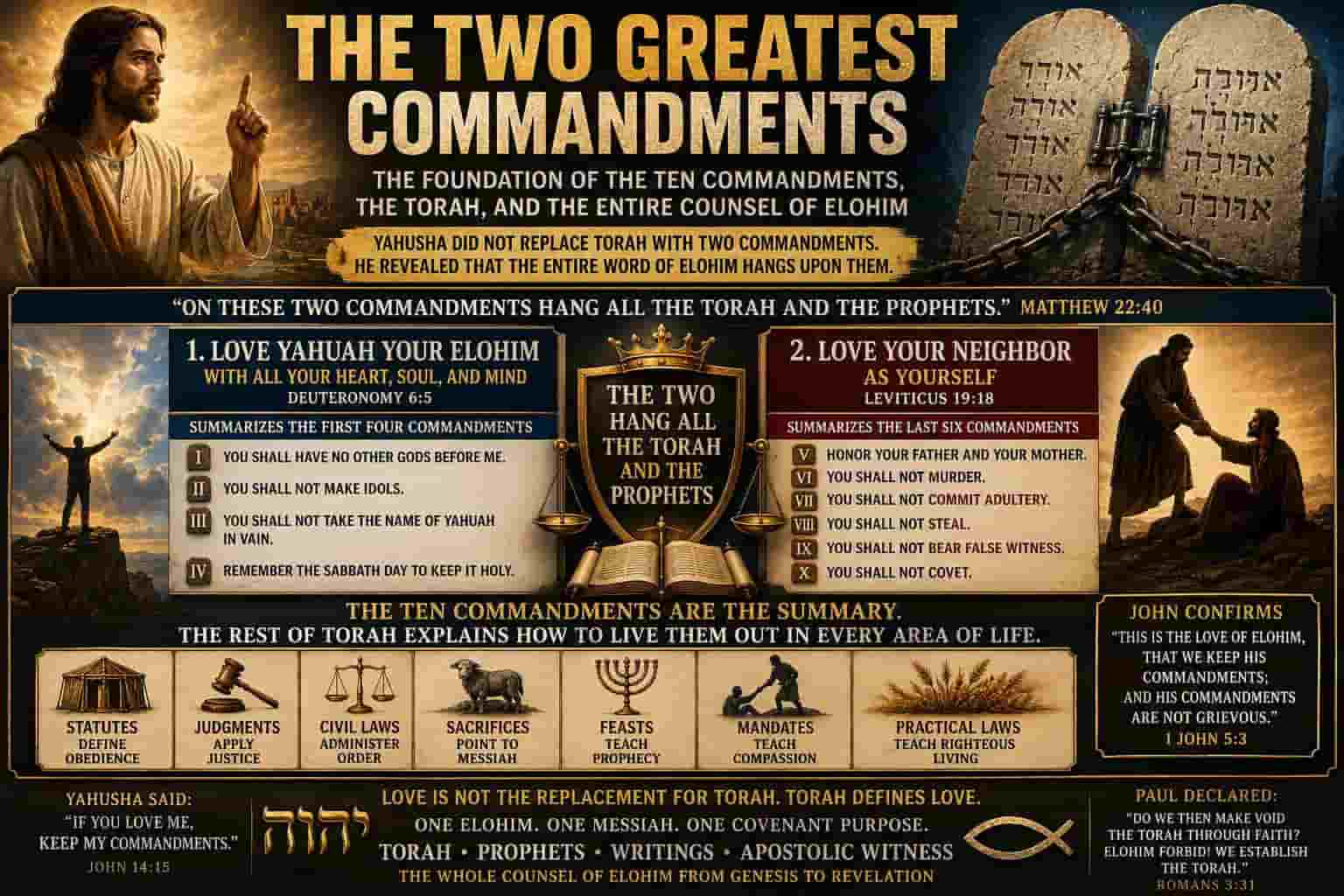
THE TWO GREATEST COMMANDMENTS
The Foundation of the Ten Commandments, the Torah, and the Entire Counsel of Elohim
Greg Witter
Ephraim’s Cry
Returning to the Ancient Path
Restoring the Hebraic Mindset of Scripture
Torah • Prophets • Writings • Apostolic Witness
Teaching the Gospel of the Kingdom through the Whole Counsel of Elohim
Yahusha did not replace Torah with two commandments. He revealed that the entire Word of Elohim hangs upon them.
One of the most misunderstood statements Yahusha ever made is found in Matthew 22:37–40. Many people quote it as though Yahusha reduced hundreds of commandments down to only two. That is not what He said, and that is not what He meant.
When asked which commandment was the greatest, Yahusha answered by quoting Torah itself.
“The first and great commandment is, ‘You shall love Yahuah your Elohim with all your heart, with all your soul, and with all your mind.'” (Deuteronomy 6:5)
“And the second is like it: ‘You shall love your neighbor as yourself.'” (Leviticus 19:18)
Then He made one of the most profound statements in all of Scripture:
“On these two commandments hang all the Torah and the Prophets.”
Notice what He did not say.
He did not say the Torah hangs from these commandments because they replaced it.
He did not say these are the only commandments that matter.
He did not say the rest of Torah has been abolished.
He said the Torah and the Prophets hang upon these two commandments.
That word is critically important.
Imagine a door hanging on two hinges.
The hinges support the door.
They hold everything together.
But the hinges are not the entire door.
Remove the hinges and the entire structure collapses.
Likewise, remove love for Yahuah and love for your neighbor, and the entire Torah collapses because every commandment flows from these two covenant principles.
These two commandments are not replacements.
They are the foundation.
THE FIRST COMMANDMENT SUMMARIZES THE FIRST FOUR
The first commandment teaches us how to love Yahuah.
How do we love Him?
The first four commandments explain it.
You shall have no other gods before Me.
You shall not make idols.
You shall not take My Name in vain.
Remember the Sabbath day to keep it holy.
These are not random commands.
They define what love for Yahuah looks like.
Love is demonstrated through covenant faithfulness.
Love is expressed through obedience.
Love is proven by loyalty.
THE SECOND COMMANDMENT SUMMARIZES THE LAST SIX
The second commandment teaches us how to love our neighbor.
How?
The final six commandments explain exactly what that means.
Honor your father and mother.
Do not murder.
Do not commit adultery.
Do not steal.
Do not bear false witness.
Do not covet.
Again, these are not random moral rules.
They define love.
You cannot claim to love your neighbor while murdering him.
You cannot claim to love your neighbor while stealing from him.
You cannot claim to love your neighbor while lying about him.
You cannot claim to love your neighbor while committing adultery against him.
Love has definition.
Yahuah defines it.
THE TEN COMMANDMENTS SUMMARIZE THE ENTIRE TORAH
Many stop with the Ten Commandments.
But the Ten Commandments themselves are only the summary.
The remainder of Torah explains how those commandments function in everyday life.
The statutes explain them.
The judgments apply them.
The civil laws administer them.
The feast days teach them prophetically.
The priesthood demonstrates them.
The sacrificial system points to Messiah.
The dietary instructions teach holiness and separation.
Business ethics teach honesty.
Agricultural laws teach compassion.
The Sabbath teaches trust.
The Sabbatical Year teaches dependence.
The Jubilee teaches redemption and restoration.
Every instruction reveals another facet of loving Yahuah or loving your neighbor according to His definition—not ours.
THE PROPHETS DID NOT CHANGE TORAH
The Prophets did not introduce a new religion.
They called Israel back to covenant faithfulness.
They rebuked idolatry.
They condemned injustice.
They exposed hypocrisy.
They warned against rebellion.
Everything they preached flowed directly from Torah.
When Israel violated the commandments, the Prophets called them back to the covenant.
They never replaced it.
YAHUSHA DID NOT ABOLISH TORAH
Yahusha lived Torah perfectly.
He taught Torah correctly.
He stripped away the traditions that had buried its true meaning.
When He said,
“If you love Me, keep My commandments,”
He was not inventing something new.
He was calling people back to covenant obedience.
When He said,
“If you love Me…”
every Jewish listener already knew what He was quoting.
Love had already been defined by Torah.
Yahusha did not replace the commandments.
He revealed their true depth.
PAUL DID NOT CONTRADICT YAHUSHA
Many attempt to place Paul against Messiah.
Paul himself rejected that idea.
“Do we then make void the Torah through faith? Elohim forbid! We establish the Torah.”
“The Torah is holy, and the commandment holy, just, and good.”
Paul fought against justification by works.
He never fought against covenant obedience.
He fought legalism.
He never fought holiness.
He fought salvation by human effort.
He never fought the commandments of Elohim.
JOHN REMOVES ALL DOUBT
John writes perhaps the simplest definition found anywhere in Scripture.
“This is the love of Elohim, that we keep His commandments.”
Notice the order.
Love.
Commandments.
Obedience.
John never separates them.
Neither did Yahusha.
Neither did Moses.
Neither did Paul.
Neither did Peter.
The entire Bible speaks with one voice.
THE WHOLE COUNSEL OF ELOHIM
This is why the Four Witnesses remain inseparable.
Torah establishes the covenant.
The Prophets enforce it.
The Writings demonstrate it.
The Apostolic Witness confirms it through Yahusha HaMashiach.
Together they reveal one continuous revelation.
One Kingdom.
One Elohim.
One Messiah.
One Gospel.
One covenant purpose.
The two greatest commandments are not the end of Torah.
They are the doorway into it.
The Ten Commandments explain them.
The rest of Torah expands them.
The Prophets defend them.
The Writings demonstrate them.
Yahusha fulfills them.
The Apostles proclaim them.
The whole counsel of Elohim hangs upon them because they reveal the very character of Yahuah Himself.
Love for Yahuah.
Love for your neighbor.
Everything else in Scripture teaches us how to live those two realities according to His definition—not ours.
If you remove Torah, you lose the definition of love.
If you remove the Prophets, you lose the covenant warnings.
If you remove the Writings, you lose the covenant witness.
If you remove the Apostolic Witness, you lose the revelation of Messiah and the fulfillment of the promises.
But when all four stand together, Scripture speaks with one unified voice from Genesis to Revelation.
That is why Yahusha said, “On these two commandments hang all the Torah and the Prophets.”
He was not reducing the Word of Elohim.
He was revealing its foundation.
#Torah#Yahusha#GreatestCommandments#LoveYahuah#LoveYourNeighbor#TenCommandments#WholeCounselOfElohim
#HebraicMindset#GospelOfTheKingdom#Covenant#Obedience#Faith#Kingdom#AncientPaths#EphraimsCry
