
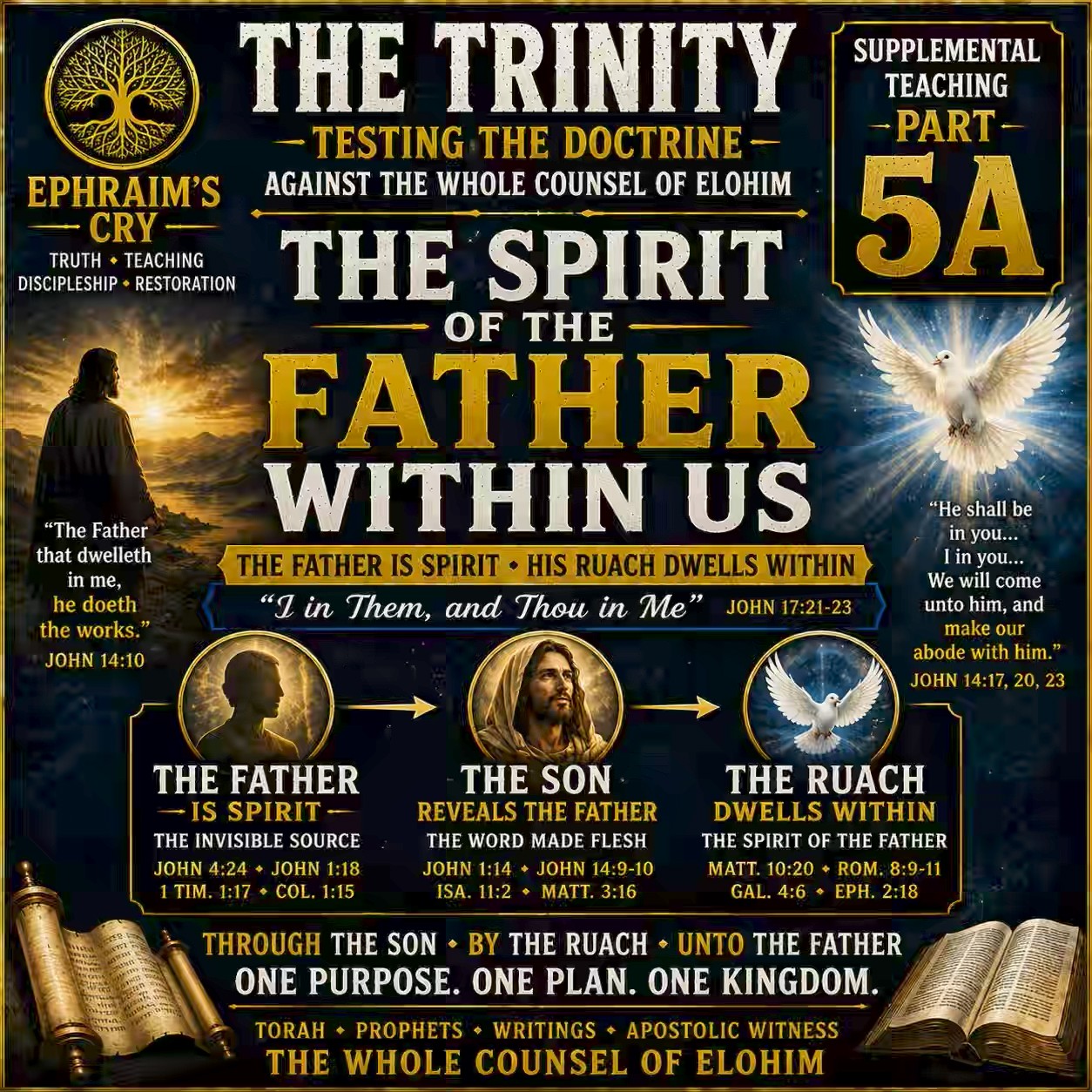
THE TRINITY — TESTING THE DOCTRINE AGAINST THE WHOLE COUNSEL OF ELOHIM
SUPPLEMENTAL TEACHING — PART 5A
THE SPIRIT OF THE FATHER WITHIN US
The Father Is Spirit • His Ruach Dwells Within • “I in Them, and Thou in Me”
Greg Witter | Ephraim’s Cry
Hebraic Mindset Study Series
Study • Learn • Apply • Grow • Share ☆ Repeat
Part 5 established what Scripture actually says concerning the Ruach ha’Qodesh. Part 6 examines Yahusha’s declaration, “I and my Father are one.” Between those two teachings stands an important question that deserves more than a passing reference:
HOW DOES THE FATHER DWELL IN THE SON, HOW DO THE FATHER AND SON DWELL IN BELIEVERS, AND WHAT DOES THE RUACH HA’QODESH HAVE TO DO WITH THAT INDWELLING?
John 14–17 provides an extraordinary answer.
Yahusha speaks of the Father dwelling IN HIM.
He promises that the Ruach will dwell IN HIS DISCIPLES.
He says, “I WILL COME TO YOU.”
He says, “I IN YOU.”
He says that he and the Father will “MAKE OUR ABODE” with the obedient believer.
Then in John 17 he prays:
“THOU, FATHER, ART IN ME, AND I IN THEE.”
And:
“I IN THEM, AND THOU IN ME.”
These statements cannot responsibly be separated from Yahusha’s teaching concerning the Ruach.
The Father is Spirit.
The Ruach ha’Qodesh is repeatedly identified as the Spirit of Yahuah and the Spirit of the Father.
The Father dwells and works through His Son.
And Yahuah’s Ruach now dwells within His people.
That relationship gives us a profoundly Hebraic and biblical framework for understanding indwelling, presence, unity, and oneness without collapsing Father, Son, Ruach, and believers into one person.
THE FOUNDATION — THE FATHER IS SPIRIT
Yahusha says plainly in John 4:24:
“GOD IS SPIRIT.”
That statement establishes our starting point.
Yahuah the Father is not introduced in Scripture as a flesh-and-blood human being.
John 1:18 says:
“No man hath seen God at any time.”
Paul describes Elohim as:
“the King eternal, immortal, INVISIBLE” (1 Timothy 1:17).
First Timothy 6:16 speaks of the One:
“whom no man hath seen, nor can see.”
Colossians 1:15 calls Yahusha:
“THE IMAGE OF THE INVISIBLE GOD.”
Why is Yahusha called the image?
Because the Father whom he reveals is invisible.
Therefore we should stay with the language Scripture actually gives us:
THE FATHER IS SPIRIT.
THE FATHER IS INVISIBLE.
THE WORD — NOT THE FATHER — BECAME FLESH
This distinction is critically important.
John 1:14 does not say:
“The Father became flesh.”
It says:
“THE WORD WAS MADE FLESH, and dwelt among us.”
The Son reveals the Father.
The Son is the image of the invisible Elohim.
The Son is the Word made flesh.
Therefore we must not collapse the invisible Father into the Son who became flesh.
John maintains the distinction from beginning to end.
THE WORD WAS WITH ELOHIM.
THE WORD BECAME FLESH.
THE SON REVEALED THE FATHER.
THE RUACH IS THE SPIRIT OF YAHUAH
Now return to the Hebrew Scriptures.
Genesis 1:2 speaks of:
רוּחַ אֱלֹהִים — RUACH ELOHIM.
The Spirit of Elohim.
Judges repeatedly speaks of:
רוּחַ יהוה — RUACH YAHUAH.
The Spirit of Yahuah.
David prays:
“Take not THY HOLY SPIRIT from me” (Psalm 51:11).
Psalm 139:7 establishes an extraordinary parallel:
“Whither shall I go from THY SPIRIT? Or whither shall I flee from THY PRESENCE?”
THY SPIRIT.
THY PRESENCE.
Isaiah 63:10 speaks of:
“HIS HOLY SPIRIT.”
The consistent possessive language matters.
MY SPIRIT.
HIS SPIRIT.
THY SPIRIT.
SPIRIT OF YAHUAH.
SPIRIT OF ELOHIM.
Scripture repeatedly identifies the Ruach as belonging to Yahuah.
YAHUSHA CALLS THE RUACH “THE SPIRIT OF YOUR FATHER”
Now Yahusha makes the identification even more explicit.
Matthew 10:20:
“For it is not ye that speak, but THE SPIRIT OF YOUR FATHER which speaketh in you.”
Do not rush past that.
THE SPIRIT.
OF YOUR FATHER.
The Ruach speaking within the disciples is identified by Yahusha as:
THE SPIRIT OF THE FATHER.
This must be allowed its full theological weight.
We do not have to begin with a fourth-century formula to explain that statement.
Yahusha already told us whose Spirit it is.
PAUL GIVES US A POWERFUL ANALOGY
First Corinthians 2:10–11 deserves particular attention.
Paul says:
“The Spirit searcheth all things, yea, the deep things of God.”
Then:
“For what man knoweth the things of a man, save THE SPIRIT OF MAN WHICH IS IN HIM? Even so the things of God knoweth THE SPIRIT OF GOD.”
Paul compares:
THE SPIRIT OF A MAN.
With:
THE SPIRIT OF ELOHIM.
A man’s spirit is intimately his own.
Paul uses that relationship to illuminate the relationship between Elohim and His Ruach.
Again, we should resist forcing Paul’s analogy beyond what he says.
But we should equally resist ignoring it because it complicates a later theological formula.
THE FATHER DWELLED IN YAHUSHA
Now John 14 becomes central.
Philip says:
“Lord, shew us the Father.”
Yahusha responds:
“He that hath seen me hath seen the Father” (John 14:9).
But Yahusha does NOT explain this by saying:
“Because I am the Father.”
Instead he says:
“Believest thou not that I am IN THE FATHER, and THE FATHER IN ME?”
Then Yahusha explains further:
“The words that I speak unto you I speak NOT OF MYSELF: but THE FATHER THAT DWELLETH IN ME, HE DOETH THE WORKS” (John 14:10).
This is one of the most important statements in this entire series.
THE FATHER DWELLS IN THE SON.
THE FATHER WORKS THROUGH THE SON.
Yet Father and Son remain distinguishable.
HOW DOES THE FATHER WORK THROUGH YAHUSHA?
The Prophets already gave us the framework.
Isaiah 11:2:
“The Spirit of Yahuah shall REST UPON HIM.”
Isaiah 42:1:
“I have put MY SPIRIT UPON HIM.”
Then at Yahusha’s immersion:
“He saw THE SPIRIT OF GOD descending like a dove, and lighting upon him” (Matthew 3:16).
Acts 10:38 explains:
“God ANOINTED Jesus of Nazareth WITH THE HOLY GHOST AND WITH POWER.”
Notice the order:
ELOHIM ANOINTS.
YAHUSHA IS ANOINTED.
THE RUACH IS UPON HIM.
Yahusha then performs the Father’s works.
Therefore when Yahusha says:
“THE FATHER THAT DWELLETH IN ME, HE DOETH THE WORKS,”
We should read that alongside the testimony that the Ruach of Yahuah rests upon and works through the Son.
YAHUSHA DID NOT OPERATE INDEPENDENTLY OF THE FATHER
John 5:19:
“The Son can do NOTHING OF HIMSELF, but what he seeth the Father do.”
John 5:30:
“I can of mine own self DO NOTHING.”
John 8:28:
“As MY FATHER HATH TAUGHT ME, I speak these things.”
John 12:49:
“The Father which sent me, HE GAVE ME A COMMANDMENT, what I should say, and what I should speak.”
John 14:10:
“THE FATHER THAT DWELLETH IN ME, HE DOETH THE WORKS.”
This is perfect dependence.
Perfect obedience.
Perfect agency.
Perfect indwelling.
Perfect unity.
THEN YAHUSHA PROMISES THE RUACH TO HIS DISCIPLES
John 14:16:
“I will pray THE FATHER, and HE shall give you another Comforter.”
Again:
THE SON ASKS.
THE FATHER GIVES.
Then Yahusha identifies the Comforter as:
“THE SPIRIT OF TRUTH” (John 14:17).
And says something extremely important:
“He dwelleth WITH YOU, and shall be IN YOU.”
Now watch the progression carefully.
This cannot be treated as disconnected sentences.
“HE SHALL BE IN YOU”
John 14:17:
“HE… SHALL BE IN YOU.”
The Ruach will indwell the disciples.
Then immediately Yahusha says:
“I WILL COME TO YOU”
John 14:18:
“I will not leave you comfortless: I WILL COME TO YOU.”
Ruach IN YOU.
Then:
I WILL COME TO YOU.
Then verse 20:
“I IN YOU”
“At that day ye shall know that I am in my Father, and ye in me, AND I IN YOU.”
Now we have:
FATHER AND SON.
SON IN DISCIPLES.
RUACH IN DISCIPLES.
This is not accidental language.
THEN YAHUSHA SAYS “WE WILL COME”
John 14:23 takes it even further:
“If a man love me, he will KEEP MY WORDS: and my Father will love him, and WE WILL COME UNTO HIM, AND MAKE OUR ABODE WITH HIM.”
WE WILL COME.
OUR ABODE.
Father and Son make their dwelling with the obedient believer.
How?
The preceding context has just explained the coming and indwelling of the Ruach.
This provides the biblical framework:
THE FATHER’S PRESENCE WITHIN HIS PEOPLE IS THROUGH HIS RUACH.
And through that same Ruach, the presence of Messiah is experienced within his people.
PAUL SAYS THE SAME THING
Romans 8:9–11 is extraordinary.
Paul begins:
“If so be that THE SPIRIT OF GOD dwell in you.”
Then immediately:
“If any man have not THE SPIRIT OF CHRIST, he is none of his.”
Then:
“If CHRIST BE IN YOU…”
Then:
“If THE SPIRIT OF HIM THAT RAISED UP JESUS FROM THE DEAD dwell in you…”
Look at the movement:
SPIRIT OF ELOHIM.
SPIRIT OF MESSIAH.
MESSIAH IN YOU.
SPIRIT OF HIM WHO RAISED YAHUSHA.
These expressions are woven together.
Paul is describing covenant indwelling through the Ruach.
GALATIANS GIVES ANOTHER WITNESS
Galatians 4:6:
“Because ye are sons, GOD HATH SENT FORTH THE SPIRIT OF HIS SON INTO YOUR HEARTS, crying, Abba, Father.”
Again:
ELOHIM SENDS.
THE RUACH ENTERS THE HEART.
THE RUACH IS CALLED:
THE SPIRIT OF HIS SON.
And what does that Ruach cause believers to cry?
ABBA.
FATHER.
The Ruach does not terminate upon himself.
The Ruach brings us into living relationship with THE FATHER.
NOW JOHN 17 OPENS UP
This is where everything begins fitting together.
Yahusha prays:
“That they all may be ONE; as THOU, FATHER, ART IN ME, AND I IN THEE, that THEY ALSO MAY BE ONE IN US” (John 17:21).
Notice the language.
FATHER IN SON.
SON IN FATHER.
BELIEVERS IN THEM.
Then Yahusha says:
“The glory which thou gavest me I have given them; that THEY MAY BE ONE, EVEN AS WE ARE ONE” (John 17:22).
Then:
“I IN THEM, AND THOU IN ME, that they may be made perfect in one” (John 17:23).
This is biblical oneness.
“I IN THEM, AND THOU IN ME”
That statement deserves to stand by itself:
I IN THEM.
THOU IN ME.
Yahusha is not teaching the disciples that they will become the Father.
He is not teaching that they will become Yahusha.
He is not teaching that millions of believers will become one metaphysical person.
He is describing covenantal, spiritual indwelling and unity.
And John 14 has already established the indwelling Ruach as central to that reality.
THE INDWELLING EXPLAINS THE ONENESS
This becomes enormously important for John 10:30:
“I AND MY FATHER ARE ONE.”
Part 6 established that biblical oneness does not require identity of person.
Now Part 5A provides an even deeper explanation.
The Father dwells in the Son.
The Son perfectly reveals the Father.
The Ruach of the Father rests upon the Son.
The same Ruach dwells within believers.
Yahusha says he will be IN believers.
Father and Son make their abode with believers.
Then Yahusha prays that believers become ONE as Father and Son are one.
Therefore:
INDWELLING DOES NOT EQUAL IDENTITY.
ONENESS DOES NOT EQUAL ONE PERSON.
That is demonstrated by Yahusha’s own prayer.
THE FATHER DOES NOT PHYSICALLY ENTER MILLIONS OF BELIEVERS
This is where we should speak carefully.
Scripture does not describe the invisible Father as physically dividing Himself into millions of pieces and entering human bodies.
It describes His RUACH dwelling within His people.
First Corinthians 3:16:
“Know ye not that ye are the temple of God, and that THE SPIRIT OF GOD DWELLETH IN YOU?”
First Corinthians 6:19:
“Your body is the temple of THE HOLY GHOST WHICH IS IN YOU.”
The Temple imagery is profound.
Yahuah’s presence dwelled among Israel.
Now through His Ruach, His presence dwells within His covenant people.
THE TABERNACLE PATTERN CONTINUES
This is thoroughly Hebraic.
Yahuah desired to dwell among His people.
Exodus 25:8:
“Let them make me a sanctuary; THAT I MAY DWELL AMONG THEM.”
The Tabernacle represented Yahuah dwelling among Israel.
The Temple continued that dwelling-place imagery.
Then John says concerning the Word:
“The Word was made flesh, and DWELT among us” (John 1:14).
The Greek carries tabernacle imagery.
Then the Apostolic Witness says believers themselves become the dwelling place of Elohim through the Ruach.
Ephesians 2:22:
“In whom ye also are builded together for AN HABITATION OF GOD THROUGH THE SPIRIT.”
There it is.
A HABITATION OF ELOHIM.
HOW?
THROUGH THE RUACH.
THIS IS THE KEY
Ephesians 2:18–22 may give us the clearest summary of this entire supplemental teaching.
Verse 18:
“FOR THROUGH HIM we both have access BY ONE SPIRIT UNTO THE FATHER.”
THROUGH HIM — YAHUSHA.
BY ONE RUACH.
UNTO THE FATHER.
Then verse 22:
“An habitation of God THROUGH THE SPIRIT.”
This is biblical order.
THROUGH THE SON.
BY THE RUACH.
UNTO THE FATHER.
And:
THE FATHER DWELLS AMONG HIS PEOPLE THROUGH HIS RUACH.
THE RUACH IS NOT COMPETING WITH THE FATHER
This is another reason the later idea of three separate centers of divine identity must be tested carefully.
Scripture continually identifies the Ruach relationally:
SPIRIT OF YAHUAH.
SPIRIT OF ELOHIM.
SPIRIT OF YOUR FATHER.
HIS HOLY SPIRIT.
SPIRIT OF HIS SON.
The Ruach is never presented as competing with Father or Son for attention.
John 16:13 says the Ruach:
“shall not speak of himself.”
Verse 14:
“HE SHALL GLORIFY ME.”
Yahusha glorifies the Father.
The Ruach glorifies Yahusha.
And through Yahusha we come unto the Father.
ORDER.
MISSION.
UNITY.
BUT DO NOT REDUCE THE RUACH TO AN IMPERSONAL FORCE
Part 5 established this, and we preserve it here.
The Ruach:
SPEAKS.
TEACHES.
GUIDES.
COMMANDS.
INTERCEDES.
SEARCHES.
EXERCISES WILL.
CAN BE GRIEVED.
Therefore calling the Ruach merely “energy” or “electricity” is insufficient.
The Ruach is Yahuah’s living, active, speaking, guiding, indwelling Spirit.
We do not have to force the Ruach into either extreme.
THE RUACH AND COVENANT OBEDIENCE
There is another essential connection.
Yahuah says in Ezekiel 36:27:
“I will put MY SPIRIT WITHIN YOU, and cause you to WALK IN MY STATUTES, and ye shall KEEP MY JUDGMENTS, AND DO THEM.”
Why does Yahuah place His Ruach within His people?
Not so they can declare His Torah obsolete.
The Ruach empowers obedience.
Jeremiah 31:
TORAH WRITTEN UPON THE HEART.
Ezekiel 36:
RUACH PLACED WITHIN.
The two promises work together.
Internalized Torah.
Indwelling Ruach.
Covenant obedience.
HOW DO WE KNOW THE FATHER IS WITH US?
Not because we physically see the invisible Father.
But because His Ruach dwells within His people.
First John 3:24 says:
“Hereby we know that he abideth in us, BY THE SPIRIT WHICH HE HATH GIVEN US.”
First John 4:13:
“Hereby know we that we dwell in him, and he in us, because HE HATH GIVEN US OF HIS SPIRIT.”
There it is again.
HE IN US.
WE IN HIM.
HOW DO WE KNOW?
HE HAS GIVEN US OF HIS RUACH.
John’s language directly connects indwelling with the Ruach.
THIS CONFIRMS JOHN 17
John 17:
“Thou in me.”
“I in them.”
First John:
“He in us.”
“We dwell in him.”
And the explanation:
“Because HE HATH GIVEN US OF HIS SPIRIT.”
That is an enormously important apostolic interpretation of Yahusha’s language.
The same John who recorded John 17 later explains how Elohim’s abiding presence is known:
BY HIS RUACH GIVEN TO US.
THIS DOES NOT MAKE US ELOHIM
This is critical.
If Father dwelling in Yahusha automatically meant Yahusha must literally BE the Father, then the same logic would produce disastrous conclusions when applied to believers.
Elohim dwells in believers.
Yahusha dwellsin believers.
The Ruach dwells in believers.
Believers dwell in Elohim.
Believers are called the Temple of Elohim.
Yet believers do not therefore become Yahuah.
John 17:21 says:
“That they also may be ONE IN US.”
If indwelling automatically meant identity, then believers would become part of the same identity as Father and Son.
That is obviously not what Yahusha means.
Therefore we must distinguish:
INDWELLING FROM IDENTITY.
UNITY FROM IDENTITY.
REPRESENTATION FROM IDENTITY.
ONENESS FROM COLLAPSE.
The Father dwelling in Yahusha demonstrates extraordinary unity, presence, authority, and relationship. But the very same biblical language of indwelling is extended to believers without transforming believers into the Father or the Son.
YAHUSHA DWELLS IN BELIEVERS THROUGH THE RUACH
Paul makes this connection particularly strong.
Romans 8:9 begins:
“The Spirit of God dwell in you.”
Then:
“The Spirit of Christ.”
Then verse 10:
“Christ be in you.”
Paul moves naturally between the indwelling Ruach and Messiah dwelling within believers.
This does not mean Yahusha physically enters every believer in bodily form.
The resurrected Yahusha has a glorified body.
Acts 1 presents him ascending.
The Apostolic Witness presents him at the right hand of the Father.
Yet Paul can simultaneously say:
“CHRIST IN YOU.”
How?
The surrounding passage gives us the answer:
THE RUACH DWELLS IN YOU.
This is spiritual indwelling—not physical location.
THE GLORIFIED YAHUSHA REMAINS BODILY DISTINCT
This matters.
After his resurrection Yahusha says:
“Handle me, and see; for a spirit hath not flesh and bones, as ye see me have” (Luke 24:39).
Yahusha is genuinely resurrected.
He is not merely transformed into an invisible spirit and dissolved into the Father.
He ascends.
He sits at the Father’s right hand.
He intercedes.
He will return.
Therefore when Scripture says:
“Christ in you,”
We should not imagine the glorified bodily Messiah being physically distributed among millions of people.
His presence among and within his people is mediated through the Ruach.
Again:
THE RUACH MAKES THE PRESENCE OF FATHER AND SON REAL WITHIN THE COVENANT COMMUNITY WITHOUT COLLAPSING THEIR IDENTITIES.
“CHRIST IN YOU, THE HOPE OF GLORY”
Colossians 1:27 speaks of:
“Christ in you, the hope of glory.”
That language fits perfectly with John 14.
“I IN YOU.”
And Romans 8.
“Christ be in you.”
And Galatians 4.
“The Spirit of his Son into your hearts.”
These are not competing explanations.
They illuminate one another.
The indwelling Ruach brings the living presence and work of Messiah into the believer.
And Messiah brings us into relationship with the Father.
THE FATHER AND SON MAKE THEIR ABODE
Now return again to John 14:23:
“We will come unto him, and make OUR ABODE with him.”
The Greek word translated “abode” is μονή — monē, a dwelling place or abiding place.
Interestingly, the same noun occurs earlier in John 14:2:
“In my Father’s house are many MANSIONS [dwelling places].”
Yahusha is using dwelling-place language.
The Father desires to dwell with His people.
That theme runs from Genesis through Revelation.
TABERNACLE.
TEMPLE.
MESSIAH TABERNACLING AMONG US.
BELIEVERS AS THE TEMPLE.
RUACH DWELLING WITHIN.
Ultimately:
“The tabernacle of God is with men” (Revelation 21:3).
This is one continuous biblical dwelling-place story.
FROM EDEN TO TABERNACLE TO TEMPLE TO PEOPLE
This is thoroughly Hebraic.
Yahuah’s purpose has always involved dwelling with His people.
Eden presents humanity in the presence of Elohim.
The Tabernacle places Yahuah’s dwelling in the midst of Israel.
The Temple continues the pattern.
Yahusha becomes the Word “tabernacling” among humanity.
Then the renewed-covenant assembly becomes:
“A habitation of God THROUGH THE SPIRIT.”
The story is not:
“Yahuah abandoned His people and invented a new religion.”
The story is:
YAHUAH RESTORES HIS DWELLING AMONG AND WITHIN HIS COVENANT PEOPLE.
THE RUACH IS THE SIGN OF COVENANT INDWELLING
Ezekiel had already promised it.
“I will put MY SPIRIT within you.”
Why?
So Yahuah’s people will walk according to His ways.
This is not merely supernatural experience.
It is covenant transformation.
The Ruach changes the heart.
The Ruach empowers obedience.
The Ruach bears witness.
The Ruach produces fruit.
The Ruach makes Yahuah’s people His dwelling place.
This is why the renewed covenant cannot properly be understood apart from both:
TORAH WRITTEN WITHIN.
AND:
RUACH DWELLING WITHIN.
JOHN LATER EXPLAINS JOHN
First John 4:12–13 is especially important:
“If we love one another, GOD DWELLETH IN US.”
Then John explains:
“Hereby know we that WE DWELL IN HIM, AND HE IN US, because HE HATH GIVEN US OF HIS SPIRIT.”
There is our interpretive key.
How can John say:
ELOHIM DWELLS IN US?
Because:
HE HAS GIVEN US OF HIS RUACH.
That is not speculation.
JOHN EXPLAINS JOHN.
John 14 says Father and Son make their abode with the believer.
John 17 says:
“Thou in me.”
“I in them.”
First John says:
“He in us.”
And then explains:
“Because he hath given us of his Spirit.”
That connection deserves to be written in capital letters:
THE INDWELLING RUACH IS THE BIBLICAL EXPLANATION OF ELOHIM’S ABIDING PRESENCE WITHIN HIS PEOPLE.
THIS ALSO PROTECTS THE DISTINCTION BETWEEN FATHER AND SON
Once we understand indwelling biblically, several passages become clearer.
“He that hath seen me hath seen the Father.”
Why?
Because the Father dwells in Yahusha and performs His works through him.
“I and my Father are one.”
How?
Perfect unity of presence, purpose, word, work, authority, love, and mission.
“I in them, and thou in me.”
How?
Through covenant indwelling by the Ruach.
None of these statements requires Father and Son to be the same person.
And John 17 actually prevents that conclusion because believers are invited into the same relational oneness.
NOR DOES THIS REDUCE YAHUSHA TO AN ORDINARY BELIEVER
Again we guard the other boundary.
Yahusha’s relationship with the Father is UNIQUE.
He is the uniquely begotten Son.
The preexistent Word.
The image of the invisible Elohim.
The One through whom creation came.
The One who had glory with the Father before the world existed.
The One to whom the Father gives universal authority.
The One before whom every knee will bow.
Therefore:
The fact that believers participate in indwelling and oneness does NOT make believers equal to Yahusha.
Participation does not erase hierarchy.
Agency does not erase uniqueness.
Indwelling does not erase Sonship.
THE FATHER IS THE SOURCE
The pattern throughout Scripture remains ordered.
THE FATHER SENDS THE SON.
THE FATHER SENDS THE RUACH.
THE SON RECEIVES FROM THE FATHER.
THE SON POURS OUT THE RUACH.
THE RUACH GLORIFIES THE SON.
THE SON GLORIFIES THE FATHER.
THE RUACH DWELLS WITHIN BELIEVERS.
THROUGH THE SON, BY THE RUACH, BELIEVERS COME UNTO THE FATHER.
That order is not confusion.
It is beautiful biblical coherence.
THE WATCHMAN’S WARNING
Do not allow later theological terminology to obscure what Yahusha himself explained.
When Yahusha says:
“THE FATHER THAT DWELLETH IN ME,”
Believe him.
When he says:
“The Spirit of truth… SHALL BE IN YOU,”
Believe him.
When he says:
“I WILL COME TO YOU,”
Believe him.
When he says:
“I IN YOU,”
Believe him.
When he says:
“WE WILL COME… AND MAKE OUR ABODE,”
Believe him.
When he prays:
“THOU, FATHER, ART IN ME, AND I IN THEE,”
Believe him.
When he says:
“I IN THEM, AND THOU IN ME,”
Believe him.
And when John later explains:
“He in us, because HE HATH GIVEN US OF HIS SPIRIT,”
BELIEVE THAT TOO.
Do not make those statements fight one another.
They explain one another.
THE FOUNDATION OF SUPPLEMENTAL PART 5A
The witnesses now come together:
THE FATHER IS SPIRIT.
THE FATHER IS INVISIBLE.
THE WORD/SON BECAME FLESH.
THE RUACH HA’QODESH IS THE SPIRIT OF YAHUAH.
YAHUSHA CALLS THE RUACH “THE SPIRIT OF YOUR FATHER.”
THE RUACH OF YAHUAH RESTED UPON YAHUSHA.
THE FATHER DWELLED IN YAHUSHA AND PERFORMED HIS WORKS THROUGH HIM.
THE FATHER GIVES THE RUACH TO HIS PEOPLE.
THE RUACH DWELLS WITHIN BELIEVERS.
SCRIPTURE THEREFORE SPEAKS OF MESSIAH DWELLING IN BELIEVERS.
FATHER AND SON MAKE THEIR ABODE WITH THE BELIEVER.
JOHN EXPLAINS THAT ELOHIM DWELLS IN US BECAUSE HE HAS GIVEN US OF HIS RUACH.
THE RUACH MAKES YAHUAH’S PEOPLE HIS DWELLING PLACE.
THE RUACH EMPOWERS COVENANT OBEDIENCE.
And therefore:
INDWELLING DOES NOT MEAN IDENTITY.
ONENESS DOES NOT MEAN ONE PERSON.
THE FATHER CAN BE IN THE SON WITHOUT THE FATHER BEING THE SON.
THE SON CAN BE IN BELIEVERS WITHOUT BELIEVERS BECOMING THE SON.
ELOHIM CAN DWELL IN BELIEVERS WITHOUT BELIEVERS BECOMING ELOHIM.
That is precisely why John 17 is so important.
“I IN THEM, AND THOU IN ME”
That may be the single line that summarizes this entire supplemental teaching.
Yahusha does not pray:
“Father, reveal to them that you and I are actually the same person.”
He prays:
“I IN THEM, AND THOU IN ME, that they may be made perfect in ONE.”
Father.
Son.
Believers.
Distinction remains.
Yet indwelling creates extraordinary unity.
And the Apostolic Witness explains that Yahuah accomplishes this indwelling:
THROUGH HIS RUACH.
THE DECISIVE BIBLICAL ORDER
Ephesians 2:18 gives us the final summary:
“FOR THROUGH HIM we both have access BY ONE SPIRIT UNTO THE FATHER.”
There is the order.
THROUGH THE SON.
BY ONE RUACH.
UNTO THE FATHER.
Then Ephesians 2:22 tells us what we become:
“AN HABITATION OF GOD THROUGH THE SPIRIT.”
That is the biblical architecture.
The Father is the destination.
The Son is the Way and Mediator.
The Ruach is the indwelling presence and empowering Spirit.
And Yahuah’s people become His dwelling place.
THE BRIDGE INTO PART 6
Now we are prepared to understand Yahusha’s declaration:
“I AND MY FATHER ARE ONE.”
Not through fourth-century metaphysical assumptions.
Not through Oneness theology.
Not by collapsing Father and Son.
But through Yahusha’s own explanation:
“THE FATHER DWELLETH IN ME.”
“I AM IN MY FATHER.”
“THE SPIRIT… SHALL BE IN YOU.”
“I IN YOU.”
“WE WILL… MAKE OUR ABODE WITH HIM.”
“THAT THEY ALL MAY BE ONE.”
“AS THOU, FATHER, ART IN ME, AND I IN THEE.”
“I IN THEM, AND THOU IN ME.”
This is not confusion.
THIS IS BIBLICAL INDWELLING.
THIS IS BIBLICAL UNITY.
THIS IS BIBLICAL ONENESS.
And the Ruach ha’Qodesh—the Spirit of the Father—is central to understanding it.
CONTINUE WITH PART 6
“I AND MY FATHER ARE ONE”
What Does Biblical Oneness Mean?
#GregWitter, #EphraimsCry, #EphraimsCryAcademy, #HebraicMindsetStudySeries, #TheTrinitySeries,
#SupplementalTeaching, #Part5A, #HebraicMindset, #HebraicBibleStudy, #BibleStudy, #BibleTeaching,
#StudentsOfScripture, #DisciplesOfYahusha, #WholeCounselOfElohim, #FourWitnesses, #SpiritOfTheFather,
#RuachHaQodesh, #RuachYahuah, #SpiritOfElohim, #Yahuah, #Yahusha, #FatherAndSon, #BiblicalIndwelling,
#BiblicalOneness, #IInThemAndThouInMe, #John14, #John17, #Romans8, #Ephesians2, #TruthOverTradition,
#ReturnToScripture
