
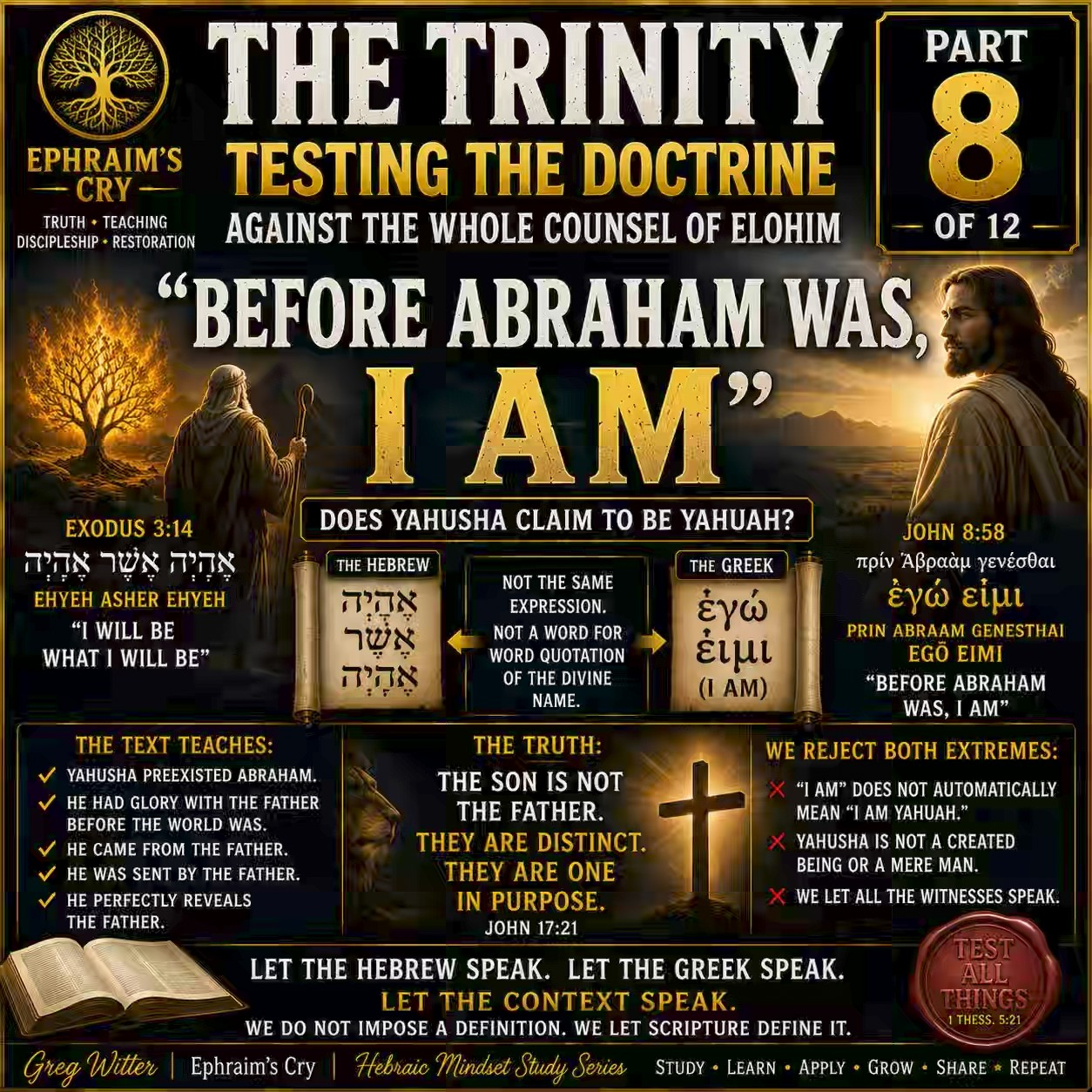
THE TRINITY — TESTING THE DOCTRINE AGAINST THE WHOLE COUNSEL OF ELOHIM
PART 8 — “BEFORE ABRAHAM WAS, I AM”
Does Yahusha Claim to Be Yahuah?
Greg Witter | Ephraim’s Cry
Hebraic Mindset Study Series
Study • Learn • Apply • Grow • Share ☆ Repeat
Few statements attributed to Yahusha have carried more theological weight than John 8:58:
“Verily, verily, I say unto you, Before Abraham was, I am.”
For generations this verse has been presented as nearly conclusive proof that Yahusha explicitly identified himself as Yahuah by invoking Exodus 3:14.
The argument normally runs like this:
Exodus 3:14 says Yahuah’s name is “I AM.”
Yahusha says “I AM” in John 8:58.
Therefore Yahusha identifies himself as Yahuah.
Therefore the Trinity is proven.
But every step in that argument must be tested.
We are NOT going to diminish Yahusha’s statement. John 8:58 is extraordinary. Yahusha places his existence before Abraham, and that must be allowed its full force.
But PREEXISTENCE and IDENTITY AS YAHUAH are not automatically the same proposition.
So the question is not whether John 8:58 is important.
It is:
DOES “EGŌ EIMI” MEAN “I AM YAHUAH”?
We begin where we always begin.
WITH THE TEXT.
EXODUS 3:14 — WHAT DOES THE HEBREW ACTUALLY SAY?
At the burning bush Moses asks Elohim what he should tell Israel when they ask His name.
Exodus 3:14 reads:
אֶהְיֶה אֲשֶׁר אֶהְיֶה
Ehyeh Asher Ehyeh.
The Hebrew verb אֶהְיֶה — ehyeh — is the first-person singular imperfect form of הָיָה — hayah, “to be/become.”
It can carry the sense:
“I AM.”
“I WILL BE.”
“I WILL BE WHAT I WILL BE.”
“I WILL BE WHO I WILL BE.”
The context itself helps us.
Only two verses earlier, Exodus 3:12, Yahuah tells Moses:
כִּי־אֶהְיֶה עִמָּךְ
Ki ehyeh immakh.
“I WILL BE WITH YOU.”
The SAME Hebrew form—ehyeh.
Therefore reducing ehyeh to an abstract philosophical title “I AM” ignores its normal verbal function and immediate context.
Yahuah is declaring His self-existence, faithfulness, presence, and sovereign being—but the Hebrew expression is richer than an English theological slogan.
EXODUS 3:15 GIVES THE COVENANT NAME
This is critically important.
After saying Ehyeh Asher Ehyeh, Elohim continues:
“Thus shalt thou say unto the children of Israel, YAHUAH Elohim of your fathers… hath sent me unto you: THIS IS MY NAME FOR EVER” (Exodus 3:15).
What does verse 15 explicitly call His name?
יהוה
YHWH — YAHUAH.
The text itself distinguishes the declaration of verse 14 from the covenant name explicitly given in verse 15.
Therefore saying:
“God’s name is literally I AM”
Is already an oversimplification of Exodus.
WHAT DOES THE SEPTUAGINT SAY?
This becomes even more important when comparing Exodus with John’s Greek.
The ancient Greek Septuagint renders Exodus 3:14:
ἐγώ εἰμι ὁ ὤν
Egō eimi ho ōn.
“I am THE ONE WHO IS,” or “I am THE EXISTING ONE.”
Then Moses is instructed:
ὁ ὢν ἀπέσταλκέν με πρὸς ὑμᾶς
Ho ōn apestalken me pros hymas.
“THE ONE WHO IS has sent me to you.”
Notice carefully.
The identifying expression in the Greek Exodus text is not merely:
ἐγώ εἰμι — egō eimi.
It is:
ὁ ὤν — HO ŌN.
“THE ONE WHO IS.”
That creates a serious problem for the simplistic argument that John 8:58 is Yahusha quoting the Greek Exodus 3:14 divine designation word-for-word.
HE DOES NOT.
WHAT DOES JOHN 8:58 ACTUALLY SAY?
Greek:
Πρὶν Ἀβραὰμ γενέσθαι ἐγώ εἰμι
Prin Abraam genesthai, egō eimi.
“Before Abraham came to be, I am.”
The statement is deliberately striking.
Abraham “came to be”—γενέσθαι, genesthai.
Yahusha says:
ἐγώ εἰμι — egō eimi.
There is a powerful contrast between Abraham’s coming into existence and Yahusha’s continuing existence.
WE SHOULD NOT WEAKEN THAT.
Yahusha is claiming something extraordinary concerning his existence relative to Abraham.
But the question remains:
Does egō eimi itself mean “I am Yahuah”?
“EGŌ EIMI” IS ORDINARY GREEK
The expression ἐγώ εἰμι simply means “I am” or, depending upon context, “I am he.”
It is not inherently the divine name.
John’s own Gospel proves this.
John 9:9 records the formerly blind man responding to people debating his identity.
He says:
ἐγώ εἰμι.
“I am he.”
Did the healed man just claim to be Yahuah?
Obviously not.
Therefore:
EGŌ EIMI ≠ AUTOMATICALLY THE DIVINE NAME.
Context must determine meaning.
YAHUSHA USES “EGŌ EIMI” REPEATEDLY
John contains many “I am” sayings:
“I am the bread of life.”
“I am the light of the world.”
“I am the door.”
“I am the good shepherd.”
“I am the resurrection and the life.”
“I am the way, the truth, and the life.”
“I am the true vine.”
The phrase itself is not a magical verbal formula transforming every statement into “I am Yahuah.”
The predicate and context matter.
John also contains absolute uses of egō eimi without an immediately expressed predicate.
These deserve examination.
But again, their theological significance must come from context—not merely from the existence of two common Greek words.
JOHN 8:24 — “IF YE BELIEVE NOT THAT I AM”
Earlier Yahusha says:
“If ye believe not that I am he, ye shall die in your sins.”
Greek again contains:
ἐγώ εἰμι.
Many English translations supply “he.”
Why?
Because Greek can use egō eimi in an identificational sense:
“I am he.”
The question becomes:
WHO IS THE “HE”?
John’s Gospel repeatedly tells us.
THE MESSIAH.
THE SON.
THE ONE SENT BY THE FATHER.
JOHN’S STATED PURPOSE MATTERS
John does not leave us guessing why he wrote his Gospel.
John 20:31 says:
“These are written, that ye might believe that Jesus is THE CHRIST, THE SON OF GOD; And that believing ye might have life through his name.”
That is John’s stated objective.
THE MESSIAH.
THE SON OF ELOHIM.
We must be exceedingly careful about replacing John’s explicit conclusion with:
“These things were written so that you would believe Jesus is Yahuah Himself.”
John did not write that sentence.
THE CONTEXT OF JOHN 8 IS SONSHIP AND THE FATHER
John 8 repeatedly distinguishes Yahusha from the Father.
John 8:16:
“I am not alone, but I and THE FATHER THAT SENT ME.”
John 8:18:
“I am one that bear witness of myself, and THE FATHER THAT SENT ME beareth witness of me.”
John 8:28:
“I do nothing of myself; But as MY FATHER HATH TAUGHT ME, I speak these things.”
John 8:29:
“HE THAT SENT ME is with me: THE FATHER hath not left me alone.”
John 8:40:
“A man that hath told you the truth, WHICH I HAVE HEARD OF GOD.”
John 8:42:
“I proceeded forth and came from God; Neither came I of myself, BUT HE SENT ME.”
That is the immediate chapter containing John 8:58.
Whatever verse 58 means, it cannot legitimately be interpreted by erasing everything Yahusha has just said about being SENT, TAUGHT, accompanied, and commissioned BY THE FATHER.
“BEFORE ABRAHAM WAS” — THE REAL FORCE OF THE VERSE
Now we must not swing to the opposite extreme.
Some attempt to explain John 8:58 as though Yahusha merely existed in Yahuah’s PLAN before Abraham.
That explanation does not adequately account for the language or John’s broader Gospel.
John 17:5 records Yahusha praying:
“Father, glorify thou me with thine own self with THE GLORY WHICH I HAD WITH THEE BEFORE THE WORLD WAS.”
That is much stronger than merely saying:
“Father, you planned me before creation.”
Yahusha speaks of glory he HAD WITH the Father before the world existed.
John 6:38 likewise says:
“I came down from heaven.”
John 8:42:
“I proceeded forth and came from God.”
John 16:28:
“I came forth from the Father, and am come into the world: again, I leave the world, and go to the Father.”
Taken together, John’s testimony strongly presents genuine preexistence.
WE SHOULD SAY THAT CLEARLY.
Rejecting Trinitarian conclusions does not give us permission to erase Yahusha’s preexistence.
ABRAHAM REJOICED TO SEE YAHUSHA’S DAY
John 8:56 provides the immediate lead-in:
“Your father Abraham rejoiced to see my day: and he saw it, and was glad.”
The opponents respond:
“Thou art not yet fifty years old, and hast thou seen Abraham?”
Then Yahusha answers:
“Before Abraham was, I am.”
The issue has become temporal existence.
They appeal to Yahusha’s physical age.
Yahusha responds by placing himself BEFORE ABRAHAM.
That is an extraordinary declaration.
But extraordinary does not automatically mean:
“I am the Father.”
Or:
“I am Yahuah who spoke to Moses.”
The text must establish those additional claims.
WHY DID THEY PICK UP STONES?
John 8:59 says:
“Then took they up stones to cast at him.”
This is commonly offered as decisive proof:
“They knew he claimed to be Yahuah!”
Again:
HOSTILE REACTION IS NOT INSPIRED EXEGESIS.
John repeatedly records Yahusha’s opponents misunderstanding him.
Furthermore, the chapter already contains escalating conflict.
Yahusha tells them they are enslaved to sin.
He challenges their claim to Abraham.
He says they seek to kill him.
He says their father is the devil.
He accuses them of rejecting the truth.
Then he claims existence before Abraham.
There was more than enough confrontation to provoke violence.
Their attempt to stone Yahusha proves they regarded his words as intolerable.
It does NOT independently establish the precise theological meaning of egō eimi.
WHAT ABOUT ISAIAH’S “I AM HE”?
There is a stronger argument that deserves serious treatment.
The Greek Septuagint uses egō eimi in several passages where Yahuah declares His unique identity, including Isaiah.
For example, Isaiah 43:10 contains language corresponding to:
“that ye may know and believe me, and understand that I am he.”
This creates genuine conceptual background for John’s use of egō eimi.
We should not hide that.
John may deliberately employ language echoing Yahuah’s self-revelation.
But even then we must ask:
Is Yahusha claiming IDENTICAL PERSONAL IDENTITY with Yahuah?
Is he acting as Yahuah’s supreme authorized representative?
Is John presenting the Father’s self-revelation embodied through His Word and Son?
Those are interpretive questions.
The phrase alone does not settle them.
THE NAME AND THE ONE WHO BEARS IT
Part 4 established the Hebraic principle of agency.
Exodus 23:20–21 describes Yahuah’s messenger:
“MY NAME IS IN HIM.”
The representative can carry the Sender’s name and authority without becoming the Sender.
Yahusha says:
“I am come IN MY FATHER’S NAME” (John 5:43).
John 17:6:
“I have manifested THY NAME.”
John 17:11 speaks of the Father’s name in relationship to the Son.
Therefore name-bearing, divine representation, and delegated authority must remain part of the discussion.
Again:
AGENCY DOES NOT DIMINISH YAHUSHA.
But representation does not automatically equal personal identity.
YAHUSHA REVEALS YAHUAH PERFECTLY
This is where simplistic categories fail.
Yahusha can reveal the Father so perfectly that:
Seeing Yahusha means seeing the Father.
Hearing Yahusha means hearing the Father.
Receiving Yahusha means receiving the Father.
Rejecting Yahusha means rejecting the Father.
Yahusha speaks the Father’s words.
Performs the Father’s works.
Carries the Father’s authority.
Manifests the Father’s name.
And is the image of the invisible Elohim.
That is far greater than ordinary prophetic agency.
But Yahusha still says:
“THE FATHER SENT ME.”
That distinction remains.
DOES JOHN 8:58 PROVE THE TRINITY?
NO.
Even if someone concludes that John 8:58 identifies Yahusha directly with divine identity, the verse still does not establish:
THREE PERSONS.
FATHER, SON, AND RUACH AS CO-EQUAL PERSONS.
ONE INDIVISIBLE ESSENCE.
CO-ETERNITY OF THREE PERSONS.
The Ruach ha’Qodesh is not even mentioned in John 8:58.
Therefore calling John 8:58 “proof of the Trinity” skips several necessary logical steps.
At most, the verse contributes to the question of YAHUSHA’S IDENTITY AND PREEXISTENCE.
The Trinity is a larger proposition.
WHAT JOHN 8:58 DOES ESTABLISH
We should be equally clear about what the passage DOES establish.
YAHUSHA’S CLAIM TRANSCENDS ORDINARY HUMAN EXISTENCE.
HE PLACES HIMSELF BEFORE ABRAHAM.
JOHN’S GOSPEL PRESENTS HIM AS PREEXISTENT.
HE CAME FROM THE FATHER.
HE CAME DOWN FROM HEAVEN.
HE HAD GLORY WITH THE FATHER BEFORE THE WORLD EXISTED.
HE RETURNS TO THE FATHER.
That evidence must not be weakened simply because Trinitarians use it.
TRUTH DOES NOT BELONG TO A DENOMINATION.
THE EXODUS 3 ERROR EXPOSED
Here is the specific claim that must be corrected:
“Jesus said ‘I AM,’ which is God’s name from Exodus 3:14.”
That statement is linguistically careless.
Exodus Hebrew:
אֶהְיֶה אֲשֶׁר אֶהְיֶה
EHYEH ASHER EHYEH.
Exodus Greek:
ἐγώ εἰμι ὁ ὤν
EGŌ EIMI HO ŌN.
The identifying designation subsequently given in the Greek is:
ὁ ὤν — HO ŌN.
And Exodus 3:15 explicitly gives the covenant name:
יהוה — YHWH.
John 8:58 says:
ἐγώ εἰμι — EGŌ EIMI.
Therefore:
JOHN 8:58 IS NOT A WORD-FOR-WORD QUOTATION OF THE DIVINE NAME IN EXODUS 3:14–15.
That claim cannot survive examination of the Hebrew and Greek texts.
THE WATCHMAN’S WARNING
This is precisely why doctrine cannot be built from English word association.
“I AM” appears in an English Bible in Exodus.
“I AM” appears in an English Bible in John.
Therefore:
“Same words = same name = same person.”
NO.
That is not responsible textual study.
You must examine:
THE HEBREW.
THE GREEK.
THE SEPTUAGINT.
THE GRAMMAR.
THE CONTEXT.
THE AUTHOR’S PURPOSE.
THE WHOLE COUNSEL OF ELOHIM.
English capitalization does not establish Greek theology.
THE FOUNDATION OF PART 8
So what can we responsibly conclude?
EXODUS 3:14 says EHYEH ASHER EHYEH.
EXODUS 3:15 explicitly identifies YHWH—YAHUAH—as the covenant name.
THE SEPTUAGINT renders Exodus 3:14 with EGŌ EIMI HO ŌN and identifies the speaker as HO ŌN.
JOHN 8:58 uses EGŌ EIMI.
EGŌ EIMI is ordinary Greek and does not inherently mean “I am Yahuah.”
JOHN 9:9 proves the expression itself is not exclusively divine.
Therefore John 8:58 is NOT simply Yahusha pronouncing the Greek form of Yahuah’s name.
BUT—
John 8:58 makes an extraordinary claim concerning Yahusha’s existence before Abraham.
John’s broader Gospel strongly presents Yahusha’s genuine preexistence.
Yahusha speaks of glory WITH the Father before the world existed.
He comes FROM the Father.
He comes DOWN FROM heaven.
And he RETURNS to the Father.
So we reject BOTH distortions.
We reject the claim:
“EGŌ EIMI automatically means Yahusha said, ‘I AM YAHUAH.’”
And we reject the attempt to reduce Yahusha to an ordinary man whose existence simply began in Bethlehem.
THE TEXT WILL NOT SUPPORT EITHER EXTREME.
Yahusha is the preexistent Son, the Word made flesh, the One sent from the Father, the One who manifests the Father’s name and perfectly reveals Him.
But the Son continues to distinguish himself from THE FATHER WHO SENT HIM.
DO NOT DIMINISH THE SON.
DO NOT ERASE THE FATHER.
DO NOT BUILD DOCTRINE FROM ENGLISH WORD ASSOCIATION.
LET THE HEBREW SPEAK.
LET THE GREEK SPEAK.
LET THE CONTEXT SPEAK.
LET ALL THE WITNESSES SPEAK.
Because now we move directly into the passage that stands at the center of nearly every discussion concerning Yahusha’s identity:
“In the beginning was the Word, and the Word was with God, and the Word was God.”
What did John mean?
What is Logos?
Why does John say the Word was WITH Elohim?
What does the Greek construction actually communicate?
And how does John’s Hebraic/Jewish worldview change the way we read the passage?
NEXT — PART 9
“THE WORD WAS GOD”
John 1 Without Fourth-Century Glasses
#GregWitter, #EphraimsCry, #EphraimsCryAcademy, #HebraicMindsetStudySeries, #TheTrinitySeries,
#TestingTheTrinity, #HebraicMindset, #HebraicBibleStudy, #BibleStudy, #BibleTeaching, #ScriptureStudy,
#StudentsOfScripture, #DisciplesOfYahusha, #TorahObservant, #RemnantOfIsrael, #WholeCounselOfElohim,
#FourWitnesses, #BeforeAbrahamWasIAm, #John858, #Exodus314, #EhyehAsherEhyeh, #EgoEimi, #Yahuah,
#Yahusha, #SonOfElohim, #PreexistentSon, #FatherAndSon, #TestAllThings, #TruthOverTradition, #ReturnToScripture
