
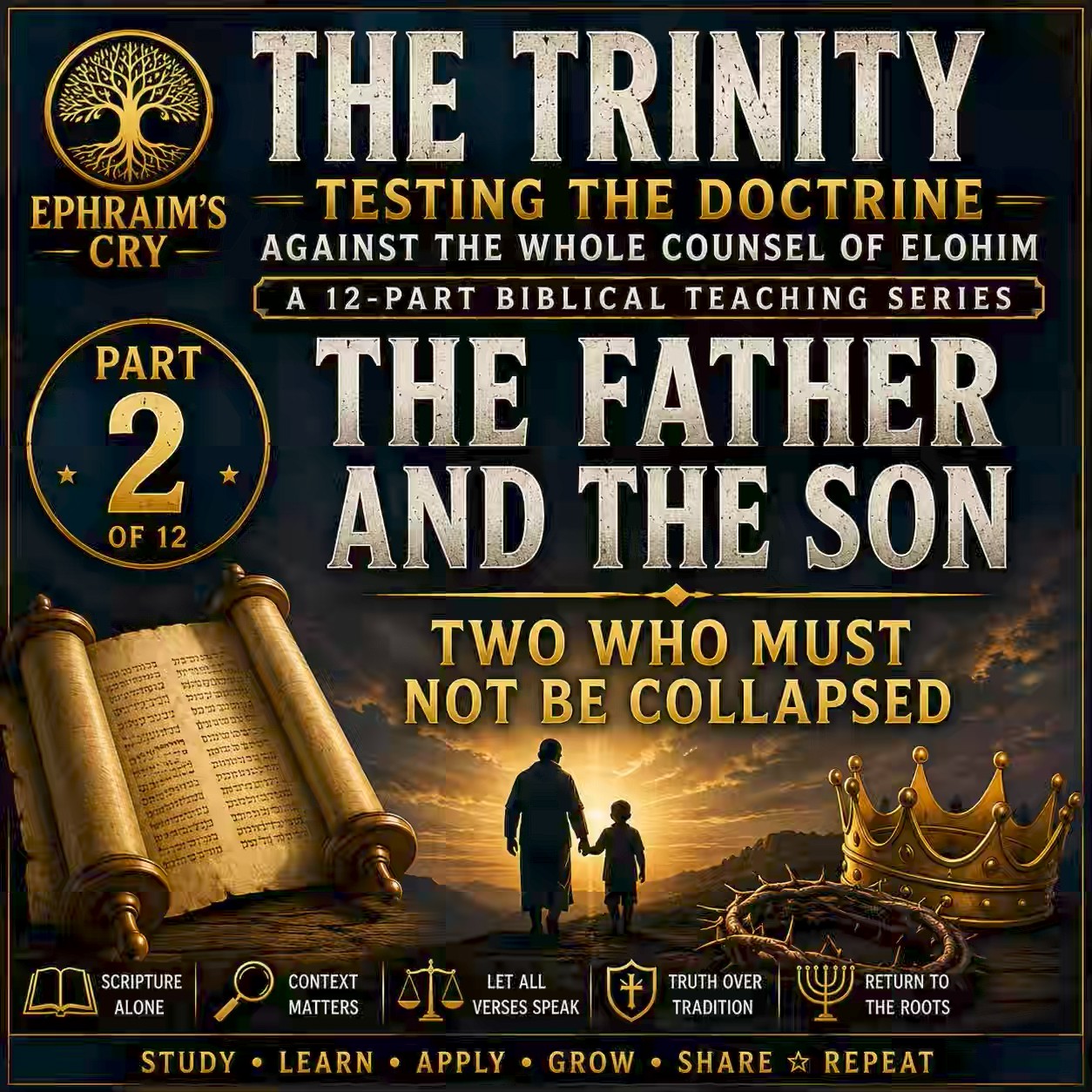
THE TRINITY — TESTING THE DOCTRINE AGAINST THE WHOLE COUNSEL OF ELOHIM
PART 2 — THE FATHER AND THE SON
Two Who Must Not Be Collapsed
Greg Witter | Ephraim’s Cry
Hebraic Mindset Study Series
Study • Learn • Apply • Grow • Share ☆ Repeat
One of the greatest errors in the discussion concerning the Trinity occurs when interpreters refuse to allow the Father and the Son to remain genuinely distinguishable because a theological system has already determined what their relationship must mean.
Part 1 established our foundation: Scripture declares Yahuah is one, identifies Yahuah as Father, and repeatedly distinguishes the Father from Yahusha His Son and Messiah. Now we must follow that distinction through Scripture.
This teaching is NOT an attempt to diminish Yahusha.
Quite the opposite.
We honor Yahusha by allowing him to identify himself rather than forcing him into terminology he never used. We will take seriously everything Scripture says concerning his glory, authority, preexistence, sonship, exaltation, and unique relationship with the Father.
But we will take equally seriously everything Yahusha says concerning THE ONE WHO SENT HIM.
The Father is not the Son.
The Son is not the Father.
And biblical unity does not require collapsing the two.
THE FOUNDATION: FATHER AND SON
Scripture does not merely use two different titles for one individual repeatedly switching roles.
It presents relationship.
Psalm 2:7 declares:
“Yahuah hath said unto me, Thou art my Son.”
There is One speaking and another being addressed.
Psalm 110:1 likewise establishes distinction:
“Yahuah said unto my Lord, Sit thou at my right hand, until I make thine enemies thy footstool.”
Yahusha himself uses this passage concerning Messiah (Matthew 22:41–46).
One speaks.
One receives the invitation.
One sits at the right hand of the Other.
The Hebrew Scriptures therefore already provide the framework later revealed more fully through Yahusha.
THE FATHER SENT THE SON
This is one of the most persistent patterns in the Apostolic Witness.
John 3:16–17 declares that Elohim gave His uniquely begotten Son and “sent not his Son into the world to condemn the world; but that the world through him might be saved.”
John 5:30 records Yahusha saying:
“I seek not mine own will, but the will of THE FATHER WHICH HATH SENT ME.”
John 6:38:
“For I came down from heaven, not to do mine own will, but THE WILL OF HIM THAT SENT ME.”
John 7:16:
“My doctrine is not mine, but HIS THAT SENT ME.”
John 8:42:
“I proceeded forth and came from God; neither came I of myself, but HE SENT ME.”
John 12:49:
“For I have not spoken of myself; but THE FATHER WHICH SENT ME, he gave me a commandment, what I should say, and what I should speak.”
This is not incidental language.
SENDER and SENT ONE occur repeatedly because they reveal something fundamental about the relationship between Father and Son.
THE FATHER SENDS.
THE SON IS SENT.
That distinction cannot simply be erased.
YAHUSHA HAS A WILL
John 6:38 deserves careful attention:
“I came down from heaven, NOT TO DO MINE OWN WILL, but the will of him that sent me.”
Yahusha distinguishes:
MY WILL.
HIS WILL.
That distinction becomes unmistakable at Gethsemane.
“Father, if thou be willing, remove this cup from me: nevertheless NOT MY WILL, BUT THINE, be done” (Luke 22:42).
Two wills are being distinguished.
Yet they are not in sinful rebellion against one another.
Yahusha voluntarily SUBMITS his will to his Father.
That is perfect covenant faithfulness.
The distinction does not destroy unity.
SUBMISSION PRODUCES UNITY.
YAHUSHA PRAYS TO HIS FATHER
This creates an enormous problem for any theology that effectively collapses Father and Son into one individual.
Yahusha repeatedly prays TO someone.
Matthew 26:39:
“O MY FATHER, if it be possible, let this cup pass from me.”
John 11:41–42:
“FATHER, I thank thee that thou hast heard me. And I knew that thou hearest me always.”
John 17 contains an extended prayer from Son to Father.
“Father, the hour is come; glorify thy Son, that thy Son also may glorify thee.”
This is relationship.
The Son addresses the Father.
The Father hears the Son.
The Son asks the Father.
The Father glorifies the Son.
We should not turn this into theological theater.
THE FATHER LOVES THE SON
John 3:35 declares:
“The Father loveth the Son, and hath given all things into his hand.”
John 5:20:
“For the Father loveth the Son, and sheweth him all things that himself doeth.”
Again, relationship.
THE FATHER LOVES.
THE SON IS LOVED.
And notice another recurring word:
GIVEN.
The Father GIVES things to Yahusha.
YAHUSHA RECEIVES AUTHORITY
Matthew 28:18 records the resurrected Yahusha saying:
“All power is GIVEN unto me in heaven and in earth.”
If authority is GIVEN, someone gives it.
Daniel 7:13–14 already showed this prophetically.
The Son of Man approaches the Ancient of Days, and:
“There was GIVEN him dominion, and glory, and a kingdom.”
The Son does not seize authority from the Father.
THE FATHER EXALTS THE SON.
This is why Philippians 2:9 declares:
“Wherefore God also hath HIGHLY EXALTED HIM, and GIVEN HIM a name which is above every name.”
Acts 2:36 likewise declares:
“God hath made that same Jesus, whom ye have crucified, both Lord and Christ.”
The language is unmistakably relational.
Elohim exalts Yahusha.
Elohim gives Yahusha authority.
Elohim appoints Yahusha.
That does not diminish Yahusha.
IT EXPLAINS HIS AUTHORITY.
THE FATHER GIVES LIFE AND JUDGMENT TO THE SON
John 5 is particularly important because it contains extremely exalted statements concerning Yahusha while simultaneously maintaining Father-Son distinction.
John 5:22 says:
“The Father judgeth no man, but hath COMMITTED ALL JUDGMENT UNTO THE SON.”
Why?
“That all men should honour the Son, even as they honour the Father” (John 5:23).
That is extraordinary honor.
We must not weaken it.
But keep reading.
John 5:26:
“For as the Father hath life in himself; so hath he GIVEN TO THE SON to have life in himself.”
Verse 27:
“And hath GIVEN HIM AUTHORITY to execute judgment also.”
Again:
GIVEN.
GIVEN.
GIVEN.
Yahusha possesses extraordinary authority precisely because THE FATHER HAS GIVEN IT TO HIM.
YAHUSHA CAN DO NOTHING OF HIMSELF
John 5:19 records Yahusha saying:
“The Son can do NOTHING OF HIMSELF, but what he seeth the Father do.”
John 5:30:
“I can of mine own self DO NOTHING.”
Those statements must be allowed to speak.
Yahusha is not declaring weakness or failure.
He is declaring perfect dependence, representation, obedience, and unity with the Father.
This prepares us for the Hebraic principle of AGENCY that we will examine in Part 4.
The Son perfectly represents the Sender because he does not act independently of the Sender.
THE SON LEARNS FROM THE FATHER
John 8:28:
“As MY FATHER HATH TAUGHT ME, I speak these things.”
John 12:49:
“The Father which sent me, HE GAVE ME A COMMANDMENT, what I should say, and what I should speak.”
John 15:15:
“All things that I have HEARD OF MY FATHER I have made known unto you.”
Again the pattern remains:
THE FATHER TEACHES.
THE SON RECEIVES.
THE SON SPEAKS WHAT HE RECEIVED.
This is agency, authority, obedience, and relationship.
THE FATHER IS GREATER THAN THE SON
Yahusha says plainly:
“My Father is GREATER THAN I” (John 14:28).
Do not erase that sentence.
Do not explain it away before allowing Yahusha to speak.
The traditional response is often that Yahusha speaks only from his temporarily humbled human condition.
Philippians 2 certainly teaches humiliation.
But that cannot be used as a universal eraser for every Father-Son distinction, because Scripture maintains ordered relationship AFTER Yahusha’s resurrection and even at the consummation of the Kingdom.
AFTER THE RESURRECTION, THE FATHER REMAINS YAHUSHA’S ELOHIM
John 20:17 occurs AFTER Yahusha has risen:
“I ascend unto MY FATHER, and your Father; and to MY GOD, and your God.”
Notice the parallel:
MY FATHER — YOUR FATHER.
MY GOD — YOUR GOD.
The resurrection did not erase the relationship.
Revelation continues it.
The glorified Yahusha repeatedly speaks of:
“MY GOD.”
Revelation 3:12 contains the expression FOUR TIMES.
The exalted Messiah still identifies the Father as his Elohim.
That fact deserves far more attention than theological systems often allow it to receive.
YAHUSHA SITS AT THE FATHER’S RIGHT HAND
Acts 7:55–56 describes Stephen seeing:
“The glory of God, and Jesus standing on the RIGHT HAND OF GOD.”
Hebrews repeatedly presents Yahusha at the Father’s right hand.
Psalm 110 had already foretold it.
This imagery means authority, exaltation, and royal position.
But it simultaneously preserves distinction.
The One seated at the right hand is not the One whose right hand it is.
YAHUSHA HAS AN ELOHIM
Paul writes:
“The God and Father of our Lord Jesus Christ” (Ephesians 1:3).
Again:
“That the God of our Lord Jesus Christ, THE FATHER OF GLORY…” (Ephesians 1:17).
Peter similarly writes:
“Blessed be the God and Father of our Lord Jesus Christ” (1 Peter 1:3).
These statements were written AFTER the resurrection.
They are apostolic theology.
The apostles did not appear troubled by saying Yahusha has an Elohim.
Neither should we be.
ONE ELOHIM, THE FATHER — ONE LORD, YAHUSHA MESSIAH
Paul gives an extraordinarily concise confession in 1 Corinthians 8:6:
“To us there is but ONE GOD, THE FATHER, of whom are all things… and ONE LORD JESUS CHRIST, by whom are all things.”
Do not diminish either side.
ONE ELOHIM — THE FATHER.
ONE LORD — YAHUSHA MESSIAH.
“OF WHOM” identifies ultimate source.
“BY WHOM” identifies agency.
This is not competition between Father and Son.
It is ordered unity.
THE SON WILL ULTIMATELY SUBJECT HIMSELF TO THE FATHER
Perhaps nowhere is this clearer than 1 Corinthians 15:24–28.
Messiah reigns.
Every enemy is defeated.
Everything is placed beneath his feet.
Then Yahusha delivers the Kingdom:
“TO GOD, EVEN THE FATHER.”
Paul then makes an astonishing statement:
“Then shall THE SON ALSO HIMSELF BE SUBJECT unto him that put all things under him, that God may be all in all.”
This is at the consummation.
The Son remains Son.
The Father remains Father.
The Son remains subject to the Father.
And that does NOT dishonor Yahusha.
It reveals perfect order in the Kingdom.
UNITY DOES NOT REQUIRE IDENTITY
This distinction is critical.
Two can be perfectly one without being the same individual.
Yahusha prayed concerning his disciples:
“That they all may be ONE; as thou, Father, art in me, and I in thee, that they also may be ONE IN US” (John 17:21).
If “one” automatically meant “one individual being,” Yahusha would be praying for all believers to become one individual entity.
Obviously that is not what he means.
The context speaks of unity, fellowship, purpose, glory, love, and relationship.
Therefore we must not take statements concerning the Father and Son being “one” and automatically import later metaphysical definitions into them.
John 10:30 deserves careful treatment.
It will receive an entire teaching in Part 6.
DO NOT SWING INTO THE OPPOSITE ERROR
Here is where anti-Trinitarian teaching often becomes equally careless.
Father-Son distinction must NOT become an excuse to reduce Yahusha to merely another prophet or ordinary human messenger.
Scripture will not allow that either.
Yahusha occupies a unique position unlike any ordinary prophet.
He is the uniquely begotten Son.
The Word made flesh.
The image of the invisible Elohim.
The firstborn over creation.
The appointed heir of all things.
The Messiah.
The Son of Man of Daniel 7.
The King.
The High Priest.
The Judge.
The one through whom Elohim created.
The one before whom every knee will bow.
The one through whom Yahuah accomplishes redemption and restoration.
We will examine these passages directly in Part 3.
WE WILL NOT DIMINISH YAHUSHA TO DISPROVE THE TRINITY.
Truth does not need that kind of manipulation.
THE WATCHMAN’S WARNING
When theological systems require us to explain away dozens of straightforward statements from Yahusha, something is wrong.
“My Father.”
“My God.”
“He sent me.”
“He gave me.”
“He taught me.”
“Not my will, but thine.”
“My Father is greater than I.”
“I can of myself do nothing.”
“The Father… hath committed all judgment unto the Son.”
Those are not theological inconveniences.
THEY ARE SCRIPTURE.
And no creed has authority to make them mean their opposites.
Likewise, no reaction against Trinitarianism has authority to erase Yahusha’s extraordinary glory, authority, preexistence, exaltation, and unique relationship with the Father.
LET ALL THE WITNESSES SPEAK.
THE FOUNDATION OF PART 2
The biblical testimony establishes a consistent pattern:
THE FATHER SENDS.
THE SON IS SENT.
THE FATHER COMMANDS.
THE SON OBEYS.
THE FATHER TEACHES.
THE SON RECEIVES.
THE FATHER GIVES.
THE SON RECEIVES.
THE FATHER EXALTS.
THE SON IS EXALTED.
THE FATHER GRANTS AUTHORITY.
THE SON EXERCISES THAT AUTHORITY PERFECTLY.
THE SON PRAYS TO THE FATHER.
THE SON CALLS THE FATHER “MY GOD.”
THE SON ULTIMATELY SUBJECTS HIMSELF TO THE FATHER.
Yet Father and Son operate in extraordinary unity of purpose, authority, love, testimony, and mission.
That is the biblical foundation.
Do not collapse what Scripture distinguishes.
And do not separate what Scripture joins.
THE FATHER IS NOT THE SON.
THE SON IS NOT THE FATHER.
YET THE SON PERFECTLY REVEALS, REPRESENTS, OBEYS, AND CARRIES THE AUTHORITY OF THE FATHER WHO SENT HIM.
Before accepting any theological system, require that system to account honestly for ALL of those witnesses.
Because Scripture—not creed, council, denomination, or reaction against them—is the standard.
NEXT — PART 3
WHO IS YAHUSHA?
Son • Messiah • Word • Image • King
#GregWitter, #EphraimsCry, #EphraimsCryAcademy, #HebraicMindsetStudySeries, #TheTrinitySeries, #TestingTheTrinity,
#HebraicMindset, #HebraicBibleStudy, #BibleStudy, #BibleTeaching, #ScriptureStudy, #StudentsOfScripture,
#DisciplesOfYahusha, #TorahObservant, #RemnantOfIsrael, #WholeCounselOfElohim, #FourWitnesses,
#TheFatherAndTheSon, #Yahuah, #Yahusha, #SonOfElohim, #OneElohim, #BiblicalOneness, #BiblicalAgency,
#FatherAndSon, #TestAllThings, #TruthOverTradition, #ReturnToScripture, #ScriptureInterpretsScripture, #WalkInTruth
