
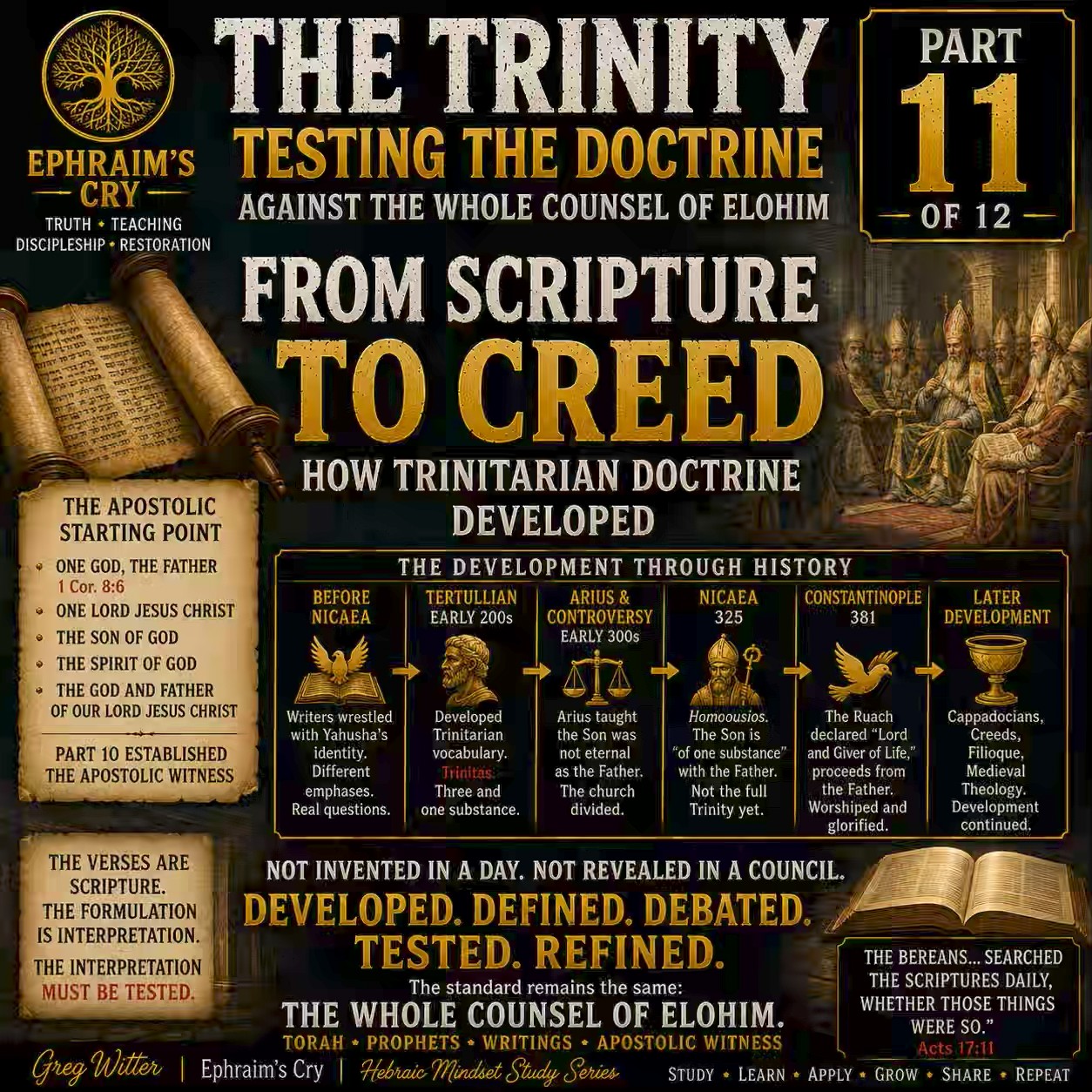
THE TRINITY — TESTING THE DOCTRINE AGAINST THE WHOLE COUNSEL OF ELOHIM
PART 11 — FROM SCRIPTURE TO CREED
How Trinitarian Doctrine Developed
For ten teachings we have deliberately kept the order straight.
Greg Witter | Ephraim’s Cry
Hebraic Mindset Study Series
Study • Learn • Apply • Grow • Share ☆ Repeat
SCRIPTURE FIRST.
THEOLOGICAL FORMULATION SECOND.
We began with Torah, moved through the Prophets and Writings, examined Yahusha’s own words, tested the major Trinitarian proof texts, examined the Hebrew and Greek, and finally asked what Peter, Paul, John, and the earliest assembly actually confessed.
Now we reach the historical question:
IF THE APOSTLES SPOKE PRIMARILY OF “ONE ELOHIM, THE FATHER,” “ONE LORD, YAHUSHA MESSIAH,” “THE SON OF ELOHIM,” AND “THE RUACH OF ELOHIM,” HOW DID CHRISTIAN THEOLOGY ARRIVE AT THE LATER FORMULA OF ONE ESSENCE AND THREE PERSONS?
This part requires accuracy.
We are NOT going to repeat the internet myth that Constantine simply “invented the Trinity” at Nicaea.
HE DID NOT.
We are NOT going to claim nobody before A.D. 325 believed Yahusha possessed divine status.
That is demonstrably false.
And we are NOT going to pretend the complete later Trinitarian formula dropped fully formed from the apostles’ mouths.
History does not support that claim either.
The doctrine developed through centuries of controversy, interpretation, philosophical terminology, councils, creeds, and attempts to define precisely how Father, Son, and Ruach relate.
That historical development must be examined honestly.
THE APOSTOLIC STARTING POINT
Part 10 established the recurring apostolic language:
“ONE GOD, THE FATHER” (1 Corinthians 8:6).
“ONE LORD JESUS CHRIST.”
“THE GOD AND FATHER OF OUR LORD JESUS CHRIST.”
“THE SON OF GOD.”
“THE SPIRIT OF GOD.”
That is our starting point.
The earliest believers were not sitting around discussing Greek technical terms such as:
Οὐσία — OUSIA — essence/substance.
ὑπόστασις — HYPOSTASIS — underlying reality/subsistence/person.
ὁμοούσιος — HOMOOUSIOS — of the same substance.
Those terms became important later because theological controversies forced increasingly precise definitions.
That distinction matters.
THE FIRST CENTURIES WERE NOT THEOLOGICALLY SILENT
We must be fair.
Early believers wrestled intensely with Yahusha’s identity.
How could Scripture declare Yahuah one while simultaneously presenting Yahusha with extraordinary preexistence, authority, glory, creative agency, and honor?
How could Yahusha be genuinely human and yet be the preexistent Word?
How did Father and Son relate?
How should the Ruach be understood?
Those are legitimate questions.
The problem is not that early theologians asked them.
WE ARE ASKING THEM TOO.
The question is whether their eventual answers remained within the boundaries of Scripture or whether philosophical categories gradually became controlling definitions.
BEFORE NICAEA
Long before A.D. 325, Christian writers were already using increasingly developed language concerning Father, Son, and Spirit.
Different schools and teachers emphasized different aspects.
Some strongly distinguished Father and Son.
Some emphasized the preexistence and divinity of the Logos.
Some developed increasingly technical language.
Others produced explanations later judged unacceptable.
The historical landscape was NOT:
“Everybody believed exactly what the apostles taught until Constantine suddenly invented the Trinity.”
That is bad history.
But neither was it:
“The complete Nicene-Constantinopolitan doctrine was universally defined and confessed from the first century onward.”
That is also historically indefensible.
THERE WAS DEVELOPMENT.
TERTULLIAN AND “TRINITAS”
By the early third century, Tertullian was using Latin terminology that became enormously influential, including trinitas—Trinity—and language concerning three and one substance.
That matters because it demonstrates Trinitarian conceptual development before Constantine.
So again:
CONSTANTINE DID NOT INVENT THE TRINITY.
But Tertullian lived roughly two centuries after the apostolic period.
Therefore the existence of increasingly developed terminology in his writings demonstrates precisely what we are examining:
THE MOVEMENT FROM BIBLICAL LANGUAGE TOWARD SYSTEMATIC THEOLOGICAL FORMULATION.
THEN CAME ARIUS
In the early fourth century, controversy erupted dramatically around Arius, a presbyter associated with Alexandria.
Arius argued that the Son was not eternal in the same manner as the Father. In his framework, the Son had a beginning and was subordinate to the Father in being, even though exalted above creation and instrumental in creation.
His opponents believed this fundamentally diminished the Son.
The dispute became enormous.
This was not merely a quiet Bible study disagreement.
Churches divided.
Bishops opposed bishops.
Theological factions formed.
And imperial stability became involved.
CONSTANTINE ENTERS THE STORY
Emperor Constantine had recently emerged as the dominant Roman emperor and wanted religious unity within the empire.
He therefore convened the Council of Nicaea in A.D. 325.
That is historically important.
But Constantine did NOT sit down and personally write the doctrine of the Trinity.
The bishops debated theology.
The controversy centered primarily upon THE RELATIONSHIP BETWEEN THE FATHER AND THE SON.
And this is crucial:
NICAEA 325 DID NOT PRODUCE THE COMPLETE LATER TRINITARIAN FORMULATION CONCERNING THE HOLY SPIRIT.
The original Nicene Creed concludes its positive confession simply:
“And in the Holy Spirit.”
The expanded language concerning the Ruach came later. �
The Nicene Creed +1
THE DECISIVE WORD — HOMOOUSIOS
The great theological word associated with Nicaea was:
ὁμοούσιος — homoousios.
Commonly translated:
“of the same substance,”
“of one substance,”
Or:
“consubstantial.”
The creed declared the Son to be homoousios with the Father.
That word was intended to reject the claim that the Son was merely a creature fundamentally unlike the Father. �
The Nicene Creed
But stop and recognize something extremely important.
Where is homoousios in Scripture?
IT ISN’T.
Where do Peter, Paul, or John define Father and Son using the term homoousios?
NOWHERE.
That does not automatically prove the theological concept false.
But it proves something historically significant:
THE CHURCH WAS NOW USING NON-BIBLICAL TECHNICAL TERMINOLOGY TO DEFINE WHAT BIBLICAL LANGUAGE WAS SUPPOSED TO MEAN.
That is a major transition.
WHY DID THEY DO IT?
Because both sides could quote Scripture.
That is the uncomfortable historical reality.
Arguments concerning Yahusha’s identity could draw upon different biblical texts.
One side emphasized passages concerning Yahusha’s preexistence, creation, glory, and exalted theos-language.
Another emphasized passages concerning his being begotten, sent, receiving authority, obeying, being exalted, and having the Father as his Elohim.
The controversy therefore moved beyond merely quoting verses.
Technical vocabulary was introduced to establish boundaries around acceptable interpretation.
This is where creed increasingly became the interpreter of Scripture.
WHAT NICAEA ACTUALLY SAID
The creed of A.D. 325 begins:
“We believe in one God, the Father Almighty…”
That language itself is worth noticing.
Then it confesses Yahusha Messiah as the Son of Elohim, “God from God,” “Light from Light,” “true God from true God,” “begotten, not made,” and homoousios with the Father. It then briefly states belief in the Holy Spirit. �
The Nicene Creed
So Nicaea’s primary theological battlefield was Father and Son.
The later fully developed three-person formulation was not yet expressed there in the form most Christians now recognize.
NICAEA DID NOT END THE CONTROVERSY
This is another historical fact frequently overlooked.
The Council did not settle everything overnight.
The decades following Nicaea were filled with intense controversy concerning terminology, interpretation, imperial politics, episcopal alliances, exile, restoration, and competing formulas.
Even the meaning and acceptability of homoousios continued to be debated.
The doctrine was still being clarified.
That fact alone should stop people from imagining that every Christian walked out of Nicaea in A.D. 325 carrying the fully developed doctrine later found in systematic theology.
THE PROCESS CONTINUED.
OUSIA AND HYPOSTASIS
As controversy developed, another distinction became increasingly important.
Οὐσία — ousia.
ὑπόστασις — hypostasis.
Eventually these terms became part of the formula:
ONE OUSIA.
THREE HYPOSTASEIS.
Roughly:
ONE ESSENCE.
THREE PERSONS/SUBSISTENCES.
But these terms had histories and semantic ranges of their own. They were not always used consistently by every theologian.
The fourth-century debates involved working out exactly how such terminology should function.
Again:
THIS IS THEOLOGICAL DEVELOPMENT.
THE CAPPADOCIANS
Basil of Caesarea, Gregory of Nazianzus, and Gregory of Nyssa—the Cappadocian Fathers—played an enormous role in stabilizing the terminology distinguishing one divine ousia and three hypostaseis.
Their work helped shape the language that became characteristic of later orthodox Trinitarian theology.
This happened DECADES AFTER NICAEA.
The vocabulary did not simply descend unchanged from the apostles.
It developed through theological controversy.
THEN CAME CONSTANTINOPLE — A.D. 381
The First Council of Constantinople in A.D. 381 reaffirmed the Nicene trajectory and gave much fuller attention to the Holy Spirit.
The creed associated with Constantinople calls the Spirit:
“the Lord and giver of life,”
Says the Spirit proceeds from the Father,
And says the Spirit is worshiped and glorified together with the Father and the Son.
That is considerably more developed than Nicaea’s simple:
“And in the Holy Spirit.” �
Early Church Texts +1
There is therefore a historical progression:
APOSTOLIC WRITINGS.
POST-APOSTOLIC THEOLOGICAL DEBATE.
NICAEA — 325.
FURTHER CONTROVERSY.
CAPPADOCIAN DEVELOPMENT.
CONSTANTINOPLE — 381.
LATER CREEDAL DEVELOPMENT.
That progression is historical fact.
THE RUACH SHOWS THE DEVELOPMENT CLEARLY
This point is particularly revealing.
If the complete later Trinitarian doctrine had already been explicitly and universally formulated at Nicaea, why did the doctrine concerning the Ruach require substantial further clarification?
Because the controversy was still developing.
The 325 creed simply professed belief in the Holy Spirit.
The 381 formulation added substantially stronger language concerning the Spirit’s lordship, life-giving activity, procession, and shared glorification. �
Early Church Texts +1
Whatever one’s theological conclusion, the HISTORICAL DEVELOPMENT cannot honestly be denied.
THE FILIOQUE PROVES DEVELOPMENT CONTINUED
And the story did not stop in 381.
The original Greek Constantinopolitan formulation says the Ruach proceeds:
“FROM THE FATHER.”
Later Western Christianity added:
“AND THE SON” — FILIOQUE.
That addition became one of the great disputes between Eastern and Western Christianity.
Even Catholic documentation acknowledges that the filioque was not present in the Constantinopolitan creed of 381 and entered Western liturgical usage later. �
Vatican
Think about what that means.
Centuries after the apostles, Christianity was STILL debating precisely how Father, Son, and Ruach relate.
That alone should destroy the claim that every detail of later Trinitarian formulation was simply quoted directly from apostolic teaching.
WHAT ABOUT THE ATHANASIAN CREED?
Later Western Christianity produced even more explicit formulations.
The so-called Athanasian Creed describes one Elohim in Trinity and Trinity in unity, distinguishing Father, Son, and Holy Spirit while asserting their shared divinity.
But it is not generally regarded as actually written by Athanasius.
It represents a later stage of Western Trinitarian formulation.
Again:
THE TERMINOLOGY BECOMES INCREASINGLY PRECISE OVER TIME.
SCRIPTURE TO CREED — WATCH THE MOVEMENT
Now compare the language.
SCRIPTURE:
“One God, THE FATHER.”
“The Son of God.”
“The Spirit of God.”
“The Father sent me.”
“My God.”
“The Spirit of your Father.”
NICENE DEVELOPMENT:
Homoousios.
One substance.
True God from true God.
CONSTANTINOPOLITAN DEVELOPMENT:
The Ruach worshiped and glorified with Father and Son.
LATER SYSTEMATIC FORMULATION:
One essence.
Three persons.
Co-equal.
Co-eternal.
Consubstantial.
This is not imaginary.
It is historical development.
DOES DEVELOPMENT AUTOMATICALLY MEAN FALSEHOOD?
NO.
And we need to be intellectually honest enough to say that.
Later terminology can theoretically clarify something already present implicitly in earlier Scripture.
The fact that a theological term does not appear in Scripture does not automatically make the concept false.
The word “monotheism” does not appear in Scripture either, yet Scripture clearly teaches that Yahuah is one.
Therefore the argument cannot simply be:
“Trinity isn’t a biblical word; Therefore Trinity is false.”
That argument is too weak.
The stronger question is:
DOES THE LATER FORMULATION ACCURATELY EXPRESS WHAT SCRIPTURE ACTUALLY TEACHES?
THAT is the test.
WHEN TERMINOLOGY BECOMES DANGEROUS
The danger appears when theological terminology stops serving Scripture and begins GOVERNING Scripture.
If Scripture says:
“The Father is greater than I,”
But the creed requires co-equality, the interpreter must explain what “greater” is allowed to mean.
If Scripture says:
“My God,”
The theological system determines how the Son can have an Elohim while remaining co-equal in essence.
If Scripture says:
“The Son also himself shall be subject,”
The system determines what kind of subjection is permissible.
At that point the interpretive framework can become stronger in practice than the straightforward language of the text.
That is precisely why theological formulations must continually be tested against Scripture.
GREEK PHILOSOPHY — BE CAREFUL WITH THE CLAIM
Another common argument says:
“The Trinity came entirely from Greek pagan philosophy.”
That claim is too simplistic.
The theologians involved believed they were defending Scripture.
They quoted Scripture extensively.
Their disputes concerned genuinely biblical questions.
However, they increasingly expressed those questions using categories and vocabulary belonging to the Greek intellectual environment—especially terms concerning substance, essence, nature, and being.
That influence matters.
But saying:
“Greek philosophical vocabulary influenced the formulation”
Is historically defensible.
Saying:
“Pagan philosophers simply invented the Trinity and Christians copied it”
Is an irresponsible caricature.
WE DO NOT NEED BAD HISTORY TO CHALLENGE BAD THEOLOGY.
CONSTANTINE DID NOT DECIDE THE CANON OR INVENT THE TRINITY
This also needs to be stated because misinformation weakens legitimate criticism.
Constantine did not sit at Nicaea and decide which books belonged in the Bible.
Nicaea was not the council where the biblical canon was created.
And Constantine did not personally invent the doctrine of the Trinity.
His role was enormously important politically because he convened the council and sought ecclesiastical unity.
But theological controversy existed before him.
Trinitarian language existed before him.
Arguments about Yahusha’s divine status existed long before A.D. 325.
If we expose history, WE EXPOSE THE REAL HISTORY.
THE REAL ISSUE IS STRONGER THAN THE MYTH
We do not need Constantine conspiracy theories.
The actual historical question is much more serious:
WHY DID APOSTOLIC LANGUAGE REQUIRE CENTURIES OF PHILOSOPHICAL DEVELOPMENT BEFORE CHRISTIAN ORTHODOXY COULD BE DEFINED AS “ONE ESSENCE IN THREE PERSONS”?
Why does Paul say:
“ONE GOD, THE FATHER,”
While later theology requires:
“ONE GOD, FATHER, SON, AND HOLY SPIRIT”?
Why does Scripture repeatedly say:
“SON OF GOD,”
While later theology requires the category:
“GOD THE SON”?
Why does Scripture say:
“SPIRIT OF GOD,”
While later theology develops:
“GOD THE HOLY SPIRIT”?
Those questions cannot simply be dismissed by shouting “heresy.”
They deserve textual answers.
CREEDS BECAME BOUNDARIES OF ORTHODOXY
This is another major historical transition.
Initially, Scripture and apostolic proclamation established the faith.
As doctrinal controversies multiplied, creeds increasingly functioned as boundaries determining which interpretations were acceptable within institutional Christianity.
Eventually a person could quote Scripture extensively and still be condemned if his interpretation violated the accepted creed.
That represents an enormous shift in authority.
The question became not merely:
“WHAT DOES SCRIPTURE SAY?”
But:
“DOES YOUR INTERPRETATION CONFORM TO THE ESTABLISHED CREED?”
That distinction should concern every serious student of Scripture.
THE BEREAN STANDARD MUST REMAIN
Acts 17:11 praises the Bereans because they:
“searched the scriptures daily, WHETHER THOSE THINGS WERE SO.”
They did not possess the Nicene Creed.
They possessed Scripture.
Therefore every later theological formulation must remain subordinate to the same standard.
Nicaea must be tested.
Constantinople must be tested.
Athanasius must be tested.
Arius must be tested.
Tertullian must be tested.
The Cappadocians must be tested.
Catholicism must be tested.
Orthodoxy must be tested.
Protestantism must be tested.
UNITARIANISM MUST BE TESTED.
OUR OWN CONCLUSIONS MUST BE TESTED.
NO HUMAN SYSTEM GETS A PASS.
THE FOUR WITNESSES REMAIN THE STANDARD
TORAH.
PROPHETS.
WRITINGS.
APOSTOLIC WITNESS.
Those witnesses existed before Nicaea.
They existed before Constantinople.
They existed before medieval scholasticism.
They existed before the Reformation.
They remain our measuring line.
If a doctrine cannot survive the whole counsel of Elohim, its age does not save it.
Its popularity does not save it.
Its institutional authority does not save it.
TRUTH DOES NOT BECOME TRUTH BY MAJORITY VOTE.
WHAT HISTORY ACTUALLY SHOWS
History shows that Trinitarian doctrine was not invented suddenly on one afternoon in A.D. 325.
It developed.
Questions about Yahusha’s identity existed from the earliest generations.
High views of Yahusha existed long before Nicaea.
Trinitarian terminology began developing before Constantine.
Nicaea defined the Son as homoousios with the Father in 325.
Controversy continued for decades.
Theological vocabulary continued developing.
Constantinople expanded the creedal treatment of the Ruach in 381.
Later centuries continued refining Tr initarian terminology and doctrine.
That is the historical record.
And it matters because it demonstrates that what many Christians now receive as a single, fixed, timeless doctrinal formula was actually the result of a LONG PROCESS of theological development.
THE QUESTION IS NOT WHETHER THE PROCESS HAPPENED.
IT DID.
The question is whether the final formulation accurately reflects the whole counsel of Elohim.
DEVELOPMENT VERSUS REVELATION
There is an important distinction between progressive revelation in Scripture and later theological development after the apostolic period.
Scriptural revelation comes through the inspired witnesses.
Later theological development consists of human beings attempting to explain, systematize, reconcile, and defend what those witnesses said.
Those are not the same category.
The prophets can expand upon Torah because they are part of inspired revelation.
The apostles can explain Messiah because they are part of inspired revelation.
But a fourth-century council does not become another inspired witness merely because bishops gathered and voted.
That council may reach a correct conclusion.
It may reach a partially correct conclusion.
It may use helpful terminology.
It may also introduce categories Scripture itself never requires.
Therefore:
REVELATION IS AUTHORITATIVE.
THEOLOGICAL DEVELOPMENT IS TESTABLE.
That distinction must never be surrendered.
THE CREED CANNOT BECOME THE INTERPRETER OF THE TEXT
Once a creed becomes the controlling lens, something dangerous happens.
Instead of asking:
“What does this verse mean?”
the interpreter begins asking:
“How must this verse be understood so that it agrees with the creed?”
That reverses the proper order.
If John 17:3 says the Father is “the only true God,” then Scripture must be allowed to speak before a theological system tells us how “only” must be qualified.
If Yahusha says:
“My Father is greater than I,”
that statement deserves its full weight before later categories explain the difference between functional and ontological equality.
If Paul says:
“The head of Christ is God,”
that witness must stand.
If Yahusha says:
“My God,”
that witness must stand.
If Paul says:
“The Son also himself shall be subject,”
that witness must stand.
Theological explanations may be offered.
But they must not erase the force of the text they claim to explain.
THIS IS WHERE THE WATCHMAN MUST SOUND THE WARNING
Tradition becomes dangerous when it becomes untouchable.
Once questioning a theological formulation is treated as rebellion against Elohim, the formulation has effectively become another authority alongside Scripture.
That is exactly what Yahusha warned about when human tradition nullifies the Word of Elohim.
The issue is not whether tradition is old.
The issue is whether tradition is TRUE.
Error does not become truth merely because it survives sixteen centuries.
And truth does not become error merely because an institution labels it heresy.
THE STANDARD REMAINS THE WORD.
THE EARLY COUNCILS WERE HUMAN COUNCILS
This should be obvious, but it needs to be said.
The bishops at Nicaea were men.
The bishops at Constantinople were men.
Athanasius was a man.
Arius was a man.
Basil was a man.
Gregory was a man.
Tertullian was a man.
They were not apostles.
They were not prophets.
They were not writing inspired Scripture.
Their arguments must therefore be judged like every other theological argument.
By Scripture.
No council possesses the authority to redefine Yahuah.
No council possesses the authority to redefine Yahusha.
No council possesses the authority to redefine the Ruach ha’Qodesh.
If their formulation is correct, Scripture will support it.
If Scripture does not support it, institutional authority cannot rescue it.
“ORTHODOX” DOES NOT AUTOMATICALLY MEAN “BIBLICAL”
The word orthodox simply means something like “right belief” or “right teaching.”
But who determines what counts as right?
If Scripture determines it, good.
If ecclesiastical tradition determines it independently of Scripture, there is a problem.
History repeatedly demonstrates that institutions can preserve truth in one area while protecting error in another.
Therefore “historic orthodoxy” is not itself proof.
The question remains:
IS IT SCRIPTURAL?
WHAT ABOUT THE EARLY CHURCH FATHERS?
The so-called Church Fathers can be historically useful.
They show us what particular teachers believed at particular points in history.
They help trace doctrinal development.
They preserve debates and interpretations.
They can provide valuable historical witnesses.
But they are NOT another inspired canon.
We do not settle doctrine by counting how many early writers believed something.
Majority opinion is not revelation.
Historical proximity to the apostles does not automatically equal apostolic authority.
The Berean test still applies.
WHY THIS HISTORY MATTERS
This is not merely academic.
Millions of believers have been taught that questioning the Trinity means rejecting Yahusha, denying Elohim, or abandoning the faith.
But history demonstrates that the exact later formula took centuries to define.
That fact alone should create humility.
If believers in the second and third centuries were still debating terminology and relationship, then modern believers should not pretend that every phrase of later systematic Trinitarian theology is a direct quotation from the apostles.
It is not.
WHAT WE SHOULD BE ABLE TO SAY WITHOUT FEAR
We should be able to say:
YAHUAH IS ONE.
THE FATHER IS ELOHIM.
YAHUSHA IS HIS SON.
YAHUSHA IS THE MESSIAH.
YAHUSHA PREEXISTED.
THE WORD WAS WITH ELOHIM.
THE WORD WAS THEOS.
THE WORD BECAME FLESH.
ALL THINGS CAME THROUGH YAHUSHA.
YAHUSHA IS THE IMAGE OF THE INVISIBLE ELOHIM.
YAHUSHA WAS SENT BY THE FATHER.
YAHUSHA RECEIVED AUTHORITY FROM THE FATHER.
YAHUSHA WAS EXALTED BY THE FATHER.
YAHUSHA CALLS THE FATHER “MY GOD.”
THE RUACH IS THE SPIRIT OF YAHUAH.
THE RUACH SPEAKS, TEACHES, GUIDES, INTERCEDES, FILLS, EMPOWERS, AND CAN BE GRIEVED.
THE RUACH PROCEEDS FROM THE FATHER.
THE FATHER, SON, AND RUACH ARE ALL PRESENT IN THE APOSTOLIC WITNESS.
We can confess ALL OF THAT.
What we must not do is assume that because those statements are true, one particular later philosophical synthesis is therefore automatically proven.
THE SYNTHESIS MUST STILL BE TESTED.
THE REAL HISTORICAL CONCLUSION
The Trinity was not invented in one moment.
It developed through centuries.
Pre-Nicene writers contributed important concepts.
Tertullian helped develop Latin Trinitarian vocabulary.
Arius triggered a major fourth-century crisis.
Nicaea in A.D. 325 defined the Son as homoousios with the Father.
The controversy continued.
The Cappadocians helped refine one ousia and three hypostaseis.
Constantinople in A.D. 381 expanded the doctrine concerning the Ruach.
Later Western Christianity added the filioque.
Further creeds and systematic theology continued refining the doctrine.
That is the history.
Not conspiracy.
Not myth.
DEVELOPMENT.
THE WATCHMAN’S WARNING
Here is the danger:
Once developed theology becomes sacred tradition, people stop testing it.
They inherit it.
Repeat it.
Defend it.
And often attack anyone who asks whether the apostles themselves ever taught it in those terms.
That is backwards.
We should never fear examination.
TRUTH SURVIVES EXAMINATION.
If “one essence in three persons” is the best biblical explanation, it should survive the whole counsel of Elohim.
If it cannot survive the whole counsel, age and popularity cannot save it.
And if another explanation better accounts for ALL the witnesses without forcing Scripture into later philosophical categories, then that explanation deserves consideration.
THE FOUNDATION OF PART 11
What did we establish?
THE TRINITY WAS NOT INVENTED BY CONSTANTINE.
NICAEA DID NOT CREATE THE BIBLE.
NICAEA DID NOT FULLY DEFINE THE LATER DOCTRINE OF THE RUACH.
TRINITARIAN THOUGHT EXISTED BEFORE A.D. 325.
BUT THE FULL LATER FORMULATION DEVELOPED OVER CENTURIES.
HOMOOUSIOS IS NOT A BIBLICAL TERM.
OUSIA AND HYPOSTASIS BECAME TECHNICAL THEOLOGICAL TERMS.
CONSTANTINOPLE EXPANDED THE CREEDAL DOCTRINE OF THE RUACH.
THE FILIOQUE SHOWS THAT DEVELOPMENT CONTINUED.
CREEDS BECAME BOUNDARIES OF ORTHODOXY.
AND LATER THEOLOGY INCREASINGLY INTERPRETED SCRIPTURE THROUGH THE CREEDAL FRAMEWORK.
That is what history actually shows.
THE DECISIVE QUESTION
So after eleven teachings, we are now ready for the final task.
Not merely:
WHAT IS WRONG WITH TRINITARIANISM?
But:
WHAT DOES SCRIPTURE POSITIVELY REQUIRE US TO CONFESS?
Who is Yahuah?
Who is Yahusha?
What is the relationship between Father and Son?
Who or what is the Ruach ha’Qodesh according to Scripture?
How do we preserve Yahusha’s preexistence, glory, authority, and exaltation without collapsing him into the Father?
How do we preserve the oneness of Yahuah without diminishing the Son?
How do we speak where Scripture speaks and remain silent where Scripture does not define?
That is where this series must end.
Not with merely tearing something down.
But with BUILDING THE BIBLICAL CONFESSION.
NEXT — PART 12
THE BIBLICAL CONFESSION
The Father, His Son, and His Ruach
No creed first.
No denomination first.
No reactionary theology first.
TORAH.
PROPHETS.
WRITINGS.
APOSTOLIC WITNESS.
THE WHOLE COUNSEL OF ELOHIM.
Then we will state plainly what the Scriptures require us to believe—and equally plainly what they do not require us to confess merely because later religious institutions declared it orthodox.
#GregWitter, #EphraimsCry, #EphraimsCryAcademy, #HebraicMindsetStudySeries, #TheTrinitySeries,
#TestingTheTrinity, #HebraicMindset, #HebraicBibleStudy, #BibleStudy, #BibleTeaching, #ScriptureStudy,
#StudentsOfScripture, #DisciplesOfYahusha, #TorahObservant, #RemnantOfIsrael, #WholeCounselOfElohim,
#FourWitnesses, #FromScriptureToCreed, #TrinityHistory, #CouncilOfNicaea, #CouncilOfConstantinople,
#Homoousios, #Ousia, #Hypostasis, #Yahuah, #Yahusha, #RuachHaQodesh, #TestAllThings,
#TruthOverTradition, #ReturnToScripture
