
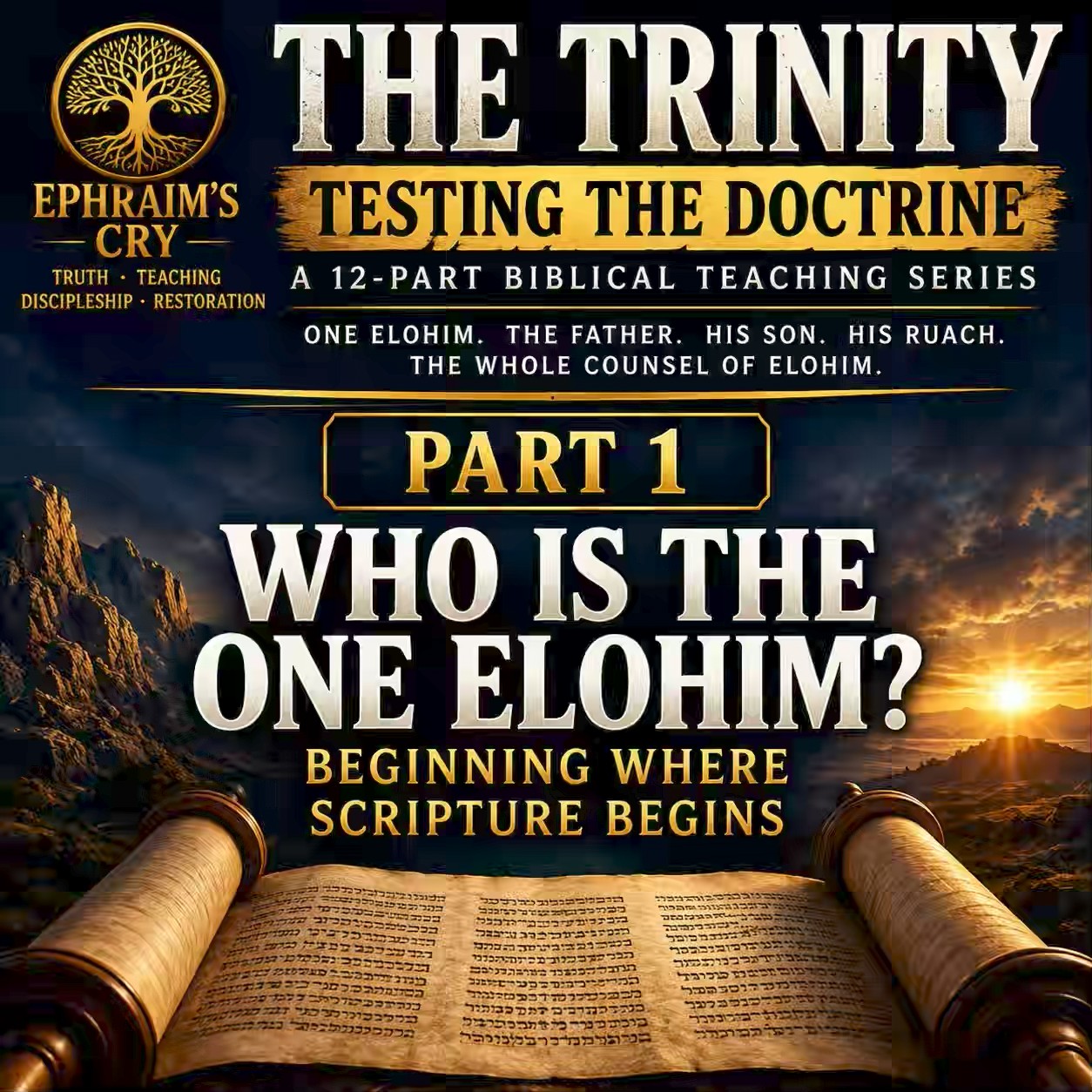
THE TRINITY — TESTING THE DOCTRINE AGAINST THE WHOLE COUNSEL OF ELOHIM
PART 1 — WHO IS THE ONE ELOHIM?
Greg Witter | Ephraim’s Cry
Hebraic Mindset Study Series
Study • Learn • Apply • Grow • Share ☆ Repeat
Beginning Where Scripture Begins
Before discussing “three persons,” “one essence,” “co-equal,” “co-eternal,” “God the Son,” or any other theological formulation, we must establish the foundation Scripture itself establishes: WHO DOES SCRIPTURE IDENTIFY AS THE ONE ELOHIM?
We are not beginning at Nicaea. We are not beginning with Constantinople. We are not beginning with Catholicism, Protestantism, Evangelicalism, Unitarianism, Oneness theology, or modern Hebrew Roots arguments. We begin where Scripture begins—with Yahuah, the Elohim of Abraham, Isaac, and Jacob.
That order matters. If we begin with a theological conclusion and then search Scripture for verses to support it, we have already reversed proper biblical interpretation. Scripture must establish the doctrine; doctrine must never become the lens that controls what Scripture is permitted to say.
THE TORAH ESTABLISHES THE FOUNDATION
Deuteronomy 6:4 declares:
“Hear, O Israel: Yahuah our Elohim is one Yahuah.”
שְׁמַע יִשְׂרָאֵל יְהוָה אֱלֹהֵינוּ יְהוָה אֶחָד
Shema Yisra’el, YHWH Eloheinu, YHWH echad.
This is not an obscure theological statement. It stands at the heart of Israel’s confession concerning Elohim.
YAHUAH IS OUR ELOHIM.
YAHUAH IS ONE.
Immediately afterward Israel is commanded to love Yahuah with all the heart, soul, and strength (Deuteronomy 6:5). Nothing in the passage explains “one” as “three persons sharing one divine essence.” That later philosophical formulation cannot simply be inserted into the Hebrew word אֶחָד — echad.
Echad means ONE. Context determines how that oneness functions. Yes, Scripture can use echad concerning a collective unity, such as “one flesh” in Genesis 2:24. But that does NOT mean echad itself means “compound unity,” much less “three persons in one being.” The same word is used throughout Scripture for straightforward numerical one.
Therefore, pointing to echad and announcing “Trinity!” proves nothing.
The Shema tells us Yahuah is one. We must allow the rest of Scripture to tell us how Father, Son, and Ruach relate to that declaration rather than forcing later theology backward into Moses.
YAHUAH ALONE IS ELOHIM
Deuteronomy intensifies the declaration:
“Unto thee it was shewed, that thou mightest know that Yahuah he is Elohim; there is none else beside him” (Deuteronomy 4:35).
Again:
“Know therefore this day, and consider it in thine heart, that Yahuah he is Elohim in heaven above, and upon the earth beneath: there is none else” (Deuteronomy 4:39).
And Deuteronomy 32:39:
“See now that I, even I, am he, and there is no elohim with me.”
This establishes the boundary within which every later passage must be understood.
The Prophets do not abandon it.
Isaiah 45:5 declares:
“I am Yahuah, and there is none else, there is no Elohim beside me.”
Isaiah 45:6:
“I am Yahuah, and there is none else.”
Isaiah 45:18:
“I am Yahuah; and there is none else.”
This is the consistent testimony of Scripture.
WHO IS THE FATHER?
Now we reach a distinction that later theological systems frequently blur.
Scripture explicitly identifies Yahuah as Father.
Isaiah 63:16 declares:
“Doubtless thou art our father… thou, O Yahuah, art our father, our redeemer; thy name is from everlasting.”
Isaiah 64:8 says:
“But now, O Yahuah, thou art our father; we are the clay, and thou our potter.”
Malachi 2:10 asks:
“Have we not all one father? hath not one God created us?”
The Apostolic Witness continues this identification rather than overturning it.
Yahusha repeatedly speaks of “MY FATHER.”
He prays TO the Father.
He is SENT BY the Father.
He obeys the Father.
He receives commandments FROM the Father.
He receives authority FROM the Father.
He returns TO the Father.
And after his resurrection he says:
“I ascend unto MY FATHER, and your Father; and to MY GOD, and your God” (John 20:17).
Those words cannot simply be erased.
Yahusha has an Elohim.
And he explicitly identifies that Elohim as HIS FATHER.
PAUL MAKES THE IDENTIFICATION EXPLICIT
First Corinthians 8:6 is foundational:
“But to us there is but ONE GOD, THE FATHER, of whom are all things, and we in him; and ONE LORD JESUS CHRIST, by whom are all things, and we by him.”
Notice Paul’s language carefully.
ONE GOD — THE FATHER.
ONE LORD — YAHUSHA MESSIAH.
Paul does not confuse them.
Yet neither does Paul diminish Yahusha.
The Father is the source—“OF WHOM are all things.”
Yahusha is the appointed agent—“BY WHOM are all things.”
That distinction is enormously important and will become central when we examine the Hebraic principle of agency later in this series.
The Sender and the Sent One can operate in perfect unity without becoming the same individual.
YAHUSHA HIMSELF IDENTIFIES THE FATHER
John 17:1–3 should be allowed to speak without theological interference.
Yahusha lifts his eyes toward heaven and says:
“Father… this is life eternal, that they might know THEE THE ONLY TRUE GOD, and Jesus Christ, whom thou hast sent.”
Who is Yahusha addressing?
THE FATHER.
Whom does Yahusha call “the only true God”?
THE FATHER.
Who is Yahusha?
THE ONE WHOM THE FATHER SENT.
Again we have distinction without diminishing Messiah.
Father — Sender.
Son — Sent.
That pattern occurs repeatedly throughout John.
“My doctrine is not mine, but his that sent me” (John 7:16).
“I do nothing of myself” (John 8:28).
“I proceeded forth and came from God; neither came I of myself, but he sent me” (John 8:42).
“The Father is greater than I” (John 14:28).
These are not embarrassing verses that must somehow be explained away to protect theology.
THEY ARE THEOLOGY.
DOES THIS DIMINISH YAHUSHA?
Absolutely not.
And this series will not make that mistake.
Rejecting an imposed theological formulation does not authorize us to reduce Yahusha to an ordinary man.
Scripture identifies Yahusha as the promised Messiah, Son of Elohim, Word made flesh, image of the invisible Elohim, firstborn over creation, appointed heir of all things, the one through whom Elohim worked in creation, King of kings, High Priest, Judge of the living and dead, and the one to whom extraordinary authority and honor have been GIVEN.
Philippians 2:9 says:
“Wherefore God also hath highly exalted him, and GIVEN him a name which is above every name.”
Matthew 28:18 records Yahusha declaring:
“ALL POWER IS GIVEN UNTO ME in heaven and in earth.”
Given by whom?
THE FATHER.
Daniel 7 already provides the prophetic pattern. The Son of Man approaches the Ancient of Days and RECEIVES dominion, glory, and a kingdom.
The One receiving authority is distinguishable from the One giving it.
That is not an attack upon Yahusha.
THAT IS HIS EXALTATION.
THE FINAL KINGDOM CONFIRMS THE ORDER
First Corinthians 15:24–28 is devastating to any theology that refuses to allow the Father and Son to remain genuinely distinguishable.
Paul describes Messiah reigning until all enemies are placed beneath his feet. Then comes the end, when Messiah delivers the Kingdom “TO GOD, EVEN THE FATHER.”
Then Paul says:
“When all things shall be subdued unto him, THEN SHALL THE SON ALSO HIMSELF BE SUBJECT unto him that put all things under him, that God may be all in all.”
Notice when this occurs.
Not merely during Yahusha’s earthly humiliation.
Not merely before Calvary.
This concerns the consummation of Messiah’s reign.
THE SON HIMSELF remains subject to the One who subjected everything to him.
Again:
Father and Son.
Giver and receiver.
Sender and sent.
One granting authority and One exercising granted authority.
We do not honor Yahusha by erasing those distinctions. We honor him by believing what Scripture actually says about him.
WHAT ABOUT THE RUACH HA’QODESH?
We are not ignoring the Ruach.
We are refusing to define the Ruach prematurely.
Scripture speaks extensively of the Ruach Elohim, Ruach Yahuah, Spirit of the Father, and Spirit associated with Messiah. Scripture describes the Ruach speaking, teaching, guiding, empowering, filling, dwelling, revealing, and being grieved.
Those passages deserve serious examination.
They will receive it.
But we will not begin with the fourth-century conclusion “third co-equal person of the Trinity” and then force every Ruach passage into that definition.
Neither will we simply declare the Ruach an impersonal force and force every passage into THAT conclusion.
THE TEXT WILL DETERMINE THE DOCTRINE.
THE FIRST MAJOR ERROR WE MUST AVOID
The debate is commonly framed falsely:
Either accept the traditional Trinity exactly as later Christianity formulated it, OR deny the glory, authority, preexistence, and exalted identity of Yahusha.
That is a false choice.
There is another option:
BELIEVE EVERYTHING SCRIPTURE SAYS.
When Scripture says Yahuah is one—believe it.
When Scripture identifies the Father as the one Elohim—believe it.
When Scripture calls Yahusha the Son of Elohim—believe it.
When Scripture presents Yahusha with extraordinary divine authority—believe it.
When Yahusha says the Father sent him—believe it.
When Yahusha says the Father is greater—believe it.
When Scripture says all things came through Yahusha—believe it.
When Yahusha calls the Father “my God”—believe it.
When Paul says the Son will ultimately subject himself to the Father—BELIEVE THAT TOO.
We do not get to discard half the witnesses to protect a theological system.
THE WATCHMAN’S WARNING
The danger begins whenever theology becomes more authoritative than Scripture.
If a creed determines beforehand what “Father,” “Son,” “one,” “sent,” “given,” “subject,” “God,” and “Lord” are allowed to mean, Scripture is no longer functioning as the standard.
The creed is.
And replacing Scripture’s authority with religious tradition is precisely the kind of error Yahusha repeatedly confronted.
We therefore begin this series with a line drawn firmly in the ground:
WE WILL NOT FORCE SCRIPTURE TO DEFEND TRINITARIANISM.
WE WILL NOT FORCE SCRIPTURE TO DEFEND UNITARIANISM.
WE WILL NOT FORCE SCRIPTURE TO DEFEND ONENESS.
WE WILL NOT FORCE SCRIPTURE TO DEFEND ANY DENOMINATIONAL SYSTEM.
We will follow the witnesses wherever they lead.
THE FOUNDATION OF PART 1
Torah declares:
YAHUAH IS ONE.
The Prophets declare:
YAHUAH ALONE IS ELOHIM.
The Writings consistently worship and exalt Yahuah.
The Apostolic Witness identifies:
ONE ELOHIM — THE FATHER.
And it identifies:
YAHUSHA — HIS SON, HIS MESSIAH, HIS SENT ONE, HIS IMAGE, HIS APPOINTED KING, AND THE ONE THROUGH WHOM HE ACCOMPLISHES HIS PURPOSE.
That is where we begin.
Before asking whether Elohim is “three persons in one essence,” first allow Scripture to answer the more fundamental question:
WHO IS THE ONE ELOHIM?
According to Yahusha himself:
“FATHER… THAT THEY MIGHT KNOW THEE THE ONLY TRUE GOD, AND JESUS CHRIST, WHOM THOU HAST SENT.”
— John 17:1–3
That distinction will become increasingly important as we move forward.
Because in Part 2 we will examine something Scripture establishes from beginning to end:
THE FATHER AND THE SON — TWO WHO MUST NOT BE COLLAPSED.
#GregWitter #EphraimsCry #EphraimsCryAcademy #HebraicMindsetStudySeries #TheTrinitySeries #TestingTheTrinity
#HebraicMindset #HebraicBibleStudy #BibleStudy #BibleTeaching #ScriptureStudy #StudentsOfScripture #DisciplesOfYahusha
#TorahObservant #RemnantOfIsrael #WholeCounselOfElohim #FourWitnesses #TorahProphetsWritingsApostolicWitness
#WhoIsTheOneElohim #YahuahIsOne #Yahuah #Yahusha #RuachHaQodesh #TheFatherAndTheSon #OneElohim
#SonOfElohim #ShemaYisrael #BiblicalOneness #TestAllThings #TruthOverTradition #ReturnToScripture
