
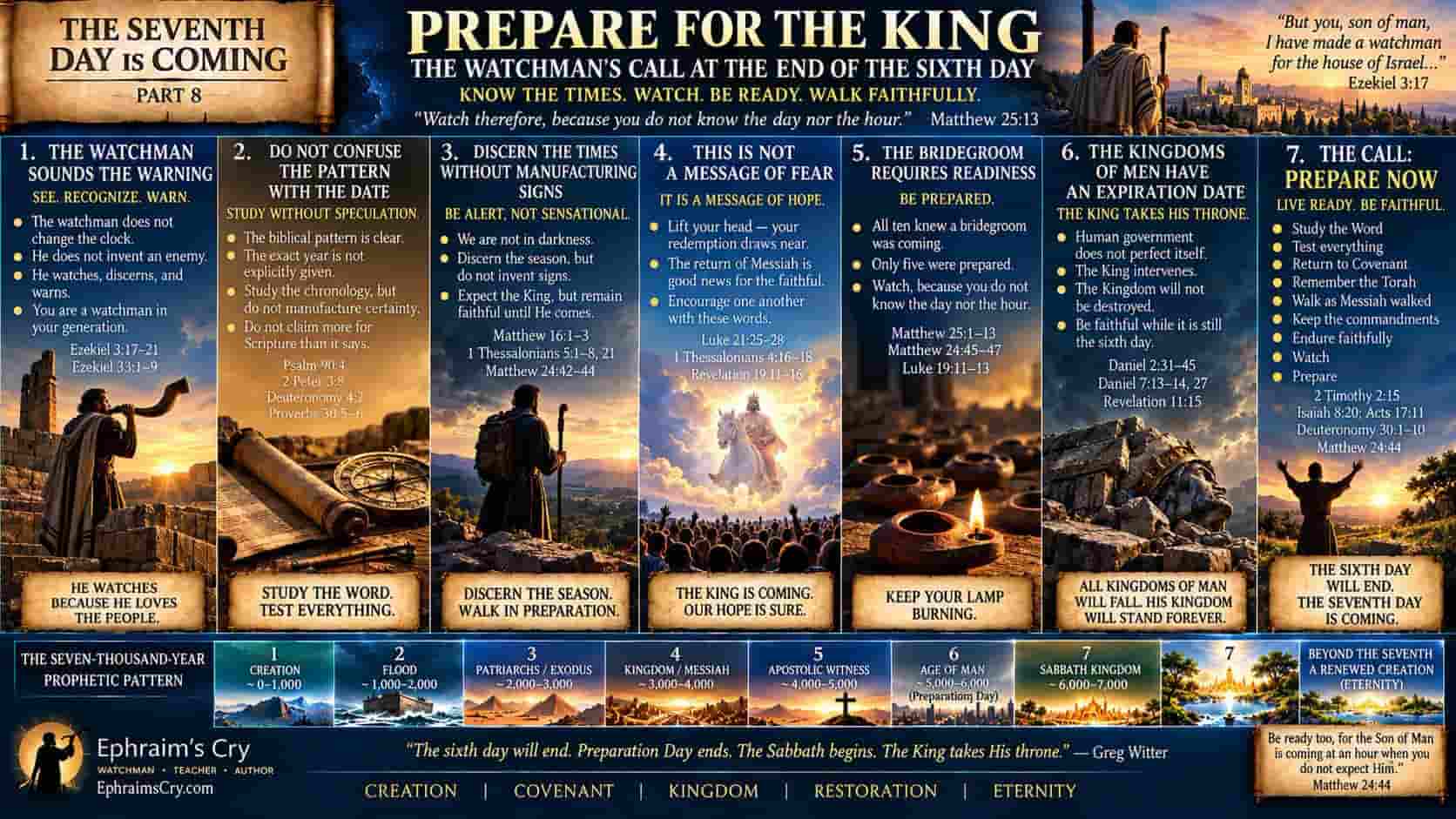
THE SEVENTH DAY IS COMING
Part 8 — Prepare for the King: The Watchman’s Call at the End of the Sixth Day
We have followed the pattern from Creation to the Sabbath Kingdom and beyond.
Six days of Creation followed by the seventh-day rest (Genesis 1:1–2:3).
Six days of labor followed by the weekly Sabbath (Exodus 20:8–11).
A day compared with a thousand years (Psalm 90:4; 2 Peter 3:8).
Approximately six thousand years of human history followed, within the prophetic pattern we have examined, by the thousand-year reign of Messiah (Revelation 20:1–6).
Then, after the Millennium, Satan’s final rebellion, final judgment, renewed Creation, the Tree of Life, and the dwelling of Elohim with mankind (Revelation 20:7–22:5).
The pattern is extraordinary.
But if all we do is understand the pattern, construct a timeline, and debate chronology, we have missed the point.
Prophecy demands a response.
The question is not merely:
“Where are we on the clock?”
The greater question is:
“What should we be doing while the clock is still moving?”
THE WATCHMAN DOES NOT CHANGE THE CLOCK
Yahuah gives Yehezqel the responsibility of a watchman.
The watchman sees danger approaching and sounds the warning (Ezekiel 3:17–21; 33:1–9).
Notice what the watchman does not do.
He does not invent an enemy that is not approaching.
He does not sound the trumpet merely because silence makes him uncomfortable.
He does not move the hands of the clock because he wants the event to arrive sooner.
He watches.
He recognizes.
He warns.
That principle should govern prophetic teaching.
If Scripture says Satan’s little season comes after the thousand-year Kingdom, we cannot move it before the Millennium (Revelation 20:1–10).
If Scripture places the resurrection in connection with Messiah’s coming, we cannot simply relocate it into an undocumented past (1 Corinthians 15:22–23, 51–52; 1 Thessalonians 4:15–17).
If Messiah’s return is visible, powerful, and accompanied by the gathering of His elect, we cannot redefine it into an invisible event that the world somehow failed to notice (Matthew 24:27, 29–31; Acts 1:9–11; Revelation 1:7).
The watchman must submit to the sequence.
DO NOT CONFUSE THE PATTERN WITH THE DATE
This distinction must remain firmly in place.
The seven-day Creation week is explicit (Genesis 1:1–2:3).
The seventh-day Sabbath is explicit (Exodus 20:8–11; Leviticus 23:3).
The comparison between a day and a thousand years is explicit (Psalm 90:4; 2 Peter 3:8).
The thousand-year reign of Messiah is explicit (Revelation 20:1–6).
Satan’s release after those thousand years is explicit (Revelation 20:7–10).
The final judgment is explicit (Revelation 20:11–15).
The renewed heaven and renewed earth are explicit (Revelation 21:1–5).
The correspondence of the six Creation days with approximately six thousand years of human history followed by a seventh-millennium Sabbath Kingdom is the prophetic pattern produced by bringing those passages together.
That distinction matters.
A faithful teacher must be willing to say:
“The text says this.”
And when necessary:
“This is the pattern I believe the text establishes.”
Those are not always the same statement.
We do not strengthen Scripture by claiming more for a passage than the passage actually says (Deuteronomy 4:2; 12:32; Proverbs 30:5–6).
CHRONOLOGY STILL MATTERS
Caution does not mean chronology should be abandoned.
The genealogies are there for a reason (Genesis 5:1–32; 11:10–32).
Scripture records ages, generations, reigns, captivities, Sabbaths, appointed times, and historical markers because Yahuah acts within history (Genesis 7:6, 11; Exodus 12:40–41; 1 Kings 6:1; Jeremiah 25:11–12; Luke 3:1–2).
The coming of Yahusha itself is presented as occurring at an appointed historical moment.
Sha’ul writes:
“But when the completion of the time came, Elohim sent forth His Son.” (Galatians 4:4).
Yahusha begins proclaiming:
“The time has been filled, and the reign of Elohim has come near.” (Mark 1:15).
Yahuah works according to appointed times.
The problem is not chronology.
The problem begins when chronology becomes speculation masquerading as revelation.
Study the years.
Compare the genealogies.
Examine the historical synchronisms.
Test the calendars.
But do not manufacture certainty.
WHAT ABOUT THE EXACT YEAR?
If the prophetic week represents seven thousand years, when exactly did the first year begin?
That question is more difficult than many prophecy charts admit.
Genesis gives detailed genealogical information from Adam through Noach and from Shem toward Abram (Genesis 5:1–32; 11:10–32).
Those passages make chronological reconstruction possible.
But textual traditions contain numerical differences within these genealogies. Chronologies based upon the Masoretic Text therefore do not produce the same Creation date as chronologies based upon the Septuagint or Samaritan Pentateuch.
There are additional questions involving the patriarchal chronology, the period in Mitsrayim, the judges, regnal-year systems, possible overlapping reigns, captivity periods, and synchronization with external historical records (Exodus 12:40–41; Judges 11:26; 1 Kings 6:1; Jeremiah 25:11–12; Acts 13:18–21).
That matters enormously if someone attempts to declare the exact Gregorian year in which six thousand years expire.
Therefore:
“The seven-thousand-year pattern is biblically compelling”
is not the same statement as:
“I can prove the exact Gregorian year when the six-thousandth year ends.”
We should not confuse them.
BUT THE PATTERN STILL SPEAKS
Chronological uncertainty does not erase biblical architecture.
The Sabbath still proclaims:
Six—and then seven (Genesis 2:1–3; Exodus 20:8–11).
Sukkot still gives us:
Seven days—and then the eighth-day assembly (Leviticus 23:33–36, 39).
Revelation still gives us:
One thousand years—and then what follows (Revelation 20:1–21:5).
The pattern does not depend upon our ability to calculate every chronological detail perfectly.
It depends upon what Yahuah established.
DISCERN THE TIMES WITHOUT MANUFACTURING SIGNS
Yahusha commands His servants to watch because they do not know the precise time of His coming (Matthew 24:36, 42–44; Mark 13:32–37).
But not knowing the exact hour does not mean remaining ignorant of the season.
Yahusha rebukes those capable of interpreting the appearance of the sky while failing to discern the signs of the times (Matthew 16:1–3).
Sha’ul tells the brethren that they are not in darkness so that the Day should overtake them like a thief. They are children of light and therefore should remain awake and sober (1 Thessalonians 5:1–8).
There is a balance here that the watchman must maintain.
Watch carefully—but refuse sensationalism.
Discern the times, but do not manufacture signs.
Study chronology, but do not invent dates.
Recognize prophetic patterns, but do not turn patterns into declarations Scripture never made.
Expect the King, but continue faithfully doing the work assigned to you until He comes (Matthew 24:45–47; Luke 19:11–13).
THIS IS NOT A MESSAGE OF FEAR
Prophecy was never given merely to frighten the people of Yahuah.
Yahusha tells His disciples that when the things He described begin occurring, they should look up and lift their heads because their redemption draws near (Luke 21:25–28).
Sha’ul describes Messiah descending from heaven, the dead in Messiah rising, and the living being gathered together with them. He then says:
“So, then, encourage one another with these words.” (1 Thessalonians 4:16–18).
The return of Messiah is not bad news for the faithful.
It is the arrival of the King (Matthew 24:29–31; Revelation 19:11–16).
It is the resurrection of the dead (Daniel 12:2–3; 1 Corinthians 15:51–54).
It is the gathering of His people (Matthew 24:31; 1 Thessalonians 4:16–17).
It is the establishment of righteous government (Isaiah 9:6–7; Daniel 7:13–14, 27).
It is the beginning of the thousand-year reign of Messiah and His saints (Revelation 20:4–6).
The warning belongs to rebellion.
The hope belongs to those faithfully waiting for Him (Isaiah 25:8–9; Hebrews 9:28).
THE BRIDEGROOM REQUIRES READINESS
Yahusha’s parable of the ten virgins brings the issue directly to us (Matthew 25:1–13).
All ten knew a bridegroom was coming.
All ten had lamps.
All ten went out expecting him.
All ten became drowsy.
All ten heard the announcement.
But only five were prepared when the moment arrived (Matthew 25:1–10).
The distinction was not whether they believed a bridegroom existed.
The distinction was readiness.
Yahusha concludes:
“Watch therefore, because you do not know the day nor the hour.” (Matthew 25:13).
That is the proper posture for prophetic chronology.
We study because we want to understand (2 Timothy 2:15).
We watch because Yahusha commanded us to watch (Matthew 24:42; Mark 13:35–37).
We test because Scripture commands us to test (Isaiah 8:20; 1 Thessalonians 5:21; 1 John 4:1).
We recognize the season because we are not children of darkness (1 Thessalonians 5:4–6).
But we do not manufacture certainty Yahuah has not given.
The wise prepare.
THE KINGDOMS OF MEN HAVE AN EXPIRATION DATE
Human civilization tends to imagine itself as permanent.
Every empire does.
But Daniel sees something different.
He sees successive human kingdoms represented by a great image (Daniel 2:31–33).
Then a stone “cut out without hands” strikes the image and breaks the kingdoms represented by it. The stone becomes a great mountain filling the whole earth (Daniel 2:34–35).
Daniel explains:
“And in the days of these sovereigns the Elah of the heavens shall set up a reign which is never destroyed.” (Daniel 2:44).
Human government does not eventually perfect itself into the Kingdom of Elohim.
The King intervenes.
Daniel later sees the Son of Man receiving dominion, glory, and a Kingdom that will not pass away (Daniel 7:13–14).
The set-apart ones ultimately receive that Kingdom (Daniel 7:18, 22, 27).
Yeshayahu sees government resting upon the promised Son (Isaiah 9:6–7).
Zechariah declares Yahuah King over all the earth (Zechariah 14:9).
Revelation announces:
“The reign of the world has become the reign of our Master, and of His Messiah.” (Revelation 11:15).
The question is not whether the Kingdom is coming.
The Kingdom is coming.
The question is whether we are preparing for it.
THE FINAL QUESTION
After all the chronology, genealogies, prophetic patterns, Sabbath connections, moedim, Kingdom passages, and discussion of the seventh millennium, one question remains.
Not:
“Can I calculate the exact date?”
Not:
“Can I build the most impressive prophecy chart?”
Not even:
“How close are we?”
The final question is:
If the King came, would He find me ready?
Would He find faithfulness? (Matthew 24:45–47; Luke 18:8).
Would He find obedience? (Deuteronomy 10:12–13; John 14:15; Revelation 14:12).
Would He find a servant doing what he was commanded to do? (Matthew 24:46).
Would He find a lamp burning and prepared for the Bridegroom? (Matthew 25:1–13).
Would He find someone testing teaching against Scripture? (Isaiah 8:20; Acts 17:11).
Would He find someone walking as Messiah walked? (1 John 2:3–6).
Would He find someone enduring faithfully? (Matthew 24:13; Revelation 14:12).
Would He find someone prepared for the Sabbath Kingdom?
That is the question prophecy is supposed to force us to confront.
THE SEVENTH DAY IS COMING
The first Sabbath was established at Creation (Genesis 2:1–3).
The Sabbath was written into the covenant instructions of Yahuah (Exodus 20:8–11; 31:13–17).
The prophets looked toward the coming righteous reign (Isaiah 2:2–4; 9:6–7; 11:1–10; Micah 4:1–4; Zechariah 14:9).
Messiah came near the close of the fourth millennium within the chronological framework we have examined, declaring Himself the Light of the world and proclaiming the Kingdom (Matthew 4:12–17; John 8:12).
He died and rose again (Matthew 27:45–54; 28:1–10).
He ascended to the Father (Acts 1:9–11).
He will return (Matthew 24:29–31; Acts 1:11; Revelation 19:11–16).
The dead will be raised (Daniel 12:2; 1 Corinthians 15:51–52; 1 Thessalonians 4:16).
The saints will reign with Him (Daniel 7:27; Revelation 20:4–6).
Satan will be bound for one thousand years (Revelation 20:1–3).
The nations will come under the government of the King (Isaiah 2:2–4; Zechariah 14:9, 16–19).
The earth will be filled with the knowledge of Yahuah (Isaiah 11:9; Habakkuk 2:14).
Only after the thousand years have been completed will Satan be released for the little season (Revelation 20:7–10).
Then comes final judgment (Revelation 20:11–15).
Then renewed Creation (Revelation 21:1–5).
Then the Tree of Life appears again (Revelation 22:1–2, 14).
Then the curse is gone (Revelation 22:3).
Then the servants of Elohim see His face and reign forever and ever (Revelation 22:3–5).
From Genesis to Revelation, the story moves forward:
Creation.
Rebellion.
Covenant.
Redemption.
Messiah.
Kingdom.
Restoration.
The beginning declared the pattern (Genesis 1:1–2:3; Isaiah 46:9–10).
The Sabbath has rehearsed it every seventh day (Exodus 20:8–11).
The prophets announced the coming Kingdom (Isaiah 2:2–4; 11:1–10; Daniel 7:13–14, 27).
Messiah proclaimed it (Matthew 4:17, 23; 24:14).
Revelation shows us the thousand-year reign that still lies ahead (Revelation 20:1–7).
So do not move the prophetic clock ahead.
Do not declare the seventh day finished before it has begun.
Do not place yourself in Satan’s little season before the thousand-year Kingdom has occurred (Revelation 20:1–10).
And do not become so consumed with calculating the clock that you fail to prepare for what the clock is pointing toward.
The sixth day will end.
The seventh day is coming.
The King is coming (Matthew 24:29–31; Revelation 19:11–16).
The Kingdom is coming (Daniel 2:44; 7:13–14; Revelation 11:15; 20:4–6).
The Sabbath rest is coming (Hebrews 4:9–11; Revelation 20:4–6).
Restoration is coming (Acts 3:19–21; Revelation 21:1–5).
So what should we do?
Study the Word (2 Timothy 2:15).
Test everything (Isaiah 8:20; Acts 17:11; 1 Thessalonians 5:21).
Return to Covenant (Deuteronomy 30:1–10).
Remember the Torah (Malachi 4:4).
Walk as Messiah walked (1 John 2:3–6).
Keep the commandments of Elohim and the faith of Yahusha (Revelation 12:17; 14:12).
Endure faithfully (Matthew 24:13; Revelation 14:12).
Watch (Matthew 24:42; Mark 13:35–37).
Prepare (Matthew 24:44; 25:1–13).
Because the sixth day does not last forever.
Preparation Day ends.
The Sabbath begins.
The King takes His throne.
Prepare for the Sabbath.
Prepare for the Kingdom.
Prepare for the King.
— Greg Witter
Ephraim’s Cry
Watchman • Teacher • Author
EphraimsCry.com
#EphraimsCry#Yahuah#Yahusha#PrepareForTheKing#SeventhDay#PreparationDay#Watchman#BiblicalProphecy
#SevenThousandYears#SabbathKingdom#MillennialKingdom#GospelOfTheKingdom#Sabbath#Shabbat#Torah#Covenant
#Restoration#KingdomOfElohim
