
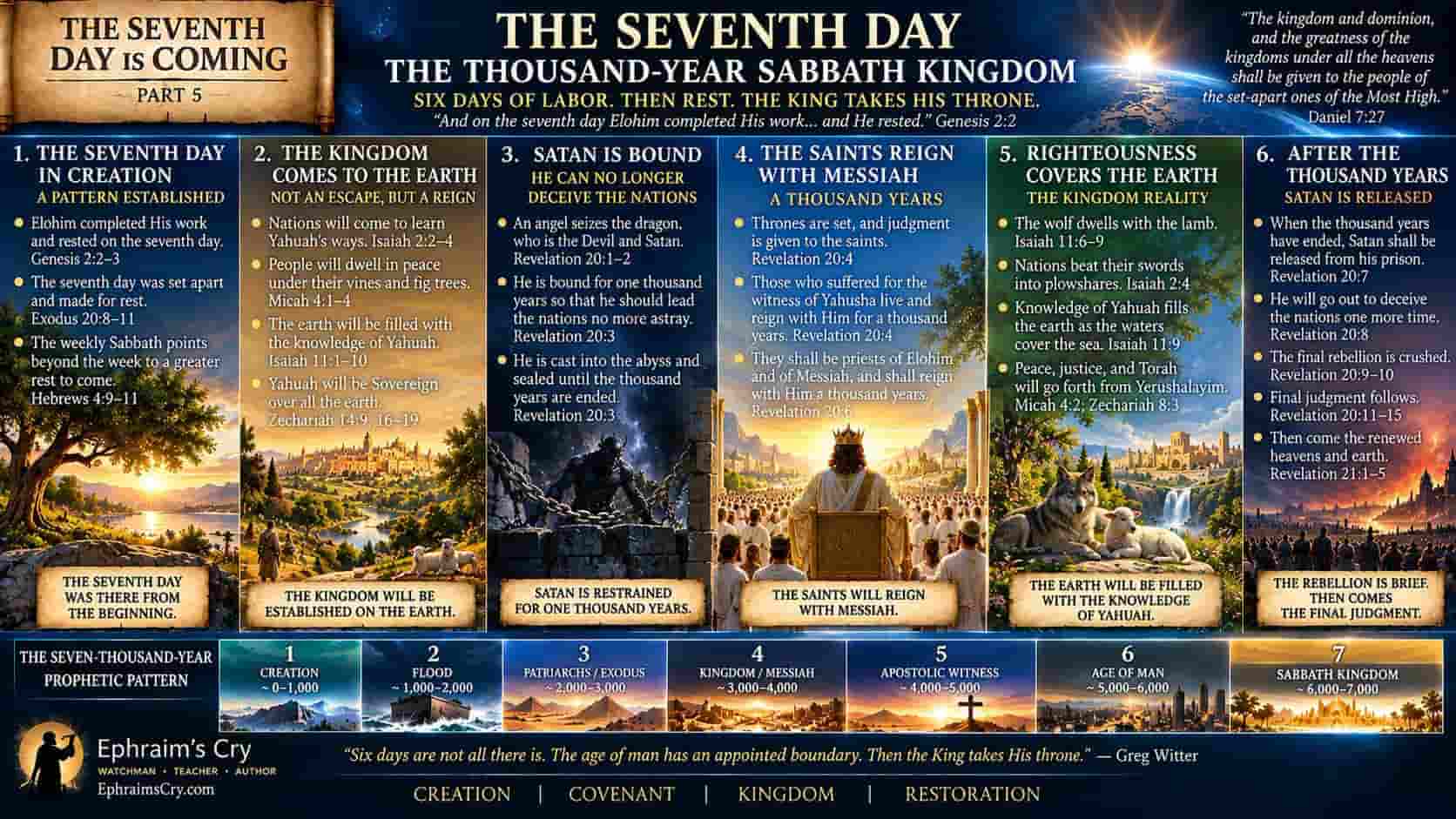
THE SEVENTH DAY IS COMING
Part 5 — The Seventh Day: The Thousand-Year Sabbath Kingdom
The sixth day does not last forever.
The age of man has an appointed boundary. Human government has an appointed boundary. Rebellion has an appointed boundary. The kingdoms of men have an appointed boundary (Daniel 2:44–45; 7:13–14, 26–27; Revelation 11:15).
And after the sixth day comes the seventh.
If the Creation-week pattern we have been examining is prophetic, then the next great movement in the pattern is not another millennium dominated by human government.
It is the Sabbath Kingdom.
THE SEVENTH THOUSAND YEARS — THE SABBATH KINGDOM
Here the pattern reaches its most powerful convergence.
The seventh Creation day is set apart as rest (Genesis 2:2–3).
The weekly seventh day becomes the Sabbath of Yahuah (Exodus 20:8–11; Leviticus 23:3).
Hebrews declares that there remains a Sabbath-rest for the people of Elohim (Hebrews 4:9–11).
And Revelation describes a future one-thousand-year reign of Messiah and His saints (Revelation 20:1–6).
Put the pattern together:
– Six days of Creation → Seventh-day rest (Genesis 1:1–2:3).
– Six days of human labor → Seventh-day Sabbath (Exodus 20:8–11).
– A day compared with a thousand years (Psalm 90:4; 2 Peter 3:8).
– Six prophetic millennia → Seventh-millennium Kingdom within the pattern we are examining.
– Messiah and His saints reign for one thousand years (Revelation 20:4–6).
The correspondence is difficult to ignore.
Six days.
Then the seventh.
Six periods of labor.
Then rest.
The age of man.
Then the Kingdom of the King.
THE KINGDOM IS NOT AN ESCAPE FROM THE EARTH
This is where another major misunderstanding needs to be corrected.
The Sabbath Kingdom is not primarily a picture of the people of Yahuah abandoning the earth and spending the Millennium somewhere else.
The prophets describe the King establishing righteous government over the earth.
Yeshayahu sees the mountain of the house of Yahuah established, with the nations coming to learn His ways:
“For out of Tsiyon comes forth the Torah, and the Word of Yahuah from Yerushalayim” (Isaiah 2:2–4).
Micah describes the same Kingdom reality. Nations come to learn the ways of Yahuah, Torah goes forth from Tsiyon, and people sit under their vines and fig trees without fear (Micah 4:1–4).
Yeshayahu describes the Branch from the root of Yishai ruling with righteousness. The wolf dwells with the lamb, the leopard lies down with the young goat, and the earth becomes filled with the knowledge of Yahuah as the waters cover the sea (Isaiah 11:1–10).
Zechariah declares:
“And Yahuah shall be Sovereign over all the earth.” (Zechariah 14:9).
He then describes survivors from the nations going up from year to year to Yerushalayim to worship the King and observe Sukkot (Zechariah 14:16–19).
Daniel sees the Son of Man receiving dominion, glory, and a Kingdom so that peoples, nations, and languages serve Him (Daniel 7:13–14).
He then declares that the Kingdom and dominion under all the heavens will be given to the people of the set-apart ones of the Most High (Daniel 7:27).
Revelation announces the same outcome:
“The reign of the world has become the reign of our Master, and of His Messiah.” (Revelation 11:15).
This is Kingdom language.
It involves nations.
It involves government.
It involves Yerushalayim.
It involves Torah.
It involves righteous judgment.
It involves Messiah reigning.
This is not mankind escaping Creation.
This is the King establishing righteous government over Creation (Isaiah 2:2–4; 11:1–10; Daniel 7:13–14, 27; Zechariah 14:9; Revelation 20:4–6).
SATAN IS BOUND FOR THE THOUSAND YEARS
Revelation 20 gives us another critical feature of this Kingdom.
Yochanan sees an angel descending from heaven with the key to the abyss and a great chain (Revelation 20:1).
The dragon is seized.
And Revelation leaves no question concerning his identity:
“The dragon, the serpent of old, who is the Devil and Satan” (Revelation 20:2).
He is bound for one thousand years (Revelation 20:2).
But why?
The text tells us.
He is cast into the abyss, which is shut and sealed over him:
“so that he should lead the nations no more astray until the thousand years were ended.” (Revelation 20:3).
That statement is enormously important.
During the thousand-year Kingdom, Satan is not roaming the nations deceiving them as he does before his binding.
He is restrained from that activity for the stated period (Revelation 20:1–3).
Then comes another explicit chronological marker:
“until the thousand years were ended.” (Revelation 20:3).
The text establishes a beginning.
It establishes a duration.
And it establishes an ending.
THE SAINTS REIGN WITH MESSIAH
Yochanan then sees thrones and those to whom judgment is given (Revelation 20:4).
He describes those who suffered because of the witness of Yahusha and the Word of Elohim. They live and reign with Messiah for one thousand years (Revelation 20:4).
Then he writes:
“Blessed and set-apart is the one having part in the first resurrection. The second death possesses no authority over these, but they shall be priests of Elohim and of Messiah, and shall reign with Him a thousand years.” (Revelation 20:6).
Again, notice how specific the text is.
The saints live.
The saints reign.
Messiah reigns.
The period is one thousand years (Revelation 20:4–6).
Daniel had already anticipated the same reality.
“The set-apart ones of the Most High shall receive the reign” (Daniel 7:18).
Judgment is given to the set-apart ones, and the time comes for them to possess the Kingdom (Daniel 7:22).
The Kingdom and dominion are ultimately given to the people of the set-apart ones of the Most High (Daniel 7:27).
Revelation is not introducing an entirely unrelated concept.
It is bringing the prophetic Kingdom expectation into sharper focus.
THE RESURRECTION COMES BEFORE THE MILLENNIAL REIGN
This also gives us an important chronological anchor.
The saints who reign with Messiah are associated with resurrection (Revelation 20:4–6).
That agrees with the broader Apostolic Witness.
Sha’ul writes that each will be raised in his proper order: Messiah the firstfruits, afterward those who belong to Messiah at His coming (1 Corinthians 15:20–23).
He describes the dead being raised incorruptible at the last trumpet (1 Corinthians 15:51–52).
He tells the Thessalonians that Yahusha descends from heaven, the dead in Messiah rise first, and the living are gathered together with them (1 Thessalonians 4:15–17).
Yahusha Himself places the gathering of His elect after the tribulation, in connection with the visible coming of the Son of Adam (Matthew 24:29–31).
Daniel likewise associates resurrection with the great time of distress and the deliverance of the people (Daniel 12:1–3).
The sequence therefore matters.
Messiah returns.
The resurrection and gathering occur.
The saints reign with Messiah.
That is not a minor detail.
It becomes essential when testing claims that the Millennium has already happened.
WE ARE NOT IN SATAN’S “LITTLE SEASON”
A growing teaching claims that Messiah’s thousand-year Kingdom has already occurred and that we are presently living in Satan’s “little season.”
Revelation 20 does not permit us simply to assert that.
The order is explicit.
Satan is bound for one thousand years (Revelation 20:1–3).
The saints reign with Messiah for one thousand years (Revelation 20:4–6).
Only after that period does the next event occur:
“And when the thousand years have ended, Satan shall be released from his prison.” (Revelation 20:7).
Read that again.
WHEN THE THOUSAND YEARS HAVE ENDED.
Not before them.
Not during them.
After them.
Only then does Satan go out to deceive the nations again and gather them for the final rebellion (Revelation 20:7–9).
Therefore, before anyone can responsibly claim that we are presently living in Satan’s little season, they must demonstrate that several enormous prophetic events have already occurred.
They would need to demonstrate that:
– Yahusha has already returned in the manner Scripture describes (Matthew 24:27, 29–31; Acts 1:9–11; Revelation 19:11–16).
– The resurrection associated with His coming has already occurred (Daniel 12:1–3; 1 Corinthians 15:22–23, 51–52; 1 Thessalonians 4:16–17).
– Satan has already been bound so that he could not deceive the nations for one thousand years (Revelation 20:1–3).
– The resurrected saints have already reigned with Messiah for one thousand years (Revelation 20:4–6).
– The prophetic Kingdom described by Yeshayahu, Micah, Daniel, and Zechariah has already occurred (Isaiah 2:2–4; 11:1–10; Micah 4:1–4; Daniel 7:13–14, 27; Zechariah 14:9, 16–19).
– That thousand-year period has already been completed (Revelation 20:7).
That is an extraordinary burden of proof.
You cannot simply erase the thousand years and jump directly to Revelation 20:7.
The text will not allow it.
DO NOT MOVE THE PROPHETIC CLOCK FORWARD
The prophetic order must remain the prophetic order.
Present age → Tribulation and persecution → Return of Messiah → Resurrection and gathering → Satan bound → Thousand-year Kingdom → Completion of the thousand years → Satan released → Final rebellion → Final judgment → Renewed heavens and earth (Daniel 12:1–3; Matthew 24:21–31; 1 Corinthians 15:51–52; 1 Thessalonians 4:16–17; Revelation 19:11–21; 20:1–15; 21:1–5).
We have not already passed through the seventh millennium.
We have not already passed through the Sabbath Kingdom.
Therefore, within this prophetic framework, we cannot already be living in the “little season” that Revelation explicitly places after the thousand-year reign (Revelation 20:7–10).
The watchman does not move the hands of the prophetic clock.
The watchman reads what the text says and sounds the warning accordingly (Ezekiel 3:17–21; 33:1–9).
THE SABBATH HAS BEEN POINTING HERE FROM THE BEGINNING
Now return once more to Genesis.
“And on the seventh day Elohim completed His work which He had done, and He rested on the seventh day from all His work which He had made” (Genesis 2:2).
The seventh day did not originate at Sinai.
It was there at Creation (Genesis 2:1–3).
Sinai later points directly back to that Creation pattern when commanding the seventh-day Sabbath (Exodus 20:8–11).
Hebrews says that a Sabbath-rest remains for the people of Elohim (Hebrews 4:9–11).
Revelation gives us a thousand-year reign of Messiah and His saints (Revelation 20:4–6).
That means every weekly Sabbath carries a testimony.
Every seventh day says:
Six days are not all there is.
Every seventh day says:
Labor has an appointed end.
Every seventh day says:
Man’s work does not continue forever.
And within this prophetic framework, every seventh day points toward the Kingdom in which Messiah reigns.
Six days.
Then the seventh.
Six millennia.
Then the Sabbath Kingdom.
The age of man does not continue forever.
The King takes His throne.
And the seventh day begins.
Next: Part 6 — Declaring the End From the Beginning: What Comes After the Seventh Day
— Greg Witter
Ephraim’s Cry
Watchman • Teacher • Author
EphraimsCry.com
#EphraimsCry#Yahuah#Yahusha#SeventhDay#SabbathKingdom#MillennialKingdom#ThousandYearReign#Revelation20
#BiblicalProphecy#SevenThousandYears#KingdomOfElohim#Sabbath#Shabbat#Torah#Covenant#Restoration#Watchman
