
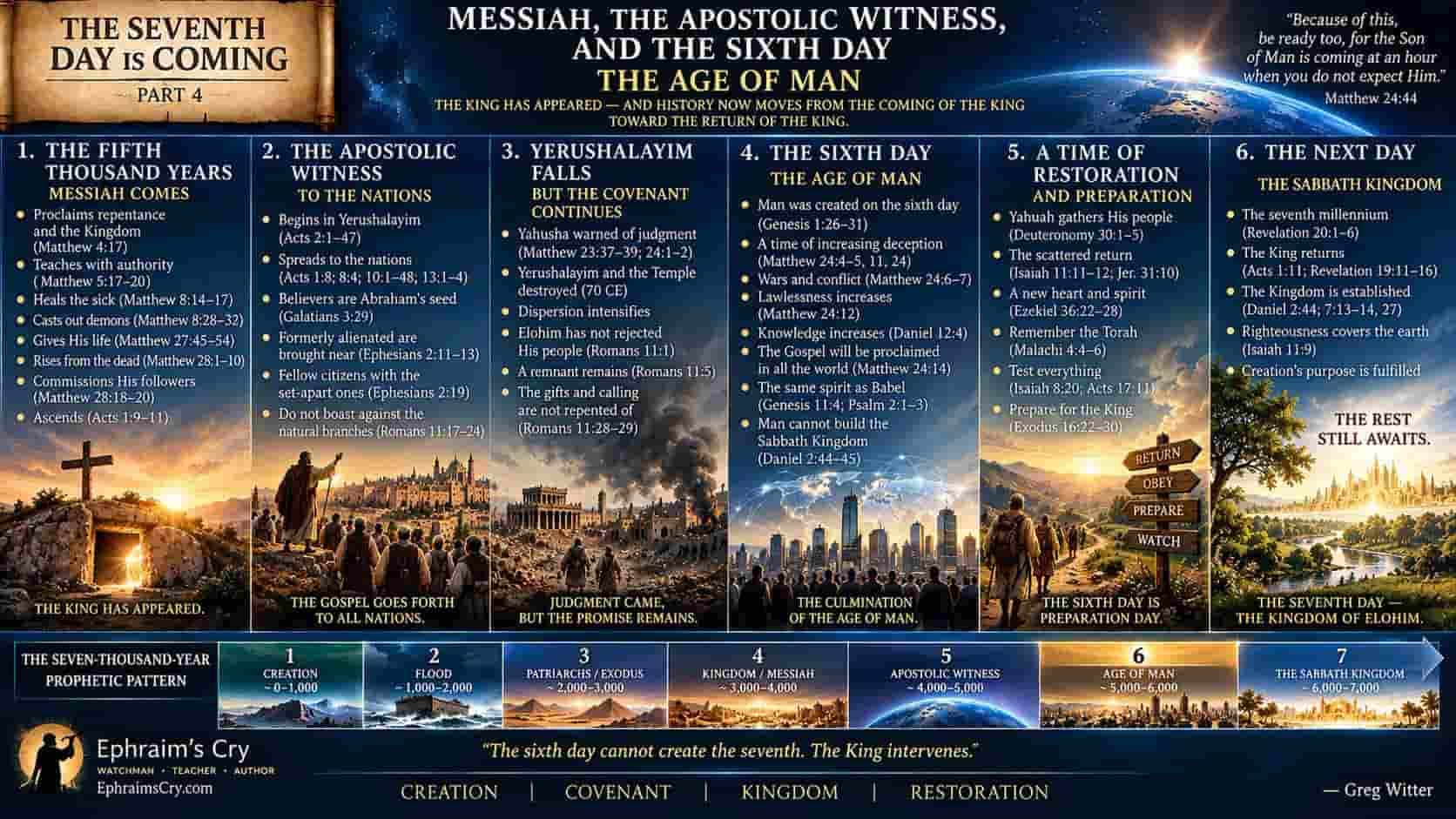
THE SEVENTH DAY IS COMING
Part 4 — Messiah, the Apostolic Witness, and the Sixth Day: The Age of Man
The fourth prophetic day has brought us to Messiah.
Near the conclusion of approximately four thousand years within the chronological framework we are examining, the Light appears (Isaiah 9:2; Matthew 4:12–16; John 1:4–9; 8:12).
But Messiah’s first coming is not the end of the prophetic week.
It is the great turning point.
The King has appeared.
The Kingdom has been proclaimed.
And history now moves from the coming of the King toward the return of the King (Matthew 4:17; Acts 1:9–11; Revelation 19:11–16).
THE FIFTH THOUSAND YEARS — MESSIAH, THE APOSTOLIC WITNESS, AND DISPERSION
Yahusha begins His ministry proclaiming repentance and the Kingdom (Matthew 4:17; Mark 1:14–15).
He announces His mission among Yisra’el (Matthew 10:5–7; 15:24), calls disciples (Matthew 4:18–22), teaches Torah with authority (Matthew 5:17–20; 7:28–29), heals the sick (Matthew 8:14–17), casts out demons (Matthew 8:28–32), and demonstrates the authority of the Kingdom (Matthew 12:28).
Everything about His ministry announces that the promised King has entered history.
Yet Yahusha does not merely proclaim the Kingdom.
He gives His life (Matthew 27:45–54; John 19:28–30).
He is raised from the dead (Matthew 28:1–10; Luke 24:1–7).
He commissions His disciples to carry the message outward (Matthew 28:18–20; Acts 1:8).
Then He ascends, with the promise that He will return in the same manner in which His disciples saw Him depart (Acts 1:9–11).
The Apostolic Witness begins in Yerushalayim and spreads outward (Acts 1:8; 2:1–47; 8:4; 10:1–48; 13:1–4).
The Gospel being proclaimed is not a replacement of everything that came before it.
It is the announcement that Yahuah’s covenant purposes are moving toward their appointed fulfillment through Messiah.
Sha’ul declares that those belonging to Messiah are Abraham’s seed and heirs according to the promise (Galatians 3:29).
He tells those formerly alienated from the citizenship of Yisra’el and strangers from the covenants of promise that they have been brought near (Ephesians 2:11–13).
He describes believing Gentiles as fellow citizens with the set-apart ones and members of the household of Elohim (Ephesians 2:19).
And he warns those grafted into the cultivated olive tree not to boast against the natural branches (Romans 11:17–24).
The story is still a covenant story.
The root has not changed.
The promises have not been discarded.
Yahuah has not abandoned what He began.
YERUSHALAYIM FALLS—BUT THE COVENANT PURPOSE CONTINUES
Yahusha warns that Yerushalayim and the Temple will face judgment (Matthew 23:37–39; 24:1–2; Luke 21:20–24).
That judgment comes.
Dispersion intensifies.
But dispersion does not mean Yahuah has forgotten His people.
Sha’ul asks the question directly:
“Has Elohim rejected His people?”
His answer is equally direct:
“Let it not be!” (Romans 11:1).
He speaks of a remnant according to the choice of favor (Romans 11:5).
He warns the grafted-in branches against arrogance (Romans 11:17–22).
And he declares that “the gifts and the calling of Elohim are not to be repented of” (Romans 11:28–29).
That matters because the fifth millennium becomes an age in which enormous portions of the covenant people are scattered.
Yerushalayim is no longer the center of national life.
The Apostolic generation passes.
Centuries unfold.
Empires rise and fall.
Religious institutions grow.
Human traditions accumulate.
And much of the Hebraic foundation of Scripture becomes increasingly obscured beneath layers of theology, philosophy, politics, and institutional tradition.
Yet the Word remains.
The promises remain.
The remnant remains.
And the King has not forgotten His Covenant (Deuteronomy 4:30–31; Psalm 105:8–10; Jeremiah 31:35–37; Romans 11:1–5, 28–29).
THEN WE ENTER THE SIXTH DAY
Here the Creation pattern becomes especially intriguing.
Man was created on the sixth Creation day (Genesis 1:26–31).
Within the seven-thousand-year framework, the sixth millennium represents the final thousand-year period before the Sabbath Kingdom.
Again, we must maintain the distinction we established from the beginning.
Genesis does not explicitly say:
“The sixth Creation day represents the sixth millennium.”
We are examining a prophetic correspondence.
But the correspondence deserves attention.
Man appears on Day Six (Genesis 1:26–31).
And within the proposed prophetic week, the sixth millennium becomes the culmination of the age of man immediately before the seventh-day Kingdom.
That raises an uncomfortable question.
What does mankind look like when the age of man approaches its fullness?
Scripture gives us a sobering answer.
THE AGE OF MAN
The biblical picture of mankind approaching the end of the age is not one of humanity gradually perfecting itself.
Yahusha warns of increasing deception (Matthew 24:4–5, 11, 24).
He warns of wars and reports of wars (Matthew 24:6).
He speaks of nation rising against nation and kingdom against kingdom (Matthew 24:7).
He warns of persecution (Matthew 24:9).
He warns of betrayal and hatred (Matthew 24:10).
He declares that because lawlessness increases, the love of many will grow cold (Matthew 24:12).
Yet He also declares that the Gospel of the Kingdom will be proclaimed in all the world as a witness to the nations before the end comes (Matthew 24:14).
Daniel speaks of a time when many will run to and fro and knowledge will increase (Daniel 12:4).
The Psalms picture the kings and rulers of the earth setting themselves against Yahuah and against His Anointed (Psalm 2:1–3).
Revelation ultimately describes the kings of the earth gathering in opposition to Messiah (Revelation 19:19).
Human knowledge increases.
Human power increases.
Human technology increases.
Human ability to communicate, travel, organize, control, build, and destroy increases.
But technological advancement is not the same thing as righteousness.
Knowledge is not the same thing as wisdom.
Power is not the same thing as obedience.
The central question introduced in Eden remains:
Will mankind submit to the Word of Yahuah, or determine good and evil for itself? (Genesis 2:16–17; 3:1–7).
BABEL NEVER REALLY DISAPPEARED
The spirit revealed at Babel is remarkably persistent.
Mankind says:
“Come, let us build ourselves a city, and a tower whose top is in the heavens, and make a name for ourselves” (Genesis 11:4).
Notice the language.
Let us build.
Let us ascend.
Let us make a name for ourselves.
The issue is larger than architecture.
It is human civilization organizing itself around human glory and human authority apart from submission to Yahuah (Genesis 11:1–9).
The same fundamental rebellion appears in Psalm 2 when the rulers of the earth seek to cast off the authority of Yahuah and His Anointed (Psalm 2:1–3).
It reaches its final expression when the kingdoms of mankind gather against the returning King (Revelation 19:19).
Babel is therefore not merely an ancient tower.
It reveals a recurring pattern of human rebellion.
Mankind repeatedly attempts to establish order without the Creator.
But the sixth day cannot create the seventh.
MAN CANNOT BUILD THE SABBATH KINGDOM
Return again to Creation.
Adam was created on the sixth day (Genesis 1:26–31).
But Adam did not create the seventh day.
Adam did not bless the seventh day.
Adam did not set it apart.
Adam did not determine its purpose.
Yahuah did (Genesis 2:1–3).
That provides a powerful prophetic picture.
If the sixth millennium corresponds broadly with the culmination of the age of man, mankind cannot manufacture the seventh-millennium Kingdom.
Political reform cannot produce it.
Technology cannot produce it.
Economic systems cannot produce it.
Religious institutions cannot produce it.
Military power cannot produce it.
Global government cannot produce it.
Human intelligence cannot produce it.
Daniel sees the kingdoms of men ultimately displaced by a Kingdom that does not originate from them (Daniel 2:31–45).
A stone “cut out without hands” strikes the image representing human kingdoms, breaks them, and becomes a great mountain filling the earth (Daniel 2:34–35).
Daniel explains:
“And in the days of these sovereigns the Elah of the heavens shall set up a reign which is never destroyed.” (Daniel 2:44).
The seventh day does not emerge because mankind finally perfects the sixth.
The King intervenes.
The kingdoms of men give way to the Kingdom established by Elohim (Daniel 2:44–45; 7:13–14, 26–27; Revelation 11:15).
BUT THE SIXTH DAY IS ALSO A TIME OF RESTORATION
This is where the picture becomes more complicated—and more hopeful.
Scripture does not merely describe increasing rebellion.
It also repeatedly anticipates restoration.
Mosheh speaks of scattered Yisra’el remembering the Covenant, returning to Yahuah, obeying His voice, and being gathered from among the peoples (Deuteronomy 30:1–5).
Yeshayahu speaks of Yahuah gathering the dispersed of Yisra’el and the scattered of Yahudah (Isaiah 11:11–12).
Yirmeyahu declares:
“Hear the word of Yahuah, O nations, and declare it in the isles afar off, and say, ‘He who scattered Yisra’el gathers him, and shall guard him as a shepherd his flock.’” (Jeremiah 31:10).
Yehezqel describes Yahuah gathering His people from the nations, cleansing them, giving them a new heart and spirit, and causing them to walk in His laws and guard His right-rulings (Ezekiel 36:22–28).
He later sees the divided houses restored as one people under one King (Ezekiel 37:15–28).
Malachi closes the prophetic witness with a call to remember the Torah of Mosheh and with a promise concerning restoration before the great and awesome Day of Yahuah (Malachi 4:4–6).
Kepha later speaks of “times of restoration of all matters, of which Elohim spoke through the mouth of all His set-apart prophets since of old” (Acts 3:19–21).
So the sixth-day picture contains two movements occurring alongside one another:
Increasing rebellion.
And:
Increasing restoration.
Deception and awakening.
Lawlessness and return.
Human kingdoms consolidating while Yahuah gathers and prepares His people.
BUT EVERY CLAIM OF RESTORATION MUST BE TESTED
This is critical.
Not everything calling itself restoration is restoration.
Not everything claiming to recover ancient truth is true.
Not everyone using Hebrew terminology is teaching according to Scripture.
Not every calendar claim is biblical.
Not every prophetic calculation is sound.
Not every teacher claiming revelation has heard from Yahuah.
Mosheh warns that even signs and wonders do not validate a teacher who leads people away from obedience to Yahuah (Deuteronomy 13:1–5).
Yeshayahu gives the standard:
“To the Torah and to the witness!” (Isaiah 8:20).
The Bereans examine the Scriptures daily to determine whether what they are being taught is true (Acts 17:11).
Sha’ul commands:
“Prove them all. Hold fast what is good.” (1 Thessalonians 5:21).
Yochanan likewise commands believers to test the spirits because many false prophets have gone out into the world (1 John 4:1).
Therefore, awakening alone proves nothing.
Restoration must be tested against the Word.
Prophecy must be tested against the Word.
Chronology must be tested against the Word.
Tradition must be tested against the Word.
Teachers must be tested against the Word.
Everything must be tested.
THE SIXTH DAY IS PREPARATION DAY
And now the pattern becomes intensely practical.
Before the weekly Sabbath arrives, there is preparation.
In the wilderness, Yisra’el gathers twice as much manna on the sixth day because the seventh day is Sabbath (Exodus 16:22–30).
The Apostolic Witness likewise identifies the day preceding the Sabbath as the Preparation (Mark 15:42; Luke 23:54–56).
Preparation occurs before Sabbath arrives.
That gives us a powerful picture within the prophetic framework.
If the sixth millennium is the prophetic sixth day immediately preceding the Sabbath Kingdom, then this is not merely the age of man.
It is Preparation Day.
This is not the time to wait until the King appears before deciding whether we will obey Him.
This is the time to prepare.
Return to Covenant (Deuteronomy 30:1–10).
Remember the Torah (Malachi 4:4).
Test everything (Isaiah 8:20; Acts 17:11; 1 Thessalonians 5:21).
Watch for deception (Matthew 24:4–5, 11, 24).
Endure faithfully (Matthew 24:13; Revelation 14:12).
Proclaim the Gospel of the Kingdom (Matthew 24:14).
Watch for the King (Matthew 24:42–44).
Yahusha says:
“Because of this, be ready too, for the Son of Adam is coming at an hour when you do not expect Him.” (Matthew 24:44).
The sixth day is not the Sabbath.
But the sixth day tells us what comes next.
The seventh day.
The fifth millennium carried the Apostolic Witness outward.
The sixth millennium brings the age of man toward its appointed boundary.
And if the Creation-week pattern is prophetic, then the next great movement is not another age of human government.
It is the Sabbath Kingdom.
Next: Part 5 — The Seventh Day: The Thousand-Year Sabbath Kingdom
— Greg Witter
Ephraim’s Cry
Watchman • Teacher • Author
EphraimsCry.com
#EphraimsCry#Yahuah#Yahusha#CreationWeek#SixthDay#PreparationDay#AgeOfMan#BiblicalProphecy
#SevenThousandYears#GospelOfTheKingdom#Sabbath#Shabbat#Torah#Covenant#Restoration#KingdomOfElohim#Watchman
