
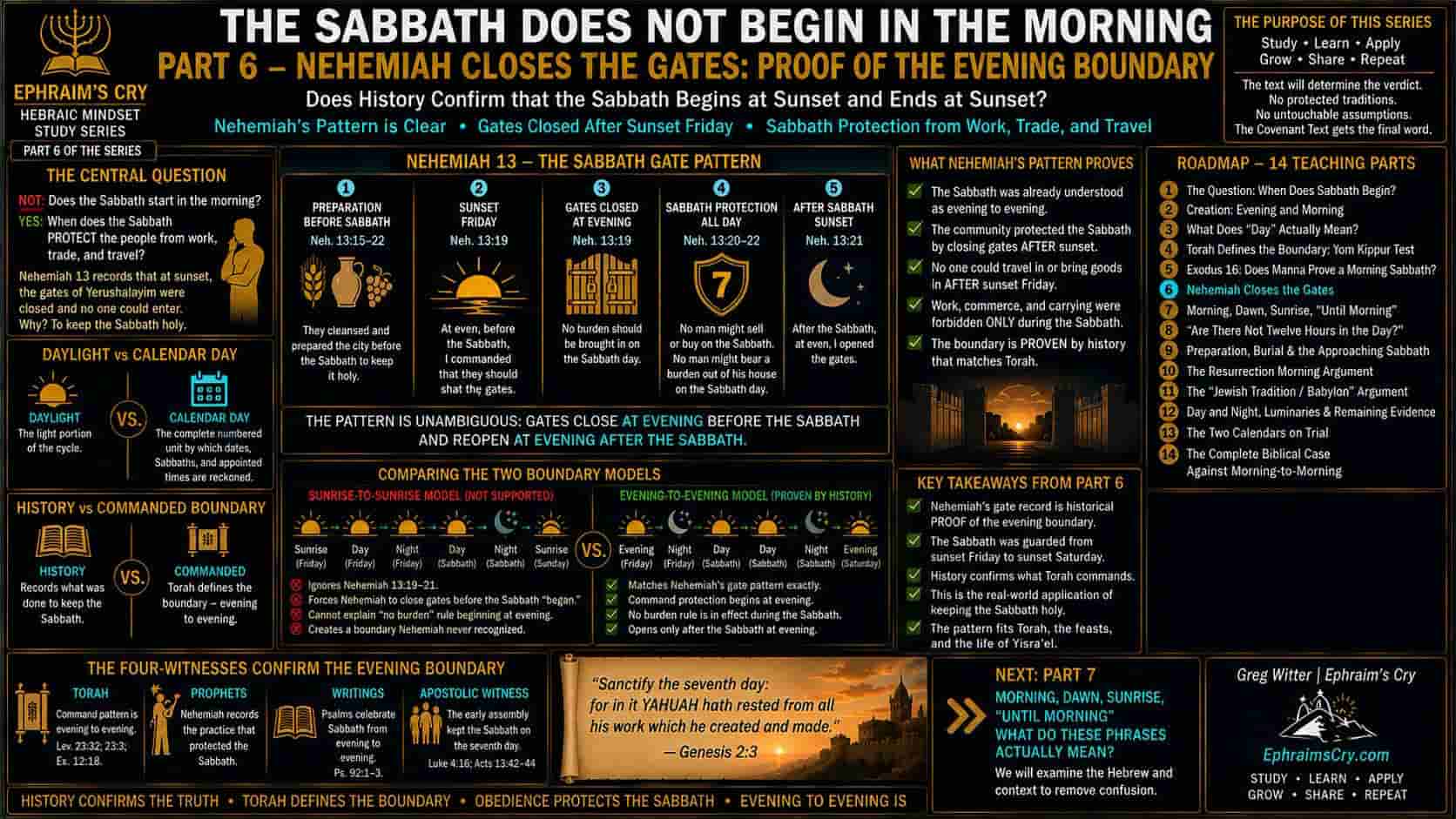
THE SABBATH DOES NOT BEGIN IN THE MORNING
PART 6 — NEHEMIAH CLOSES THE GATES
Greg Witter | Ephraim’s Cry
Hebraic Mindset Study Series
Study • Learn • Apply • Grow • Share • Repeat
The Weekly Sabbath Test — Why Did Jerusalem Shut Down as Darkness Approached If Sabbath Did Not Begin Until Morning?
Torah Establishes the Boundary • Covenant History Demonstrates the Practice • Darkness Approaches • Commerce Stops • Sabbath Arrives
The first five parts of this series have progressively narrowed the question.
Part 1 established Creation’s repeated pattern:
EVENING → MORNING → NUMBERED DAY
Part 2 established that yom does not always mean daylight. Scripture uses “day” contextually for daylight, a numbered calendar day, a specific date, and broader periods.
Part 3 examined Yom Kippur and Torah’s explicit command:
“FROM EVEN UNTO EVEN.”
Part 4 demonstrated that evening-boundary language is not isolated to Yom Kippur. Passover and Unleavened Bread provide additional evening-based appointed-time structure.
Part 5 examined Exodus 16 and demonstrated that manna appearing in the morning proves when manna was gathered—it does not prove when Sabbath began. Both calendar models predict no manna on Sabbath morning. Therefore the manna argument cannot determine the disputed boundary.
Now we come to something different.
We leave the morning.
We go directly to the disputed period:
THE APPROACHING EVENING BEFORE THE WEEKLY SABBATH.
And we watch what Nehemiah actually does.
THIS IS NOT YOM KIPPUR
This distinction immediately matters.
One of the primary responses to Leviticus 23:32 is:
“That is Yom Kippur, not the weekly Sabbath.”
Fine.
Nehemiah 13 concerns the weekly Sabbath.
This is not an annual appointed-time exception.
This is not Passover.
This is not Unleavened Bread.
This is not Yom Kippur.
The controversy concerns:
buying,
selling,
transporting goods,
bringing merchandise into Jerusalem,
and ordinary commercial labor on the weekly Sabbath.
Therefore Nehemiah gives us an historical test of how the Sabbath boundary functioned in actual covenant practice.
READ THE CONTEXT BEFORE THE KEY VERSE
Nehemiah 13:15 says:
“In those days saw I in Judah some treading wine presses on the sabbath, and bringing in sheaves, and lading asses; as also wine, grapes, and figs, and all manner of burdens, which they brought into Jerusalem on the sabbath day…”
The problem is unmistakable.
People are working.
Transporting.
Selling.
Moving agricultural products.
Conducting commerce.
Profaning Sabbath.
This is not a theoretical calendar discussion.
Nehemiah is enforcing covenant obedience.
THE TYRIANS ARE SELLING IN JERUSALEM
Verse 16 continues:
“There dwelt men of Tyre also therein, which brought fish, and all manner of ware, and sold on the sabbath unto the children of Judah, and in Jerusalem.”
Again, the issue is commercial activity.
The Sabbath boundary therefore has practical consequences.
When must buying and selling stop?
When must merchandise stop entering Jerusalem?
When does ordinary commerce become Sabbath violation?
Those questions make the temporal boundary essential.
NEHEMIAH CONFRONTS THE LEADERS
Verse 17 says:
“Then I contended with the nobles of Judah, and said unto them, What evil thing is this that ye do, and profane the sabbath day?”
Nehemiah does not treat this casually.
He identifies Sabbath commerce as evil and profanation.
Verse 18 reminds them that their ancestors’ rebellion brought judgment upon Yisra’el.
This is covenant enforcement.
The Sabbath is not merely cultural.
It is covenantal.
And then Nehemiah acts.
THE KEY TEXT — NEHEMIAH 13:19
“When the gates of Jerusalem began to be dark before the sabbath, I commanded that the gates should be shut, and charged that they should not be opened till after the sabbath…”
Stop there.
Do not rush past the wording.
The gates begin growing dark.
The Sabbath is approaching.
Nehemiah orders:
SHUT THE GATES.
Then:
DO NOT OPEN THEM UNTIL AFTER SABBATH.
That sequence is extraordinarily important.
THE TEXT GIVES US A TRANSITION
Watch the movement:
DAYLIGHT IS FADING.
THE GATES BEGIN TO GROW DARK.
SABBATH IS APPROACHING.
THE GATES CLOSE.
COMMERCE STOPS.
THE GATES REMAIN CLOSED THROUGH SABBATH.
THEY OPEN AFTER SABBATH.
This is exactly the kind of historical evidence we have been waiting for.
Unlike Exodus 16, which tells us what happens on Sabbath morning, Nehemiah takes us directly to the evening preceding Sabbath.
That is the disputed period.
APPLY THE EVENING-TO-EVENING MODEL
Under evening reckoning, Nehemiah’s actions are straightforward.
The sixth day is ending.
Daylight fades.
Evening approaches.
The seventh day is about to begin.
Therefore Nehemiah closes the gates so commercial activity cannot continue into Sabbath.
The sequence becomes:
DAY 6 DAYLIGHT → DARKNESS APPROACHES → GATES CLOSE → DAY 7 / SABBATH → GATES REMAIN CLOSED → SABBATH ENDS
No additional explanation is necessary.
The action matches the boundary.
NOW APPLY THE MORNING-TO-MORNING MODEL
Under morning reckoning, the same event becomes much more difficult.
The sixth-day daylight ends.
Darkness approaches.
But according to morning-to-morning reckoning:
IT IS STILL DAY 6.
The entire following night supposedly remains Day 6.
Sabbath supposedly does not begin until sunrise.
Yet Nehemiah closes Jerusalem against Sabbath commerce as darkness approaches.
Why?
Under the morning model, hours of non-Sabbath Day 6 supposedly remain.
That creates the central Part 6 question:
WHY DOES APPROACHING DARKNESS TRIGGER THE SHUTDOWN OF SABBATH COMMERCE IF SABBATH DOES NOT BEGIN UNTIL THE FOLLOWING MORNING?
“HE CLOSED THE GATES EARLY AS A PRECAUTION”
This is one possible response.
Perhaps Nehemiah simply established a protective buffer before Sabbath.
That argument is possible.
But now it must be proven.
Where does the text say:
“Nehemiah closed the gates many hours before Sabbath as an additional precaution”?
It does not.
The text directly connects:
GROWING DARK
with:
BEFORE THE SABBATH
and immediately:
THE GATES ARE SHUT.
A precautionary interpretation is therefore an additional explanation brought to the text.
The evening model does not require it.
PREPARATION IS NOT THE SAME AS AN ALL-NIGHT COMMERCIAL BAN
Someone might appeal to preparation:
“Nehemiah simply wanted everyone prepared early.”
But that still does not explain why the gates themselves must remain closed against merchandise.
This is not merely households preparing food.
It is governmental enforcement against Sabbath commerce.
Nehemiah is preventing merchants from entering the city.
If the entire night remained lawful Day-6 commercial time, shutting the gates at darkness would prohibit hours of commerce Torah supposedly still allowed.
Could Nehemiah impose such a precaution?
Possibly.
But Scripture does not say that is what he is doing.
The more natural reading is that Sabbath is arriving.
“BEFORE THE SABBATH” DOES NOT SUPPORT A MORNING BOUNDARY
Another objection says:
“The text says the gates became dark before Sabbath. Therefore darkness itself cannot be Sabbath.”
That misses the nature of a transition.
Of course it is before Sabbath as darkness begins approaching.
That is why Nehemiah acts then.
He does not wait until the boundary has passed and commerce is already violating Sabbath.
He secures the gates as Sabbath approaches.
The phrase does not tell us Sabbath remains twelve hours away.
It places growing darkness in immediate temporal relationship to the approaching Sabbath.
THE TEXT SAYS “BEGAN TO BE DARK”
That wording matters.
The passage describes a process.
The gates begin to grow dark.
This is evening transition language.
It is not describing deep midnight darkness.
It is not describing the hours immediately before sunrise.
It is describing the fading of daylight.
Nehemiah recognizes the approaching Sabbath and acts.
That fits an evening boundary naturally.
EVENING IS A TRANSITION — NOT A DIGITAL SECOND
Part 3 established this principle.
Modern people often want one mathematical instant:
6:43:00 PM.
But biblical temporal language commonly describes observable transitions.
Daylight fades.
The sun descends.
Darkness approaches.
Evening occurs.
Therefore Nehemiah does not need to provide a modern timestamp for the passage to demonstrate an evening Sabbath transition.
The relevant fact is that approaching darkness triggers Sabbath enforcement.
THE MERCHANTS CONFIRM WHAT IS HAPPENING
Nehemiah 13:20 says:
“So the merchants and sellers of all kind of ware lodged without Jerusalem once or twice.”
Why are they outside?
Because the gates are closed.
Why are the gates closed?
Because Sabbath commerce has been stopped.
The merchants apparently remain nearby hoping to resume business.
Nehemiah notices.
Then he confronts them.
NEHEMIAH THREATENS THE MERCHANTS
Verse 21 says:
“Then I testified against them, and said unto them, Why lodge ye about the wall? if ye do so again, I will lay hands on you.”
This is strong enforcement.
Nehemiah is not merely closing the city gate while telling merchants:
“You still have twelve hours of lawful Day-6 commerce, but I prefer you wait.”
He drives the commercial presence away from the walls.
The context is Sabbath protection.
That makes much more sense if Sabbath has begun or is immediately arriving.
THE LEVITES ARE INVOLVED
Verse 22 says:
“And I commanded the Levites that they should cleanse themselves, and that they should come and keep the gates, to sanctify the sabbath day.”
There is the purpose.
TO SANCTIFY THE SABBATH DAY.
The gate closure is directly tied to keeping the Sabbath set apart.
This is not merely municipal traffic management.
This is covenant enforcement.
THE ENTIRE PASSAGE CONNECTS DARKNESS WITH SABBATH SANCTIFICATION
Put the pieces together:
SABBATH COMMERCE IS PROFANATION.
Nehemiah rebukes it.
DARKNESS APPROACHES.
Nehemiah closes the gates.
MERCHANTS REMAIN OUTSIDE.
Nehemiah drives them away.
LEVITES GUARD THE GATES.
Why?
TO SANCTIFY THE SABBATH.
The connection is difficult to dismiss.
THE MORNING MODEL MUST EXPLAIN THE ENTIRE NIGHT
This is the crucial problem.
Under morning reckoning, when Nehemiah closes the gates:
The sixth day supposedly continues.
The night supposedly belongs to Day 6.
Ordinary commerce is supposedly not yet Sabbath commerce.
The Sabbath supposedly remains hours away.
Yet Nehemiah has already shut down commercial access specifically to sanctify Sabbath.
Where does the text explain this enormous advance restriction?
It does not.
THE EVENING MODEL REQUIRES NO SUCH EXTRA RULE
Under evening reckoning:
Day 6 closes.
Sabbath arrives.
Commerce stops.
Gates close.
Levites guard them.
Merchants remain outside.
The city stays protected until Sabbath passes.
Everything aligns.
The historical practice matches the Torah evening structure already examined.
THIS IS WHY NEHEMIAH IS STRONGER THAN THE MANNA ARGUMENT
Exodus 16 takes us to Sabbath morning.
Both models agree Sabbath exists then.
Therefore Sabbath morning cannot distinguish the models.
Nehemiah takes us to the preceding evening.
That is precisely where the models disagree.
Evening model:
SABBATH IS ARRIVING.
Morning model:
SABBATH IS STILL AN ENTIRE NIGHT AWAY.
Nehemiah acts as though Sabbath is arriving.
That is why this passage carries such weight.
THIS IS HISTORICAL COVENANT PRACTICE
Part 3 gave us Torah boundary language.
Part 6 now gives us historical implementation.
This distinction matters.
Torah tells us what covenant obedience requires.
Nehemiah shows us a covenant leader enforcing Sabbath in actual life.
The historical witness agrees with the evening-boundary structure.
NEHEMIAH DOES NOT CREATE THE RULE
We should be precise.
Nehemiah is not authorized to invent a new Sabbath.
He is restoring covenant faithfulness.
His reforms repeatedly involve bringing Yisra’el back into alignment with Torah.
Therefore Nehemiah’s actions should be understood as covenant enforcement, not calendar innovation.
He is not announcing:
“From now on Sabbath begins at evening.”
He behaves as though the approaching evening boundary is already understood.
That is significant.
IF MORNING-TO-MORNING WERE TORAH, NEHEMIAH’S ACTIONS WOULD REQUIRE EXPLANATION
Suppose Torah really established:
SABBATH = SUNRISE TO SUNRISE.
Then Nehemiah is preventing lawful sixth-day commerce throughout the preceding night.
Why?
Where did he receive authority to add that restriction?
Where does the passage identify it as a fence?
Where does he distinguish his precautionary closure from the actual Sabbath?
Those explanations are absent.
Again, the morning model must import additional assumptions.
“NEHEMIAH WAS FOLLOWING LATER JEWISH TRADITION”
Another response attempts to dismiss Nehemiah historically:
“By Nehemiah’s time, evening Sabbath practice had already developed.”
But that argument creates another problem.
Nehemiah is presented as a covenant reformer calling the people back to Torah.
If his Sabbath enforcement directly contradicted Torah’s supposed morning boundary, the text gives no indication whatsoever that he is corrupting the Sabbath.
Instead, his actions are presented positively.
He asks Elohim to remember him for his faithfulness.
Therefore simply labeling his practice “later tradition” does not answer the canonical witness.
THE WRITINGS ARE A WITNESS TO TORAH
Within our Four-Witness framework, Nehemiah does not replace Torah.
The Writings demonstrate Torah lived out in covenant history.
That is exactly what we have here.
TORAH FOUNDATION:
Sabbath is set apart.
Ordinary work and commerce cease.
HISTORICAL WITNESS:
As darkness approaches before Sabbath, Jerusalem’s commercial gates are shut and guarded.
The witness reinforces the foundation.
THE TEXT DOES NOT SAY “WAIT UNTIL MORNING”
This should be obvious.
Nehemiah does not say:
“Close the gates before sunrise.”
He does not say:
“Allow commerce through the night, because Sabbath begins tomorrow morning.”
He does not say:
“When dawn appears, shut the gates.”
The actual trigger described in the text is:
THE GATES BEGINNING TO GROW DARK.
That is the evidence we must interpret.
WHAT ABOUT THE END OF SABBATH?
Nehemiah commands that the gates:
“should not be opened till after the sabbath.”
The passage does not give us a detailed description of the precise ending marker in that sentence.
Therefore we should not claim more than the text gives.
But the overall sequence remains:
Gates close as darkness approaches before Sabbath.
They remain closed through Sabbath.
They reopen after Sabbath.
The beginning-side evidence is explicit enough to matter.
DO NOT OVERSTATE THE PASSAGE
Nehemiah 13:19 does not say:
“The Sabbath begins at exactly sunset.”
We should not claim it does.
It does not give a clock time.
It does not settle every question about twilight.
It does not define a three-star rule.
It does not authorize later rabbinic formulas.
What it does establish is narrower and powerful:
AS DARKNESS APPROACHES BEFORE THE WEEKLY SABBATH, NEHEMIAH SHUTS DOWN COMMERCIAL ACCESS TO JERUSALEM AND KEEPS IT SHUT THROUGH SABBATH.
That is enough for the present argument.
PRECISION STRENGTHENS THE CASE
Our case does not require exaggeration.
We do not need Nehemiah to say more than Nehemiah says.
The question is whether the historical practice aligns more naturally with:
EVENING SABBATH ARRIVAL
or:
SABBATH STILL MANY HOURS AWAY UNTIL MORNING.
The evening model explains the action naturally.
The morning model requires an unstated all-night precaution.
That is the comparison.
WHAT ABOUT BUYING AND SELLING?
Nehemiah’s reform also establishes an important practical Sabbath principle.
The Sabbath is not merely about avoiding one’s paid employment.
Commerce itself is being restrained.
Buying.
Selling.
Transporting goods for trade.
Market activity.
The gates are controlled precisely because Sabbath sanctification affects economic activity.
That broader teaching is important, although our present subject is the temporal boundary.
THE WATCHMAN FUNCTION IS VISIBLE HERE
Nehemiah sees covenant violation and does not remain passive.
He warns.
He confronts the nobles.
He shuts the gates.
He stations servants.
He threatens persistent merchants.
He commands the Levites to guard the boundary.
Why?
Because covenant boundaries mean nothing if nobody is willing to honor them.
This is watchman behavior.
Truth is not merely identified.
It is defended.
THE SABBATH BOUNDARY IS BOTH TEMPORAL AND COVENANTAL
The gate itself becomes almost a physical picture of the Sabbath boundary.
Outside:
commerce waits.
Inside:
the set-apart day is protected.
The temporal boundary creates a behavioral boundary.
Ordinary commerce belongs on one side.
Sabbath sanctification belongs on the other.
That is why knowing when Sabbath begins matters.
THE MORNING MODEL CREATES A STRANGE PRACTICAL RESULT
Under morning reckoning, imagine the sequence.
Friday-equivalent daylight ends.
Nehemiah closes the gates.
Merchants are barred.
Yet Sabbath supposedly has not begun.
The entire night remains ordinary Day 6.
People theoretically could continue ordinary work and commerce.
But Jerusalem’s market access has already been shut down specifically for Sabbath sanctification.
Then sunrise finally arrives and Sabbath begins.
That is possible only if Nehemiah imposed an extensive pre-Sabbath restriction.
Again:
WHERE DOES THE TEXT SAY THAT?
It does not.
THE EVENING MODEL CREATES THE EXPECTED RESULT
Day 6 daylight ends.
Darkness approaches.
The Sabbath boundary arrives.
Gates close.
Commerce ceases.
Sabbath continues through night.
Morning brings Sabbath daylight.
Sabbath continues.
After Sabbath, gates reopen.
No special all-night pre-Sabbath restriction is necessary.
The practice and calendar align.
THE CUMULATIVE CASE IS NOW MUCH STRONGER
We now have several different kinds of evidence.
CREATION PATTERN
Evening → morning.
LEXICAL EVIDENCE
Daylight does not equal the complete calendar day.
EXPLICIT TORAH BOUNDARY
From evening unto evening.
APPOINTED-TIME STRUCTURE
Passover and Unleavened Bread use evening transitions.
EXODUS 16
Morning manna does not establish a morning calendar boundary.
HISTORICAL WEEKLY SABBATH PRACTICE
Nehemiah shuts Jerusalem against commerce as darkness approaches.
Different kinds of evidence.
Different contexts.
Same direction.
The morning-to-morning theory still lacks the one thing it desperately needs:
AN EXPLICIT MORNING BOUNDARY.
THE NEHEMIAH TEST
We can now put the two models directly against the passage.
MORNING-TO-MORNING MODEL
Day 6 daylight ends.
Darkness approaches.
Nehemiah closes the gates.
Merchants are barred.
But the calendar supposedly remains Day 6 throughout the night.
Sabbath supposedly does not begin until morning.
Therefore Nehemiah’s Sabbath enforcement begins many hours before Sabbath itself.
That requires an additional explanation:
Nehemiah created an all-night protective restriction before Sabbath.
Possible?
Yes.
Stated?
No.
EVENING-TO-EVENING MODEL
Day 6 daylight ends.
Darkness approaches.
Sabbath approaches.
Nehemiah closes the gates.
Commerce stops.
The seventh day begins.
The gates remain closed throughout Sabbath.
They reopen after Sabbath.
No additional rule needs to be invented.
The historical practice fits the calendar boundary naturally.
WHAT WOULD WE EXPECT IF SABBATH REALLY BEGAN IN THE MORNING?
This is a useful test.
If the Sabbath actually began at sunrise, a passage specifically concerned with Sabbath commerce might reasonably show something like:
Commerce continues through the evening.
Commerce continues through the night.
Before morning, the gates are shut.
Sunrise arrives.
Sabbath begins.
But Nehemiah gives us nothing like that.
Instead, the temporal marker provided is:
GROWING DARKNESS.
That is not proof by itself of every technical detail, but it is exactly the opposite marker we would expect if sunrise were the critical boundary.
THE MORNING MODEL MUST EXPLAIN WHY MORNING IS ABSENT
This is especially important because morning-to-morning advocates regularly appeal to morning passages elsewhere.
But here we have a passage dealing directly with the cessation of Sabbath commerce.
Where is morning?
Where is dawn?
Where is sunrise?
Where is a statement that the gates are closed when daylight begins?
It is absent.
Instead:
DARKNESS APPROACHES.
The burden of explanation belongs to the morning model.
NEHEMIAH IS NOT DISCUSSING A FESTIVAL SABBATH
This must remain clear because it eliminates one of the major responses used against Leviticus 23:32.
Yom Kippur can be dismissed by saying:
“Special appointed day.”
Unleavened Bread can be dismissed by saying:
“Festival boundary.”
But Nehemiah is confronting recurring weekly Sabbath commerce.
The merchants are not appearing for one annual feast.
This is an ongoing Sabbath problem.
The weekly Sabbath itself is now on the examination table.
THE WEEKLY SABBATH AGREES WITH THE APPOINTED-TIME EVIDENCE
This is where the cumulative argument becomes difficult to escape.
The appointed times gave us evening boundaries.
Now weekly Sabbath practice gives us Sabbath enforcement as darkness approaches.
If annual appointments were evening-based but weekly Sabbath morning-based, we should expect Scripture somewhere to establish that distinction.
Instead, the historical weekly Sabbath practice aligns with the same evening pattern.
ONE COVENANT CALENDAR CONTINUES TO EMERGE
The evidence increasingly points toward a coherent temporal architecture.
EVENING
Introduces the dark portion.
NIGHT
Continues.
MORNING
Introduces daylight.
DAYLIGHT
Continues.
Then:
EVENING
Marks the next transition.
Thus:
EVENING → NIGHT → MORNING → DAYLIGHT → EVENING
This structure explains:
Creation.
Yom Kippur.
Unleavened Bread.
And now Nehemiah’s Sabbath enforcement.
It also remains fully compatible with Exodus 16.
THE MORNING MODEL CONTINUES TO REQUIRE DIFFERENT EXPLANATIONS
Watch what happens when morning-to-morning is applied across the evidence.
Genesis?
“Evening and morning does not establish sequence.”
Yom Kippur?
“Special exception.”
Unleavened Bread?
“Special feast boundary.”
Exodus 16?
“Morning manna proves morning.”
Nehemiah?
“Nehemiah closed the gates early.”
Each difficult text receives a separate rescue mechanism.
That should concern us.
A theory requiring repeated exceptions deserves greater scrutiny than one in which the passages naturally converge.
THIS IS NOT ABOUT COUNTING ARGUMENTS
We are not saying:
“Five verses for evening, three verses for morning, therefore evening wins.”
Scripture is not decided by vote.
One explicit passage can outweigh numerous weak inferences.
The issue is the quality and function of the evidence.
Does the passage define a boundary?
Describe an activity?
Establish a numbered date?
Demonstrate covenant practice?
That is how the evidence must be weighed.
NEHEMIAH PROVIDES PRACTICE — NOT MERELY VOCABULARY
That is what makes this passage particularly valuable.
We are not debating what one Hebrew word might mean.
We are watching behavior.
A covenant leader believes Sabbath commerce must cease.
Darkness begins approaching.
He closes the gates.
He keeps them closed throughout Sabbath.
He appoints Levites to guard them.
The behavior interprets the temporal relationship.
COVENANT PRACTICE CAN ILLUMINATE COVENANT INSTRUCTION
Practice does not override Torah.
But faithful covenant practice can show us how Torah was understood and applied.
That is one of the functions of the historical Writings.
They demonstrate:
Obedience,
Rebellion,
Restoration,
Judgment,
And covenant enforcement.
Nehemiah 13 is exactly such a witness.
NEHEMIAH IS RESTORING — NOT REINVENTING
The larger context of Nehemiah is restoration.
Jerusalem is restored.
Covenant order is restored.
Torah is read.
The people are corrected.
Mixture is confronted.
Sabbath violation is confronted.
Nehemiah’s role is not to invent a new religious calendar.
It is to bring the people back into covenant faithfulness.
Therefore his Sabbath enforcement carries historical weight.
THE WARNING FROM YISRA’EL’S HISTORY
Nehemiah 13:18 asks:
“Did not your fathers thus, and did not our Elohim bring all this evil upon us, and upon this city? Yet ye bring more wrath upon Israel by profaning the sabbath.”
Nehemiah understands Sabbath violation within covenant history.
Their fathers rebelled.
Judgment came.
Now the same pattern is returning.
That is why he acts forcefully.
The Sabbath boundary is not treated as a minor preference.
It is covenant obedience.
THE WATCHMAN DOES NOT WAIT UNTIL THE VIOLATION IS COMPLETE
There is also a powerful watchman principle here.
Nehemiah sees the boundary approaching and acts before the city crosses it.
He does not wait for merchants to flood Jerusalem during Sabbath and then complain afterward.
He closes the gates.
That is what a watchman does.
He recognizes the approaching danger.
He protects the boundary.
He warns those attempting to cross it.
This does not create the Sabbath boundary.
It demonstrates respect for it.
“BEFORE SABBATH” ACTUALLY STRENGTHENS THE WATCHMAN PICTURE
The gates begin growing dark before Sabbath.
Exactly.
The watchman acts before violation occurs.
That does not mean Sabbath remains an entire night away.
It means the transition is approaching.
The gates are secured before the boundary is crossed.
That is preparation joined to enforcement.
PREPARATION AND BOUNDARY WORK TOGETHER
This gives us another connection to Exodus 16.
Exodus 16:
Prepare before Sabbath.
Nehemiah 13:
Secure commerce before Sabbath.
Neither passage suggests waiting until Sabbath has already begun before preparing.
The people anticipate the boundary.
That is exactly what covenant obedience requires.
THE DIFFERENCE BETWEEN PREPARING BEFORE SABBATH AND MOVING SABBATH
This distinction is essential.
Yes, Nehemiah acts before Sabbath.
But acting before Sabbath does not mean the Sabbath boundary can be moved arbitrarily.
If Sabbath begins at evening, closing the gates as evening approaches is reasonable preparation.
If Sabbath begins at morning, closing them at the previous evening imposes an entire night of additional restriction.
The scale of the proposed precaution matters.
The morning model must account for that.
A FEW MINUTES OF PREPARATION IS NOT THE SAME AS AN ENTIRE NIGHT
This exposes another weak response.
Someone may say:
“Everybody prepares before Sabbath. Nehemiah simply closed early.”
But under morning-to-morning reckoning, “early” means potentially the whole nighttime period.
That is not merely securing the gates shortly before a boundary.
It is barring commerce through hours that supposedly remain ordinary Day 6.
That is a substantial addition.
Where is it explained?
Again, nowhere.
THE MERCHANTS’ BEHAVIOR MAKES SENSE WITH AN EVENING SABBATH
The merchants lodge outside Jerusalem.
Why?
Because Sabbath has blocked commerce.
They wait.
Nehemiah drives them away from the walls to prevent pressure or attempted trade.
Under evening reckoning, this is exactly what we would expect merchants to do after being shut out for Sabbath.
Under morning reckoning, they are being excluded during what supposedly remains lawful sixth-day nighttime commerce.
The evening model again requires fewer assumptions.
WHAT ABOUT THE PHRASE “TILL AFTER THE SABBATH”?
The gates remain shut until after Sabbath.
This establishes continuity of the restriction.
The closure is not temporary.
It spans the Sabbath period.
Therefore the action at approaching darkness is directly connected with the entire Sabbath closure.
This makes it difficult to treat the evening shutdown as unrelated preparation.
The gates are shut for Sabbath and remain shut through Sabbath.
THE HISTORICAL WITNESS HAS NOW SPOKEN
The Four-Witness structure is becoming clearer.
TORAH
Creation establishes evening before morning.
Torah provides explicit evening boundaries.
WRITINGS / HISTORICAL WITNESS
Nehemiah demonstrates weekly Sabbath protection as darkness approaches.
We have not yet completed the Prophets or Apostolic Witness in this series.
But the historical witness is now aligned with the Torah foundation.
That is exactly what we should expect if the covenant story is continuous.
WHAT NEHEMIAH 13 DOES NOT ESTABLISH
Precision requires us to identify the limits of the passage.
Nehemiah 13 does not establish:
A modern clock time for Sabbath beginning.
A rabbinic three-star formula.
A fixed number of twilight minutes.
A modern civil-calendar system.
A new Sabbath command.
It does not need to.
For this series, the important point is:
WEEKLY SABBATH ENFORCEMENT BEGINS AS DARKNESS APPROACHES.
That directly bears upon the evening-versus-morning controversy.
WHAT NEHEMIAH 13 DOES ESTABLISH
The passage establishes:
1. WEEKLY SABBATH COMMERCE WAS OCCURRING AND WAS CONDEMNED.
2. NEHEMIAH IDENTIFIED THE ACTIVITY AS SABBATH PROFANATION.
3. HE CONNECTED SABBATH VIOLATION WITH COVENANT JUDGMENT.
4. AS JERUSALEM BEGAN GROWING DARK BEFORE SABBATH, HE CLOSED THE GATES.
5. MERCHANDISE WAS PREVENTED FROM ENTERING.
6. THE GATES REMAINED CLOSED UNTIL AFTER SABBATH.
7. MERCHANTS WAITING OUTSIDE WERE CONFRONTED.
8. LEVITES WERE ASSIGNED TO GUARD THE GATES.
9. THE PURPOSE WAS TO SANCTIFY THE SABBATH DAY.
10. THE PASSAGE PLACES APPROACHING DARKNESS IN DIRECT RELATIONSHIP TO WEEKLY SABBATH ENFORCEMENT.
Those are the facts.
WHAT THE PASSAGE DOES NOT SAY
It does not say:
“Sabbath begins at sunrise.”
It does not say:
“The night before Sabbath remains Day 6.”
It does not say:
“Commerce may continue through the night.”
It does not say:
“Close the gates before dawn.”
It does not say:
“Nehemiah added an entire night of extra restrictions as a fence around Sabbath.”
Those explanations belong to the morning model, not to the text.
THE NEHEMIAH TEST — FINAL FORM
Ask:
When does Nehemiah act?
As darkness approaches before Sabbath.
What does he stop?
Commercial access and merchandise.
Why?
To prevent Sabbath profanation and sanctify the Sabbath.
How long are the gates closed?
Until after Sabbath.
Under which model does this occur naturally at the Sabbath boundary?
Evening-to-evening.
What must morning-to-morning add?
An unstated all-night pre-Sabbath commercial restriction.
That is the comparison.
THE MORNING-TO-MORNING THEORY HAS NOW LOST ANOTHER ESCAPE ROUTE
Yom Kippur could be called special.
Unleavened Bread could be called a festival.
Exodus 16 could be used to emphasize morning.
But Nehemiah concerns the weekly Sabbath itself.
And the weekly Sabbath is being protected as darkness approaches.
That does not finish the entire biblical case.
But it removes the claim that evening-boundary evidence exists only in annual appointed times.
It does not.
THE EVIDENCE SO FAR
We can now summarize the first six parts.
PART 1 — CREATION
Evening → morning repeated six times.
PART 2 — “DAY”
Daylight is not identical to the complete numbered calendar day.
PART 3 — YOM KIPPUR
Day 10 is explicitly observed from Day 9 at evening to the following evening.
PART 4 — PASSOVER / UNLEAVENED BREAD
Evening transitions continue within Torah’s appointed-time structure.
PART 5 — EXODUS 16
Morning manna proves morning activity, not a morning Sabbath boundary.
PART 6 — NEHEMIAH
Weekly Sabbath commerce is shut down as darkness approaches.
The case is no longer dependent upon one verse.
The witnesses are accumulating.
THE PART 6 VERDICT
Nehemiah 13 is devastating to the claim that Scripture plainly establishes a morning-to-morning Sabbath.
The text does not wait for morning.
The text does not mention sunrise as the Sabbath boundary.
The text does not permit commerce through the night and stop it at dawn.
Instead:
DARKNESS APPROACHES.
SABBATH APPROACHES.
THE GATES CLOSE.
COMMERCE STOPS.
THE GATES REMAIN CLOSED THROUGH SABBATH.
THE LEVITES GUARD THE BOUNDARY.
That historical practice aligns naturally with the Torah evidence already established.
Creation gave us the pattern.
Torah gave us explicit evening boundaries.
The appointed times confirmed the structure.
Exodus 16 failed to provide the claimed morning boundary.
Now covenant history shows the weekly Sabbath being protected as darkness approaches.
The morning-to-morning model must explain why.
Simply saying:
“Nehemiah closed early”
Is not enough.
Show it from the text.
If the entire night remained lawful Day 6, prove that Nehemiah was imposing an additional all-night restriction.
If Sabbath began in the morning, show the morning boundary.
The passage does neither.
The evidence points toward evening.
But now we need to confront a much larger collection of morning arguments.
Because the morning-to-morning position does not depend only upon manna.
It appeals repeatedly to:
MORNING.
DAWN.
SUNRISE.
“TOMORROW.”
“UNTIL MORNING.”
And numerous passages describing events beginning after dawn.
Those arguments need to be gathered together and tested according to one consistent standard.
NEXT — PART 7: MORNING, DAWN, SUNRISE AND “TOMORROW”
Part 7 will examine the larger family of morning-to-morning arguments.
We will ask:
Does “tomorrow” define a calendar boundary?
Does “until morning” mean the date changes at morning?
Do morning sacrifices prove the day begins at morning?
Does beginning work in the morning prove a calendar reset?
Does traveling in the morning establish the beginning of a numbered date?
Does dawn automatically mean a new calendar day?
Does sunrise establish the seventh-day boundary?
Or are these passages simply describing:
THE BEGINNING OF DAYLIGHT AND HUMAN ACTIVITY?
We will distinguish once again:
EVENT TIME
From:
CALENDAR BOUNDARY.
And we will establish a rule that must govern every supposed morning proof text:
A VERSE THAT TELLS US SOMETHING HAPPENED IN THE MORNING DOES NOT, BY THAT FACT ALONE, TELL US THE CALENDAR DAY BEGAN IN THE MORNING.
The gates have closed.
Now we examine the morning arguments one by one.
#EphraimsCry#HebraicMindset#HebraicMindsetStudySeries#Yahuah#Yahusha#Torah#Covenant#Sabbath#Shabbat#SeventhDay
#BiblicalSabbath#BiblicalCalendar#BiblicalDay#EveningToEvening#MorningToMorning#Nehemiah13#SabbathCommerce
#SabbathBoundary#RememberTheSabbath#Exodus16#YomKippur#Passover#UnleavenedBread#AppointedTimes#Moedim
#FourWitnesses#ScriptureInterpretsScripture#TextFirst#ContextMatters#CovenantFaithfulness #TestEverything #AncientPaths
#ReturnToCovenant #KingdomPreparation #StudyLearnApplyGrowShareRepeat
