
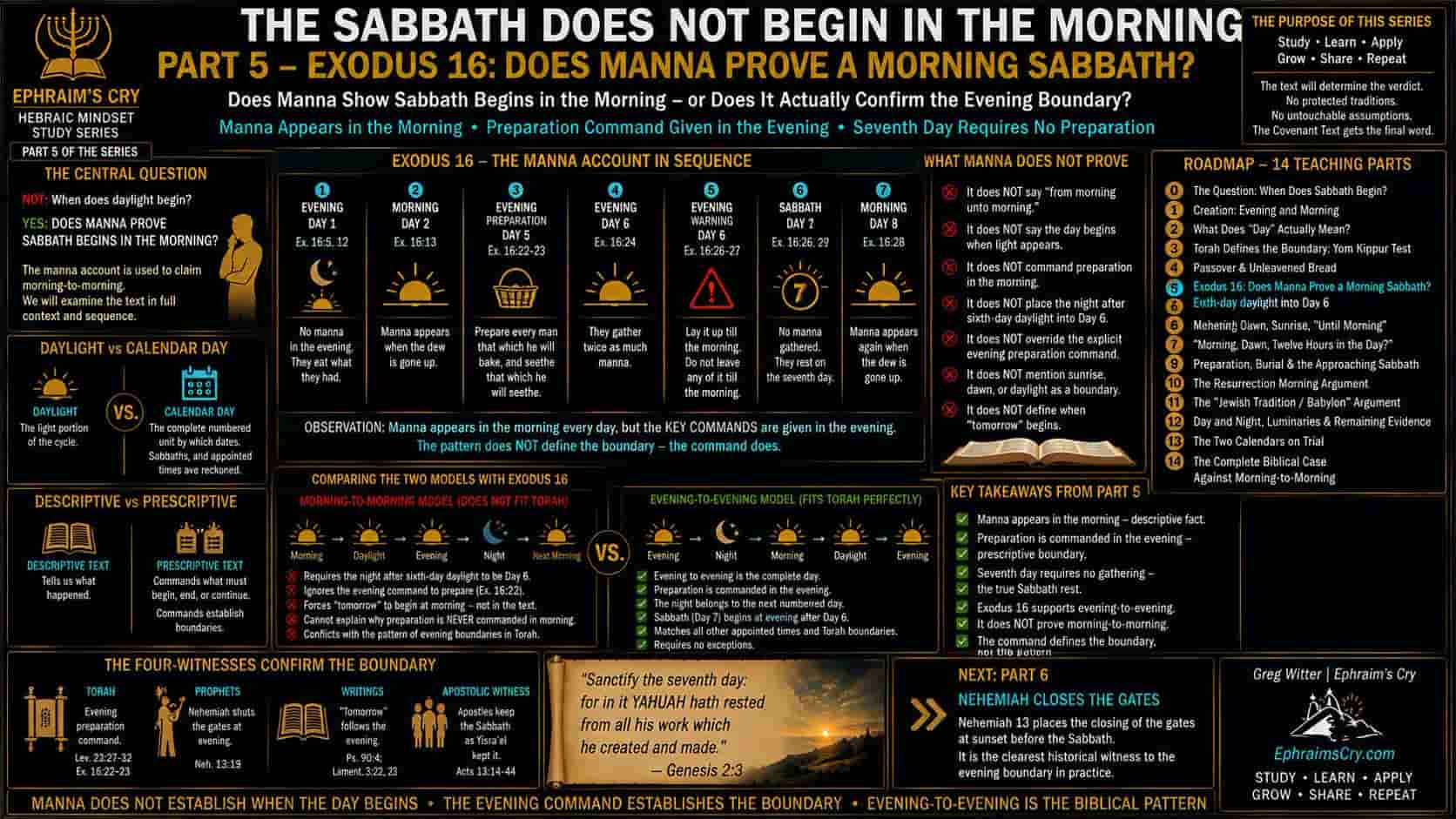
THE SABBATH DOES NOT BEGIN IN THE MORNING
PART 5 — EXODUS 16: DOES MANNA PROVE A MORNING SABBATH?
Greg Witter | Ephraim’s Cry
Hebraic Mindset Study Series
Study • Learn • Apply • Grow • Share • Repeat
The Manna Appeared in the Morning — But Did the Sabbath Begin in the Morning?
Preparation Happens Before Sabbath • Morning Identifies the Gathering Period • “Tomorrow” Does Not Define the Calendar Boundary • The Text Must Say What We Claim It Says
The morning-to-morning argument now arrives at what many consider one of its strongest passages: Exodus 16.
The argument sounds straightforward.
Manna appeared in the morning. Yisra’el gathered manna in the morning. On the sixth day they gathered twice as much. Moses told them, “Tomorrow is the rest of the holy sabbath unto Yahuah.” The following morning no manna was provided for gathering.
Therefore, the argument concludes:
THE SABBATH MUST HAVE BEGUN THAT MORNING.
But does Exodus 16 actually say that?
That is the question.
We are not asking whether manna was gathered in the morning. It was.
We are not asking whether the seventh morning was Sabbath. It was.
We are asking something much more precise:
DOES THE FACT THAT THE SEVENTH MORNING OCCURRED DURING SABBATH PROVE THAT THE SABBATH BEGAN THAT MORNING?
Those are not the same proposition.
Part 5 puts Exodus 16 under examination.
BEGIN WITH THE CONTEXT
Exodus 16 occurs after Yisra’el has departed Mitsrayim and before Sinai.
The people enter the wilderness and complain concerning food.
Yahuah responds by providing bread from heaven.
Exodus 16:4 says:
“Behold, I will rain bread from heaven for you; and the people shall go out and gather a certain rate every day…”
But the manna is not merely food.
It becomes a test of obedience.
The verse continues:
“that I may prove them, whether they will walk in my law, or no.”
That statement matters.
The manna cycle teaches Yisra’el obedience before the formal giving of the covenant instructions at Sinai.
And the seventh-day Sabbath is central to the test.
THE MANNA CYCLE
The basic pattern is straightforward.
For six days manna is provided.
The people gather what they need.
On the sixth day they gather twice as much.
They prepare the extra portion.
On the seventh day no manna is provided for gathering.
The seventh day is Sabbath.
The sequence establishes:
SIX DAYS — GATHER
DAY 6 — DOUBLE PORTION / PREPARE
DAY 7 — DO NOT GATHER
That much is clear.
But none of those statements yet defines the beginning of the seventh calendar day.
MANNA APPEARED IN THE MORNING
Exodus 16:13–14 says:
“and in the morning the dew lay round about the host. And when the dew that lay was gone up, behold, upon the face of the wilderness there lay a small round thing…”
The manna becomes visible in connection with the morning.
Verse 21 says:
“And they gathered it every morning, every man according to his eating: and when the sun waxed hot, it melted.”
This establishes a functional gathering period.
MORNING → GATHER MANNA
Then:
SUN BECOMES HOT → MANNA MELTS
That tells us when manna could be gathered.
It does not yet tell us when the calendar date began.
THE MANNA HAD TO BE GATHERED IN THE MORNING
Why did Yisra’el gather manna in the morning?
Because that is when it was available.
Once the sun became hot, it melted.
Therefore morning gathering was dictated by the nature of the provision.
This is extremely important.
The morning is connected directly to:
MANNA AVAILABILITY
and:
HUMAN ACTIVITY.
It does not follow automatically that morning is connected to:
CALENDAR RESET.
Those are separate questions.
THE MORNING-TO-MORNING ARGUMENT CONFUSES EVENT TIME WITH DAY BOUNDARY
The argument effectively says:
Manna was gathered in the morning.
No manna was gathered on Sabbath.
Therefore:
Sabbath began in the morning.
That conclusion does not logically follow.
Consider the difference.
If Sabbath had already begun the previous evening, what would we expect on Sabbath morning?
Exactly what Exodus records:
NO MANNA TO GATHER.
Therefore the absence of manna on the seventh morning is completely compatible with an evening-start Sabbath.
The seventh morning proves that Sabbath existed by morning.
It does not prove Sabbath began at morning.
That distinction is decisive.
THE SIXTH DAY IS THE PREPARATION DAY
Now examine Exodus 16:22.
“And it came to pass, that on the sixth day they gathered twice as much bread…”
The rulers report this to Moses.
Then verse 23 says:
“This is that which Yahuah hath said, Tomorrow is the rest of the holy sabbath unto Yahuah: bake that which ye will bake to day, and seethe that ye will seethe…”
This establishes preparation.
On Day 6:
Gather twice as much.
Bake what needs baking.
Boil what needs boiling.
Prepare what needs preparing.
Preserve the remainder.
Why?
Because Sabbath is approaching.
The sixth day is functioning as preparation for the seventh.
“TOMORROW” IS THE CENTRAL MORNING ARGUMENT
The morning-to-morning position emphasizes Moses’ statement:
“Tomorrow is the rest of the holy sabbath.”
The argument is:
Moses said “tomorrow.”
Tomorrow begins in the morning.
Therefore Sabbath begins in the morning.
But the second premise is being assumed.
The word “tomorrow” identifies the approaching subsequent day.
It does not, by itself, define the precise astronomical boundary at which that day begins.
That must be established separately.
WE STILL SPEAK THIS WAY
Suppose at 5:00 PM I say:
“Tomorrow is Sabbath.”
Have I just proven Sabbath cannot begin three hours later at sunset?
No.
I have identified the approaching calendar day according to ordinary speech.
Likewise, someone can say on Friday afternoon:
“Tomorrow is Saturday.”
That statement does not establish whether a particular religious calendar reckons the date from midnight, sunset, or sunrise.
“Tomorrow” identifies succession.
It does not necessarily define boundary mechanics.
THE HEBREW CONCEPT OF “TOMORROW” MUST BE USED CONTEXTUALLY
The Hebrew term commonly rendered “tomorrow” or “the morrow” can refer to the following day or subsequent time.
But lexical meaning alone cannot answer:
AT WHAT EXACT MOMENT DOES THAT NEXT CALENDAR DAY BEGIN?
Again, context must determine function.
The word tells us what follows.
It does not automatically tell us where the date boundary lies.
EXODUS 16:23 NEVER SAYS “THE SABBATH BEGINS TOMORROW MORNING”
This needs to be stated plainly.
Moses says:
“Tomorrow is the rest of the holy sabbath unto Yahuah.”
He does not say:
“Tomorrow morning begins the Sabbath.”
He does not say:
“At sunrise the Sabbath begins.”
He does not say:
“The sixth day continues throughout tonight.”
He does not say:
“The seventh day begins when the manna would normally appear.”
Every one of those statements must be added by the morning-to-morning interpreter.
The text itself does not contain them.
PREPARATION BEFORE SABBATH FITS EVENING RECKONING NATURALLY
Under evening-to-evening reckoning, the sequence is simple.
DAY 6 — MORNING
Gather the double portion.
DAY 6 — DAYLIGHT
Prepare the food.
Bake.
Boil.
Complete necessary preparation.
DAY 6 — EVENING
The sixth day closes.
DAY 7 — SABBATH BEGINS.
Night passes.
DAY 7 — MORNING
No manna appears for gathering.
Why?
Because it is already Sabbath.
Nothing in Exodus 16 contradicts that sequence.
NOW APPLY MORNING-TO-MORNING RECKONING
Under the morning model:
DAY 6 — MORNING
Gather the double portion.
DAY 6 — DAYLIGHT
Prepare the food.
DAY 6 — EVENING
The sixth day supposedly continues.
DAY 6 — NIGHT
Still Day 6.
NEXT MORNING
Day 7 begins.
Sabbath begins.
No manna appears.
Is that sequence theoretically possible?
Yes.
But does Exodus 16 explicitly establish it?
No.
Both models can explain the absence of manna on the seventh morning.
Therefore the morning manna cannot, by itself, decide the boundary question.
We need additional evidence.
THIS IS CRITICAL: EXODUS 16 DOES NOT DISTINGUISH THE MODELS AT MORNING
At Sabbath morning:
The evening model predicts:
NO MANNA.
The morning model predicts:
NO MANNA.
Therefore:
NO MANNA ON SABBATH MORNING CANNOT PROVE WHICH MODEL IS CORRECT.
This is basic logical testing.
Evidence that both models predict cannot distinguish between them.
The boundary must be established somewhere else.
WHAT WOULD DISTINGUISH THE MODELS?
We would need evidence concerning the preceding evening and night.
Was that period already Sabbath?
Or was it still Day 6?
That is the disputed period.
The morning manna tells us nothing decisive about that question.
It tells us what happened after morning arrived.
The debate concerns what happened before morning arrived.
That is why using morning manna as proof of a morning Sabbath misses the actual disputed boundary.
THE DISPUTED HOURS ARE THE NIGHT BEFORE
This should be visualized clearly.
Both sides agree:
SEVENTH-DAY MORNING = SABBATH.
The disagreement concerns:
THE PRECEDING NIGHT.
Evening model:
PRECEDING EVENING/NIGHT = SABBATH / DAY 7.
Morning model:
PRECEDING EVENING/NIGHT = DAY 6 / NOT YET SABBATH.
Therefore any proof offered from the seventh morning does not settle the disputed nighttime period.
The argument must address the boundary itself.
EXODUS 16:24 SHOWS THE PREPARED PORTION SURVIVED
Verse 24 says:
“And they laid it up till the morning, as Moses bade: and it did not stink, neither was there any worm therein.”
Morning advocates sometimes emphasize this:
The manna was stored until morning.
Therefore, they argue, morning marks the new day.
But what does the verse actually establish?
It establishes that the preserved manna remained usable until morning.
That is all.
“UNTIL MORNING” = STORAGE / DEADLINE LANGUAGE.
It does not automatically mean:
“AT MORNING THE CALENDAR DATE CHANGED.”
We addressed this category already in Parts 2 and 4.
The same principle applies here.
THE MIRACLE WAS THAT THE MANNA DID NOT ROT
Normally, stored manna became foul.
Exodus 16:19–20 says Moses instructed the people not to leave it until morning, but some did, and it bred worms and stank.
Yet the sixth-day extra portion did not spoil.
Why?
Because Yahuah preserved it for Sabbath.
Therefore “until morning” is directly connected with the preservation miracle.
Turning that phrase into a calendar-boundary statement ignores the immediate point of the narrative.
EXODUS 16:25 — “EAT THAT TODAY”
Moses says on the seventh day:
“Eat that to day; for to day is a sabbath unto Yahuah: to day ye shall not find it in the field.”
Morning advocates may argue:
Moses says “today” in the morning; therefore the Sabbath began that morning.
Again, the conclusion does not follow.
If Sabbath began the previous evening, then Sabbath morning is still:
TODAY — THE SABBATH.
Saying “today is Sabbath” in the morning tells us the identity of the current day.
It does not tell us when that day began.
AN EVENT INSIDE A DAY DOES NOT DEFINE THE BEGINNING OF THAT DAY
This principle is simple.
If at 9:00 AM I say:
“Today is Wednesday,”
I have not proven Wednesday began at 9:00 AM.
If at sunrise Moses says:
“Today is Sabbath,”
that proves Sabbath is underway.
It does not prove Sabbath began at sunrise.
The distinction between:
IDENTIFYING THE CURRENT DAY
and:
DEFINING THE BEGINNING OF THE CURRENT DAY
must remain intact.
EXODUS 16:26 IDENTIFIES THE SIX-PLUS-ONE PATTERN
“Six days ye shall gather it; but on the seventh day, which is the sabbath, in it there shall be none.”
This establishes:
DAYS 1–6 — MANNA GATHERING
DAY 7 — SABBATH / NO MANNA GATHERING
Again, no dispute.
But the verse still does not say:
“Day 7 begins in the morning.”
The seventh day must have a boundary, but Exodus 16:26 does not define that boundary explicitly.
SOME PEOPLE WENT OUT TO GATHER ON THE SEVENTH DAY
Exodus 16:27 says:
“And it came to pass, that there went out some of the people on the seventh day for to gather, and they found none.”
This demonstrates disobedience.
They were told there would be no manna.
They went looking anyway.
Yahuah responds:
“How long refuse ye to keep my commandments and my laws?”
The Sabbath test concerns obedience.
But again, their going out during the daylight portion of Sabbath does not establish when Sabbath began.
EXODUS 16:29 — “ABIDE YE EVERY MAN IN HIS PLACE”
Verse 29 says:
“See, for that Yahuah hath given you the sabbath, therefore he giveth you on the sixth day the bread of two days…”
The logic is explicit:
DAY 6 PROVIDES FOR DAY 7.
The sixth day prepares for Sabbath.
This reinforces the preparation principle.
But the text still does not say:
“The transition occurs at sunrise.”
THE PREPARATION PRINCIPLE ACTUALLY FITS AN EVENING TRANSITION VERY WELL
Think functionally.
The double portion is gathered in the morning of Day 6.
Food preparation occurs during Day 6.
By evening, preparation can be complete.
Then the household enters Sabbath.
That is an orderly transition:
GATHER → PREPARE → COMPLETE LABOR → ENTER REST.
The evening model gives the sixth day a natural preparation period before Sabbath begins.
The morning model extends the sixth day throughout the entire following night.
Again, that is possible only if Scripture establishes it.
Exodus 16 does not.
WHAT ABOUT THE QUAIL IN THE EVENING?
This is an important part of Exodus 16 that is sometimes ignored.
Exodus 16:12 says:
“At even ye shall eat flesh, and in the morning ye shall be filled with bread.”
Then verse 13 says:
“at even, that the quails came up, and covered the camp: and in the morning the dew lay round about the host.”
The passage itself distinguishes:
EVENING — QUAIL
and:
MORNING — MANNA.
This demonstrates functional time periods.
It does not say either event creates a calendar boundary.
The evening event does not prove the day begins at evening by itself.
The morning event does not prove the day begins at morning by itself.
Events are not boundaries unless the text makes them boundaries.
That standard must be applied consistently.
WE WILL NOT CHEAT FOR THE EVENING MODEL EITHER
This is important.
We cannot say:
“Quail came at evening, therefore Exodus 16 proves the day begins at evening.”
That would commit the same error we are exposing.
An evening event is not automatically an evening calendar boundary.
Likewise:
A morning event is not automatically a morning calendar boundary.
The evidence must actually address the boundary.
This is text-first study.
EXODUS 16 MUST BE READ WITH THE TORAH ALREADY EXAMINED
While Exodus 16 does not explicitly define the boundary, other Torah passages do provide boundary evidence.
We have already examined:
CREATION — EVENING → MORNING
YOM KIPPUR — FROM EVENING UNTO EVENING
PASSOVER / UNLEAVENED BREAD — EVENING TRANSITIONS
Therefore Exodus 16 cannot legitimately be isolated from those witnesses.
If Exodus 16 contained an explicit morning boundary, we would have to reconcile the passages.
But it does not.
Instead, Exodus 16 is fully compatible with the evening structure already established.
“BUT EXODUS 16 COMES BEFORE LEVITICUS 23”
Chronologically within the narrative, yes.
But we possess the entire Torah witness.
The purpose of interpretation is not to pretend later Torah clarification does not exist.
Torah interprets Torah.
A later explicit instruction can clarify a temporal structure that an earlier narrative does not explicitly define.
That is not importing foreign theology.
It is allowing the covenant document to interpret itself.
THE MANNA TEST IS THEREFORE DIFFERENT FROM THE YOM KIPPUR TEST
Yom Kippur gives us:
NUMBERED DATE + EXPLICIT BEGINNING + EXPLICIT ENDING.
Exodus 16 gives us:
MORNING ACTIVITY + PREPARATION + SABBATH IDENTITY + NO MANNA.
Those are different types of evidence.
Therefore Yom Kippur carries greater weight when the specific question is:
WHAT IS THE CALENDAR BOUNDARY?
Exodus 16 carries enormous weight concerning:
SABBATH OBEDIENCE
and:
PREPARATION.
But it does not explicitly establish sunrise as the boundary.
DESCRIPTIVE VERSUS PRESCRIPTIVE — AGAIN
This is exactly why Part 0 established the methodological rule before we began the series.
“They gathered it every morning”
is descriptive of manna gathering.
“From evening unto evening”
is prescriptive boundary language for an appointed Sabbath.
They should not be treated as though they answer the same question with equal directness.
The explicit must govern the inferred.
THE MORNING MODEL IS READING ITS CONCLUSION INTO THE TEXT
Here is what Exodus 16 actually says:
Manna is gathered in the morning.
A double portion is gathered on Day 6.
Food is prepared.
Moses says tomorrow is Sabbath.
The extra manna survives until morning.
The seventh day is Sabbath.
No manna is found.
Some people disobediently go looking.
Yahuah rebukes them.
Now here is what the morning theory adds:
“Therefore the Sabbath began at that morning.”
That final sentence is not in Exodus 16.
It is the interpretation being debated.
It cannot be smuggled into the evidence and then presented as though Moses said it.
THE QUESTION IS NOT WHETHER SABBATH MORNING EXISTS
Of course Sabbath has a morning.
An evening-to-evening Sabbath contains:
EVENING → NIGHT → MORNING → DAYLIGHT → EVENING
Therefore finding Sabbath activity, Sabbath instruction, or the absence of manna in the morning is exactly what evening-to-evening reckoning predicts.
This point cannot be overstated.
A morning occurring during Sabbath is not evidence that morning started Sabbath.
To establish that, the text would need to identify morning as the transition from Day 6 into Day 7.
Exodus 16 never does.
THE MORNING ARGUMENT PROVES TOO LITTLE
Let us put the argument into formal terms.
Premise 1: Manna normally appeared in the morning.
True.
Premise 2: No manna appeared for gathering on the seventh-day morning.
True.
Premise 3: The seventh day was Sabbath.
True.
Then comes the proposed conclusion:
Therefore the Sabbath began that morning.
That conclusion does not follow.
The evidence proves:
BY THE SEVENTH MORNING, IT WAS SABBATH.
It does not prove:
THE SEVENTH MORNING WAS THE MOMENT SABBATH BEGAN.
That difference is the heart of the Exodus 16 controversy.
THE TWO MODELS MAKE THE SAME PREDICTION FOR SABBATH MORNING
This is one of the strongest logical tests in the entire teaching.
EVENING-TO-EVENING MODEL
Day 6 daylight → preparation → evening → Sabbath begins → night → Sabbath morning → no manna.
MORNING-TO-MORNING MODEL
Day 6 daylight → evening → night remains Day 6 → morning → Sabbath begins → no manna.
At the point where manna would normally be gathered, both models predict:
NO MANNA.
Therefore the absence of manna cannot distinguish between the models.
The disputed evidence must come from the period before that morning.
And Exodus 16 does not explicitly say the preceding night remained Day 6.
“TOMORROW” DOES NOT SOLVE THE PROBLEM
Return to Exodus 16:23:
“Tomorrow is the rest of the holy sabbath unto Yahuah.”
Morning advocates frequently treat “tomorrow” as though Moses had said:
“At tomorrow morning the Sabbath begins.”
He did not.
“Tomorrow” identifies the approaching seventh day.
The word itself does not define whether that day begins at evening, midnight, or morning.
To make “tomorrow” establish sunrise, the morning boundary must already have been assumed.
Then that assumption is read back into the word.
That is circular reasoning.
THE ARGUMENT BECOMES CIRCULAR
The reasoning effectively becomes:
The biblical day begins in the morning.
Therefore:
“Tomorrow” begins in the morning.
Therefore:
When Moses says “tomorrow is Sabbath,” Sabbath begins in the morning.
Therefore:
The biblical day begins in the morning.
The conclusion has been placed inside the premise.
Nothing has actually been proven.
A text-first study must break that circle and ask:
What independently establishes when “tomorrow” begins?
Exodus 16:23 does not answer that question.
“UNTIL MORNING” DOES NOT SOLVE IT EITHER
Verse 24 says the extra manna was kept:
“till the morning.”
Again, the immediate issue is preservation.
Ordinary manna kept overnight spoiled.
The Sabbath portion did not.
The miracle demonstrated Yahuah’s provision for the seventh day.
The text does not say:
“And when morning arrived the calendar changed from Day 6 to Day 7.”
That is not what “until morning” is doing in the passage.
THE SAME PHRASE CAN MARK A DEADLINE WITHOUT MARKING A DATE
This principle appears throughout Scripture.
Something may be commanded:
Until morning,
Until evening,
Until the third day,
Until a particular event,
Or until a specified condition changes.
Those expressions define the duration of the command in context.
They do not automatically define the universal calendar boundary.
We must stop turning every temporal deadline into calendar legislation.
WHAT ABOUT THE FACT THAT THE MANNA DID NOT STINK?
That detail actually tells us why morning is mentioned.
Exodus 16:20 says manna improperly retained ordinarily:
“bred worms, and stank.”
But the sixth-day extra portion remained good.
Verse 24:
“it did not stink, neither was there any worm therein.”
The narrative emphasis is:
YAHUAH SUPERNATURALLY PRESERVED THE SABBATH PORTION.
Morning demonstrates that preservation.
The verse is not attempting to define the beginning of the seventh calendar day.
THE SIXTH-DAY DOUBLE PORTION IS ABOUT PREPARATION
Exodus 16:22–23 should be allowed to retain its actual emphasis.
On Day 6:
GATHER DOUBLE.
BAKE.
BOIL.
PREPARE.
LAY UP WHAT REMAINS.
Why?
Because ordinary gathering will cease for Sabbath.
This is covenant preparation.
The text teaches Yisra’el to anticipate the set-apart day before it arrives.
That principle is much clearer than any supposed morning-boundary doctrine.
PREPARATION REQUIRES ANTICIPATION
The Sabbath is not something Yisra’el discovers accidentally when the sun rises and manna fails to appear.
They already know it is coming.
They prepare beforehand.
Moses announces it beforehand.
The food is prepared beforehand.
The extra portion is preserved beforehand.
The Sabbath therefore exists as an anticipated covenant appointment before the seventh morning ever arrives.
The morning merely confirms the reality for which they have already prepared.
THEY DID NOT WAKE UP AND DISCOVER THAT IT HAD BECOME SABBATH
This is another important point.
The narrative does not present the seventh morning as though a new Sabbath boundary suddenly catches Yisra’el by surprise.
Moses has already told them:
“Tomorrow is the rest of the holy sabbath unto Yahuah.”
They have already gathered.
They have already prepared.
They have already preserved the Sabbath portion.
The seventh morning occurs inside a previously announced and prepared-for appointment.
Nothing in the text says the appointment itself begins when they wake.
EXODUS 16 ACTUALLY ESTABLISHES SABBATH BEFORE SINAI
This is one of the larger theological implications of the chapter.
Exodus 16 occurs before Exodus 20.
Yet Yahuah says in Exodus 16:28:
“How long refuse ye to keep my commandments and my laws?”
Then verse 29 says:
“See, for that Yahuah hath given you the sabbath…”
The Sabbath was not invented by the Ten Commandments at Sinai.
The people are already being tested concerning it.
That agrees with Genesis 2.
Creation established the seventh day.
Exodus 16 trains Yisra’el in its observance.
Exodus 20 later codifies the command within the covenant declaration and points directly back to Creation.
THIS CREATES A CONTINUOUS TORAH WITNESS
The progression is powerful:
GENESIS 2
Seventh day blessed and set apart.
EXODUS 16
Yisra’el trained to prepare for and rest on the seventh day.
EXODUS 20
“Remember the sabbath day.”
The command points back to Creation.
There is continuity.
Nothing in Exodus 16 announces a new morning boundary.
WHAT ABOUT EXODUS 16:29 — “THE SIXTH DAY THE BREAD OF TWO DAYS”?
Verse 29 says Yahuah gives:
“on the sixth day the bread of two days.”
That establishes provision spanning Day 6 and Day 7.
But it still does not define where Day 6 ends.
The verse tells us which numbered days the provision serves.
It does not state:
“Day 6 ends at the following sunrise.”
Again, identity is not boundary.
THE TEXT DISTINGUISHES NUMBERED DAYS FROM GATHERING PERIODS
This is another important observation.
The manna is gathered:
Every morning.
But the days themselves are numbered:
Day 1 through Day 7.
The morning is therefore an activity period occurring within the numbered cycle.
Nothing requires us to identify the gathering period with the boundary of that numbered cycle.
The distinction is perfectly natural.
THE MORNING MODEL MUST FIND THE MISSING SENTENCE
At this stage, ask the morning-to-morning advocate to locate one statement in Exodus 16:
“THE SEVENTH DAY BEGAN IN THE MORNING.”
Where is it?
It is not verse 13.
That says the dew appeared in the morning.
It is not verse 21.
That says manna was gathered every morning.
It is not verse 23.
That says tomorrow is Sabbath.
It is not verse 24.
That says the preserved manna remained good until morning.
It is not verse 25.
That says today is Sabbath.
It is not verse 26.
That says the seventh day is Sabbath.
It is not verse 27.
That says some people went to gather on the seventh day.
It is not verse 29.
That says Yahuah gave the Sabbath and provided double on Day 6.
The missing sentence does not exist.
WHAT EXODUS 16 ACTUALLY PROVES
Let us separate the established facts from the imported conclusion.
Exodus 16 proves:
1. MANNA WAS PROVIDED FOR SIX DAYS.
2. MANNA WAS GATHERED IN THE MORNING.
3. THE SUN’S HEAT MELTED THE MANNA.
4. DAY 6 REQUIRED A DOUBLE PORTION.
5. DAY 6 FUNCTIONED AS PREPARATION FOR SABBATH.
6. MOSES ANNOUNCED THAT THE FOLLOWING DAY WAS SABBATH.
7. THE EXTRA MANNA WAS MIRACULOUSLY PRESERVED.
8. DAY 7 WAS THE SABBATH.
9. NO MANNA WAS AVAILABLE FOR GATHERING ON DAY 7.
10. SOME PEOPLE DISOBEYED AND ATTEMPTED TO GATHER ANYWAY.
11. YAHUAH REBUKED THEIR DISOBEDIENCE.
12. THE SABBATH WAS ALREADY BEING OBSERVED BEFORE SINAI.
Those conclusions are firmly grounded in the text.
Now add the claim:
13. THE SABBATH BEGAN AT SUNRISE.
Where does Exodus 16 establish number 13?
It does not.
That is the problem.
WHAT EXODUS 16 DOES NOT SAY
Exodus 16 does not say:
“The day begins at morning.”
It does not say:
“The sixth day ends at sunrise.”
It does not say:
“The seventh day begins when manna would normally appear.”
It does not say:
“The preceding night belongs to Day 6.”
It does not say:
“The Sabbath begins at dawn.”
It does not say:
“From morning unto morning shall you keep Sabbath.”
Those are precisely the statements the morning model needs.
They are absent.
THE MORNING-TO-MORNING CLAIM HAS NOT BEEN PROVEN
This is the correct conclusion from Exodus 16.
We should not say Exodus 16 alone proves evening-to-evening.
It does not explicitly state:
“Sabbath begins at evening.”
But neither does it prove morning-to-morning.
And because the morning position repeatedly presents Exodus 16 as positive proof of sunrise Sabbath reckoning, that distinction is devastating to the claim.
The supposed proof text does not actually prove the proposition.
NOW PUT EXODUS 16 BACK INTO THE LARGER TORAH WITNESS
This is where the cumulative case becomes important.
CREATION
Evening → morning repeated.
YOM KIPPUR
From evening unto evening.
PASSOVER / UNLEAVENED BREAD
Evening transitions frame appointed-time observance.
EXODUS 16
Morning manna demonstrates morning activity, but gives no morning calendar boundary.
The pieces do not conflict.
They fit.
The morning-to-morning theory, however, still lacks an explicit morning-boundary command.
EXPLICIT EVIDENCE OUTWEIGHS AN INFERENCE FROM MANNA
This is the interpretive hierarchy.
When one passage explicitly says:
“FROM EVENING UNTO EVENING”
And another says:
“THEY GATHERED IT EVERY MORNING,”
We must ask which statement actually addresses a boundary.
The first does.
The second describes an activity.
Using the activity statement to overthrow the boundary statement reverses sound interpretation.
THE MANNA WAS A TEST OF OBEDIENCE — SO WE SHOULD HANDLE IT OBEDIENTLY
There is a certain irony here.
Exodus 16 exists partly to test whether Yisra’el will follow Yahuah’s instruction.
Therefore we should be particularly careful not to make the passage say something Yahuah did not say.
If the text says morning gathering, say morning gathering.
If the text says Sabbath, say Sabbath.
If the text says tomorrow, say tomorrow.
But do not add:
“Therefore Sabbath begins at sunrise”
Unless Scripture establishes that connection.
Obedience includes handling the Word accurately.
THE PREPARATION PATTERN WILL RETURN IN THE APOSTOLIC WITNESS
This is something to remember for later in the series.
Exodus 16 establishes:
DAY 6 → PREPARATION → DAY 7 SABBATH.
When we reach the burial narratives, we again encounter:
PREPARATION → APPROACHING SABBATH → SABBATH REST.
That continuity deserves examination.
The Apostolic Witness does not appear in isolation.
It sits upon the Torah foundation.
THE FOUR-WITNESS CHECK SO FAR
We are not yet at the final verdict, but our evidence continues building.
TORAH / CREATION
Evening and morning establish the recurring pattern.
TORAH / APPOINTED TIMES
Explicit evening boundaries appear.
TORAH / MANNA
The seventh day is Sabbath, preparation occurs beforehand, and morning activity does not define the calendar boundary.
The next major step is to move from Torah instruction into historical covenant practice.
That brings us to Nehemiah.
And Nehemiah is particularly important because unlike Yom Kippur or Unleavened Bread, Nehemiah 13 deals directly with the weekly Sabbath and commerce.
THE EXODUS 16 TEST
Ask the morning model:
Does manna appear in the morning?
Yes.
Is the seventh morning Sabbath?
Yes.
Does Exodus 16 say Sabbath begins at that morning?
No.
Would evening-to-evening reckoning also predict no manna on Sabbath morning?
Yes.
Does “tomorrow” explicitly mean “the calendar changes at sunrise”?
No.
Does “until morning” explicitly establish a universal date boundary?
No.
Does Exodus 16 tell us the preceding night is still Day 6?
No.
Then Exodus 16 cannot function as proof of morning-to-morning Sabbath reckoning.
It proves Sabbath morning.
It does not prove a morning Sabbath beginning.
THE PART 5 VERDICT
The manna argument sounds powerful until the actual claim is separated from the events.
Yes:
MANNA APPEARED IN THE MORNING.
Yes:
YISRA’EL GATHERED IT IN THE MORNING.
Yes:
MOSES SAID TOMORROW WAS SABBATH.
Yes:
THE EXTRA PORTION SURVIVED UNTIL MORNING.
Yes:
NO MANNA WAS AVAILABLE ON THE SEVENTH MORNING.
Yes:
THE SEVENTH DAY WAS SABBATH.
But none of those statements says:
THE SABBATH BEGAN THAT MORNING.
That final proposition is imported.
Morning identifies the manna-gathering period.
It identifies the daylight activity period.
It identifies a time when Sabbath was already in effect.
It does not identify the calendar reset.
Therefore Exodus 16 does not rescue the morning-to-morning theory.
The supposed proof text fails to prove the claim.
And now the investigation moves into an even more difficult passage for the morning position.
NEXT — PART 6: NEHEMIAH CLOSES THE GATES
Now we leave manna and move directly into weekly Sabbath practice.
Nehemiah 13 confronts:
Buying,
Selling,
Transporting merchandise,
Loading goods,
Bringing produce into Jerusalem,
And commercial activity on the Sabbath.
Then Scripture tells us:
“WHEN THE GATES OF JERUSALEM BEGAN TO BE DARK BEFORE THE SABBATH…”
Nehemiah ordered the gates shut.
That raises a direct question.
If the Sabbath does not begin until the following morning, why does approaching darkness trigger the shutting down of Sabbath commerce?
Under morning-to-morning reckoning, the entire night should still belong to Day 6.
Under evening-to-evening reckoning:
DARKNESS APPROACHES → SABBATH APPROACHES → COMMERCE STOPS.
Part 6 will put both models against the actual historical practice.
Exodus 16 did not establish a morning boundary.
Nehemiah now takes us directly to the disputed evening.
THE GATES ARE ABOUT TO CLOSE.
#EphraimsCry#HebraicMindset#HebraicMindsetStudySeries#Yahuah#Yahusha#Torah#Covenant#Sabbath#Shabbat
#SeventhDay#BiblicalSabbath#BiblicalCalendar#BiblicalDay#EveningToEvening#MorningToMorning#Exodus16#Manna
#BreadFromHeaven#PreparationDay#TomorrowIsTheSabbath#RememberTheSabbath#Nehemiah13#AppointedTimes
#Moedim#YomKippur#Passover#UnleavenedBread#ScriptureInterpretsScripture#FourWitnesses#TextFirst #ContextMatters
#CovenantFaithfulness #TestEverything #AncientPaths #ReturnToCovenant #KingdomPreparation #StudyLearnApplyGrowShareRepeat
