
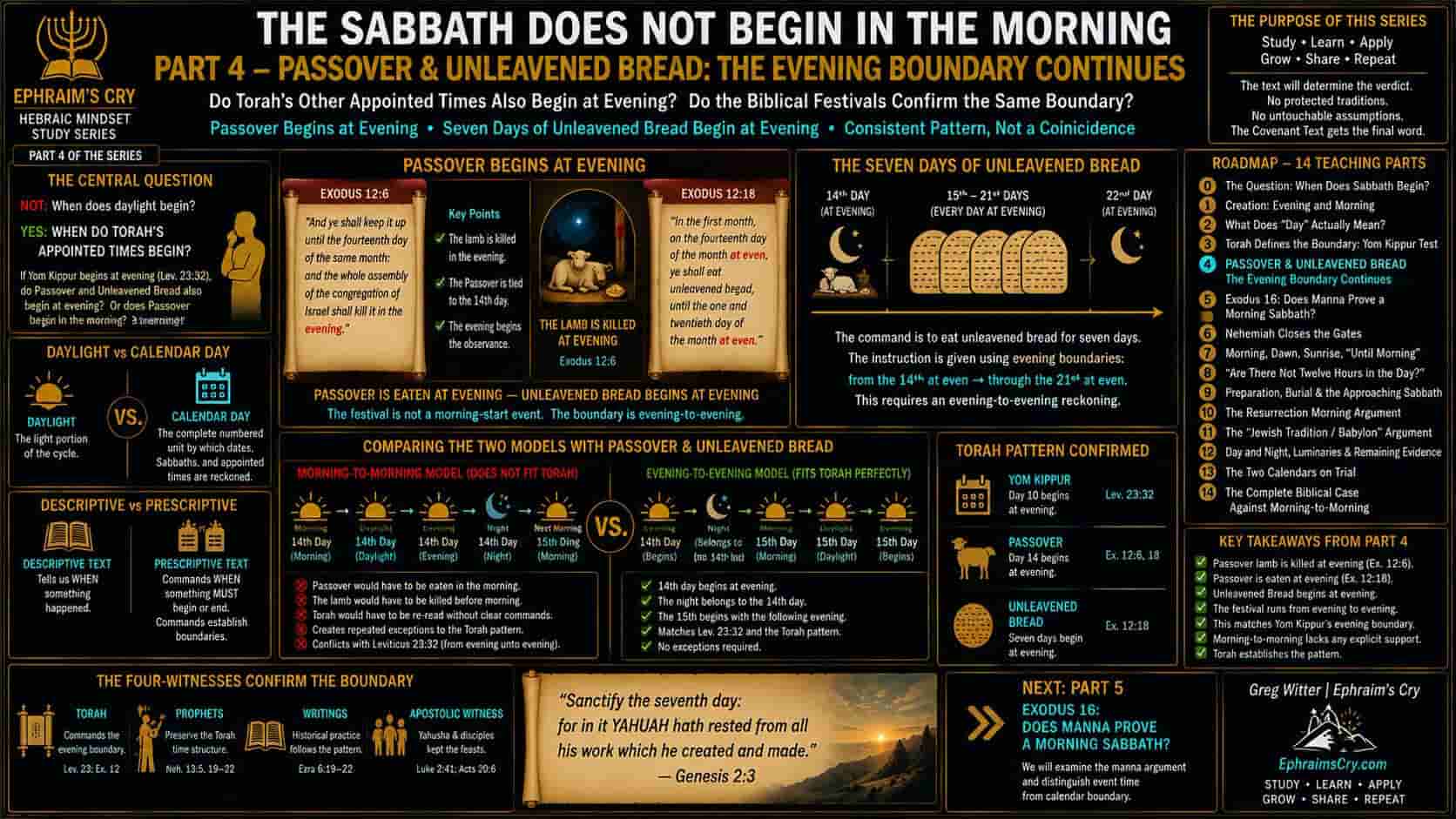
THE SABBATH DOES NOT BEGIN IN THE MORNING
PART 4 — PASSOVER AND UNLEAVENED BREAD: THE EVENING BOUNDARY CONTINUES
Greg Witter | Ephraim’s Cry
Hebraic Mindset Study Series
Study • Learn • Apply • Grow • Share • Repeat
Yom Kippur Is Not an Isolated Evening Text — Exodus and Leviticus Reveal a Consistent Appointed-Time Structure
Creation Establishes the Pattern • Context Defines the Meaning • Torah Defines the Boundary • The Appointed Times Confirm the Structure
Part 1 took us to Creation and established the repeated pattern:
EVENING → MORNING → NUMBERED DAY
Part 2 examined yom and established that “day” does not have one rigid meaning. Scripture can use it for daylight, a numbered calendar day, a specific date, or a broader period. Therefore, “Elohim called the light Day” cannot be turned automatically into “the complete calendar day begins at sunrise.”
Part 3 then moved beyond pattern and definition into explicit Torah boundary language.
Yom Kippur is:
MONTH 7 — DAY 10.
Yet Torah commands its observance beginning:
DAY 9 — AT EVENING
and continuing:
FROM EVENING UNTO EVENING.
That created a serious problem for morning-to-morning reckoning. Under a sunrise calendar, the commanded Day-10 observance begins while the calendar supposedly remains Day 9 and ends while the calendar supposedly remains Day 10.
The common response is predictable:
“Yom Kippur is an exception.”
Part 4 now asks whether evening-boundary language really is isolated to Yom Kippur.
It is not.
We now move backward in Torah to the Exodus and examine Passover and Unleavened Bread.
BEGIN WITH EXODUS — NOT LATER TRADITION
This point matters immediately.
The claim is sometimes made that evening-to-evening reckoning was imported into Yisra’el later through Babylonian influence or developed through later Judaism.
But before discussing Babylon, the Pharisees, the Mishnah, the Talmud, or rabbinic practice, we need to read Exodus.
The Exodus narrative predates every one of those later systems within the biblical record.
And Exodus contains explicit evening language connected to Yahuah’s appointed-time structure.
The question is not:
What did later Judaism do?
The question is:
What does Torah already say?
THE PASSOVER DATE IS EXPLICIT
Leviticus 23:5 says:
“In the fourteenth day of the first month at even is Yahuah’s passover.”
The appointed date is:
AVIV 14 — PASSOVER.
Then Leviticus 23:6 says:
“And on the fifteenth day of the same month is the feast of unleavened bread unto Yahuah: seven days ye must eat unleavened bread.”
Now we have two consecutive numbered dates:
AVIV 14 — PASSOVER
followed by:
AVIV 15 — UNLEAVENED BREAD BEGINS.
The dates are not interchangeable.
They are consecutive.
Therefore the transition between them matters.
EXODUS 12 GIVES US THE EVENING STRUCTURE
Exodus 12:18 says:
“In the first month, on the fourteenth day of the month at even, ye shall eat unleavened bread, until the one and twentieth day of the month at even.”
There it is again.
AT EVENING
through:
AT EVENING.
This is not Leviticus 23:32.
This is not Yom Kippur.
This is Exodus 12.
We now have another Torah passage structuring appointed-time observance through evening boundaries.
READ THE SEQUENCE CAREFULLY
The structure is:
AVIV 14 — PASSOVER
Then the fourteenth reaches evening.
Then:
AVIV 15 — FIRST DAY OF UNLEAVENED BREAD
The Feast continues for seven days.
The evening boundaries matter because Torah is moving from one numbered appointed date into another.
Again, the natural sequence is:
AVIV 14 → EVENING → AVIV 15
not:
AVIV 14 → EVENING → NIGHT STILL AVIV 14 → MORNING → AVIV 15.
The morning model can propose the second sequence.
But once again, it must explain why Torah repeatedly attaches appointed-time transitions to evening if the actual calendar date supposedly remains unchanged until morning.
THE TEXTUAL ISSUE IS LARGER THAN PASSOVER SUPPER
We must distinguish several questions that are frequently blended together.
One question is:
When was the Passover lamb slaughtered?
Another is:
When was it eaten?
Another is:
When did Aviv 14 transition into Aviv 15?
Another is:
When did the seven-day Feast of Unleavened Bread begin?
These are related questions.
They are not identical.
If they are collapsed into one question, confusion follows quickly.
Part 4 is primarily concerned with the calendar boundary.
The slaughter-time debate does not determine the calendar boundary by itself.
“BETWEEN THE EVENINGS” MUST NOT DISTRACT FROM THE PRIMARY QUESTION
Exodus 12:6 describes the slaughter of the Passover using the Hebrew expression commonly rendered:
“between the evenings.”
There has been extensive debate over the precise temporal meaning of that phrase.
Does it refer to a period beginning after noon?
Late afternoon?
Sunset?
The twilight period?
Those questions deserve their own careful study.
But notice something important.
Every one of those proposals concerns an afternoon/evening temporal range.
The disagreement does not establish:
MORNING-TO-MORNING CALENDAR RECKONING.
A disagreement over where precisely an evening expression falls cannot legitimately be transformed into evidence that the calendar begins at sunrise.
Again:
PRIMARY QUESTION: Evening or morning boundary?
SECONDARY QUESTION: Precisely where within the evening transition?
Do not confuse them.
PASSOVER AND UNLEAVENED BREAD MUST REMAIN DISTINCT
Leviticus 23 preserves the distinction clearly.
Verse 5:
AVIV 14 — PASSOVER.
Verse 6:
AVIV 15 — UNLEAVENED BREAD.
This matters because some calendar arguments blur Passover and the first day of Unleavened Bread into one undifferentiated date.
Torah does not.
Passover belongs to the fourteenth.
The Feast of Unleavened Bread begins on the fifteenth.
The transition between those numbered dates therefore becomes important evidence.
EXODUS 12:18 CONNECTS THE FEAST TO EVENING
Exodus 12:18 tells Yisra’el:
“on the fourteenth day of the month at even”
they begin the unleavened-bread period specified there.
That evening stands at the transition into the fifteenth.
Then the instruction continues:
“until the one and twentieth day of the month at even.”
The observance is therefore framed by evening.
This gives us another example where Torah does not structure the appointed period from morning to morning.
“BUT EXODUS 12:18 SAYS THE FOURTEENTH, NOT THE FIFTEENTH”
Correct.
And that is precisely why the passage matters.
The text identifies the evening attached to the fourteenth as the transition into the Feast beginning on the fifteenth.
This resembles the structure we observed with Yom Kippur:
DAY 9 AT EVENING → DAY 10 OBSERVANCE
and here:
AVIV 14 AT EVENING → AVIV 15 FEAST PERIOD
The outgoing numbered date is identified at its evening boundary as the next appointed period begins.
That is consistent calendar architecture.
THE MORNING MODEL CREATES THE SAME TYPE OF PROBLEM AGAIN
Apply morning-to-morning reckoning.
Aviv 14 begins at sunrise.
Daylight passes.
Evening arrives.
Exodus 12:18 begins the unleavened-bread observance.
But under morning reckoning:
IT IS STILL AVIV 14.
The entire night remains Aviv 14.
Then sunrise arrives.
Only then does Aviv 15 supposedly begin.
Once again, the appointed observance begins before the calendar date associated with the Feast supposedly exists.
This is strikingly similar to the Yom Kippur problem.
One exception might be argued.
But when the same structural issue appears repeatedly, calling everything an exception becomes increasingly difficult.
THE EVIDENCE IS BEGINNING TO FORM A PATTERN
We now have:
CREATION
Evening → morning.
YOM KIPPUR
Day 9 at evening → Day 10 observance → evening.
UNLEAVENED BREAD
Aviv 14 at evening → Aviv 15 Feast → evening-boundary structure.
This is no longer one isolated verse.
The evening boundary is appearing across different Torah contexts.
THE FIRST DAY OF UNLEAVENED BREAD IS A NO-WORK DAY
Leviticus 23:7 says:
“In the first day ye shall have an holy convocation: ye shall do no servile work therein.”
That first day is:
AVIV 15.
Therefore the boundary matters practically.
When does the holy convocation/no-servile-work date begin?
If Aviv 15 begins at evening, the commanded set-apart period begins then.
If Aviv 15 begins at sunrise, then the preceding night remains Aviv 14.
The calendar model changes when the commanded date begins.
This is not merely academic.
It affects obedience.
THE SEVENTH DAY OF UNLEAVENED BREAD IS ALSO SET APART
Leviticus 23:8 establishes another holy convocation on the seventh day of the Feast.
Again, numbered dates matter.
A biblical calendar is not merely concerned with identifying daylight.
It determines when commanded periods begin and end.
That is why getting the basic day boundary correct matters throughout Torah.
EXODUS 12:15 ESTABLISHES SEVEN DAYS
Exodus 12:15 says:
“Seven days shall ye eat unleavened bread.”
The Feast is not seven isolated daylight periods.
It is a seven-day appointed period.
Therefore the definition of a complete calendar day necessarily affects how the seven days are counted.
If the starting boundary is wrong, the entire Feast can be shifted.
THE EVENING BOUNDARY MAKES THE COUNT COHERENT
Under evening-to-evening reckoning:
AVIV 14 DAYLIGHT — PASSOVER
Then evening transitions into:
AVIV 15 — UNLEAVENED BREAD DAY 1
Then:
Day 16 — Feast Day 2.
Day 17 — Feast Day 3.
Day 18 — Feast Day 4.
Day 19 — Feast Day 5.
Day 20 — Feast Day 6.
Day 21 — Feast Day 7.
The appointed period is bounded coherently through the evening transitions.
THE MORNING MODEL MUST EXPLAIN THE OVERLAP
Under morning-to-morning reckoning, Exodus 12:18 begins the unleavened-bread observance during the evening/night portion that supposedly still belongs to Aviv 14.
The Feast date of Aviv 15 does not supposedly begin until sunrise.
Therefore the commanded observance again begins before the numbered Feast date.
The same structural mismatch encountered in Leviticus 23:32 appears again.
That matters.
“THE FEAST STARTS AT EVENING BUT THE CALENDAR DAY STARTS AT MORNING”
This is the likely response.
Someone may say:
“Fine. The Feast begins at evening even though Aviv 15 does not begin until morning.”
But where does Torah establish that distinction?
Where does Torah say:
“The Feast begins during Aviv 14, but its first calendar day does not begin until sunrise”?
The text does not.
That distinction is supplied by the morning model.
Again, the morning theory survives only by separating the commanded appointed-time boundary from the numbered date boundary.
HOW MANY EXCEPTIONS ARE WE GOING TO CREATE?
This is where the cumulative evidence becomes important.
Yom Kippur?
“Special exception.”
Unleavened Bread?
“Another special evening observance.”
Passover?
“Another unusual evening.”
At what point does the accumulation of “exceptions” reveal the actual rule?
If multiple Torah appointments consistently use evening transitions, perhaps evening is not the exception.
Perhaps evening is the boundary.
That possibility must at least be allowed to stand on the evidence.
EXODUS 12 OCCURS BEFORE SINAI
This is especially important historically.
Exodus 12 occurs before the giving of the covenant instructions at Sinai.
Yisra’el is still in Mitsrayim.
The Passover is connected directly with deliverance from bondage.
Therefore the evening structure cannot honestly be dismissed as something invented centuries later by rabbis.
The text places it at the foundational Exodus event.
Again:
Later tradition is not our authority.
But neither can later tradition be blamed for words already present in Exodus.
THE EXODUS ITSELF IS MARKED BY NIGHT
Exodus 12:29 describes the judgment upon Mitsrayim occurring at midnight.
Verse 31 records Pharaoh calling for Moses and Aaron by night.
The Exodus narrative therefore includes substantial nighttime activity associated with Passover and deliverance.
This should caution us against imagining biblical dates as though only daylight carries calendrical significance.
Night is fully integrated into the covenant narrative.
EXODUS 12:42 CALLS IT A NIGHT TO BE OBSERVED
Exodus 12:42 says:
“It is a night to be much observed unto Yahuah for bringing them out from the land of Egypt…”
Night is not an irrelevant gap between biblical dates.
It participates directly in covenant remembrance.
That does not by itself establish the day boundary.
But it reinforces the fact that biblical covenant time encompasses night as meaningful time within the appointed structure.
NUMBERS 33:3 ADDS IMPORTANT CHRONOLOGICAL INFORMATION
Numbers 33:3 says Yisra’el departed from Rameses:
“in the first month, on the fifteenth day of the first month; on the morrow after the passover…”
This places the departure in relationship to:
PASSOVER — AVIV 14
and:
AVIV 15 — THE MORROW AFTER PASSOVER.
This chronology must be handled carefully.
The departure narrative contains nighttime and daylight elements, and simplistic arguments from “morrow” can easily create confusion.
But one thing is clear:
Torah distinguishes Passover on the fourteenth from the fifteenth that follows it.
The date transition matters.
“MORROW” DOES NOT AUTOMATICALLY MEAN THE DATE BEGAN AT MORNING
This is where the principle established in Part 2 returns.
“Morrow” can identify the next period/day from the speaker’s narrative perspective.
It does not automatically define the technical astronomical instant when the date changed.
If Numbers 33:3 calls Aviv 15 “the morrow after the passover,” that identifies Aviv 15 as the subsequent date.
It does not say:
“Aviv 15 began at sunrise.”
That conclusion still requires additional evidence.
NARRATIVE LANGUAGE MUST NOT OVERRIDE EXPLICIT BOUNDARY LANGUAGE
This becomes a major interpretive rule.
When one passage says:
“the morrow”
and another explicitly says:
“at even”
we should not take the more ambiguous narrative expression and use it to erase the explicit temporal marker.
The explicit governs the ambiguous.
That principle prevents us from manufacturing contradictions where none are necessary.
THE EXODUS CHRONOLOGY DESERVES PRECISION
We should also resist oversimplification.
Passover chronology contains several related but distinct moments:
selection of the lamb,
slaughter,
blood application,
meal,
night of judgment,
departure preparations,
actual movement out of the land,
and the beginning of Unleavened Bread.
These events should not be compressed into one undifferentiated instant.
The purpose of this series is not to solve every Passover chronology question inside Part 4.
Our question remains narrower:
DOES TORAH PROVIDE ADDITIONAL EVIDENCE OF EVENING-BASED APPOINTED-TIME BOUNDARIES?
Yes.
LEVITICUS 23 CONFIRMS THE NUMBERED STRUCTURE
Return to Leviticus 23.
Passover:
MONTH 1 — DAY 14.
Unleavened Bread:
MONTH 1 — DAY 15.
This confirms that Torah is working with consecutive numbered calendar dates.
When Exodus 12:18 identifies the fourteenth at evening in connection with the beginning of the unleavened-bread period, the natural calendrical interpretation is that the evening boundary transitions into the fifteenth.
That interpretation agrees with what we already observed in Yom Kippur.
TWO APPOINTED-TIME WITNESSES NOW AGREE
We now have two major Torah structures.
YOM KIPPUR
DAY 9 → EVENING → DAY 10 → EVENING
PASSOVER / UNLEAVENED BREAD
AVIV 14 → EVENING → AVIV 15 → CONTINUING FEAST COUNT
Different appointed times.
Different months.
Different covenant purposes.
Same evening-transition architecture.
That is significant.
THE ARGUMENT FROM “SPECIAL FESTIVAL DAYS” IS GETTING WEAKER
Someone may still respond:
“These are annual appointed times. They do not establish the weekly Sabbath.”
That objection deserves respect.
We have not yet reached Nehemiah 13, where weekly Sabbath practice becomes explicit.
But notice what has already been established.
The morning-to-morning claim is usually broader than:
“Only weekly Sabbaths begin in the morning.”
It commonly claims that the biblical day itself begins in the morning.
If that universal claim were correct, then annual appointed dates should also operate within that morning-based calendar unless Torah explicitly says otherwise.
Instead, Torah repeatedly structures appointed dates around evening.
That creates a substantial problem for the universal morning-day claim.
IF THE CLAIM IS ONLY THAT THE WEEKLY SABBATH USES A DIFFERENT BOUNDARY, PROVE IT
The argument could retreat to:
“Ordinary calendar days and annual appointed times may use evening boundaries, but the weekly Sabbath begins at morning.”
Very well.
Where does Torah establish that distinction?
Where does Scripture say:
ANNUAL APPOINTED DAYS = EVENING
but:
WEEKLY SABBATH = MORNING?
That command must be produced.
Otherwise the distinction is another mechanism invented to preserve the morning-Sabbath theory.
ONE TORAH CALENDAR — NOT MULTIPLE INVENTED CALENDARS
The same Torah gives us:
numbered days,
weeks,
months,
the weekly Sabbath,
Passover,
Unleavened Bread,
Shavuot,
Yom Teruah,
Yom Kippur,
and Sukkot.
Instructions differ between appointments.
Of course they do.
But the existence of different instructions does not automatically mean the underlying definition of a numbered calendar date changes from feast to feast.
If someone proposes multiple definitions, Scripture must establish them.
WHAT ABOUT GENESIS 1:14?
Genesis 1:14 says the luminaries are given:
“for signs, and for seasons, and for days, and years.”
Correct.
The heavenly lights have a function in marking and governing observable time. But Genesis does not say:
“Sunrise begins every numbered calendar day.”
The luminaries help us identify and measure the temporal order established by Elohim. They do not authorize us to invent a calendar boundary that Scripture never states.
The question remains the same:
HOW DOES TORAH ITSELF RECKON THE TRANSITION BETWEEN NUMBERED DATES?
In the appointed-time passages examined thus far, evening repeatedly stands at that transition.
THE CALENDAR IS DETERMINED BY COVENANT INSTRUCTION
Astronomy tells us when the sun rises.
Astronomy tells us when the sun sets.
Astronomy can describe twilight.
Astronomy can identify lunar phases.
But astronomy does not tell us what Yahuah commanded His people to do with those observable phenomena.
That comes from Torah.
Therefore:
OBSERVATION IDENTIFIES THE PHENOMENON.
TORAH DETERMINES ITS COVENANT FUNCTION.
Sunrise undeniably begins the daylight period.
That does not automatically make sunrise the covenant calendar reset.
The latter proposition must come from Scripture.
THE PASSOVER TEST EXPOSES THE SAME CATEGORY ERROR
Notice how the argument continues returning to the same problem.
Morning advocates point to:
morning events,
daylight terminology,
“tomorrow,”
sunrise,
and activity occurring after dawn.
But none of those things answers the appointed-time boundary question.
Exodus 12 gives us evening language connected directly to the Feast.
Leviticus 23 gives us numbered dates.
The evidence must be interpreted together.
We cannot allow an event occurring in the morning to erase an explicit evening boundary.
THE NIGHT OF PASSOVER CANNOT BE TREATED AS CALENDARLY MEANINGLESS
The Passover narrative itself makes this obvious.
The lamb is eaten.
The people remain in their houses.
Judgment passes through Mitsrayim.
The firstborn are struck.
Pharaoh responds.
The people prepare to depart.
All of this occurs within a nighttime covenant context.
Night is not dead space between two meaningful daylight periods.
It is part of the chronological structure of the Exodus.
This does not by itself establish evening reckoning, but it destroys any assumption that biblical calendrical meaning belongs only to daylight.
THE FEAST BEGINS BEFORE THE NEXT MORNING ACTIVITY
This is another distinction worth emphasizing.
Under the evening model, the Feast can begin at the evening transition even though much of the visible communal activity associated with the following date occurs after morning.
There is nothing contradictory about that.
A calendar date can begin before people wake up.
The fact that major activity occurs after morning tells us when people acted.
It does not tell us when the date began.
This principle will become extremely important when we later examine resurrection morning.
HUMAN ACTIVITY IS NOT THE CALENDAR CLOCK
People sleep at night.
People rise in the morning.
People work during daylight.
People travel when they can see.
People gather when conditions permit.
Naturally, historical narratives frequently cluster activity around morning.
If we are careless, that can create the illusion that morning begins the calendar.
But it may simply demonstrate that morning begins human daytime activity.
The calendar boundary must be established independently.
EXODUS 12 DOES NOT SAY “THE DAY BEGAN IN THE MORNING”
This should be obvious, but it must be placed on the record.
Exodus 12 contains:
morning.
night.
midnight.
evening.
numbered dates.
Passover.
Unleavened Bread.
Yet nowhere does Exodus 12 say:
“THE CALENDAR DAY BEGINS IN THE MORNING.”
That statement is absent.
By contrast, the chapter explicitly says:
“ON THE FOURTEENTH DAY OF THE MONTH AT EVEN…”
and:
“UNTIL THE ONE AND TWENTIETH DAY OF THE MONTH AT EVEN.”
When investigating boundaries, explicit boundary language deserves greater weight than inferred boundaries from narrative activity.
“UNTIL MORNING” AND “UNTIL EVENING” DO NOT ALWAYS SERVE THE SAME FUNCTION
This is another place where careful interpretation matters.
Exodus 12:10 says nothing of the Passover sacrifice is to remain:
“until the morning.”
That is a disposal deadline.
Exodus 12:18 says the unleavened-bread period is reckoned:
from the fourteenth at evening until the twenty-first at evening.
That is an appointed-time temporal framework.
Those statements do not answer the same question.
The mistake is taking the morning deadline from verse 10 and making it override the evening framework of verse 18.
That reverses their functions.
DEADLINE IS NOT BOUNDARY
This distinction should now be familiar.
“Do not leave it until morning”
means:
Something must be completed by morning.
It does not necessarily mean:
Morning begins the next calendar date.
Likewise, if I say:
“Return this book before noon,”
I have established a deadline.
I have not declared noon the beginning of a new calendar date.
The same interpretive discipline must be applied to Scripture.
THE EXODUS 12:10 ARGUMENT FAILS FOR THIS REASON
Morning-to-morning proponents sometimes emphasize that Passover remains must be burned in the morning.
Then they argue that morning must begin the next date.
But that conclusion is not stated.
The command simply prevents the Passover remains from being retained beyond the appointed morning deadline.
To determine the calendar transition, we must examine the passages that actually address the appointed-time structure.
And those passages repeatedly bring us back to evening.
THE APPOINTED-TIME STRUCTURE MUST BE READ AS A WHOLE
This is why proof-texting is dangerous.
If someone isolates:
“until morning”
they can construct one impression.
If someone isolates:
“at evening”
they can construct another.
But Torah is not a collection of disconnected phrases.
We must read:
Exodus 12,
Leviticus 23,
Numbers,
and the broader covenant chronology together.
Then the structure becomes visible.
PASSOVER IS NOT THE SAME AS THE FEAST OF UNLEAVENED BREAD
This must remain locked.
Passover is:
AVIV 14.
Unleavened Bread begins:
AVIV 15.
The Feast lasts seven days.
The first and seventh days have holy-convocation requirements.
Confusing Passover with the entire Feast can produce chronological errors.
The distinction actually strengthens our calendar study because it gives us consecutive numbered dates to examine.
THE TRANSITION BETWEEN AVIV 14 AND AVIV 15 IS THEREFORE CRITICAL
If Passover is Day 14 and Unleavened Bread begins Day 15, there must be a boundary between them.
Exodus 12:18 places evening directly at the beginning of the unleavened-bread observance.
That makes evening the natural transition point between the two appointed dates.
Again:
AVIV 14 → EVENING → AVIV 15.
The morning model must insert:
AVIV 14 → EVENING → NIGHT STILL AVIV 14 → MORNING → AVIV 15.
But then it must explain why the Aviv-15 Feast observance has already begun during what it still calls Aviv 14.
That is the problem.
THE SAME PROBLEM APPEARED IN PART 3
Remember Yom Kippur.
Morning reckoning produced:
DAY 9 → EVENING / YOM KIPPUR BEGINS → NIGHT STILL DAY 9 → MORNING / DAY 10 BEGINS.
Now Unleavened Bread produces:
AVIV 14 → EVENING / UNLEAVENED BREAD BEGINS → NIGHT STILL AVIV 14 → MORNING / AVIV 15 BEGINS.
The same structural mismatch has appeared twice.
That is no longer easily dismissed as accidental.
THE EVENING MODEL PRODUCES NO SUCH MISMATCH
Evening reckoning gives:
YOM KIPPUR
Day 9 → evening → Day 10 begins → observance begins.
And:
UNLEAVENED BREAD
Aviv 14 → evening → Aviv 15 begins → Feast begins.
The numbered dates and appointed observances align.
That coherence matters.
WE ARE NOW DEALING WITH CUMULATIVE EVIDENCE
A biblical case becomes stronger when independent passages converge.
We now have:
CREATION WITNESS
Evening precedes morning repeatedly.
LEXICAL WITNESS
“Day” does not mean daylight exclusively.
YOM KIPPUR WITNESS
Day 10 begins its commanded observance at Day 9 evening and runs evening to evening.
PASSOVER / UNLEAVENED BREAD WITNESS
The transition from Passover into the Feast is structured through evening.
Each layer strengthens the next.
WHAT WOULD THE MORNING MODEL NEED TO PRODUCE?
At this stage, the morning model needs something more substantial than another morning narrative.
It needs explicit calendrical evidence.
For example:
“The numbered day begins at morning.”
Or:
“The Sabbath begins at sunrise.”
Or:
“The night following daylight belongs to the same numbered date until morning.”
Or some clear Torah chronology that requires morning-to-morning reckoning.
Without that, the theory continues to depend upon inference while evening reckoning accumulates explicit boundary evidence.
EXODUS 16 WILL BE THE NEXT MAJOR MORNING TEST
This is why the next part matters so much.
Morning-to-morning advocates frequently point to Exodus 16 and say:
“There. Manna proves the Sabbath begins in the morning.”
That argument deserves more than a paragraph.
It deserves its own teaching.
Because Exodus 16 contains:
manna,
morning,
evening,
sixth-day preparation,
“tomorrow,”
the seventh day,
and Sabbath.
If morning-to-morning reckoning is truly biblical, Exodus 16 should be one of its strongest witnesses.
So we are going to put it under examination.
But before moving there, Part 4 must finish what Passover and Unleavened Bread establish.
THE “BABYLONIAN CALENDAR” CLAIM FAILS AS A TEXTUAL ARGUMENT
Suppose someone says:
“Evening-to-evening came from Babylon.”
Our response must be:
SHOW HOW THAT EXPLAINS EXODUS 12:18.
Show how Babylon inserted:
“the fourteenth day of the month at even”
into Torah.
Show how Babylon inserted:
“the twenty-first day of the month at even.”
Show how Babylon inserted Leviticus 23:32:
“from even unto even.”
Merely attaching a historical label to a doctrine is not exegesis.
The Torah texts still have to be explained.
HISTORICAL CLAIMS MUST NEVER BE USED TO EVADE SCRIPTURE
External history can be useful.
Archaeology can be useful.
Ancient Near Eastern calendar studies can be useful.
Linguistics can be useful.
Astronomy can be useful.
But none of those disciplines has authority to rewrite the covenant text.
If an external historical theory appears to contradict the plain wording of Torah, then the first task is to examine whether the Torah has been interpreted correctly.
We do not simply declare:
“Babylon did it”
and move on.
THE TEXT-FIRST ORDER IS NONNEGOTIABLE
The proper order is:
TORAH → TEXTUAL MEANING → COVENANT CONTEXT → OTHER SCRIPTURAL WITNESSES → EXTERNAL HISTORICAL CORROBORATION WHERE USEFUL.
Not:
Historical theory → force Torah into it.
That distinction protects the study from becoming dependent upon whichever academic reconstruction happens to be popular.
WHAT PART 4 HAS ESTABLISHED
We can now state the findings precisely.
1. PASSOVER IS APPOINTED TO AVIV 14.
Leviticus 23:5.
2. THE FEAST OF UNLEAVENED BREAD BEGINS AVIV 15.
Leviticus 23:6.
3. TORAH THEREFORE DISTINGUISHES TWO CONSECUTIVE NUMBERED DATES.
4. EXODUS 12:18 CONNECTS THE BEGINNING OF THE UNLEAVENED-BREAD PERIOD WITH AVIV 14 AT EVENING.
5. EXODUS 12:18 ALSO USES AN EVENING BOUNDARY AT THE OTHER END OF THE APPOINTED PERIOD.
6. THE MORNING MODEL MAKES THE FEAST OBSERVANCE BEGIN WHILE ITS CALENDAR SUPPOSEDLY REMAINS AVIV 14 UNTIL SUNRISE.
7. THE EVENING MODEL NATURALLY ALIGNS AVIV 14 EVENING WITH THE TRANSITION INTO AVIV 15.
8. THIS REPEATS THE SAME TYPE OF DATE/OBSERVANCE ALIGNMENT ALREADY SEEN WITH YOM KIPPUR.
9. “UNTIL MORNING” PASSOVER INSTRUCTIONS ESTABLISH DEADLINES; THEY DO NOT BY THEMSELVES ESTABLISH A MORNING CALENDAR RESET.
10. DISPUTES ABOUT “BETWEEN THE EVENINGS” CONCERN THE PRECISION OF AN EVENING PERIOD, NOT EVIDENCE FOR A MORNING BOUNDARY.
11. EXODUS ALREADY CONTAINS EVENING-BOUNDARY LANGUAGE, SO EVENING RECKONING CANNOT SIMPLY BE DISMISSED AS A LATER RABBINIC INVENTION.
12. THE CLAIM THAT EVENING RECKONING CAME FROM BABYLON DOES NOT EXPLAIN AWAY THE EVENING LANGUAGE ALREADY PRESENT IN TORAH.
The evidence continues to accumulate.
THE PART 4 VERDICT
Yom Kippur was not an isolated evening text.
Passover and Unleavened Bread provide another Torah witness.
The pattern now stands:
CREATION:
EVENING → MORNING.
YOM KIPPUR:
DAY 9 → EVENING → DAY 10 → EVENING.
PASSOVER / UNLEAVENED BREAD:
AVIV 14 → EVENING → AVIV 15.
This does not mean every chronological question surrounding Passover has been exhausted.
It does mean the claim that Torah operates on an obvious universal morning-to-morning calendar is becoming increasingly difficult to sustain.
The morning model continues requiring appointed observances to begin before the numbered date supposedly begins.
The evening model allows the appointed observance and appointed date to align at the same boundary.
That is not something we should ignore.
Creation gave us the pattern.
Context clarified the meaning of yom.
Yom Kippur gave us explicit evening-to-evening boundary language.
Passover and Unleavened Bread now confirm that evening transitions are embedded elsewhere in Torah’s appointed-time architecture.
The evidence is converging.
But now we must confront one of the strongest passages used by the opposing position.
NEXT — PART 5: EXODUS 16 — DOES MANNA PROVE A MORNING SABBATH?
This is where the morning-to-morning argument believes it has strong ground.
Exodus 16 says:
manna appears in the morning.
The people gather in the morning.
A double portion is gathered on the sixth day.
Moses says:
“Tomorrow is the rest of the holy sabbath unto Yahuah.”
No manna appears for gathering on the seventh day.
Morning advocates argue:
“There it is. Sabbath begins in the morning.”
Does it?
Part 5 will examine Exodus 16 line by line.
We will distinguish:
WHEN MANNA APPEARED
from:
WHEN THE SEVENTH CALENDAR DAY BEGAN.
We will examine the sixth-day preparation.
We will examine the evening before Sabbath.
We will examine “tomorrow.”
We will examine the seventh morning.
And we will ask the question that must govern the entire passage:
DOES EXODUS 16 EVER ACTUALLY SAY THAT THE SABBATH BEGINS AT MORNING — OR IS THAT CONCLUSION BEING IMPORTED FROM THE TIME THE MANNA WAS GATHERED?
The morning model has presented Exodus 16 as evidence.
Next, we put that evidence on the table.
#EphraimsCry#HebraicMindset#HebraicMindsetStudySeries#Yahuah#Yahusha#Torah#Covenant#Sabbath#Shabbat
#SeventhDay#BiblicalSabbath#BiblicalCalendar#BiblicalDay#EveningToEvening#MorningToMorning#Passover#Pesach
#UnleavenedBread#Matzot#Aviv#Exodus12#Leviticus23#YomKippur#FromEvenUntoEven#AppointedTimes#Moedim
#BiblicalCalendarStudy#ScriptureInterpretsScripture#FourWitnesses#TextFirst #ContextMatters #CovenantFaithfulness
#TestEverything #AncientPaths #ReturnToCovenant #KingdomPreparation #StudyLearnApplyGrowShareRepeat
