
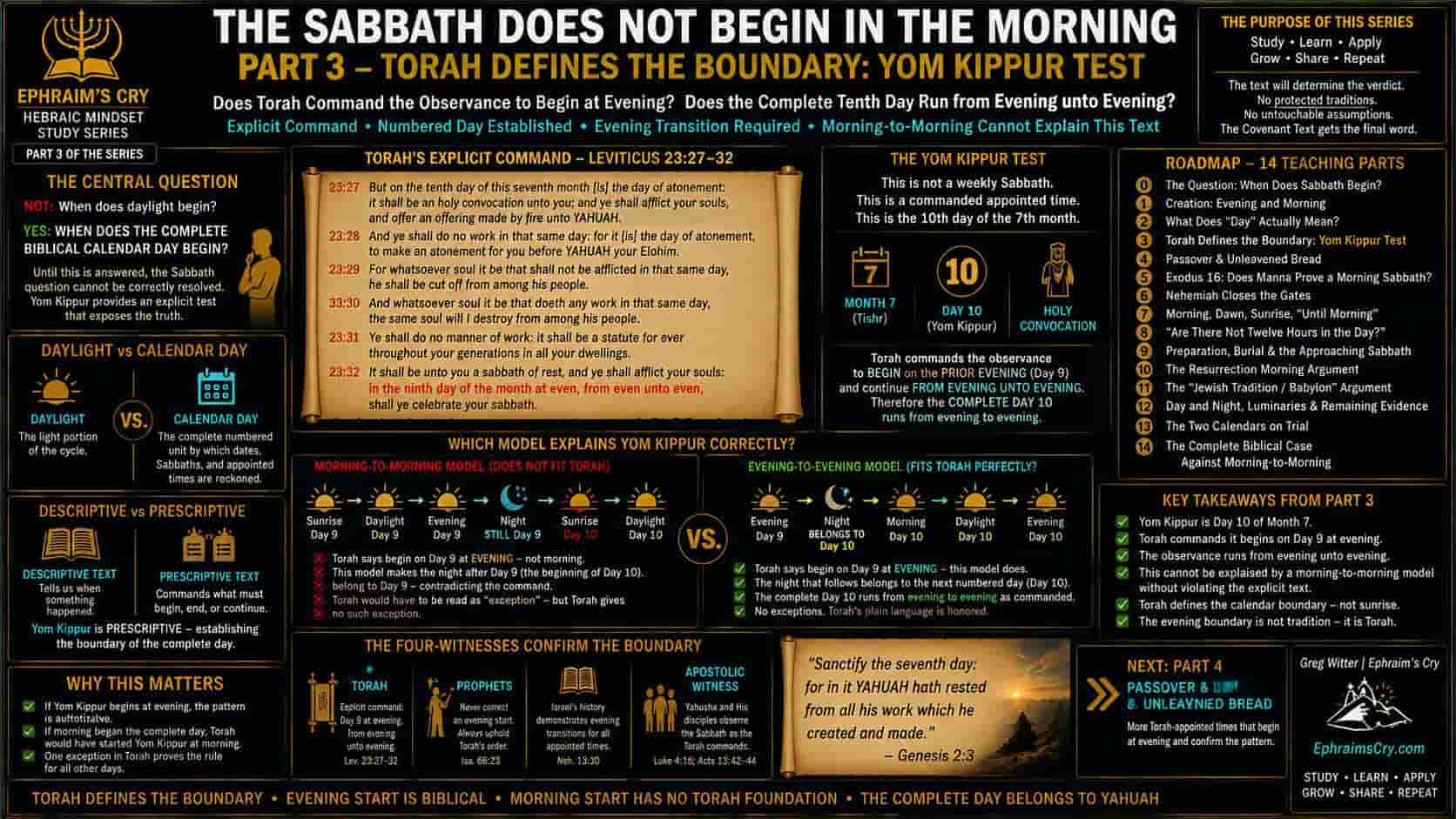
THE SABBATH DOES NOT BEGIN IN THE MORNING
PART 3 — TORAH DEFINES THE BOUNDARY
Greg Witter | Ephraim’s Cry
Hebraic Mindset Study Series
Study • Learn • Apply • Grow • Share • Repeat
The Yom Kippur Test — What Does “From Evening Unto Evening” Actually Establish?
Creation Establishes the Pattern • Context Defines the Meaning • Torah Defines the Boundary • The Covenant Witness Must Agree
Parts 1 and 2 established two foundations.
Part 1 examined Creation. Genesis repeatedly gives us:
EVENING → MORNING → NUMBERED DAY
Part 2 examined the Hebrew concept of yom and exposed the category error behind one of the primary morning-to-morning arguments. Scripture can use “day” for daylight, a numbered calendar day, a specific date, or a broader period. Therefore:
“Elohim called the light Day”
does not automatically mean:
“The complete numbered calendar day begins when light begins.”
Now we move from pattern and definition to something stronger:
AN EXPLICIT TORAH BOUNDARY.
The question is no longer merely how yom can function.
The question becomes:
WHEN TORAH IDENTIFIES A SPECIFIC NUMBERED DAY, WHEN DOES TORAH TELL YISRA’EL TO BEGIN OBSERVING IT?
Leviticus 23 gives us the test.
BEGIN WITH THE ACTUAL TEXT
Leviticus 23:27 says:
“Also on the tenth day of this seventh month there shall be a day of atonement: it shall be an holy convocation unto you; and ye shall afflict your souls…”
The date is explicit.
MONTH 7 — DAY 10.
This is not merely daylight terminology.
It is calendrical language.
Torah has identified a particular numbered date.
Then Leviticus 23:32 says:
“It shall be unto you a sabbath of rest, and ye shall afflict your souls: in the ninth day of the month at even, from even unto even, shall ye celebrate your sabbath.”
Read those statements together.
VERSE 27: DAY 10
VERSE 32: DAY 9 AT EVENING
Then:
FROM EVENING UNTO EVENING.
That relationship must be explained by every proposed biblical calendar.
THE TEXT GIVES US THREE FIXED POINTS
Do not begin with a theory.
Begin with what Torah explicitly gives us.
POINT 1 — THE APPOINTED DATE
Yom Kippur is:
MONTH 7 — DAY 10.
POINT 2 — THE BEGINNING OF THE OBSERVANCE
Torah says:
MONTH 7 — DAY 9 — AT EVENING.
POINT 3 — THE DURATION
Torah says:
FROM EVENING UNTO EVENING.
Those are textual facts.
Now the calendar model must explain them.
THE EVENING-TO-EVENING READING IS STRAIGHTFORWARD
Under evening-to-evening reckoning:
DAY 9 proceeds through its daylight portion.
Then:
DAY 9 REACHES EVENING.
At that boundary:
DAY 10 BEGINS.
Yom Kippur begins.
The night belongs to Day 10.
Morning arrives within Day 10.
The daylight portion of Day 10 continues.
Then:
THE NEXT EVENING CLOSES DAY 10.
The command functions naturally:
DAY 9 → EVENING → DAY 10 / YOM KIPPUR → EVENING → DAY 11
Nothing needs to be added.
Nothing needs to be moved.
No special calendrical exception needs to be invented.
NOW APPLY MORNING-TO-MORNING RECKONING
Under morning-to-morning reckoning:
Day 9 begins at sunrise.
Day 9 continues through daylight.
Evening arrives.
Night falls.
But according to morning reckoning:
IT IS STILL DAY 9.
Day 10 supposedly does not begin until the following sunrise.
Yet Torah has already commanded the Day-10 observance to begin:
“in the ninth day of the month at even.”
That creates the central problem.
Under the morning model:
YOM KIPPUR BEGINS WHILE THE CALENDAR IS SUPPOSEDLY STILL ON DAY 9.
Then sunrise arrives and Day 10 supposedly begins after the observance has already been underway for the entire night.
That is not impossible merely because it is unusual.
But it creates a burden of proof.
If Torah intends that arrangement, where does Torah explain it?
THE QUESTION THE MORNING MODEL MUST ANSWER
The question is simple:
WHY DOES TORAH COMMAND A DAY-10 OBSERVANCE TO BEGIN WHEN DAY 9 REACHES EVENING IF DAY 10 DOES NOT BEGIN UNTIL THE FOLLOWING MORNING?
That is the Yom Kippur test.
It cannot be answered merely by saying:
“Day means daylight.”
Part 2 already demonstrated why that is insufficient.
We are now dealing with:
A NUMBERED DATE.
Day 10.
And Torah explicitly connects its observance with the evening of Day 9.
“BUT YOM KIPPUR IS A SPECIAL EXCEPTION”
This is the most common escape route.
The response is:
“Yom Kippur is special. Torah specifically tells us to begin it the previous evening. That does not establish when ordinary calendar days begin.”
We must answer this carefully.
Yom Kippur certainly has unique instructions.
It is a unique appointed time.
It carries specific commands concerning affliction, cessation, and holy convocation.
We should not pretend otherwise.
But calling something “special” does not answer the calendrical question.
The issue remains:
WHY DOES THE TENTH-DAY OBSERVANCE BEGIN AT THE EVENING OF THE NINTH?
If evening does not transition the date, then Torah has intentionally commanded Day 10 to begin during Day 9.
If that is the intended structure, Scripture should be allowed to establish it.
But we cannot simply assume an exception because the ordinary reading creates difficulty for the morning model.
WHERE DOES TORAH CALL IT A CALENDAR EXCEPTION?
This question must be answered.
Where does Torah say:
“Ordinarily the calendar date begins in the morning, but Yom Kippur is an exception”?
Where does Torah establish:
NORMAL DAY = MORNING TO MORNING
and:
YOM KIPPUR = EVENING TO EVENING?
Where is the two-boundary system defined?
It is not enough to say:
“Yom Kippur is unique.”
Its instructions are unique.
That does not prove its calendar date operates according to an entirely different date-transition system.
The distinction matters.
SPECIAL OBSERVANCE DOES NOT AUTOMATICALLY MEAN SPECIAL CALENDAR
Suppose Torah commands a particular activity on a particular date.
The activity can be unique without the definition of the date becoming unique.
Yom Kippur has unique requirements.
That does not automatically mean Day 10 is calculated according to a different kind of day than Day 9 or Day 11.
The burden lies with the person proposing two calendrical systems to demonstrate that Torah establishes two calendrical systems.
LEVITICUS 23:32 IS NOT BEING USED ALONE
This is equally important.
If Leviticus 23:32 were the only evening-related temporal statement in Scripture, caution would be warranted before constructing a universal calendar from it.
But it is not alone.
We already have Creation:
EVENING → MORNING
repeated six times.
We will later examine Exodus 12:
EVENING BOUNDARIES AROUND UNLEAVENED BREAD.
Then Nehemiah 13:
DARKNESS APPROACHES → WEEKLY SABBATH APPROACHES → GATES CLOSE.
Then the Apostolic Witness:
PREPARATION → SABBATH APPROACHES → SABBATH REST.
Therefore Leviticus 23:32 is not an isolated proof text.
It is explicit boundary language sitting inside a larger converging pattern.
CREATION GIVES THE PATTERN — TORAH NOW GIVES THE BOUNDARY
This is why the order of this series matters.
Had we begun immediately with Leviticus 23:32, someone could accuse us of constructing an entire calendar from one appointed-time command.
We did not.
Part 1 established:
THE CREATION PATTERN.
Part 2 established:
THE CONTEXTUAL MEANING OF “DAY.”
Now Part 3 establishes:
THE EXPLICIT EVENING-TO-EVENING BOUNDARY.
The evidence is accumulating.
“FROM EVENING UNTO EVENING” IS BOUNDARY LANGUAGE
Part 2 distinguished definition from boundary.
Genesis 1:5:
“Elohim called the light Day.”
That is naming language.
Leviticus 23:32:
“from even unto even.”
That is boundary language.
The difference is enormous.
The first tells us what the light portion is called.
The second tells us the temporal extent of an observance.
Therefore when investigating calendar boundaries, Leviticus 23:32 speaks directly to the kind of question we are asking.
THE NINTH-DAY LANGUAGE IS NOT ACCIDENTAL
Torah could simply have said:
“Observe Yom Kippur from evening unto evening.”
But the text says more.
It specifies:
“in the ninth day of the month at even.”
Why identify the ninth?
Because the observance concerns the tenth.
That relationship matters.
DAY 9 AT EVENING → DAY 10 OBSERVANCE
This is exactly what we would expect if evening marks the transition between those numbered dates.
THE TEXT DOES NOT SAY “AFTER THE NINTH DAY”
Notice the precision.
It does not say:
“sometime after the ninth.”
It identifies:
THE NINTH DAY AT EVENING.
That is the transition point.
Then it says:
FROM EVENING UNTO EVENING.
The beginning and ending boundaries correspond.
This creates a complete temporal unit.
THE TEXT DOES NOT SAY “FROM MORNING UNTO MORNING”
This may sound obvious, but it must be stated.
If Torah wanted to establish a morning-boundary observance, it possessed perfectly adequate language to refer to morning.
Torah repeatedly uses morning terminology elsewhere.
Yet here, where the beginning and ending of a set-apart observance are explicitly defined, the command is not:
FROM MORNING UNTO MORNING.
It is:
FROM EVENING UNTO EVENING.
We must deal with the text we actually possess, not the text a theory requires.
WHAT DOES “EVENING” MEAN?
This raises another legitimate question.
Exactly what is meant by “evening”?
Is it sunset?
The period approaching sunset?
The twilight transition?
A period after the sun has descended?
Those are valid secondary questions.
Hebrew temporal vocabulary deserves careful study.
But notice what those questions do not establish.
They do not establish morning.
Even if two students disagree over the exact point within the evening transition, both are still discussing:
AN EVENING BOUNDARY.
Disagreement about the precision of the evening boundary does not turn the boundary into sunrise.
DO NOT CONFUSE PRIMARY AND SECONDARY QUESTIONS
The primary question is:
EVENING OR MORNING?
The secondary question is:
WHERE PRECISELY WITHIN THE EVENING TRANSITION?
Those questions must not be confused.
A debate over sunset versus a later twilight marker cannot legitimately be used as evidence that morning-to-morning is correct.
It merely demonstrates that the evening period itself may require careful definition.
“EREV” DOES NOT RESCUE THE MORNING MODEL
Some attempt to challenge evening reckoning by arguing that the Hebrew concept of erev is broader than a single sunset instant.
Fine.
That may affect precision.
It does not change the basic textual fact:
Torah says:
AT EVENING.
Not:
AT MORNING.
Then:
FROM EVENING UNTO EVENING.
Whatever legitimate lexical discussion surrounds erev, it remains evening terminology.
The morning model still needs its own positive evidence.
YOM KIPPUR IS CALLED A SABBATH OF REST
Leviticus 23:32 describes the observance as:
“a sabbath of rest.”
The Hebrew concept here intensifies the required cessation.
This is not the ordinary weekly seventh-day Sabbath; it is the annual Day of Atonement with its own commanded rest.
That distinction must remain clear.
We should never argue:
“Leviticus 23:32 directly says every weekly Sabbath begins evening-to-evening.”
It does not say that explicitly.
Instead, our argument is more precise:
TORAH PROVIDES AN EXPLICIT EXAMPLE OF A NUMBERED SET-APART DAY WHOSE OBSERVANCE IS DEFINED FROM EVENING TO EVENING, BEGINNING WHEN THE PREVIOUS NUMBERED DATE REACHES EVENING.
Then we ask whether the rest of Scripture confirms that temporal architecture.
That is the stronger argument.
PRECISION MAKES THE CASE STRONGER
We do not need to exaggerate Scripture.
The morning position should not be defeated with bad arguments.
If a verse specifically concerns Yom Kippur, say it concerns Yom Kippur.
If a verse describes rather than commands, say it describes.
If an inference is being made, identify it as inference.
Textual precision strengthens the case because it prevents someone from dismissing a valid argument on the basis of an exaggerated claim.
THE MORNING MODEL STILL HAS A PROBLEM
Even after granting everything above, the morning model still faces the same unanswered question.
Yom Kippur is Day 10.
It begins on Day 9 at evening.
Why?
Under evening reckoning:
Because Day 10 begins at that evening boundary.
Under morning reckoning:
Because Yom Kippur uniquely begins during the previous calendar day, hours before Day 10 begins.
Which explanation requires an additional assumption?
The second.
The text itself never says:
“Begin observing Day 10 during Day 9 because this is an exception to the ordinary morning calendar.”
That explanation is supplied to preserve the morning model.
OCCAM’S RAZOR IS NOT OUR AUTHORITY — BUT COHERENCE MATTERS
We do not determine doctrine merely by choosing whichever explanation seems simplest.
Scripture is the authority.
But when one interpretation allows the text to function naturally and another requires an unstated exception, that difference matters.
A coherent interpretation should not multiply exceptions unnecessarily.
Especially when additional Scripture points in the same direction.
THE COMPLETE YOM KIPPUR SEQUENCE
Let us place the Torah instructions in order.
MONTH 7 — DAY 9
Ordinary ninth day proceeds.
DAY 9 — EVENING
The commanded observance begins.
MONTH 7 — DAY 10
Yom Kippur.
Holy convocation.
Affliction.
No work.
Complete cessation.
NEXT EVENING
The commanded evening-to-evening observance concludes.
The sequence is coherent:
9TH DAY → EVENING → 10TH DAY → EVENING
That is precisely the structure evening-to-evening reckoning predicts.
THE MORNING MODEL’S SEQUENCE
Now place the morning model beside it.
DAY 9 — MORNING
Day 9 begins.
DAY 9 — EVENING
Yom Kippur observance begins.
But according to the model:
IT IS STILL DAY 9.
The entire night remains Day 9.
NEXT MORNING
Day 10 finally begins.
Yom Kippur has already been observed for approximately the entire night.
NEXT EVENING
The Torah-commanded evening-to-evening observance ends.
But under the morning model:
DAY 10 HAS NOT ENDED.
Day 10 supposedly continues through the following night until another sunrise.
That means the Torah observance begins before the proposed calendar Day 10 and ends before the proposed calendar Day 10 ends.
That is the unavoidable consequence.
THE MORNING MODEL SEPARATES THE APPOINTED DAY FROM ITS OWN OBSERVANCE
This deserves emphasis.
Under morning reckoning:
THE APPOINTED OBSERVANCE AND THE APPOINTED CALENDAR DATE DO NOT SHARE THE SAME BOUNDARIES.
Yom Kippur is called Day 10.
Yet its commanded observance would begin during Day 9 and terminate before Day 10 itself supposedly ends.
That is possible only if Torah deliberately intends the observance to overlap two morning-based calendar dates.
Where is that explained?
It is not.
Evening reckoning requires no such separation.
The appointed observance and appointed date coincide naturally.
THAT IS WHY YOM KIPPUR IS SUCH AN IMPORTANT TEST
Yom Kippur does not single-handedly establish every Sabbath boundary.
But it gives us something extraordinarily valuable:
A NUMBERED DATE + AN EXPLICIT BEGINNING + AN EXPLICIT ENDING.
That combination is rare and powerful.
It allows us to test proposed calendar systems against an actual Torah instruction.
And morning-to-morning reckoning produces an immediate mismatch between the appointed date and the commanded observance.
DOES “IN THE NINTH DAY AT EVEN” MEAN THE NINTH CONTINUES AFTER EVENING?
That is exactly what the morning model must argue.
It must say:
At evening on Day 9, Torah begins the Day-10 observance, but the calendar itself remains Day 9 until morning.
Again, that is a possible proposed interpretation.
But it cannot simply be assumed.
The interpreter must produce evidence that Torah normally reckons dates from morning to morning.
That evidence cannot come merely from daylight being called “day,” because Part 2 demonstrated the lexical problem.
We need explicit morning-boundary evidence.
WHERE IS THE CORRESPONDING MORNING TEXT?
If ordinary dates begin in the morning, we should expect some text somewhere to function like:
“On the morning, the next day began.”
Or:
“From morning unto morning.”
Or:
“At dawn was the beginning of the seventh day.”
But the morning-to-morning model repeatedly depends upon events occurring in the morning rather than statements defining morning as the calendar transition.
That distinction remains fatal to the argument unless stronger evidence is produced.
TORAH KNOWS HOW TO SAY “MORNING”
This is important.
Morning is not an unavailable concept in Torah.
Torah speaks repeatedly of morning.
The manna is gathered in the morning.
Sacrificial instructions mention morning.
People rise in the morning.
Events occur early in the morning.
Therefore if Yahuah intended to define the Day of Atonement from morning to morning, Torah had the vocabulary to say so.
Instead, the explicit boundary given is:
EVENING → EVENING.
That deserves full weight.
THE COMMAND ALSO EXPOSES ANOTHER ERROR: DAYLIGHT CANNOT BE THE WHOLE DATE
If “day” meant only daylight in Leviticus 23:27, then Yom Kippur would be only the daylight portion of the tenth date.
But Torah commands the observance:
FROM EVENING UNTO EVENING.
That necessarily encompasses darkness and daylight.
Therefore the commanded observance itself demonstrates that the appointed “day” cannot be reduced to daylight alone.
The tenth day is an appointed calendar date whose observance spans:
EVENING → NIGHT → MORNING → DAYLIGHT → EVENING.
That is enormously important.
The Torah itself forces us to distinguish:
DAYLIGHT
from:
THE COMPLETE APPOINTED DAY.
Part 2 established that distinction linguistically.
Leviticus 23 now demonstrates it covenantally.
THE AFFLICTION IS NOT LIMITED TO DAYLIGHT
Leviticus 23:27 commands Yisra’el to afflict themselves on the tenth day.
Then verse 32 tells them when:
THE NINTH AT EVENING
through:
THE FOLLOWING EVENING.
Therefore the commanded affliction includes the nighttime portion.
If “the tenth day” meant only daylight, Torah’s own instructions would extend the observance beyond the supposed meaning of the term.
The natural conclusion is that the numbered appointed day encompasses more than daylight alone.
THE NO-WORK COMMAND IS ALSO NOT LIMITED TO DAYLIGHT
Leviticus 23:28 says:
“And ye shall do no work in that same day.”
What is “that same day”?
The tenth day.
Yet verse 32 establishes the observance from evening to evening.
Therefore the commanded cessation belongs to the appointed period as Torah defines it.
Again, the complete appointed day cannot simply be equated with the daylight hours.
THIS DIRECTLY CONNECTS DEFINITION WITH BOUNDARY
Part 2 asked:
What does “day” mean?
Part 3 now gives us an actual Torah example where the meaning and boundary interact.
DAY 10 = APPOINTED DATE.
EVENING OF DAY 9 = BEGINNING OF OBSERVANCE.
NEXT EVENING = END OF OBSERVANCE.
The numbered date and the evening-to-evening observance align naturally under one model.
That is not an abstract word study.
That is Torah functioning as calendar instruction.
WHAT ABOUT “ON THE NINTH DAY”?
Some may argue:
“If the tenth begins at evening, why does Torah call it the ninth day at evening rather than simply saying the tenth day begins at evening?”
That is a legitimate question.
The answer lies in the perspective of the transition.
Torah identifies the date being completed:
the ninth day at evening.
The evening boundary belongs to the transition out of the ninth and into the tenth.
We speak similarly even now.
We can say:
“Friday at sunset begins the Sabbath.”
We are identifying the civil/daylight date from which the transition occurs while simultaneously identifying what begins at that boundary.
The phrase does not require the ninth to continue throughout the following night.
The rest of the command determines the function of the boundary.
EVENING IS A TRANSITION
This is important because modern Western thinking often wants a boundary to be nothing more than an abstract mathematical instant.
Biblical temporal language frequently operates through observable transitions.
Evening is a transition from daylight toward darkness.
Morning is a transition from darkness toward daylight.
Therefore:
DAY 9 AT EVENING
identifies the transition point at which the commanded tenth-day observance begins.
We do not need to force the language into modern digital-clock categories for it to function coherently.
THE SCRIPTURE DOES NOT REQUIRE MIDNIGHT THINKING
Modern civil calendars condition us to think:
11:59:59 PM = one date.
12:00:00 AM = another date.
That is a legal and technological convention.
Biblical timekeeping is expressed through observable phenomena:
evening,
night,
morning,
daylight,
sunset,
dawn,
and other natural markers.
Therefore when Torah says:
“at even”
we should hear the text according to its own temporal world rather than demanding a modern midnight-style timestamp.
THE PRIMARY POINT REMAINS UNCHANGED
Whether someone identifies the operational evening boundary at sunset, within twilight, or according to another carefully argued evening marker, the primary evidence remains:
TORAH PLACES THE BOUNDARY IN THE EVENING.
Not at sunrise.
Not at dawn.
Not at morning.
Secondary precision cannot erase primary direction.
THE MORNING MODEL MUST DO MORE THAN CRITICIZE SUNSET PRECISION
This is another debate tactic that must be exposed.
Someone may challenge the exact definition of sunset and then act as though evening-to-evening reckoning has been disproved.
It has not.
Suppose someone successfully demonstrates that a particular teacher begins Sabbath ten minutes too early or twenty minutes too late.
What has been proven?
Only that the teacher’s precision may need correction.
It has not proven:
SABBATH BEGINS IN THE MORNING.
To establish morning-to-morning reckoning, morning advocates still need positive textual evidence for a morning boundary.
Criticizing one evening calculation is not evidence for sunrise.
A FALSE DICHOTOMY MUST BE AVOIDED
The choice is not:
Rabbinic sunset calculation
or:
Morning-to-morning.
There may be legitimate discussions about how Scripture defines evening without accepting later rabbinic formulas.
That is why our position remains:
TORAH FIRST.
We do not need rabbinic authority to recognize that Torah says evening.
And we do not need to adopt every later Jewish rule concerning twilight to reject a morning calendar.
THE TEXT PRECEDES THE TRADITION
Leviticus 23 is especially important when someone claims:
“Evening-to-evening is Jewish tradition.”
Whatever later Judaism did with evening reckoning, the words:
“FROM EVEN UNTO EVEN”
are already in Torah.
Therefore the existence of later Jewish evening observance cannot be used to explain away the Torah text.
The textual evidence must be dealt with first.
THE ARGUMENT FROM BABYLON DOES NOT ANSWER LEVITICUS
Another claim says Yisra’el adopted evening-to-evening reckoning from Babylon.
That historical claim, even if asserted repeatedly, cannot simply erase Torah.
Before anyone appeals to Babylon, they must answer:
What does Leviticus 23:32 mean?
Why is Day 10 connected to Day 9 at evening?
Why does the command run evening to evening?
A historical theory cannot be allowed to replace exegesis.
First explain the text.
Then discuss history.
EVEN IF LATER PRACTICE WERE CORRUPTED, TORAH STILL STANDS
Suppose, for the sake of argument, that later Jewish calendar practice accumulated errors.
That would prove later Jewish practice accumulated errors.
It would not prove that every element of later practice originated in error.
If Torah already contains evening-boundary language, then later corruption cannot retroactively remove that language from Torah.
Again:
SCRIPTURE FIRST.
THIS IS WHY SOURCE ORDER MATTERS
Our methodology must proceed in the correct order:
1. TORAH
What does the foundational covenant text say?
2. PROPHETS
Do they enforce, clarify, or contradict that foundation?
3. WRITINGS
How is the covenant lived historically?
4. APOSTOLIC WITNESS
Does Yahusha or the apostolic testimony preserve or explicitly modify the established structure?
Only after establishing the textual witness should external historical claims be permitted to illuminate background.
They do not govern the doctrine.
THE FOUR-WITNESS TEST BEGINS TO TAKE SHAPE
We do not yet have the entire series completed, but the structure is already emerging.
TORAH / CREATION
Evening → morning repeatedly accompanies the numbered days.
TORAH / APPOINTED TIME
Day 10 is observed from the evening boundary of Day 9 until the following evening.
The next question is whether covenant practice outside these Torah instructions confirms the same architecture.
That is where later parts become important.
NO PROPHET ANNOUNCES A MORNING RESET
If the foundational covenant structure were morning-to-morning, we should expect that structure to become visible somewhere explicitly.
If the foundational structure were evening-to-evening but later changed, we should expect a prophetic or apostolic announcement of that change.
Neither type of morning-boundary command appears.
No prophet says:
“The day begins at sunrise.”
No prophet says:
“Begin Sabbath in the morning.”
No prophet overturns:
“from evening unto evening.”
That silence does not independently prove evening reckoning, but it becomes significant when joined to the positive evidence already established.
THE HISTORICAL WITNESS WILL MATTER
Later in the series we will examine Nehemiah 13.
That passage is crucial because it concerns the weekly Sabbath itself.
As Jerusalem begins growing dark before Sabbath, Nehemiah closes the gates against commerce.
If Sabbath begins only at sunrise, we must explain why approaching darkness triggers Sabbath protection.
If Sabbath begins at evening, the action fits naturally.
That historical witness will test whether the Torah pattern was actually understood and practiced as an evening boundary.
THE APOSTOLIC WITNESS WILL ALSO MATTER
We will later examine:
Preparation.
Evening.
The burial of Yahusha.
The Sabbath drawing near.
The women preparing spices.
Their resting according to the commandment.
And their later arrival at the tomb.
If the Apostolic Witness establishes a morning boundary, we must accept it.
If it preserves the existing covenant pattern, we must accept that.
What we will not do is begin with resurrection dawn and force the entire calendar backward from the time the women arrived at the tomb.
The witnesses must be read together.
THE MORNING MODEL CANNOT CLAIM TORAH SUPPORT FROM SILENCE
At this point, notice the imbalance in the evidence.
For evening reckoning we have:
Creation’s repeated evening → morning pattern.
And now:
Torah’s explicit evening → evening boundary.
For morning reckoning, what explicit boundary statement have we found?
None.
We have morning events.
We have daylight definitions.
We have morning activity.
But we have not found:
“FROM MORNING UNTO MORNING.”
That distinction matters.
THE DIFFERENCE BETWEEN EVIDENCE AND INTERPRETATION
Every position involves interpretation.
There is no shame in that.
But we must distinguish the data from the conclusion.
The data:
Genesis repeatedly says evening and morning.
The data:
Leviticus says Day 10.
The data:
Leviticus says Day 9 at evening.
The data:
Leviticus says from evening unto evening.
The interpretation:
These statements reveal an evening-based calendar boundary.
Now compare the morning interpretation:
The Day-10 observance begins during calendar Day 9 as a special exception, because ordinary days still begin at morning.
What explicit text establishes that exception?
That is where the evidence becomes uneven.
DO NOT INVENT AN EXCEPTION TO SAVE A THEORY
This principle applies far beyond the calendar.
Whenever a doctrine encounters a clear passage, there is a temptation to create an exception.
Sometimes Scripture genuinely establishes exceptions.
When it does, accept them.
But an exception must come from the text.
It cannot be invented simply because the plain reading threatens a theological system.
If the morning model requires Yom Kippur to be a calendrical exception, then Scripture must establish that exception.
Otherwise the theory is protecting itself from the evidence.
THE TEST OF COHERENCE
Ask which model explains all three statements naturally:
YOM KIPPUR = DAY 10.
BEGIN = DAY 9 AT EVENING.
DURATION = EVENING TO EVENING.
Evening-to-evening reckoning:
All three align.
Morning-to-morning reckoning:
The observance begins during calendar Day 9, continues into calendar Day 10 at sunrise, and ends at evening while calendar Day 10 supposedly continues until the next morning.
That does not automatically make the morning model logically impossible.
It makes it textually less natural and dependent upon an unstated exception.
That is a significant difference.
THE TORAH TEST
We can now formulate the Part 3 test clearly.
Ask the morning-to-morning model:
1. Is Yom Kippur the tenth day?
Yes.
2. Does Torah command its observance beginning on the ninth at evening?
Yes.
3. Does Torah command it from evening unto evening?
Yes.
4. Under morning reckoning, is it still Day 9 after that first evening?
Yes.
5. Under morning reckoning, does Day 10 continue beyond the second evening until the next sunrise?
Yes.
Then the unavoidable conclusion is:
THE MORNING MODEL MAKES THE COMMANDED YOM KIPPUR OBSERVANCE AND THE PROPOSED CALENDAR DAY 10 HAVE DIFFERENT BOUNDARIES.
Now ask:
Where does Torah establish that difference?
That is the unanswered question.
THE EVENING MODEL PASSES THE SAME TEST DIFFERENTLY
Ask evening-to-evening reckoning:
1. Is Yom Kippur Day 10?
Yes.
2. What happens when Day 9 reaches evening?
Day 10 begins.
3. When does Yom Kippur therefore begin?
At that evening boundary.
4. What happens the following morning?
The daylight portion of Day 10 begins.
5. What happens at the next evening?
Day 10 and its commanded observance conclude.
The appointed date and commanded observance align.
No additional exception is required.
THIS DOES NOT MEAN OUR INVESTIGATION IS OVER
We must not commit the same mistake we are criticizing.
Part 3 provides powerful evidence.
But we still have additional witnesses to examine.
The calendar must remain coherent through:
Passover.
Unleavened Bread.
Exodus 16.
The weekly Sabbath.
Nehemiah.
Morning terminology.
John 11.
Preparation and burial.
Resurrection morning.
And the claim of later Jewish or Babylonian origin.
The case is cumulative.
WHAT PART 3 HAS ESTABLISHED
We can now state the findings carefully.
1. YOM KIPPUR IS EXPLICITLY MONTH 7, DAY 10.
Leviticus 23:27.
2. TORAH COMMANDS THE OBSERVANCE TO BEGIN ON DAY 9 AT EVENING.
Leviticus 23:32.
3. TORAH DEFINES ITS DURATION FROM EVENING UNTO EVENING.
Leviticus 23:32.
4. THIS IS EXPLICIT BOUNDARY LANGUAGE, NOT MERELY A MORNING OR EVENING EVENT.
5. UNDER EVENING RECKONING, THE APPOINTED DATE AND THE COMMANDED OBSERVANCE ALIGN.
6. UNDER MORNING RECKONING, THE OBSERVANCE BEGINS DURING THE PROPOSED DAY 9 AND ENDS BEFORE THE PROPOSED DAY 10 HAS ENDED.
7. TORAH DOES NOT EXPLICITLY IDENTIFY YOM KIPPUR AS AN EXCEPTION TO AN OTHERWISE MORNING-TO-MORNING CALENDAR.
8. DEBATES OVER THE PRECISE DEFINITION OF EVENING DO NOT ESTABLISH A MORNING BOUNDARY.
9. LATER JEWISH PRACTICE DOES NOT CREATE THE WORDS “FROM EVEN UNTO EVEN”; THEY ARE ALREADY IN TORAH.
10. THE MORNING MODEL STILL HAS NOT PRODUCED AN EXPLICIT “MORNING-TO-MORNING” CALENDAR COMMAND.
The evidence has moved beyond Creation pattern and lexical definition.
We now have explicit Torah boundary language.
THE PART 3 VERDICT
Creation established:
EVENING → MORNING.
Context established:
DAYLIGHT IS NOT IDENTICAL TO THE COMPLETE NUMBERED DAY.
Torah now declares:
FROM EVENING UNTO EVENING.
The morning-to-morning theory can attempt to classify Yom Kippur as an exception.
But it must prove that exception from Scripture.
It cannot merely assert it because the text otherwise conflicts with the theory.
The simplest covenant reading is that the evening of the ninth marks the transition into the tenth, the appointed Day of Atonement continues through its night and daylight portions, and the following evening closes that numbered day.
The Torah text fits that structure without alteration.
DAY 9 → EVENING → DAY 10 → EVENING → DAY 11
That is the Yom Kippur test.
And the morning-to-morning model has not passed it.
But one witness is not enough for us.
Now we expand the Torah evidence.
NEXT — PART 4: PASSOVER AND UNLEAVENED BREAD
Part 4 moves into Exodus 12 and Leviticus 23.
We will examine:
AVIV 14 — PASSOVER
and:
AVIV 15 — UNLEAVENED BREAD.
We will examine Exodus 12:18:
“ON THE FOURTEENTH DAY OF THE MONTH AT EVEN…”
through:
“THE ONE AND TWENTIETH DAY OF THE MONTH AT EVEN.”
We will ask whether the evening boundary appears only in Yom Kippur or whether Torah’s appointed-time architecture gives us additional evening-based evidence.
We will also confront the claim:
“EVENING-TO-EVENING WAS ADOPTED LATER FROM BABYLON.”
If Torah already contains evening-boundary instructions in Exodus and Leviticus, then attaching the word “Babylonian” to evening reckoning does not answer the text.
Part 1 gave us the pattern.
Part 2 established the meaning.
Part 3 gave us the explicit boundary.
Next we test that boundary across the appointed times.
PASSOVER AND UNLEAVENED BREAD ARE NEXT.
#EphraimsCry#HebraicMindset#HebraicMindsetStudySeries#Yahuah#Yahusha#Torah#Covenant#Sabbath#Shabbat#SeventhDay
#BiblicalSabbath#BiblicalCalendar#BiblicalDay#EveningToEvening#MorningToMorning#YomKippur#DayOfAtonement#Leviticus23
#FromEvenUntoEven#AppointedTimes#Moedim#Passover#UnleavenedBread#Exodus12#CalendarStudy#ScriptureInterpretsScripture
#FourWitnesses#TextFirst#ContextMatters#CovenantFaithfulness #TestEverything #AncientPaths #ReturnToCovenant #KingdomPreparation #StudyLearnApplyGrowShareRepeat
