
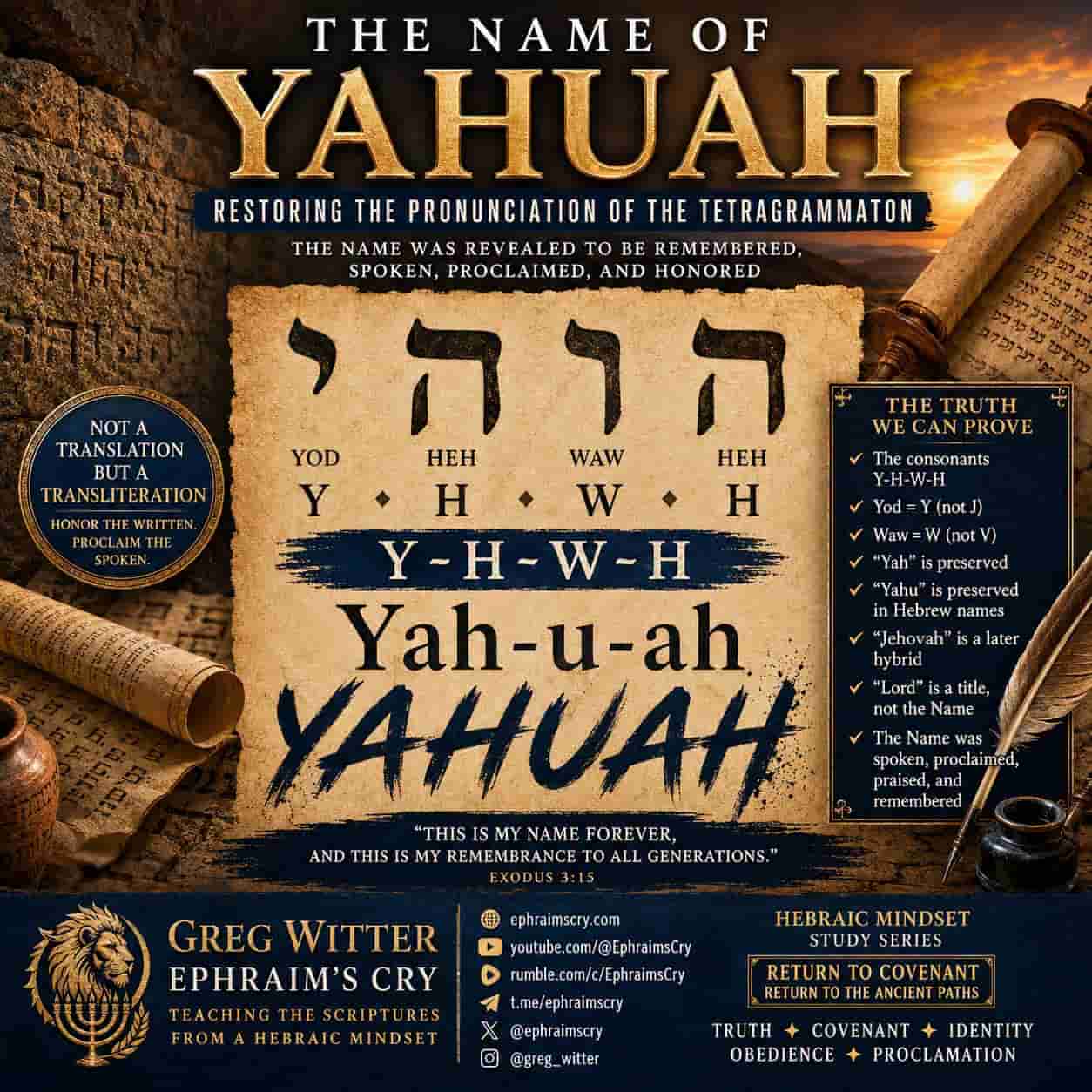
THE NAME OF YAHUAH
Restoring the Pronunciation of the Tetragrammaton
— Greg Witter
Ephraim’s Cry
Teaching the Scriptures from a Hebraic Mindset
The Name Was Revealed to Be Remembered, Spoken, Proclaimed, and Honored
The personal Name of the Creator appears nearly seven thousand times throughout the Hebrew Scriptures.
In Paleo-Hebrew, it is written:
𐤉𐤄𐤅𐤄
In later square Hebrew, it is written:
יהוה
These four letters are commonly called the Tetragrammaton, meaning “the four letters.”
They are:
𐤉 — Yod
𐤄 — Heh
𐤅 — Waw
𐤄 — Heh
The written consonantal structure is therefore:
Y-H-W-H
That is not a theory.
That is what the Hebrew text actually contains.
The controversy begins when men ask how those four consonants were pronounced.
THE NAME WAS WRITTEN WITHOUT MASORETIC VOWEL POINTS
The original Hebrew Scriptures were not written with the system of vowel points now commonly printed beneath and above the Hebrew letters.
Those dots and markings were added by the Masoretes many centuries after the biblical books had been written.
Mosheh did not write Masoretic vowel points.
David did not write Masoretic vowel points.
The prophets did not write Masoretic vowel points.
The inspired text preserved the consonants of the Name:
יהוה
The vowels placed around the Name in later Masoretic manuscripts were not intended to reveal its original pronunciation. They functioned largely as a reading reminder, instructing the reader to substitute another word—usually Adonai, meaning “Lord”—instead of pronouncing the written Name.
The scribal system was therefore designed to prevent the reader from speaking the Name.
It was not designed to preserve the original vocalization openly.
This matters because later readers mistakenly combined the consonants of יהוה with substitute vowel markings and produced the hybrid form commonly rendered as Jehovah.
WHY “JEHOVAH” CANNOT BE THE ORIGINAL PRONUNCIATION
The form “Jehovah” fails immediately when tested against the Hebrew letters.
The first Hebrew letter is Yod.
It carries a Y sound.
There was no ancient Hebrew letter producing the modern English J sound heard in words such as “John,” “James,” or “Jehovah.”
The opening consonant is therefore Y, not J.
The third letter is Waw.
In ancient Hebrew and related Semitic languages, Waw carried a W sound.
The later pronunciation Vav reflects a linguistic development found in later Hebrew traditions.
The ancient consonantal form is therefore:
Y-H-W-H
Not:
J-H-V-H
“Jehovah” combines later English and European sound values with vowel markings associated with a substitute reading.
It is a religious hybrid.
It is not the original Hebrew Name.
This does not mean everyone who uses “Jehovah” is intentionally lying. Most people simply repeat what they inherited.
But tradition does not become truth merely because generations have repeated it.
THE NAME WAS NEVER UNPRONOUNCEABLE
Another common claim is that the pronunciation of the Name was completely lost and can no longer be recovered in any meaningful way.
That claim goes beyond the evidence.
The people of Israel spoke the Name.
Mosheh proclaimed the Name.
David sang the Name.
The prophets declared the Name.
The priests blessed the people in the Name.
The nations heard the Name.
The Name was incorporated into the personal names of Israelites.
It is true that the four written consonants do not provide absolute certainty concerning every vowel sound.
But it is false to say that we have no evidence.
The Scriptures preserve shortened forms and name elements that establish important parts of the pronunciation.
We must distinguish between two claims:
We cannot prove every vowel beyond all possible dispute.
That is honest.
We know absolutely nothing about the pronunciation.
That is false.
THE SCRIPTURES PRESERVE “YAH”
The opening form Yah is preserved directly in Scripture.
It appears as:
יה — Yah
We hear it in the biblical expression:
Hallelu-Yah
That means:
Praise Yah
This is not a modern Sacred Name invention.
It is a biblical form of the Name.
Therefore, the beginning of the Name is not merely an uncertain consonant.
The biblical witness preserves:
YAH
Any pronunciation beginning with the modern English sound Jeh must explain why Scripture plainly preserves Yah.
The evidence begins with:
Yah
THE SCRIPTURES ALSO PRESERVE “YAHU”
The divine Name appears within numerous Hebrew personal names.
At the end of many names, the divine element appears as:
-yahu
Examples include:
Yirmeyahu
Yesha‘yahu
Eliyahu
Mattithyahu
These names preserve the sounds:
Yah-u
The form Yahu is not a modern invention.
It is embedded within ancient Hebrew names.
That does not, by itself, settle every vowel in the complete Tetragrammaton.
But it does establish that Yahu was a recognized form connected directly to the Name of Yahuah.
The evidence therefore progresses:
Yah
Then:
Yahu
THE IMPORTANCE OF WAW
The third letter of the Name is:
𐤅 — Waw
The ancient letter must be treated according to its ancient function, not according to a later pronunciation tradition.
Waw carried a W consonantal value.
It could also function in Hebrew writing as a vowel carrier associated with sounds such as u or o.
This means the Waw can participate in the movement between the sounds:
hu
and
wah
When the mouth moves from an oo sound into an ah sound, a natural W-like glide often occurs.
Say slowly:
oo-ah
As the two sounds come together, the transition naturally approaches:
wah
This helps explain the relationship between the written forms:
Yahuah
and
Yahuwah
They represent closely related attempts to express the pronunciation of the Hebrew Name using English letters.
The Hebrew Name itself remains:
𐤉𐤄𐤅𐤄
English spelling is only attempting to carry the sound across from one language to another.
YAHUAH IS A TRANSLITERATION
A translation replaces a word with a word of similar meaning in another language.
A transliteration attempts to reproduce the sound of a word by using the letters of another alphabet.
For example:
משה is transliterated as Mosheh.
דוד is transliterated as David.
אליהו is transliterated as Eliyahu.
In the same manner:
𐤉𐤄𐤅𐤄
is represented consonantally as:
YHWH
When vocalized through the preserved forms Yah and Yahu, it can be represented in English as:
Yahuah
Written out:
Y-A-H-U-A-H
Pronounced:
Yah-u-ah
The English letters do not replace the four Hebrew letters.
They represent the spoken sounds of those Hebrew letters.
The Hebrew text remains four letters:
Yod-Heh-Waw-Heh
The transliteration uses English letters to communicate the pronunciation:
Yahuah
WHY THE ENGLISH W MAY NOT APPEAR IN “YAHUAH”
Some people argue that because the Hebrew contains Waw, the English transliteration must visibly contain the letter W.
That argument misunderstands transliteration.
Transliteration is not always a rigid one-letter-for-one-letter substitution. It often represents the actual sound produced in pronunciation.
In Yahuah, the Waw is reflected in the transition from the u sound into the final ah.
The movement:
u-ah
produces a natural W glide:
u-wah
Therefore:
Yahuah
may be pronounced:
Yah-hoo-wah
The absence of a separately written English W does not mean the Hebrew Waw has been ignored.
The sound is carried through the vocal movement.
This is why both spellings may be encountered:
Yahuah
Yahuwah
The authority is not the English spelling.
The authority is the Hebrew Name:
𐤉𐤄𐤅𐤄
WHAT ABOUT “YAHWEH”?
“Yahweh” is widely accepted within modern scholarship.
But it must be described honestly.
It is a scholarly reconstruction.
It is not preserved as a fully vowel-pointed original form written by Mosheh or the prophets.
Scholars developed the form by examining grammar, ancient transcriptions, shortened forms, and testimony from later writers.
The form may preserve important features, including the opening Yah and the ancient W sound.
But academic popularity is not absolute proof.
No original Hebrew manuscript presents the fully vocalized English form “Yahweh.”
Furthermore, the common English pronunciation Yah-way introduces an ending that must be demonstrated rather than assumed.
The form should not be treated as though it descended untouched from Sinai.
It is a reconstruction.
WHY “YEHOVAH” AND “YEHOWAH” FAIL
Some attempt to defend forms such as “Yehovah” or “Yehowah” by appealing to Masoretic vowel points.
But that reasoning ignores the purpose of those vowel points.
The points surrounding the Tetragrammaton were used to remind the reader to say a substitute title.
Using those substitute vowels to recover the original pronunciation is circular reasoning.
It takes a scribal instruction not to pronounce the Name and then uses that instruction as proof of how the Name should be pronounced.
That is not sound scholarship.
The Masoretes preserved the consonants:
Y-H-W-H
They did not openly preserve the original pronunciation through the ordinary pointing system attached to the Name.
“LORD” IS NOT THE NAME
“Lord” is a title.
“God” is a title or classification.
“Adonai” is a title meaning Master or Lord.
None of those words is the personal Name written in the Hebrew text:
𐤉𐤄𐤅𐤄
Replacing the Name with LORD may follow a long translation tradition, but it still removes the written Name from the reader’s sight.
A title tells us what someone is.
A name identifies who someone is.
The Hebrew Scriptures often place titles and the personal Name together because they are not identical.
When the Name is replaced with a title, that distinction disappears.
The translation tradition has therefore hidden the Name from generations of readers.
THE NAME WAS NOT TOO HOLY TO SPEAK
The idea that the Name must never be pronounced is a later religious prohibition.
The Scriptures command the people of Yahuah to:
Call upon His Name.
Praise His Name.
Proclaim His Name.
Bless His Name.
Sing to His Name.
Declare His Name among the nations.
Remember His Name throughout the generations.
Yahuah told Mosheh:
“This is My Name forever, and this is My remembrance to all generations.”
He did not say:
“This is My Name until religious tradition removes it.”
He did not reveal His Name so that men could bury it beneath a title.
The command against taking the Name in vain does not prohibit faithful pronunciation.
It prohibits bearing, using, or representing the Name falsely, emptily, deceptively, or wickedly.
Reverence does not require silence.
Holiness does not require erasure.
The Name must not be profaned.
But neither should it be concealed.
PRONUNCIATION MATTERS—BUT OBEDIENCE MATTERS MORE
Some claim that pronunciation does not matter at all.
That is careless.
Names carry identity.
Names distinguish one person from another.
If names did not matter, Scripture would not repeatedly record, preserve, reveal, change, and explain them.
However, pronunciation must not become another form of religious pride.
A person can correctly pronounce every syllable and still profane the Name through rebellion.
A person can say Yahuah and refuse to obey Him.
A person can speak the Name and live contrary to the covenant.
The purpose of restoring the Name is not to create a superior religious class.
The purpose is to restore remembrance, identity, reverence, proclamation, and covenant faithfulness.
The Name should be carried in both speech and conduct.
WHAT THE EVIDENCE ACTUALLY PROVES
The Hebrew text proves the consonants:
Y-H-W-H
The text proves that the first letter is Yod, carrying a Y sound rather than the modern English J sound.
The ancient language proves that the third letter was Waw, not originally Vav.
Scripture proves the shortened form:
Yah
Hebrew names prove the preserved divine element:
Yahu
The evidence proves that “Jehovah” is a later hybrid rather than the original pronunciation.
The text proves that “Lord” is a substituted title rather than the written personal Name.
Scripture proves that the Name was spoken, proclaimed, praised, and remembered.
What the evidence does not prove with absolute certainty is every ancient vowel sound in the complete four-letter Name.
We must never claim more than the evidence establishes.
But neither should we deny what the evidence plainly preserves.
THE CONCLUSION
The form Yahuah is a defensible restored transliteration grounded in the written consonants and the preserved biblical forms:
Yah
Yahu
Waw
The final Heh
The progression is:
𐤉𐤄𐤅𐤄
Y-H-W-H
Yah-u-ah
Yahuah
It is not a translation.
It is a transliteration of the proposed pronunciation of the Name.
We do not claim that an English spelling is inspired.
We do not claim that every vowel can be proven beyond all debate.
We do claim that the revealed Name should not be erased, replaced, or hidden beneath later religious tradition.
The Name was revealed to Mosheh.
The Name was proclaimed by the prophets.
The Name was sung by David.
The Name was carried within the names of the people.
The Name was declared among the nations.
The Name was given as a remembrance to every generation.
Therefore, we refuse the falsehood that the Name must remain hidden.
We reject the hybrid form built from later substitute vowels.
We reject the replacement of the personal Name with a generic title.
We restore the written Name:
𐤉𐤄𐤅𐤄
We pronounce it reverently:
Yahuah
We proclaim it faithfully.
We refuse to use it vainly.
We bear it through covenant obedience.
And we declare:
𐤉𐤄𐤅𐤄 — Yahuah is His Name.
#EphraimsCry #GregWitter#HebraicMindsetStudySeries#EphraimsCryAcademy#TheNameAboveEveryName
#TorahCommunity#MessianicBelievers #BibleStudents#BibleTeachers #CovenantCommunity#TruthSeekers
#FollowersOfYahusha#HebrewLanguage #BiblicalHebrew#PaleoHebrew #Tetragrammaton #Yahuah#DivineName
#NameOfYahuah#YodHehWawHeh #AncientHebrew#SacredName #HebrewTransliteration#ScriptureTruth
#ReturnToCovenant#AncientPaths #FourWitnesses#HebraicBibleStudy #CovenantFaithfulness#ProclaimHisName
