
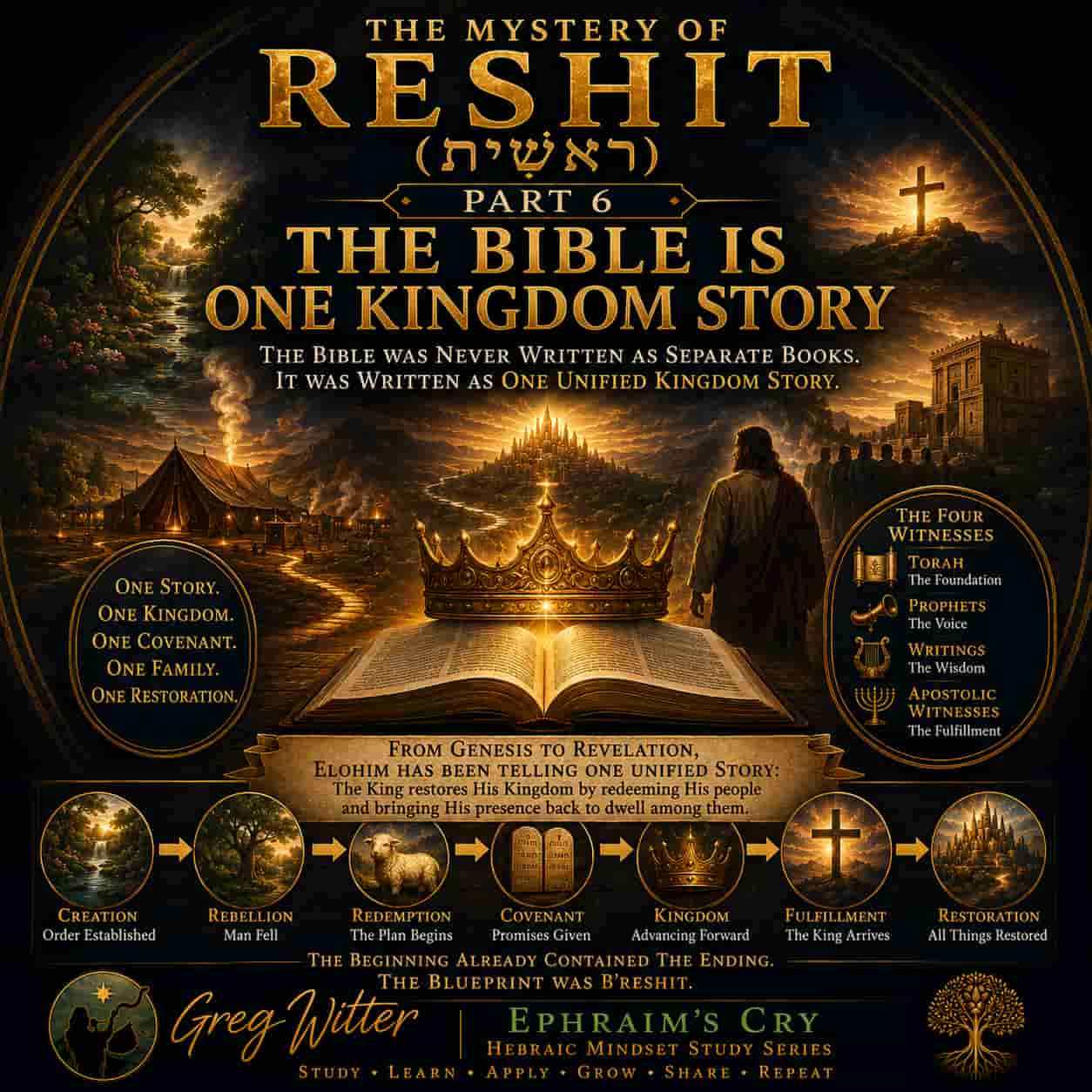
THE MYSTERY OF RESHIT (רֵאשִׁית)
PART 6
THE BIBLE IS ONE KINGDOM STORY
Discovering the Divine Blueprint of the Gospel of the Kingdom Hidden in the Beginning
Declaring the End from the Beginning Through the Whole Counsel of Elohim
The Bible Was Never Written As Separate Books. It Was Written As One Unified Kingdom Story.
The King, The Kingdom, The Covenant, And The Restoration Have Always Been The Story.
Greg Witter | Ephraim’s Cry
Hebraic Mindset Study Series
Study • Learn • Apply • Grow • Share • Repeat
By now, perhaps something inside of us is beginning to shift.
Perhaps we are beginning to realize that the Bible was never intended to be read the way many of us inherited it. For generations, we have been taught to approach Scripture as if it were a collection of independent stories bound together under one cover. We learn about Noah, then we move on to Abraham. We study Moses, then David. We read the prophets, then we jump to the Gospels. Eventually, we arrive at Revelation and treat it as if it were disconnected from everything that came before it.
But what if that was never the intention at all?
What if the Bible is not sixty-six independent books?
What if it is one book?
What if it is one story?
What if Elohim has never been telling multiple stories, but one unified Kingdom story from beginning to end?
Perhaps that is one of the greatest discoveries we will make throughout this entire journey. Because once we begin recognizing the patterns that Elohim established in B’reshit, suddenly everything begins connecting. The Scriptures stop feeling fragmented and begin feeling unified. The pieces stop competing with one another and begin supporting one another. The story itself begins to emerge from the pages.
This changes everything.
Because the Bible is no longer about ancient history.
It is no longer about disconnected doctrines.
It is no longer about isolated events.
It is no longer about multiple religions, multiple peoples, multiple plans, or multiple destinations.
It is one story.
The story of a King establishing His Kingdom, redeeming His covenant family, and restoring His dwelling place among His people.
That has always been the story.
If we had to summarize the entire Bible into one sentence, perhaps it would be this:
The King is restoring His Kingdom by redeeming His covenant people and bringing them back into His presence.
Everything else supports that story.
When we begin reading the Bible through that lens, Genesis suddenly changes. Creation is no longer simply about the origin of the universe. It becomes the establishment of Kingdom order. The Garden is no longer simply a beautiful location. It becomes the first earthly dwelling place where heaven and earth function together under the authority of Elohim. Adam is no longer simply the first man. He becomes the first image bearer, the first steward, and the first representative assigned Kingdom responsibility.
Then something happens.
Rebellion enters the story.
And immediately the story changes from a creation story into a restoration story.
That distinction is critically important.
From Genesis 3 forward, everything begins moving toward restoration.
Not replacement.
Restoration.
This is one of the greatest misunderstandings in modern theology. Many systems have taught us to think in terms of replacement. But the whole counsel of Elohim repeatedly teaches restoration.
Elohim is not abandoning His original design.
He is restoring His original design.
Perhaps that is why the same patterns appear repeatedly throughout Scripture. They are not separate stories. They are chapters within the same story.
The Garden becomes the Tabernacle.
The Tabernacle becomes the Temple.
The Temple points toward Messiah.
Messiah builds His body.
His body becomes a dwelling place.
New Jerusalem becomes the eternal dwelling place.
The pattern never changes.
The story simply grows larger.
The same thing happens with the people Elohim uses throughout Scripture. Once we begin recognizing Kingdom patterns, we stop seeing isolated individuals and begin seeing one continuous story unfold before our eyes.
Adam introduces stewardship.
Noah preserves what Adam lost.
Abraham receives covenant promises.
Isaac inherits those promises.
Jacob multiplies them.
Joseph preserves them.
Moses redeems them.
David models Kingdom rulership.
The prophets call people back to covenant faithfulness.
And Yahusha fulfills every pattern that was progressively being revealed all along.
Not because we inserted Him into the story.
Because He was always the destination of the story.
That is a critically important distinction.
Messiah was never Plan B.
Messiah was never an emergency response to human failure.
Messiah was never suddenly introduced in Bethlehem.
Messiah was progressively being revealed from the very beginning.
Not by name.
By pattern.
By blueprint.
By covenant.
By first things.
By inheritance.
By firstborn principles.
By firstfruits.
By Kingdom language.
That is precisely how Yahusha taught.
Luke 24:27 says:
“And beginning at Moses and all the prophets, he expounded unto them in all the scriptures the things concerning himself.”
Think about that for a moment.
He did not begin with Matthew.
He began with Moses.
He began with the blueprint.
Then in Luke 24:44 He said:
“And he said unto them, These are the words which I spake unto you, while I was yet with you, that all things must be fulfilled, which were written in the law of Moses, and in the prophets, and in the psalms, concerning me.”
Do you see it?
The whole counsel was always telling one story.
The Torah.
The Prophets.
The Writings.
The Apostolic Witnesses.
Four witnesses.
One story.
One King.
One Kingdom.
One restoration.
Perhaps one of the greatest tragedies of modern churchianity is that we have fragmented what Elohim unified. We have separated Moses from Messiah. We have separated law from grace. We have separated Israel from the church. We have separated Genesis from Revelation. We have separated earth from heaven.
But Elohim never separated them.
He wrote one story.
Over and over again, He repeats the patterns until we finally recognize what He is teaching.
Creation becomes New Creation.
Eden becomes New Jerusalem.
The Tree of Life returns.
The river returns.
The dwelling place returns.
The Kingdom returns.
The curse is removed.
The beginning already contained the ending.
Perhaps that is why B’reshit is so important.
B’reshit is not merely introducing creation.
B’reshit is introducing the entire story.
The house is there.
The Kingdom is there.
The covenant is there.
The dwelling place is there.
The restoration is there.
The blueprint is there.
Everything is already present in seed form.
That is how Elohim teaches.
He plants seeds before He reveals harvests.
He establishes patterns before He reveals fulfillments.
He introduces beginnings before He reveals endings.
And perhaps that is the greatest thing we are rediscovering through this journey.
The Bible is not about escaping earth.
It is about restoring the Kingdom.
The Bible is not about abandoning creation.
It is about restoring creation.
The Bible is not about replacing Israel.
It is about restoring the covenant family.
The Bible is not about creating a new story.
It is about completing the original story.
And perhaps for the very first time, we are beginning to see what Elohim intended us to see all along.
One King.
One Kingdom.
One Covenant.
One Family.
One Restoration.
One Story.
Key Takeaways
• The Bible is one unified Kingdom story.
• Elohim has always been telling one story.
• The story is about a King restoring His Kingdom.
• The whole counsel teaches restoration, not replacement.
• The Four Witnesses reveal one unified blueprint.
• Genesis introduces the story and Revelation completes it.
• The ending was embedded within the beginning.
• The Bible is a restoration story.
#TheMysteryOfReshit #Bereshit #Reshit #TheGospelOfTheKingdom #WholeCounselOfElohim #FourWitnesses
#PatternRecognition #Genesis #Firstfruits #Firstborn #Messiah #KingdomOfElohim #HebraicMindset
#EphraimsCry #StudyLearnApplyGrowShareRepeat
