
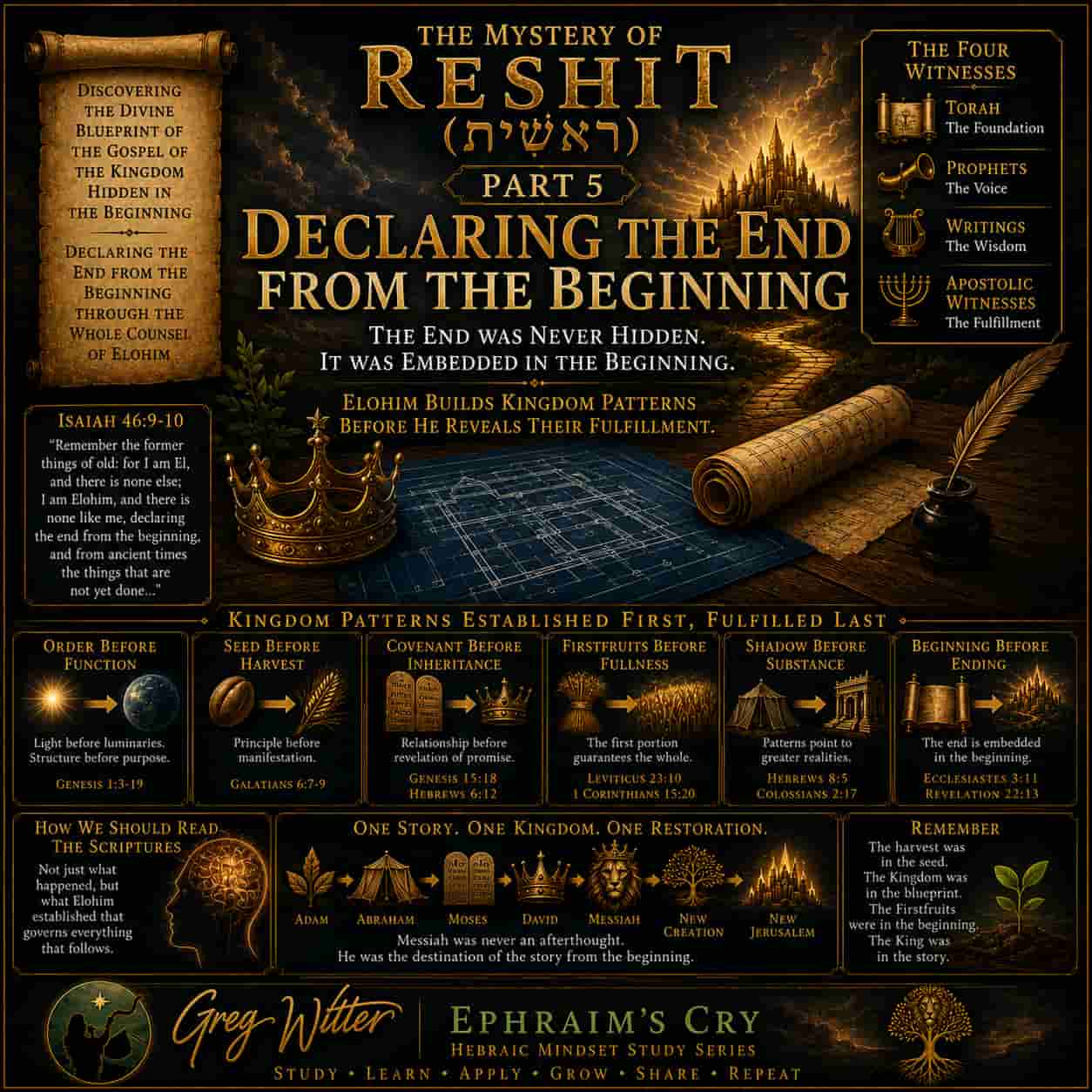
THE MYSTERY OF RESHIT (רֵאשִׁית)
PART 5
DECLARING THE END FROM THE BEGINNING
Discovering the Divine Blueprint of the Gospel of the Kingdom Hidden in the Beginning
Declaring the End from the Beginning Through the Whole Counsel of Elohim
The End Was Never Hidden. It Was Embedded In The Beginning.
Elohim Builds Kingdom Patterns Before He Reveals Their Fulfillment.
Greg Witter | Ephraim’s Cry
Hebraic Mindset Study Series
Study • Learn • Apply • Grow • Share • Repeat
At this point in our journey, something should begin happening inside of us. We should slowly begin realizing that the Bible was never intended to be read as a collection of disconnected stories. In fact, one could argue that many of our modern struggles with Scripture are not because we lack information, but because we have lost the ability to recognize patterns.
For generations, many believers have approached the Bible as if Elohim were writing an encyclopedia. We read a story, then another story, then another story. We memorize facts. We defend doctrines. We debate interpretations. Yet somewhere along the way, we unknowingly lost the story itself.
What if Elohim never intended us to read the Bible that way?
What if He intended us to see patterns?
What if He intended us to see blueprints?
What if He intended us to recognize that He was constructing a Kingdom story from the very beginning?
Because if there is one phrase that may become the cornerstone of this entire series, it is this:
“Declaring the end from the beginning.”
We have all heard those words countless times. We quote them often. We memorize them. We repeat them. But perhaps we have never stopped long enough to ask a very important question.
How?
How does Elohim declare the end from the beginning?
Does He simply know the future?
Of course He does.
But perhaps Isaiah is revealing something much bigger than omniscience. Perhaps Isaiah is revealing methodology. Perhaps he is revealing how Elohim teaches. Perhaps he is revealing how Elohim builds His Kingdom.
Isaiah 46:9-10 says:
“Remember the former things of old: for I am El, and there is none else; I am Elohim, and there is none like me, declaring the end from the beginning, and from ancient times the things that are not yet done…”
Most people immediately think, “Elohim knows the future.”
True.
But what if that is only the surface?
What if Elohim is telling us that He establishes the ending inside the beginning?
Think about an architect for a moment. Before a single stone is ever laid, before construction crews ever arrive, before walls are erected, before doors are hung, the finished building already exists in the architect’s mind. Every room is already there. Every hallway is already there. Every support beam is already there. Every measurement is already there.
The finished structure exists before construction begins.
That is a blueprint.
Perhaps that is exactly how Elohim works.
He establishes patterns before He reveals fulfillments.
He plants seeds before He reveals harvests.
He establishes beginnings before He reveals endings.
He reveals shadows before He reveals fullness.
Once we begin seeing this, we suddenly realize that Genesis is not simply the first book of the Bible.
Genesis is the blueprint of the Bible.
Everything that follows has already been introduced there in seed form.
Suddenly, we begin noticing things we have never seen before. Elohim establishes light before He creates luminaries. He establishes order before He establishes function. He establishes covenant before inheritance. He establishes seed before harvest. He establishes rest before He establishes work.
Again and again, the pattern repeats itself.
This is not coincidence.
This is design.
This is Kingdom architecture.
Perhaps that is why Western thinking and Hebraic thinking are often so different.
Western thinking asks:
“What happened first?”
Hebraic thinking asks:
“What did Elohim establish first that governs everything that follows?”
One seeks information.
The other seeks patterns.
One seeks chronology.
The other seeks Kingdom architecture.
One collects facts.
The other discovers design.
Once you begin thinking this way, the entire Bible starts to come alive.
You begin seeing that Adam is not just Adam.
Adam introduces sonship, stewardship, authority, responsibility, and Kingdom assignment.
Noah is not simply surviving a flood.
Noah introduces preservation, covenant, and restoration.
Abraham is not simply a man being called.
Abraham introduces promise, covenant, and inheritance.
Isaac introduces inheritance.
Jacob introduces multiplication.
Joseph introduces deliverance.
Moses introduces redemption.
David introduces kingship.
And Yahusha fulfills every one of those patterns.
Not because we inserted Him into the story.
Because He was always the destination of the story.
That distinction is extremely important.
Messiah was never an afterthought.
Messiah was never Plan B.
Messiah was never suddenly introduced in Bethlehem.
Messiah was progressively revealed from the beginning.
Not by name.
By pattern.
By blueprint.
By covenant.
By first things.
By inheritance.
By firstborn principles.
By firstfruits.
By Kingdom language.
That is exactly how Yahusha taught.
Luke 24:27 says:
“And beginning at Moses and all the prophets, he expounded unto them in all the scriptures the things concerning himself.”
Notice where He began.
Moses.
The blueprint.
The foundation.
The beginning.
Then Luke 24:44 says:
“And he said unto them, These are the words which I spake unto you, while I was yet with you, that all things must be fulfilled, which were written in the law of Moses, and in the prophets, and in the psalms, concerning me.”
Do you see it?
The whole counsel of Elohim was always telling one story.
The Torah.
The Prophets.
The Writings.
The Apostolic Witnesses.
Four witnesses.
One story.
One King.
One Kingdom.
One restoration.
Perhaps one of the greatest tragedies of modern churchianity is that we have fragmented what Elohim unified. We have separated Moses from Messiah. We have separated law from grace. We have separated Israel from the church. We have separated earth from heaven. We have separated Genesis from Revelation.
But Elohim never separated them.
He wrote one story.
The same story.
Over and over.
From different angles.
With increasing clarity.
Perhaps that is why so many believers struggle today. We have become experts at collecting verses while missing patterns. We have become experts at defending doctrines while missing the story. We have become experts at debating theology while missing the Kingdom itself.
But Elohim was never hiding His plan.
The blueprint was always there.
Creation becomes New Creation.
Eden becomes New Jerusalem.
The Tree of Life returns.
The river returns.
The dwelling place returns.
The Kingdom returns.
The curse is removed.
The beginning already contained the ending.
Then another pattern emerges.
Garden.
Tabernacle.
Temple.
Messiah.
Body of believers.
New Jerusalem.
Again, a dwelling place pattern.
Then another.
Seed.
Growth.
Harvest.
Firstfruits.
Fullness.
Again, the pattern repeats.
What are we seeing?
Kingdom architecture.
Perhaps one of the greatest questions we can ever begin asking is no longer:
“What does this verse mean?”
But instead:
“What pattern is Elohim revealing?”
That one question may completely transform the way you read Scripture.
Because suddenly everything begins connecting.
The Four Witnesses connect.
The covenants connect.
The feasts connect.
The Sabbath connects.
The firstborn connects.
The firstfruits connect.
The restoration connects.
The Kingdom connects.
The story connects.
And the blueprint comes alive.
Perhaps Isaiah was telling us this all along.
Elohim was never merely predicting the future.
He was establishing it.
The ending was not hidden.
The ending was embedded.
The harvest was inside the seed.
The Kingdom was inside the blueprint.
The restoration was inside creation.
The dwelling place was inside the garden.
The Firstfruits were inside the beginning.
The King was inside the story.
And perhaps that is the greatest discovery we will make in this entire series.
The Bible is not a collection of stories.
It is one story.
The blueprint is not hidden.
The blueprint is B’reshit.
The beginning was never simply about beginnings.
The beginning was always about the Kingdom.
Key Takeaways
• Elohim declares the end from the beginning.
• Declaring is more than predicting; it is establishing patterns.
• Genesis is a blueprint, not merely a history book.
• Elohim teaches through patterns before fulfillments.
• The Four Witnesses tell one unified story.
• Messiah fulfills patterns established from the beginning.
• The Kingdom story is woven throughout all Scripture.
• The beginning already contains the ending.
#TheMysteryOfReshit #Bereshit #Reshit #TheGospelOfTheKingdom #WholeCounselOfElohim #FourWitnesses
#PatternRecognition #Genesis #Firstfruits #Firstborn #Messiah #KingdomOfElohim #HebraicMindset
#EphraimsCry #StudyLearnApplyGrowShareRepeat
