
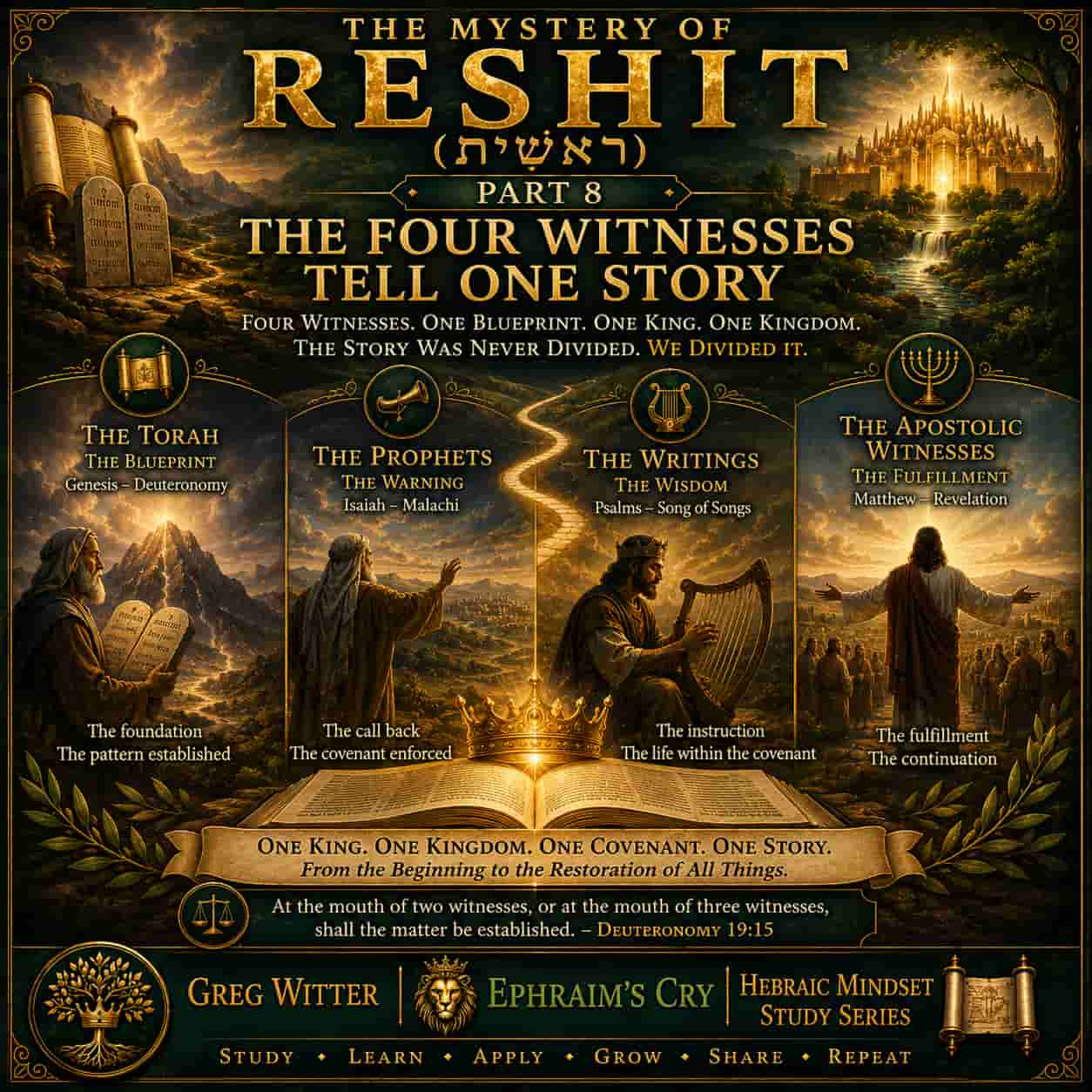
THE MYSTERY OF RESHIT (רֵאשִׁית)
PART 8
THE FOUR WITNESSES TELL ONE STORY
Discovering the Divine Blueprint of the Gospel of the Kingdom Hidden in the Beginning
Declaring the End from the Beginning Through the Whole Counsel of Elohim
Four Witnesses. One Blueprint. One King. One Kingdom.
The Story Was Never Divided. We Divided It.
Greg Witter | Ephraim’s Cry
Hebraic Mindset Study Series
Study • Learn • Apply • Grow • Share • Repeat
Perhaps one of the greatest discoveries we are making throughout this journey is that Elohim never intended for His Word to be read in fragments. Yet, for many of us, that is exactly how we inherited it. We were taught to study Genesis, then jump to Psalms, then to Matthew, then to Revelation, as though each section existed independently from the others. We learned stories, doctrines, timelines, and theology, but somewhere along the way, we lost the story itself.
What if that was never the design?
What if Elohim was never writing multiple stories?
What if He was writing one story?
What if He intentionally gave us multiple witnesses so we would never isolate truth?
Perhaps that is exactly what He did.
From the very beginning, Elohim established the principle of witnesses. He did not build truth upon one isolated statement, one isolated event, or one isolated verse. He established truth through agreement.
Deuteronomy 19:15 says:
“One witness shall not rise up against a man for any iniquity, or for any sin… at the mouth of two witnesses, or at the mouth of three witnesses, shall the matter be established.”
Truth is established through agreement.
Perhaps that principle governs the entire Bible itself.
This is where the Four Witnesses become so important.
The Torah.
The Prophets.
The Writings.
The Apostolic Witnesses.
Four witnesses.
One story.
One blueprint.
One King.
One Kingdom.
One restoration.
Perhaps one of the greatest mistakes modern theology has made is dividing what Elohim intentionally unified. We have separated the Bible into two testaments, separated Moses from Messiah, separated Israel from the church, separated law from grace, separated Genesis from Revelation, and even separated earth from heaven. Yet Elohim never did any of those things.
He wrote one unified story.
The Torah establishes the blueprint. The Prophets call covenant people back to the blueprint. The Writings teach us how to live within the blueprint. The Apostolic Witnesses reveal the fulfillment and continuation of the blueprint.
None of them are competing.
All of them are cooperating.
Imagine four men standing around a magnificent mountain. One stands on the east side. One stands on the west side. One stands on the north side. One stands on the south side. Each one describes what he sees. The descriptions may sound different, but they are all describing the same mountain.
That is how the Bible works.
The Torah sees the foundation.
The Prophets see the warnings.
The Writings see the application.
The Apostolic Witnesses see the fulfillment.
Different perspectives.
One mountain.
Perhaps this is why Yahusha repeatedly brought people back to Moses.
Luke 24:27 says:
“And beginning at Moses and all the prophets, he expounded unto them in all the scriptures the things concerning himself.”
Then again in Luke 24:44 He said:
“…all things must be fulfilled, which were written in the law of Moses, and in the prophets, and in the psalms, concerning me.”
Notice what Yahusha did not say.
He did not say, “Forget Moses.”
He did not say, “Replace the Torah.”
He did not say, “Start over.”
He pointed people back to the blueprint.
Because if you understand the blueprint, you will recognize the Builder.
This is also important to remember because the Apostolic Witnesses were never introducing a new religion. They were explaining the fulfillment of an existing story. At the time the apostles preached, there was no New Testament. The Scriptures they used were the Torah, the Prophets, and the Writings.
Peter preached from Joel (Acts 2:16-21).
Paul preached from Moses and the Prophets (Acts 28:23).
The Bereans searched the Scriptures daily to verify Paul’s teachings (Acts 17:11).
Those Scriptures were the Torah, the Prophets, and the Writings.
This changes everything.
Suddenly, we stop reading the Bible as disconnected books and begin seeing one continuous thread woven throughout every page.
The same patterns appear again and again.
Creation becomes New Creation (Genesis 1; Revelation 21:1).
Eden becomes New Jerusalem (Genesis 2:8-10; Revelation 21:2).
The Tree of Life returns (Genesis 2:9; Revelation 22:2).
The river returns (Genesis 2:10; Revelation 22:1).
The dwelling place returns (Exodus 25:8; Revelation 21:3).
The Kingdom is restored (Daniel 2:44; Revelation 11:15).
The curse is removed (Genesis 3:17-19; Revelation 22:3).
Do you see it?
The ending was embedded in the beginning.
That is exactly what we have been discovering throughout this entire series.
Perhaps this is why Elohim repeatedly teaches through patterns.
The Garden becomes the Tabernacle.
The Tabernacle becomes the Temple.
The Temple points to Messiah.
Messiah builds His body.
His body becomes a dwelling place.
New Jerusalem becomes the eternal dwelling place.
One story.
The same thing happens with covenant leadership throughout Scripture.
Adam introduces stewardship (Genesis 1:26-28).
Noah preserves life (Genesis 9:8-17).
Abraham receives covenant promises (Genesis 12:1-3).
Isaac inherits those promises (Genesis 26:2-5).
Jacob multiplies them (Genesis 28:13-15).
Joseph preserves them (Genesis 50:20).
Moses redeems them (Exodus 3:7-10).
David models Kingdom rule (2 Samuel 7:12-16).
The prophets call people back to covenant faithfulness (Jeremiah 31:31-33; Ezekiel 36:24-28).
Yahusha fulfills every pattern progressively revealed throughout the story (Colossians 1:18; 1 Corinthians 15:20; Hebrews 3:1-6).
Not because we inserted Him into the story.
Because He was always the destination of the story.
That distinction is critically important.
Messiah was never an afterthought.
Messiah was never Plan B.
Messiah was never suddenly introduced in Bethlehem.
Messiah was progressively revealed from the beginning.
Not by name.
By pattern.
By blueprint.
By covenant.
By first things.
By firstborn principles.
By firstfruits.
By Kingdom language.
This is also why the Four Witnesses protect us from error.
When one witness is removed, distortion immediately begins.
Remove the Torah, and you lose the foundation.
Remove the Prophets, and you lose the warnings.
Remove the Writings, and you lose wisdom.
Remove the Apostolic Witnesses, and you lose fulfillment.
Every witness is necessary.
Every witness is connected.
Every witness supports the others.
Perhaps this is one of the greatest questions we can begin asking every time we open our Bible.
Instead of asking:
“What does this one verse say?”
Perhaps we should begin asking:
“What do all four witnesses say together?”
That single question may transform the way you read Scripture for the rest of your life.
Because suddenly the Bible comes alive.
The King becomes visible.
The Kingdom becomes visible.
The blueprint becomes visible.
The restoration becomes visible.
And perhaps for the very first time, we begin seeing what Elohim intended us to see all along.
One King.
One Kingdom.
One Covenant.
One Family.
One Restoration.
One Story.
Four Witnesses.
Key Takeaways
• Elohim establishes truth through multiple witnesses (Deuteronomy 19:15).
• The Four Witnesses tell one unified story.
• The Torah establishes the blueprint.
• The Prophets call people back to the blueprint.
• The Writings teach covenant life within the blueprint.
• The Apostolic Witnesses reveal fulfillment and continuation.
• The Bible is not fragmented; it is unified.
• The Four Witnesses protect us from isolated theology.
• The ending was embedded within the beginning.
• The whole counsel reveals one unified Kingdom story.
#TheMysteryOfReshit #Bereshit #Reshit #TheGospelOfTheKingdom #WholeCounselOfElohim #FourWitnesses
#PatternRecognition #Genesis #Firstfruits #Firstborn #Messiah #KingdomOfElohim #HebraicMindset
#EphraimsCry #StudyLearnApplyGrowShareRepeat
