
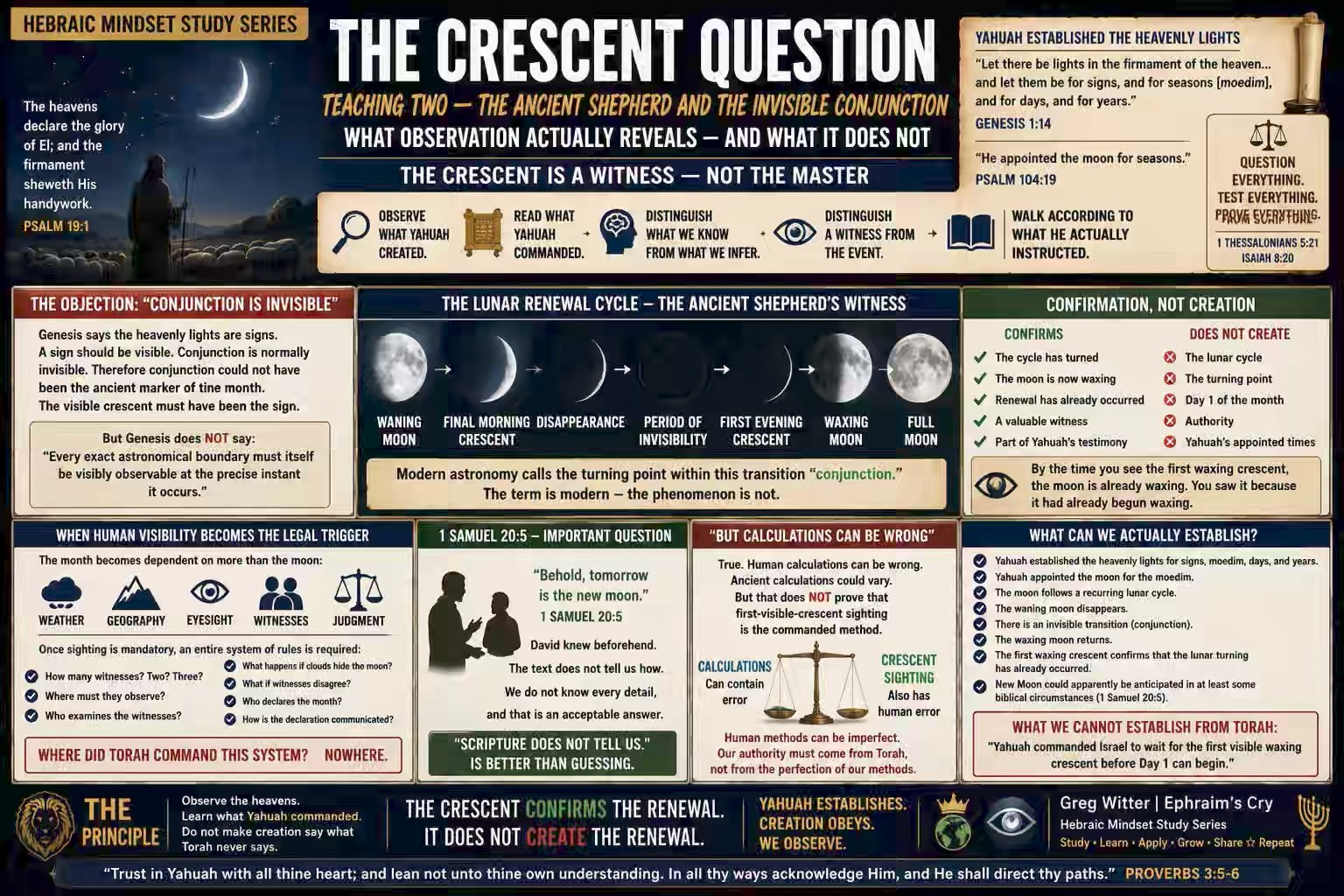
THE CRESCENT QUESTION
TEACHING TWO — THE ANCIENT SHEPHERD AND THE INVISIBLE CONJUNCTION
What Observation Actually Reveals — and What It Does Not
Greg Witter | Ephraim’s Cry
Hebraic Mindset Study Series
Study • Learn • Apply • Grow • Share ☆ Repeat
In Teaching One, we established the governing principle for this entire study:
We must question everything, confirm everything, test everything, and prove everything from Scripture.
We also established something equally important: we must be careful not to claim more than Scripture actually says. I am not going to tell you that Torah contains a command saying, “Calculate the astronomical conjunction.” It does not.
But intellectual honesty requires the same standard from the other side.
Torah also does not contain a command saying:
“Wait for the first visible waxing crescent, and when human witnesses see it, declare Day 1.”
Therefore, before we turn either astronomical calculation or crescent observation into a commandment, we have to distinguish between what Yahuah commanded, what creation demonstrates, and what men later developed as a procedure.
That distinction is essential.
THE OBJECTION: “CONJUNCTION IS INVISIBLE”
One of the strongest arguments made against conjunction is straightforward:
“Genesis says the heavenly lights are signs. A sign should be visible. Conjunction is normally invisible. Therefore conjunction could not have been the ancient marker of the month. The visible crescent must have been the sign.”
At first glance, that sounds reasonable.
But there is a logical leap hidden inside the argument.
Genesis 1:14 says:
“Let there be lights in the firmament of the heaven… and let them be for signs, and for seasons [moedim], and for days, and years.”
Absolutely.
But Genesis does not say:
“Every exact astronomical boundary must itself be visibly observable at the precise instant it occurs.”
Those are not the same statement.
Something can be observable as a cycle without every mathematical turning point within that cycle being directly visible.
And that is precisely what happens with the moon.
THE ANCIENT SHEPHERD DID NOT NEED A COMPUTER
We sometimes make the mistake of imagining ancient people as scientifically ignorant simply because they did not possess modern technology.
That is a serious mistake.
An ancient shepherd may not have possessed a telescope, computer, atomic clock, calculator, or modern astronomical tables.
But he possessed something most modern people do not:
constant exposure to the heavens.
Imagine living outdoors year after year without electric lights.
You watch the sun rise and set.
You watch shadows move.
You watch stars change position through the seasons.
You watch the moon night after night.
You know where it rises.
You know approximately when it rises.
You recognize its changing phases.
You watch it become full.
You watch it begin waning.
You watch it become a crescent.
You watch that crescent become progressively thinner.
Eventually you see the final thin crescent in the morning sky.
Then it disappears.
For a period, you see no moon.
Then, after sunset, the thin waxing crescent eventually returns.
No telescope is required to recognize that pattern.
No trigonometry is required.
No atomic clock is required.
No modern astronomical terminology is required.
The observable sequence is:
WANING → FINAL MORNING CRESCENT → DISAPPEARANCE → INVISIBILITY → WAXING → FIRST EVENING CRESCENT
That is the lunar renewal cycle being witnessed from the earth.
CONJUNCTION IS NOT A MODERN INVENTION
The word “conjunction” is technical terminology describing an astronomical relationship.
The terminology is not the phenomenon.
This distinction matters.
Ancient Yisra’el did not need to possess our modern technical vocabulary for a physical event to exist.
Torah does not need to use the modern term “gravity” for gravity to operate.
Torah does not need to say “axial tilt” for seasonal changes to occur.
Torah does not need to describe orbital mechanics mathematically for the moon to move through its cycle.
Likewise, the absence of a technical Hebrew calendar term equivalent to our modern astronomical use of conjunction would not establish that the physical lunar turning was meaningless.
The event exists independently of what human beings call it.
So when someone asks:
“What Hebrew word did Moses use for conjunction?”
that is a legitimate lexical question.
But it cannot carry the weight sometimes placed upon it.
The better question is:
What happens physically between the final waning crescent and the first waxing crescent?
Something objectively happens.
The moon does not teleport from waning to waxing.
There is a transition.
Modern astronomy identifies the central relationship in that transition as conjunction.
I AM NOT CLAIMING ANCIENT YISRA’EL HAD ATOMIC-CLOCK PRECISION
This needs to be stated clearly because otherwise a straw-man argument develops.
I am not suggesting an ancient Israelite stood outside and said:
“Conjunction will occur today at precisely 2:37:18 PM.”
That would be absurd.
Modern astronomy gives us a degree of mathematical precision ancient agricultural societies did not possess.
But greater modern precision does not mean ancient people could not understand the underlying cycle.
Consider the annual solar cycle.
An ancient farmer could recognize that the sun’s annual course was turning without knowing the exact second of the astronomical solstice.
He could observe changing shadows.
Changing daylight.
Changing sunrise and sunset positions.
Changing temperatures.
Changing seasons.
Modern astronomers can calculate the solstice to extraordinary precision.
The ancient observer recognized the same cycle through accumulated observation.
Modern precision measures the event more accurately. It does not create the event.
The same principle applies to the moon.
THE WHOLE LUNAR CYCLE IS THE WITNESS
This is where I believe the crescent-only position artificially narrows the evidence.
Why focus exclusively upon the first visible waxing crescent?
What about the rest of the lunar testimony?
The final waning crescent is observable.
Its disappearance is observable.
The period of lunar invisibility is observable as an absence.
The returning waxing crescent is observable.
The moon is giving us an entire sequence of witnesses.
The last morning crescent tells us the previous visible cycle is closing.
The disappearance tells us we have entered the transition.
The returning evening crescent confirms that the transition has occurred and the moon is now waxing.
The entire pattern matters.
That is why I continually make this distinction:
THE CRESCENT CONFIRMS THE RENEWAL; IT DOES NOT CREATE THE RENEWAL.
By the time you see the first waxing crescent, the moon is already waxing.
That statement is astronomically unavoidable.
The moon does not begin waxing because you saw it.
You saw it because it had already begun waxing.
That changes the entire argument.
A WITNESS DOES NOT CREATE WHAT IT WITNESSES
This is a simple principle.
Suppose I walk into a field and observe ripe barley.
Did my eyesight cause the barley to ripen?
No.
My observation confirmed an existing condition.
Suppose I watch dawn appear in the eastern sky.
Did my seeing dawn cause the earth to rotate?
No.
My observation confirmed an astronomical reality already occurring.
Likewise, when I observe the first waxing crescent, my observation does not cause the moon to pass conjunction.
It confirms that it already has.
Therefore the crescent can be extremely valuable without being the legal mechanism that creates Day 1.
This is an important distinction between:
SIGN and CAUSE.
WITNESS and AUTHORITY.
CONFIRMATION and CREATION.
HUMAN VISIBILITY CREATES ANOTHER PROBLEM
Now consider what happens when we make human visibility the legal requirement controlling the month.
Suppose the lunar turning has occurred, but Jerusalem is covered by clouds.
Did the lunar cycle stop?
Obviously not.
Suppose the crescent is visible from Jericho but clouds prevent its visibility from Jerusalem.
Which location determines Yahuah’s month?
Suppose an observer standing on higher ground can see the crescent while someone in a valley cannot.
Whose observation controls the calendar?
Suppose a twenty-year-old observer with excellent eyesight sees the crescent while a seventy-year-old observer does not.
Whose eyes determine Day 1?
Suppose atmospheric haze prevents naked-eye visibility.
Suppose binoculars reveal the crescent.
Suppose a camera detects it.
Which level of visibility counts?
These questions matter because once visibility becomes the legal trigger, the month becomes dependent upon more than the moon.
It now depends upon:
MOON + ATMOSPHERE + GEOGRAPHY + WEATHER + EYESIGHT + TESTIMONY + HUMAN JUDGMENT
That is a very different system from simply saying:
Yahuah appointed the moon for the moedim.
AND NOW WE NEED MORE RULES
Once sighting becomes mandatory, an entire secondary system becomes necessary.
How many witnesses?
One?
Two?
Three?
Where must they observe?
Jerusalem?
Anywhere in the Land?
Who receives their testimony?
Who determines whether they actually saw the crescent?
What questions are asked?
What happens if witnesses disagree?
What happens if nobody sees it because of clouds?
What happens if the crescent is visible somewhere outside the designated location?
Who declares the month?
Who communicates that declaration to everyone else?
Those questions are not theoretical.
Historically, later Judaism developed exactly these kinds of administrative procedures.
Why?
Because once human visibility becomes legally decisive, somebody must regulate human visibility.
But here we return to the question from Teaching One:
WHERE DID TORAH COMMAND THAT SYSTEM?
It didn’t.
And that should make us very careful about declaring the later system to be “Yahuah’s commanded calendar.”
“BUT CALCULATIONS CAN BE WRONG”
Absolutely.
This objection deserves a fair answer.
Someone may say:
“What if two people calculate conjunction and their calculations differ by two hours?”
That is a legitimate question.
Human calculations can be wrong.
Ancient calculations could certainly have been less precise than ours.
Modern calculations can contain errors if incorrect data or methods are used.
But what does that actually prove?
It proves:
HUMAN METHODS CAN CONTAIN ERROR.
It does not prove:
THEREFORE YAHUAH COMMANDED FIRST-VISIBLE-CRESCENT SIGHTING.
That conclusion still requires a Torah command.
And the crescent method does not eliminate human uncertainty.
It simply relocates it.
Instead of:
“Whose calculation?”
we now ask:
“Whose eyesight?”
Instead of mathematical uncertainty, we introduce atmospheric and observational uncertainty.
So we should not create a false choice between perfect modern conjunction calculation and perfectly objective crescent observation.
Neither human process is immune to error.
The issue remains:
WHAT DID YAHUAH COMMAND?
1 SAMUEL 20 CREATES AN IMPORTANT QUESTION
First Samuel 20:5 deserves much more attention in this discussion than it usually receives.
David tells Jonathan:
“Behold, tomorrow is the new moon.”
Stop there.
Tomorrow IS the New Moon.
David apparently knew it beforehand.
The text does not say:
“Tomorrow might be the New Moon.”
It does not say:
“Tomorrow will be New Moon if somebody sees the crescent tonight.”
It does not say:
“After tonight’s witnesses report to the authorities, we will discover whether tomorrow is New Moon.”
David says:
“Tomorrow is the new moon.”
Now, we must not commit the same error we are criticizing.
That verse does not tell us precisely how David knew.
It does not say:
“David calculated astronomical conjunction.”
So I will not claim that.
Perhaps accumulated lunar observation allowed them to anticipate the month.
Perhaps they counted the lunar cycle.
Perhaps there was astronomical knowledge passed through generations.
Perhaps several methods worked together.
Scripture does not tell us.
And that is an acceptable answer.
Sometimes the most honest biblical statement is:
WE DO NOT KNOW.
We do not fill biblical silence with our preferred tradition and then call our reconstruction Scripture.
“THEY MUST HAVE USED THE CRESCENT” IS NOT PROOF
This is where assumptions become dangerous.
Someone says:
“They had no computers.”
Therefore:
“They couldn’t calculate conjunction.”
Therefore:
“They must have used the visible crescent.”
Therefore:
“The visible crescent established Day 1.”
Therefore:
“Yahuah commanded crescent sighting.”
Watch what happened.
We moved from a reasonable historical question to a claimed divine command without ever producing the command.
That is precisely the process we must guard against.
An assumption becomes a theory.
The theory becomes a reconstruction.
The reconstruction becomes tradition.
The tradition becomes doctrine.
And eventually the doctrine is announced as:
“This is what Yahuah commanded.”
Yet the Torah passage establishing it was never produced.
DO NOT THROW AWAY THE CRESCENT
None of this means the crescent is meaningless.
Far from it.
Observe it.
Study it.
Understand it.
The crescent is a beautiful and valuable part of Yahuah’s lunar witness.
Watch the final morning crescent.
Watch it disappear.
Recognize the dark transition.
Watch the first waxing crescent return.
Follow the moon through quarter phase.
Watch it become full.
Watch it begin waning again.
The entire lunar cycle testifies to order.
Psalm 19:1 says:
“The heavens declare the glory of El; and the firmament sheweth his handywork.”
Creation is speaking.
The mistake is not listening to creation.
The mistake is making creation say something Torah never says.
THE CRESCENT IS A WITNESS — NOT THE MASTER
The first visible crescent does not command the moon to renew.
The observer does not command the month into existence.
Clouds do not possess authority to postpone Yahuah’s celestial order.
A court does not cause the moon to begin another cycle.
The moon follows the order Yahuah established.
We are observers of that order.
That relationship must remain intact:
YAHUAH ESTABLISHES.
CREATION OBEYS.
WE OBSERVE.
We should be very cautious whenever that order becomes:
Yahuah establishes → creation moves → humans fail to see it → therefore Yahuah’s calendar waits for humans.
Something has been inverted.
WHAT CAN WE ACTUALLY ESTABLISH?
From Scripture and observation we can safely say that Yahuah established the heavenly lights for signs, moedim, days, and years. Yahuah appointed the moon for the moedim. The moon follows a recurring lunar cycle. The waning moon disappears. There is an invisible transition. The waxing moon returns. The first waxing crescent confirms that the lunar turning has already occurred. New Moon could apparently be anticipated in at least some biblical circumstances, as 1 Samuel 20:5 demonstrates.
What we cannot honestly say from an explicit Torah command is:
“Yahuah commanded Yisra’el to wait for the first visible waxing crescent before Day 1 can begin.”
That command still has to be produced.
Until it is, we should not confuse a useful observational witness with a Torah-mandated legal requirement.
THE PRINCIPLE
This entire discussion ultimately returns to the principle established in Teaching One:
QUESTION EVERYTHING.
TEST EVERYTHING.
PROVE EVERYTHING.
Do not reject the crescent because someone else abuses it.
Do not turn conjunction into a command merely because modern astronomy can calculate it.
Do not impose modern precision upon ancient Yisra’el.
And do not impose later crescent traditions upon Moses.
Observe what Yahuah created.
Read what Yahuah commanded.
Distinguish what we know from what we infer.
Distinguish observation from legislation.
Distinguish a witness from the event being witnessed.
And when Scripture does not tell us something, have enough intellectual integrity to say:
“SCRIPTURE DOES NOT TELL US.”
That is not weakness.
That is responsible study.
The heavens belong to Yahuah.
The moon belongs to Yahuah.
The moedim belong to Yahuah.
The calendar belongs to Yahuah.
Therefore our responsibility is not to make Yahuah’s creation fit our tradition.
Our responsibility is to discover the order He established and walk according to what He actually instructed.
The crescent is real.
The crescent is observable.
The crescent is useful.
The crescent is a witness.
But the first visible crescent does not become a Torah command merely because we can see it.
THE CRESCENT CONFIRMS THE RENEWAL.
IT DOES NOT CREATE THE RENEWAL.
#HebraicMindset#Torah#BiblicalCalendar#NewMoon#CrescentMoon#Conjunction#LunarCycle#BiblicalAstronomy
#Moedim#Yahuah#ScriptureFirst#AncientPaths#TestEverything#ProveAllThings#CreationWitness#Genesis114
#Psalm10419#FirstSamuel20#AncientIsrael#TorahFirst#QuestionEverything#TruthOverTradition#DoNotAdd
#DoNotTakeAway#CalendarTruth#MoonCycle#FourWitnesses#Covenant#Watchman#EphraimsCry
