
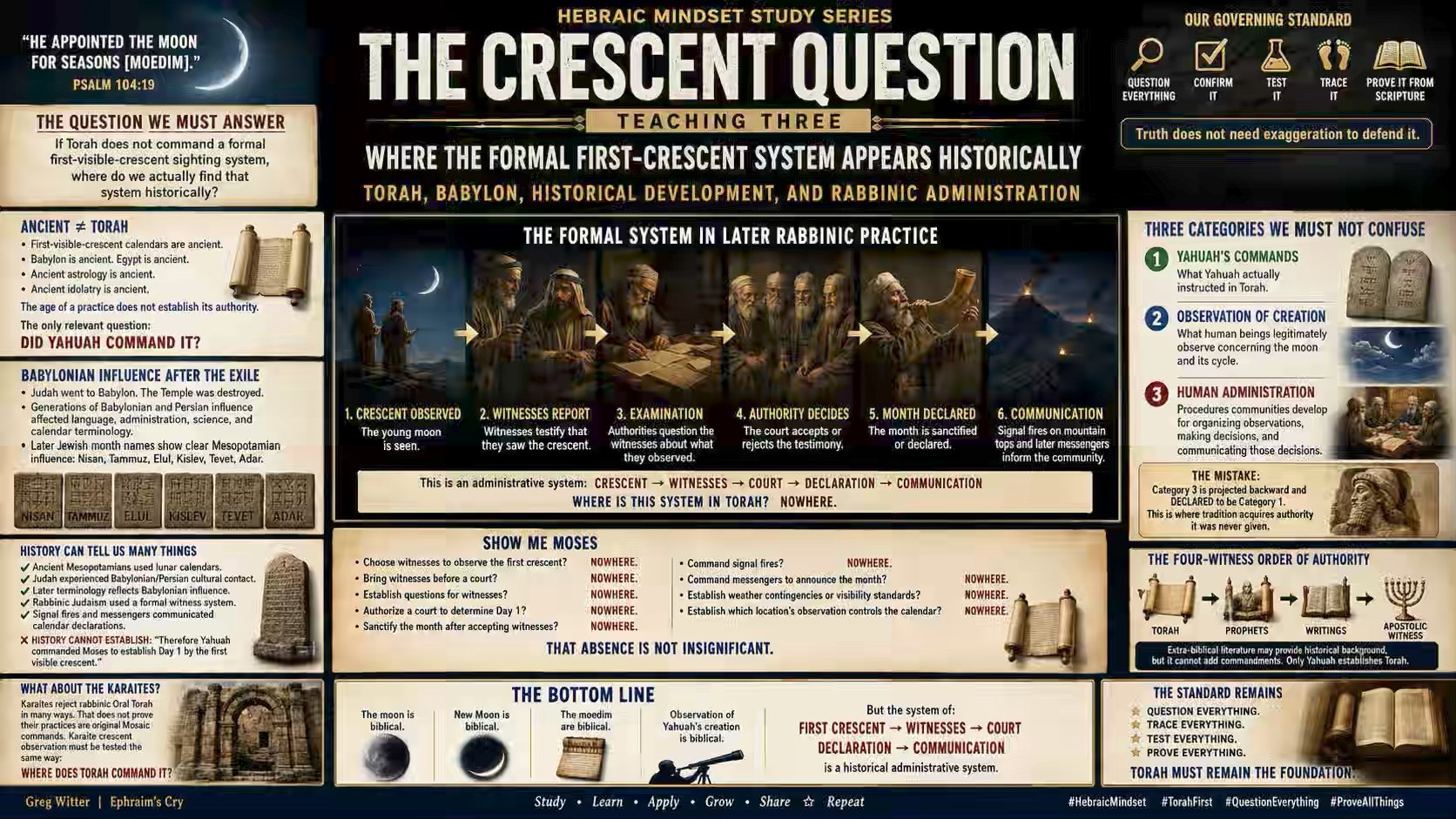
THE CRESCENT QUESTION
TEACHING THREE — WHERE THE FORMAL FIRST-CRESCENT SYSTEM APPEARS HISTORICALLY
Torah, Babylon, Historical Development, and Rabbinic Administration
In Teaching One, we established the governing standard:
Question everything. Confirm it. Test it. Trace it. Prove it from Scripture.
Greg Witter | Ephraim’s Cry
Hebraic Mindset Study Series
Study • Learn • Apply • Grow • Share ☆ Repeat
In Teaching Two, we examined the astronomical argument. We established that the first visible waxing crescent is certainly an observable witness, but visibility does not create astronomical renewal. By the time the waxing crescent becomes visible, the moon has already passed through the invisible transition and is already waxing.
Now we come to another question that must be asked:
IF TORAH DOES NOT COMMAND A FORMAL FIRST-VISIBLE-CRESCENT SIGHTING SYSTEM, WHERE DO WE ACTUALLY FIND THAT SYSTEM HISTORICALLY?
This is where we must proceed carefully. We do not need exaggeration. We do not need conspiracy theories. We do not need to accuse everyone who observes a crescent of paganism. And we should never claim more than the evidence establishes.
Truth does not need exaggeration to defend it.
ANCIENT DOES NOT AUTOMATICALLY MEAN BIBLICAL
One of the arguments sometimes made for first-visible-crescent reckoning is simply that it is ancient.
That is true. First-visible-crescent calendars are ancient. But that does not settle anything.
Babylon is ancient. Egypt is ancient. Canaanite religious practices are ancient. Ancient astrology is ancient. Ancient idolatry is ancient.
Therefore:
ANCIENT ≠ TORAH.
The age of a practice does not establish its authority. The relevant question is not, “How old is this practice?” The relevant question is:
“DID YAHUAH COMMAND IT?”
That distinction must remain at the center of everything we examine.
MESOPOTAMIA AND BABYLON
First-visible-crescent lunar calendrical systems were known throughout the ancient Near East, particularly in Mesopotamia and Babylonia.
Babylonian calendrical practice was strongly lunar and observational. The appearance of the young crescent was significant in determining the beginning of the month within that system.
That historical reality immediately establishes something important:
FIRST-VISIBLE-CRESCENT RECKONING EXISTED OUTSIDE TORAH.
Therefore, simply pointing to the antiquity of crescent observation cannot establish that Moses received it as a commandment from Yahuah.
But we must make an equally important qualification.
THE MOON IS NOT PAGAN
The moon is not Babylonian. The moon is not pagan. The crescent itself is not pagan.
Yahuah created the moon.
Genesis 1:16 says:
“And Elohim made two great lights; the greater light to rule the day, and the lesser light to rule the night.”
Psalm 104:19 says:
“He appointed the moon for seasons [moedim].”
Therefore, observing the moon cannot reasonably be condemned merely because pagan civilizations also observed it.
Pagans observed the sun. That does not make sunlight pagan. Pagans watched the stars. That does not make the stars pagan. Pagans practiced agriculture. That does not make barley pagan.
The issue is not whether Babylon looked at the moon. The issue is whether a particular human procedure involving the moon was commanded by Yahuah.
That is the question.
BABYLONIAN RELIGION AND THE MOON
There is nevertheless an important historical context that should not be ignored.
Ancient Mesopotamian religion gave considerable religious significance to celestial bodies. The Babylonian and Mesopotamian world contained developed systems of astronomical observation intertwined with calendrical administration, omens, astrology, and religious practice.
The moon was associated with the Mesopotamian lunar deity commonly called Sîn in Akkadian sources.
Again, precision matters.
The fact that Babylonians associated the moon with a deity does not mean observing Yahuah’s moon is worshipping Sîn. That would be foolish.
But it demonstrates that sophisticated lunar observation and crescent-based calendrical systems existed in the surrounding pagan world independently of Torah.
Therefore, when someone says, “First-crescent observation is ancient, therefore it must be the original biblical system,” history requires us to answer:
Not so fast.
Ancient pagan civilizations were using lunar observation too.
Antiquity alone proves nothing about Torah authority.
THEN JUDAH WENT TO BABYLON
Now the historical situation becomes considerably more relevant.
Judah did not remain culturally isolated. Jerusalem fell. The Temple was destroyed. Large portions of Judah were carried into Babylonian exile.
The people of Judah then lived for generations within a Mesopotamian imperial environment and subsequently under Persian rule.
That means they encountered foreign language, administration, commerce, science, astronomical knowledge, calendar terminology, and cultural practices.
We should not pretend that generations of contact produced no influence.
The biblical record itself demonstrates repeatedly that foreign environments affected Yisra’el. Sometimes that influence was harmless. Sometimes it was practical. Sometimes linguistic. Sometimes administrative. And sometimes it became deeply corrupting.
The historical task is to determine which is which.
LOOK AT THE MONTH NAMES
One obvious indication of Babylonian cultural influence appears in later Jewish month names.
Torah frequently identifies months numerically: the first month, the second month, the seventh month, and so forth.
Exodus 12:2 says:
“This month shall be unto you the beginning of months: it shall be the first month of the year to you.”
Leviticus 23:24 says:
“In the seventh month, in the first day of the month…”
Torah’s system is remarkably straightforward.
Yet later biblical and Jewish usage contains month names such as Nisan, Tammuz, Elul, Kislev, Tevet, and Adar.
Several of these names have clear parallels in Babylonian calendrical terminology.
That does not prove the entire Jewish calendar was copied wholesale from Babylon. We must not make that leap.
But it establishes something historically significant:
POST-EXILIC JEWISH CALENDAR LANGUAGE SHOWS REAL MESOPOTAMIAN INFLUENCE.
That is evidence, and evidence should be examined rather than ignored.
BE CAREFUL WHAT WE CLAIM
This is where responsible historical study differs from polemics.
Can I prove that one day a Jewish leader in Babylon announced, “Beginning today, we are abandoning Moses and adopting the Babylonian first-visible-crescent calendar”?
No.
We do not possess evidence that neat. Therefore I will not claim it.
Can we demonstrate that Babylonia used an observational lunar calendar in which crescent visibility mattered?
Yes.
Can we demonstrate that Judah spent generations within the Babylonian and Persian cultural world?
Yes.
Can we demonstrate Babylonian influence upon later Jewish calendrical terminology?
Yes.
Can we demonstrate that later Jewish religious authorities operated a formal crescent-witness system?
Yes.
Can we demonstrate that Moses explicitly commanded that formal system?
No.
That is the historical picture we actually have.
We do not need to exaggerate beyond it.
THE FORMAL SYSTEM BECOMES CLEAR IN RABBINIC LITERATURE
When we reach later rabbinic literature, particularly material preserved in Mishnah Rosh Hashanah, the administrative structure becomes explicit.
Now we are no longer merely talking about somebody looking outside and observing the moon.
We have a system.
Witnesses report having seen the young moon. Authorities examine those witnesses. Questions are asked concerning what they observed. Their testimony is evaluated. If accepted, the month is formally declared or sanctified.
Notice what has happened.
The procedure has become:
CRESCENT → WITNESSES → EXAMINATION → AUTHORITY → DECLARATION
That is considerably more than:
“Yahuah appointed the moon for the moedim.”
An administrative institution now stands between the astronomical phenomenon and the national calendar.
WHY WERE WITNESSES NECESSARY?
Because human visibility is variable.
This connects directly with Teaching Two.
One person may see the crescent. Another may not. Clouds may interfere. Geographical location matters. Atmospheric conditions matter. Elevation matters. Eyesight matters.
Therefore, once visible sighting becomes legally determinative, someone must determine whether the sighting is valid.
That produces witnesses. Then witnesses require examination. Examination requires recognized authorities. Authorities make a determination. The determination becomes a declaration.
And now another problem appears.
HOW DOES EVERYONE ELSE FIND OUT?
Imagine Yisra’el spread across considerable territory.
A crescent is observed. Witnesses testify. Authorities accept the testimony. The month is declared.
How does someone living many miles away know what happened?
Now communication becomes necessary.
Rabbinic tradition preserves descriptions of signal fires on mountaintops being used to communicate the declaration of the month. Later, messengers were employed.
That gives us another stage:
CRESCENT → WITNESSES → COURT → DECLARATION → SIGNAL FIRES/MESSENGERS → COMMUNITY
That is a complete administrative system.
And now we must ask the question this entire series requires us to ask:
WHERE IS THAT SYSTEM IN TORAH?
SHOW ME MOSES
Where does Moses command, “Choose witnesses to observe the first waxing crescent”?
Nowhere.
Where does Moses say, “Bring those witnesses before a court”?
Nowhere.
Where does Moses establish the questions that should be asked?
Nowhere.
Where does Moses authorize that court to determine whether Day 1 has begun?
Nowhere.
Where does Moses say, “Sanctify the month after accepting the witnesses”?
Nowhere.
Where does Moses command mountaintop signal fires?
Nowhere.
Where does Moses command messengers to announce the beginning of the month?
Nowhere.
Where does Moses establish weather contingencies, visibility standards, or jurisdiction over which location’s observation controls the calendar?
Nowhere.
That absence is not insignificant.
THREE CATEGORIES MUST NOT BE CONFUSED
This gives us three categories we must keep separate.
1. YAHUAH’S COMMANDS — What Yahuah actually instructed in Torah.
2. OBSERVATION OF CREATION — What human beings legitimately observe concerning the moon and its cycle.
3. HUMAN ADMINISTRATION — Procedures communities develop for organizing observations, making decisions, and communicating those decisions.
Those categories are not identical.
Human administration may sometimes be useful. It may even be necessary for particular communities.
But useful does not equal commanded.
Historical does not equal commanded.
Ancient does not equal commanded.
Jewish does not equal commanded.
The mistake occurs when category three is projected backward and declared to be category one.
That is where tradition acquires authority it was never given.
“BUT THE MISHNAH MAY PRESERVE AN OLDER PRACTICE”
Perhaps.
That possibility should be acknowledged.
A practice being recorded in the Mishnah does not prove it originated when the Mishnah was compiled. It could preserve something older.
But notice what that actually proves.
If we demonstrate that a crescent-witness procedure existed 100 years earlier, we have established an older historical practice. If we push it back another 200 years, we have established an even older historical practice.
But even if we established that some form of crescent sighting existed centuries before the Common Era, we still have not answered:
WHERE DID YAHUAH COMMAND IT IN TORAH?
Age and authority are different questions.
That distinction is absolutely essential.
EARLY PRACTICE DOES NOT EQUAL DIVINE COMMAND
This principle applies throughout Scripture.
Yisra’el practiced things very early that Yahuah did not command. People built high places. Kings developed political customs. Religious traditions accumulated. Some practices were harmless. Some became corrupt.
Therefore:
“They did it a long time ago”
is not equivalent to:
“Yahuah commanded it.”
The only way to establish the second statement is to establish the instruction.
That is why our standard remains:
BOOK. CHAPTER. VERSE.
WHAT ABOUT THE KARAITES?
This historical distinction also matters when discussing Karaite calendar practice.
Karaites rejected the authority of rabbinic Oral Torah in significant ways. That historical fact does not automatically prove that every Karaite practice represents the original Mosaic method.
A group can reject one tradition while retaining another historical practice.
Therefore Karaite crescent observation must be tested exactly the same way as rabbinic practice.
Not:
“Do Karaites practice it?”
But:
“Where does Torah command it?”
No community receives an exemption from the scriptural test.
Not Christianity.
Not Judaism.
Not Karaites.
Not Messianics.
Not Hebrew Roots.
Not Ephraim’s Cry.
EVERYONE ANSWERS TO SCRIPTURE.
THE SIGNAL FIRES PROVE HISTORY — NOT TORAH
This is particularly important concerning graphics showing observers, crescent moons, torches, mountain signal fires, and declarations.
Those images may represent elements known from later historical Jewish practice.
But an image cannot prove Moses commanded something.
An illustration can depict a tradition.
It cannot establish Torah.
Signal fires may tell us how a community communicated a calendar decision.
They do not tell us that Yahuah commanded that method at Sinai.
That distinction must remain clear.
EXTRA-BIBLICAL LITERATURE HAS A PROPER PLACE
The same principle applies to Enoch, Jubilees, Josephus, the Mishnah, Talmudic literature, historical documents, archaeological evidence, and modern scholarship.
These materials can be useful. They can illuminate history. They can show us what particular communities believed. They can document practices. They can help us trace developments.
But they must remain in their proper place.
They are not Torah.
They cannot create Torah commandments.
They cannot reach backward and place instructions into Moses’ mouth.
Historical evidence can answer:
“What did people do?”
Torah answers:
“What did Yahuah command?”
Those are different questions.
THE FOUR-WITNESS ORDER OF AUTHORITY
This is why the order matters:
TORAH → PROPHETS → WRITINGS → APOSTOLIC WITNESS
Torah establishes the foundation.
The Prophets call Yisra’el back to Yahuah’s established ways.
The Writings demonstrate and illuminate Covenant life.
The Apostolic Witness testifies concerning Messiah and the restoration of Yahuah’s people.
Everything must remain in alignment.
Extra-biblical literature may provide historical background.
But it does not become a fifth witness with authority to add commandments.
Babylon cannot establish Torah.
The Mishnah cannot establish Torah.
The Karaites cannot establish Torah.
Modern astronomy cannot establish Torah.
And neither can I.
YAHUAH ESTABLISHES TORAH.
Our responsibility is to understand and obey what He actually said.
WHAT HISTORY CAN ACTUALLY ESTABLISH
History can establish that ancient Mesopotamian and Babylonian societies used observational lunar calendars in which crescent visibility was important.
History can establish that Judah experienced generations of Babylonian and Persian cultural contact.
History can establish that later Jewish calendar terminology reflects Babylonian influence.
History can establish that rabbinic Judaism developed or preserved a formal witness-and-declaration procedure concerning the New Moon.
History can establish that signal fires and later messengers were used to communicate calendar declarations.
What history cannot establish by itself is:
“Therefore Yahuah commanded Moses to establish Day 1 by the first visible crescent.”
That conclusion requires Torah.
And Torah still has to be produced.
DO NOT MAKE HISTORY SAY MORE THAN IT SAYS
People on every side of doctrinal debates are tempted to overstate their evidence.
If we exaggerate history to win an argument, we have abandoned the very truth we claim to defend.
We do not need to say:
“Every crescent observer is practicing Babylonian paganism.”
That is neither necessary nor defensible.
We do not need to say:
“The Jews deliberately abandoned Moses and consciously copied Babylon’s calendar on a particular day.”
We cannot prove that.
What we can say is stronger because it is defensible:
The formal first-visible-crescent procedure is not commanded in Torah. Crescent-based calendrical systems existed in Mesopotamia. Post-exilic Jewish culture shows Babylonian calendrical influence. Later rabbinic literature clearly documents an institutional crescent-witness system. Therefore we have no legitimate basis for simply assuming that this later system equals the original Torah command.
That is enough.
TRACE THE TRADITION — THEN TEST IT
This gives us a powerful method for studying every inherited religious practice.
First, find the command.
Second, examine the context.
Third, trace the historical practice.
Fourth, determine when additional procedures appeared.
Fifth, separate Scripture from tradition.
Sixth, keep what agrees with Scripture.
Seventh, abandon whatever requires us to add to or take from Yahuah’s instruction.
That is not rebellion against history.
That is putting history in its proper place.
History is a witness to what men did.
TORAH IS THE AUTHORITY CONCERNING WHAT YAHUAH COMMANDED.
WHEN THE EVIDENCE STOPS, OUR CLAIMS MUST STOP
There is one more principle we need to establish before closing this teaching:
Our certainty must never exceed our evidence.
If Scripture explicitly commands something, we can say, “Yahuah commanded it.”
If Scripture necessarily establishes something from the text, we can say, “The text establishes this.”
If history documents something, we can say, “History demonstrates this practice existed.”
If something is a reasonable possibility, we can say, “This may have occurred.”
But we cannot take “This may have occurred” and turn it into “This is what Moses did.”
We cannot take “Later Jewish communities practiced this” and turn it into “Therefore Yahuah commanded it at Sinai.”
And we cannot take “Babylonians used a crescent calendar” and leap to “Therefore every Jewish crescent practice was deliberately copied from Babylon.”
That would commit the same error we are exposing—making the evidence say more than it actually says.
Truth requires precision.
WHAT WE KNOW — AND WHAT WE DO NOT KNOW
We know that the moon was appointed by Yahuah for the moedim. We know that New Moons were recognized in Scripture. We know that ancient Mesopotamian civilizations operated lunar calendrical systems involving crescent observation. We know Judah experienced Babylonian exile and subsequent Persian rule. We know post-exilic Jewish calendrical terminology shows Mesopotamian influence. We know later Jewish tradition documents witnesses, courts, declarations, signal fires, and messengers connected with determining and announcing the New Moon.
Those are legitimate historical observations.
But we do not have a Torah passage saying:
“The first visible waxing crescent shall establish the first day of every month.”
We do not have a Torah passage establishing the witness tribunal.
We do not have a Torah passage establishing the court declaration.
We do not have a Torah passage establishing signal fires.
We do not have a Torah passage establishing the entire administrative mechanism later documented in Jewish tradition.
That distinction is decisive.
SCRIPTURE FIRST — HISTORY SECOND
This is the proper order:
SCRIPTURE establishes doctrine.
History helps us understand what happened afterward.
Reverse that order and we create serious problems.
If we begin with later historical practice and then search backward through Scripture looking for something that can be made to support it, we are no longer allowing Torah to establish our doctrine.
We have already established the doctrine from tradition.
Now Scripture is being recruited to defend it.
That is backwards.
Our method must be:
TORAH → UNDERSTANDING → APPLICATION → HISTORICAL COMPARISON
not:
TRADITION → ASSUMPTION → SEARCH FOR A VERSE → CALL IT TORAH
That methodological difference is enormous.
THIS IS BIGGER THAN THE CALENDAR
And that is why this series is ultimately about much more than the moon.
The crescent question gives us a laboratory for learning how to study Scripture.
What do we do when something we inherited is challenged?
Do we immediately defend it?
Or do we examine it?
What happens when a respected teacher tells us something is biblical?
Do we accept the teacher’s authority?
Or do we search the Scriptures?
What happens when something has been practiced for centuries?
Do we assume longevity proves legitimacy?
Or do we ask where Yahuah commanded it?
That is the Hebraic mindset we must recover.
Not rebellion for rebellion’s sake.
Not skepticism for skepticism’s sake.
But Covenant faithfulness.
If Yahuah commanded it, do it.
If Yahuah prohibited it, reject it.
If men developed it, identify it honestly as human practice.
If Scripture does not tell us, say Scripture does not tell us.
That is intellectual integrity.
That is scriptural integrity.
PREPARE FOR TEACHING FOUR
And this brings us directly to the final teaching in this series.
Because once we discover that a practice is not actually commanded in Torah, another question arises:
What happens when we continue requiring it anyway?
What happens when historical practice becomes religious tradition?
What happens when tradition becomes doctrine?
What happens when doctrine becomes an obligation?
What happens when an obligation Yahuah never gave is imposed upon His people in His name?
Now we have moved beyond history.
We have entered the territory of:
ADDING TO TORAH.
And that is where the issue becomes considerably more serious.
Because Yahuah did not merely tell us to obey His commandments.
He also told us:
DO NOT ADD TO THEM.
And:
DO NOT TAKE AWAY FROM THEM.
That will be the subject of Teaching Four:
WHEN TRADITION BECOMES COMMANDMENT — ADDING TO TORAH EVENTUALLY FORCES US TO TAKE AWAY.
For now, Teaching Three leaves us with one unavoidable standard:
HISTORY CAN TELL US WHAT MEN DID.
TRADITION CAN TELL US WHAT MEN INHERITED.
ARCHAEOLOGY CAN TELL US WHAT MEN LEFT BEHIND.
RABBINIC LITERATURE CAN TELL US WHAT RABBIS TAUGHT AND PRACTICED.
BABYLONIAN RECORDS CAN TELL US WHAT BABYLON DID.
But only Yahuah’s Word can establish:
WHAT YAHUAH COMMANDED.
And therefore:
TORAH REMAINS THE FOUNDATION.
History can illuminate Torah.
History cannot legislate Torah.
#HebraicMindset#Torah#BiblicalCalendar#NewMoon#CrescentMoon#FirstVisibleCrescent#Babylon#Babylonia
#Mesopotamia#AncientNearEast#RabbinicTradition#Mishnah#Karaites#CalendarHistory#BiblicalAstronomy#Moedim
#DoNotAdd#DoNotTakeAway#FourWitnesses#Covenant#Watchman#EphraimsCry
