
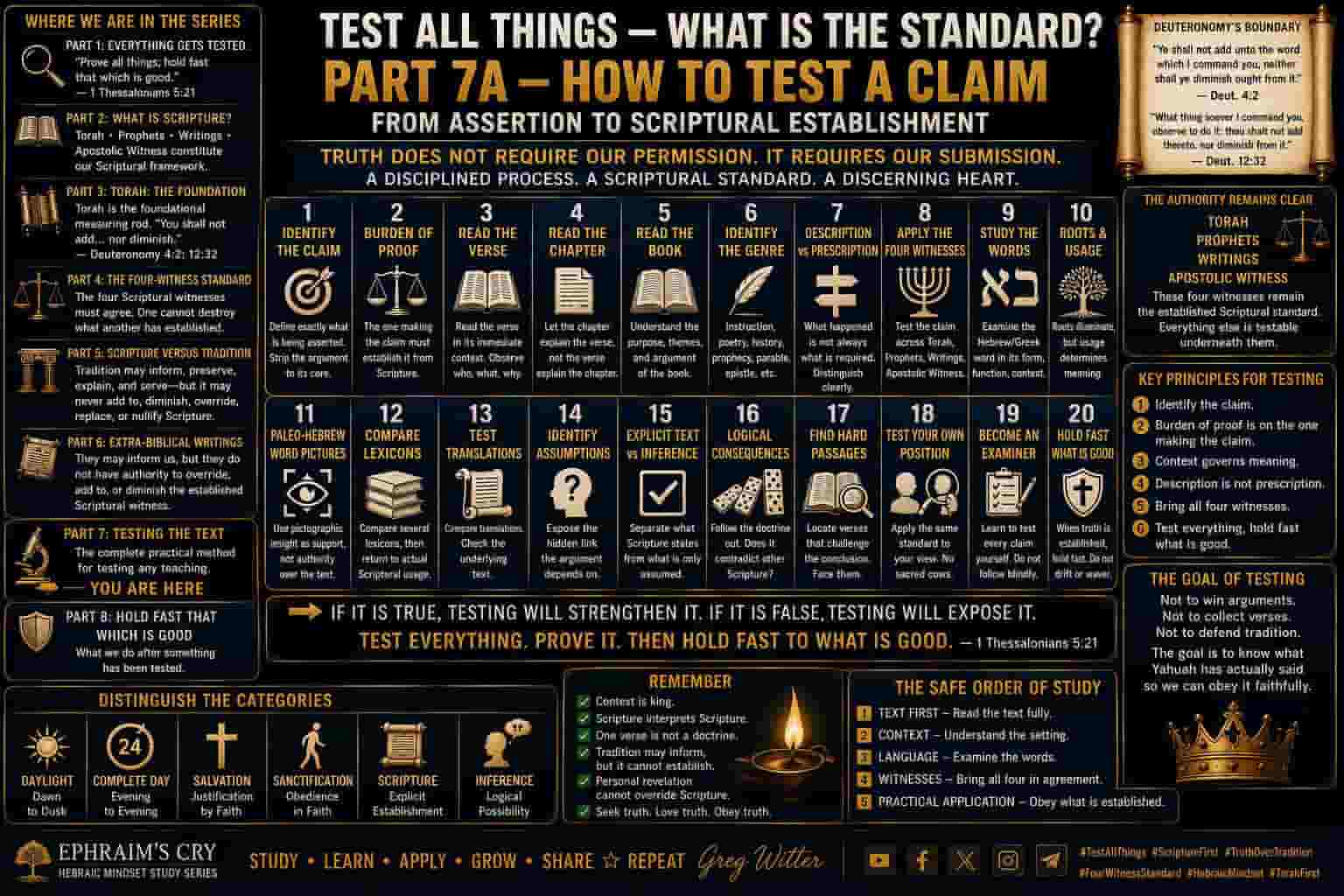
TEST ALL THINGS — WHAT IS THE STANDARD?
PART 7A — HOW TO TEST A CLAIM
FROM ASSERTION TO SCRIPTURAL ESTABLISHMENT
Greg Witter | Ephraim’s Cry
Hebraic Mindset Study Series
Study • Learn • Apply • Grow • Share • Repeat
There comes a point in studying Scripture when simply collecting verses is no longer enough.
Anyone can quote a verse.
Anyone can build a graphic.
Anyone can repeat something they heard from a teacher.
Anyone can say, “The Hebrew proves it.”
Anyone can cite a lexicon, a manuscript, a historian, a rabbi, a pastor, an archaeologist, an early church writer, or an ancient book.
Anyone can say, “Yahuah showed me.”
But none of those things, by themselves, establish doctrine.
That is where discernment begins.
The question is not merely, “Can somebody present evidence?”
The question is:
WHAT DOES THE EVIDENCE ACTUALLY PROVE?
That distinction is enormous.
A claim can sound persuasive while resting almost entirely upon assumptions. A person may produce ten supporting quotations and still never establish the doctrine being asserted. A word study may be technically correct and still be used incorrectly. Historical information may be accurate while the theological conclusion drawn from it is false.
This is why Scripture commands examination.
«“Prove all things; hold fast that which is good.”
— 1 Thessalonians 5:21»
The instruction is not:
Believe all things.
It is not:
Reject all things.
It is:
TEST ALL THINGS.
And testing requires a standard.
That standard is not Greg Witter.
It is not Ephraim’s Cry.
It is not a denomination.
It is not Judaism.
It is not Christianity.
It is not scholarship.
It is not tradition.
It is not consensus.
It is not antiquity.
It is not novelty.
The standard is the whole counsel of the written Word of Elohim.
This teaching begins the practical testing process.
—
1. IDENTIFY THE ACTUAL CLAIM
Before examining evidence, determine exactly what is being claimed.
This sounds simple, but it is where many discussions immediately go wrong.
Someone says:
“The moon determines the Sabbath.”
That contains a claim.
Someone says:
“The Book of Jubilees proves the calendar.”
That contains another claim.
Someone says:
“Paul abolished Torah.”
That is a claim.
Someone says:
“The Hebrew word means…”
That is a claim.
Someone says:
“This practice existed during the Second Temple period.”
That may be historically true, but notice carefully: historical existence is not the same thing as Scriptural authority.
So the first question must be:
WHAT, EXACTLY, ARE YOU ASKING ME TO BELIEVE?
Strip the argument down.
Remove the graphics.
Remove the emotional language.
Remove the personalities.
Remove the claimed revelation.
Remove the theological vocabulary.
What proposition remains?
Until the actual proposition is identified, the claim cannot be tested properly.
This prevents what commonly happens in doctrinal arguments: when one claim begins failing, the person quietly changes to another.
That is moving the goalposts.
A disciplined student does not allow that.
Define the claim.
Then test that claim.
—
2. DETERMINE THE BURDEN OF PROOF
The person making the claim carries the burden of establishing it.
If someone says:
“Scripture commands this,”
the proper response is:
Where?
If someone says:
“This is how Yisra’el always did it,”
ask:
What establishes that historically, and even if demonstrated historically, where does Scripture authorize it?
If someone says:
“The Hebrew proves this,”
ask:
Which Hebrew word? In what grammatical construction? In what context? With what witnesses?
The burden of proof does not transfer merely because someone demands that you disprove an unsupported assertion.
If I say there were twelve additional commandments given secretly to Moses and then demand that you prove there were not, I have reversed the burden of proof.
I made the claim.
I must establish it.
Deuteronomy repeatedly operates upon evidentiary standards. Matters are established through witnesses rather than unsupported accusation.
«“At the mouth of two witnesses, or at the mouth of three witnesses, shall the matter be established.”
— Deuteronomy 19:15»
The principle is unmistakable:
A matter must be established.
Assertions are not establishment.
Confidence is not establishment.
Repetition is not establishment.
—
3. READ THE VERSE IN ITS PASSAGE
One of the fastest ways to manufacture false doctrine is to isolate a sentence from its surroundings.
Never begin with the quotation somebody handed you.
Begin with the passage.
Read before it.
Read after it.
Ask:
Who is speaking?
Who is being addressed?
What question is being answered?
What event is happening?
What subject is under discussion?
What covenant setting is involved?
What command, warning, promise, judgment, or historical event surrounds the verse?
A verse does not become independent merely because someone placed it on a graphic.
Context governs meaning.
Many doctrinal errors survive only because people are trained to read isolated verses rather than arguments, narratives, covenant instructions, and complete thought units.
Therefore:
VERSE CONTEXT FIRST.
—
4. READ THE CHAPTER
Then widen the lens.
What is the chapter doing?
Is the verse part of:
• an instruction?
• a judgment?
• a historical account?
• a prophecy?
• a prayer?
• a proverb?
• a parable?
• an apostolic argument?
• a correction of error?
Reading the chapter often exposes interpretations that appeared convincing when only one verse was shown.
Sometimes the very verses immediately before or after the quoted text contradict the conclusion being imposed upon it.
That should stop us immediately.
Never allow a doctrine to depend upon ignoring the chapter containing its supposed proof text.
—
5. READ THE BOOK
The next circle is the book itself.
What is the author establishing?
Why was the book written?
What themes repeat?
How does the author use the same terminology elsewhere?
For example, if Paul says something that appears at first glance to contradict Torah, do not immediately announce that Paul abolished Torah.
Read Paul.
The same man says:
«“Do we then make void the Torah through faith? Elohim forbid: yea, we establish the Torah.”
— Romans 3:31»
He also says:
«“Wherefore the Torah is holy, and the commandment holy, and just, and good.”
— Romans 7:12»
Therefore an interpretation requiring Paul to condemn what Paul himself calls holy, righteous, and good deserves immediate reexamination.
The book must interpret the sentence before a theological system interprets it for us.
—
6. IDENTIFY THE GENRE
Not every passage functions the same way.
Poetry uses imagery.
Proverbs state wisdom principles.
Narrative describes events.
Torah establishes covenant instruction.
Prophecy may employ symbols.
Apocalyptic literature frequently contains visionary imagery.
Parables communicate truth through figurative stories.
Epistles reason through questions, objections, doctrine, correction, and application.
Confusion develops when genre is ignored.
A poetic expression cannot automatically be converted into calendar legislation.
A narrative occurrence does not automatically become a universal command.
A symbolic prophetic vision cannot be interpreted as though every detail were woodenly literal.
Genre does not weaken Scripture.
Genre helps us read Scripture as Scripture was actually written.
—
7. DISTINGUISH DESCRIPTION FROM PRESCRIPTION
This is critical.
Scripture records many things people did without commanding us to imitate them.
That is description.
A prescription establishes what ought to be done.
For example, the historical fact that a particular group followed a practice does not automatically prove Yahuah commanded that practice.
This applies to Biblical history.
It applies even more strongly to extra-Biblical history.
Someone may demonstrate that Jews during a certain century practiced something.
Fine.
That establishes that some Jews practiced it.
It does not establish:
Yahuah commanded it.
Those are different claims.
Do not collapse them.
Historical practice must itself be tested against Torah.
—
8. APPLY THE FOUR-WITNESS TEST
Now the claim moves beyond its immediate context into the whole counsel of Elohim.
The Ephraim’s Cry testing framework asks whether the doctrine survives:
TORAH — PROPHETS — WRITINGS — APOSTOLIC WITNESS
Torah provides the foundation.
The Prophets enforce, warn, correct, and call Yisra’el back to that covenant foundation.
The Writings demonstrate covenant truth through wisdom, history, worship, obedience, rebellion, consequence, and experience.
The Apostolic Witness confirms the Kingdom and Covenant through Yahusha and those commissioned to bear witness concerning Him.
These witnesses are not competing theological systems.
They testify together.
Therefore, when someone claims that an apostolic passage overturns Torah, something has gone wrong.
When someone interprets a Prophet in a manner that contradicts Torah, something has gone wrong.
When someone turns poetic imagery from the Writings into a new command absent from Torah, something has gone wrong.
When someone makes Paul overthrow Yahusha, something has gone very wrong.
The witnesses must agree.
Truth does not require one portion of Scripture to destroy another.
—
9. STUDY THE WORD — BUT DO NOT WORSHIP THE LEXICON
Word studies are valuable.
They are also abused constantly.
Someone will say:
“The Hebrew word means…”
and suddenly the conversation is treated as finished.
No.
A lexicon gives possible semantic ranges.
It does not automatically tell you which meaning applies in every passage.
Words function in sentences.
Sentences function in contexts.
Contexts function in books.
Books function within the greater Scriptural witness.
Therefore a responsible Hebrew or Greek study asks:
What word is actually present?
What is its root?
What grammatical form is being used?
How is the word used elsewhere?
What range of meaning is attested?
Which meaning fits this context?
Does the proposed definition create contradiction elsewhere?
Is somebody taking one possible dictionary definition and forcing it into every occurrence?
That last mistake is extremely common.
Lexicons are tools. They are not inspired authorities.
Use them.
Do not enthrone them.
—
10. ROOTS ARE NOT DEFINITIONS
Hebrew roots can illuminate relationships between words, but root association must never be allowed to erase actual usage.
A word means what it means in its linguistic and textual setting.
Etymology can help explain development.
It does not automatically determine meaning.
This is especially important when people build theological doctrines entirely from root relationships while ignoring how the Biblical authors actually used the word.
The same caution applies to Greek.
The origin of a word is not necessarily the meaning of the word in every later context.
Usage governs.
Context governs.
Scripture governs.
—
11. PALEO-HEBREW WORD PICTURES — USE THEM CORRECTLY
Paleo-Hebrew can add a powerful layer of insight.
The ancient pictographic associations of the letters can illuminate concepts and provide memorable teaching connections.
But Paleo-Hebrew word pictures must remain supporting evidence, not independent doctrinal authority.
A reconstructed pictographic concept does not get to overturn the plain contextual meaning of a word.
We do not reverse the hierarchy and make a speculative letter picture rule over Torah.
The proper order is:
TEXT → CONTEXT → LANGUAGE → SUPPORTING WORD PICTURE
Not:
WORD PICTURE → INVENTED DOCTRINE → FORCE THE TEXT TO FIT
That distinction protects Paleo-Hebrew study from becoming mystical speculation.
We are seeking meaning already rooted in the text, not manufacturing hidden meanings the text itself cannot sustain.
—
12. COMPARE LEXICONS — DO NOT BUILD DOCTRINE FROM ONE
Another major mistake is treating one dictionary or lexicon as final authority.
Lexicons are produced by scholars.
Scholars make judgments.
Scholars disagree.
Therefore significant word studies should compare sources.
Then go back to actual Scriptural usage.
The strongest evidence for what a Biblical word means is frequently how Scripture itself uses that word repeatedly.
Concordance work matters.
Search the occurrences.
Examine patterns.
Compare contexts.
Notice covenant usage.
This can expose definitions that look impressive in a lexicon entry but do not fit the Biblical evidence.
—
13. TEST TRANSLATION CLAIMS
Translations are valuable.
Translations are also interpretations.
When a theological conclusion depends heavily upon one English wording, compare translations and then examine the underlying text.
Ask:
Is the disputed word actually present?
Was something supplied for readability?
Is there an idiom being translated?
Is the English word broader or narrower than the Hebrew or Greek?
Does punctuation affect the interpretation?
Remember: punctuation in modern translations is editorial.
Chapter numbers are later.
Verse numbers are later.
Headings are later.
Those tools help us navigate Scripture.
They are not themselves Scripture.
Never allow a translator’s heading to become doctrine.
—
14. IDENTIFY ASSUMPTIONS HIDING BETWEEN VERSES
Some of the strongest-looking arguments contain a hidden sentence that Scripture never actually says.
Watch for this.
Verse A says one thing.
Verse B says another.
Then the teacher supplies an unstated connection:
“Therefore…”
That therefore may contain the entire doctrine.
Ask:
Does Scripture actually establish that connection?
Or is the interpreter inserting it?
This is where disciplined testing becomes indispensable.
Write the argument as a logical chain.
A.
B.
Therefore C.
Then examine whether C necessarily follows.
If it does not, the doctrine is not yet established.
Possible does not mean probable.
Probable does not mean proven.
And plausible does not mean Scriptural.
—
15. DISTINGUISH EXPLICIT TEXT FROM INFERENCE
There are different levels of evidence.
Scripture may state something explicitly.
Scripture may necessarily establish something through multiple passages.
Or someone may simply infer something.
These are not equal categories.
If Scripture explicitly says:
“Remember the Sabbath day, to keep it holy,”
that is explicit instruction.
If several passages together establish an event sequence, that may constitute necessary establishment.
But if someone says:
“This must have happened because I cannot imagine it happening any other way,”
that is assumption.
Do not elevate assumption to revelation.
Say what the evidence allows us to say.
No more.
No less.
That intellectual discipline is part of fearing Yahuah.
—
16. TEST THE LOGICAL CONSEQUENCES
Every doctrine produces consequences.
Follow them.
If the doctrine is true, what else must also be true?
Does it require another clear passage to become false?
Does it require Yahuah to contradict Himself?
Does it require Yahusha to violate Torah?
Does it require the Prophets to teach one covenant structure while the Apostolic Witness destroys it?
Does it create two contradictory standards of righteousness?
Does it depend upon defining obedience as bondage while Scripture calls Yahuah’s commandments righteous?
A doctrine may initially sound plausible until its consequences are traced.
Follow the doctrine all the way down.
False premises eventually produce contradictions.
—
17. LOOK FOR THE PASSAGES THE THEORY CANNOT SURVIVE
This may be one of the most important disciplines in serious study.
Do not merely collect verses supporting your position.
Look deliberately for verses that appear to challenge it.
This is the difference between confirmation and examination.
Ask:
What passage would someone who disagrees with me use?
What is the strongest objection?
What verse appears hardest for my position?
Can my doctrine explain that verse naturally?
Or do I have to redefine words, change categories, create exceptions, dismiss context, or invoke hidden meanings every time contrary evidence appears?
A sound doctrine should be able to face hostile cross-examination.
A doctrine is not proven until it survives the passages its advocate would rather avoid.
—
18. DO NOT CONFUSE ACCUMULATION WITH PROOF
Twenty weak arguments do not become one strong argument merely because they are stacked together.
A pile of assumptions remains a pile of assumptions.
Ten historians demonstrating that a practice existed do not establish that Yahuah commanded it.
Fifty quotations from later rabbis do not overturn Torah.
A hundred social-media graphics do not create a verse.
Three lexicons giving a possible definition do not prove that definition applies to the passage being disputed.
Count evidence by quality, not merely quantity.
—
19. TEST YOUR OWN POSITION WITH THE SAME STANDARD
This may be the hardest part.
The standard cannot only be used against everybody else.
If we demand explicit Scripture from an opponent, we must not excuse our own assumptions.
If we reject their tradition, we cannot protect ours.
If we criticize their favorite teacher, we cannot place our favorite teacher beyond examination.
If we demand context from them, we must read context ourselves.
If we tell them to test their calendar, doctrine, terminology, or interpretation, then ours must go onto the same examination table.
That includes Ephraim’s Cry.
That includes Greg Witter.
Because the standard is not a ministry.
The standard is not a man.
THE STANDARD IS THE WORD OF ELOHIM.
—
20. THE STUDENT MUST BECOME AN EXAMINER
The goal of mature teaching is not to produce people who merely repeat the teacher.
The goal is to produce disciples who can examine claims themselves.
You should eventually be able to hear:
“The Hebrew proves…”
and know what questions to ask.
You should hear:
“The early believers practiced…”
and immediately recognize the distinction between historical evidence and divine authority.
You should hear:
“Paul said…”
and know to examine Torah, Yahusha, the Prophets, Paul’s larger argument, and the complete Apostolic Witness.
You should hear:
“Yahuah showed me…”
and know that the claim must still be tested.
You should hear:
“Everybody knows…”
and immediately ask:
Where is it written?
That is not cynicism.
That is discernment.
—
THE TESTING SEQUENCE
When confronted with a doctrinal claim, slow the process down.
Identify the claim.
Establish the burden of proof.
Read the verse.
Read the passage.
Read the chapter.
Read the book.
Identify the genre.
Separate description from prescription.
Test Torah first.
Bring the Prophets.
Bring the Writings.
Bring the Apostolic Witness.
Examine the original-language terminology.
Use roots carefully.
Use Paleo-Hebrew carefully.
Compare lexicons.
Examine Biblical usage.
Identify hidden assumptions.
Separate explicit statements from inference.
Trace the consequences.
Find the difficult passages.
Try to disprove your own conclusion.
Then—and only then—
HOLD FAST THAT WHICH IS GOOD.
—
CONCLUSION — TRUTH CAN SURVIVE EXAMINATION
Truth does not fear investigation.
If a doctrine is true, testing will strengthen it.
If it is false, testing will expose it.
If it is partly right and partly wrong, testing will separate what can be retained from what must be discarded.
That is why a mature disciple does not ask:
“How can I defend what I already believe?”
The better question is:
“What does the whole counsel of Elohim actually establish?”
We are not collecting arguments.
We are pursuing truth.
We are not defending traditions.
We are testing them.
We are not protecting teachers.
We are examining what they teach.
We are not chasing secret knowledge.
We are learning how to handle the written Word faithfully.
And once the evidence establishes the matter, we do not remain permanently undecided merely because someone continues objecting.
Testing has a purpose.
Paul did not say:
“Test everything and remain uncertain forever.”
He said:
«“Prove all things; hold fast that which is good.”»
Test it.
Establish it.
Reject what fails.
Hold tightly to what survives.
Because truth does not require our permission.
It requires our submission.
—
#GregWitter#EphraimsCry#EphraimsCryAcademy#HebraicMindsetStudySeries#HebraicMindset#TorahCommunity
#TorahStudy#BibleStudy#ScriptureStudy#BiblicalTruth#CovenantCommunity#RemnantAwakening#KingdomDisciples
#Watchmen#TestAllThings#WhatIsTheStandard#FourWitnesses#Torah#Prophets#Writings#ApostolicWitness#
ScriptureInterpretsScripture#BiblicalContext#HebrewWordStudy#PaleoHebrew#BiblicalDiscernment#SoundDoctrine#
WholeCounselOfElohim#StudyToShowYourselfApproved#HoldFastWhatIsGood
