
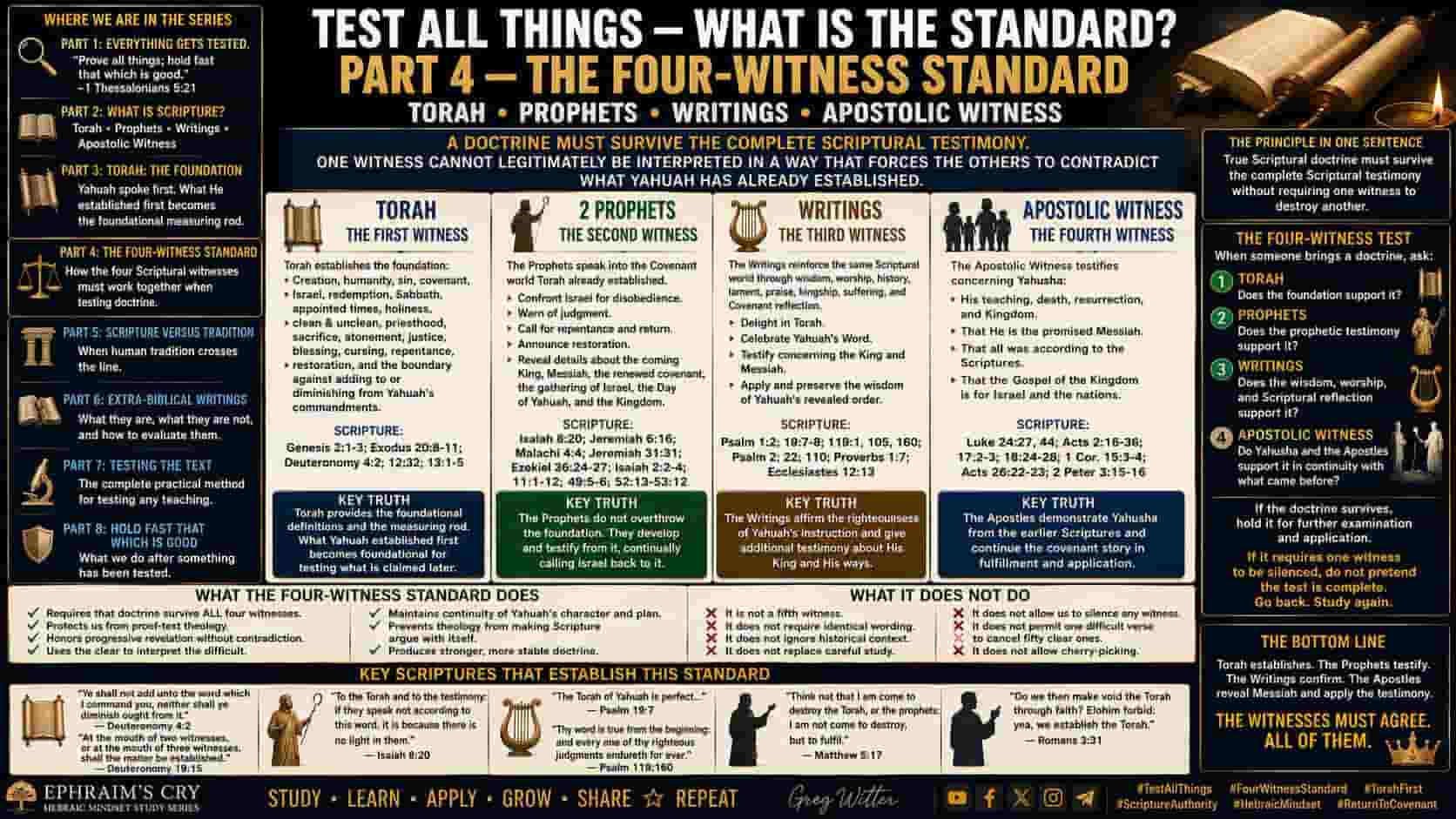
TEST ALL THINGS — WHAT IS THE STANDARD?
Part 4 — The Four-Witness Standard
Torah • Prophets • Writings • Apostolic Witness
A doctrine must survive the complete Scriptural testimony. One witness cannot legitimately be interpreted in a way that forces the other witnesses to contradict what Yahuah has already established.
Greg Witter | Ephraim’s Cry
Hebraic Mindset Study Series
Study • Learn • Apply • Grow • Share ☆ Repeat
Part 1 established:
EVERYTHING GETS TESTED. (1 Thessalonians 5:21; Acts 17:11)
Part 2 established our Scriptural framework:
TORAH • PROPHETS • WRITINGS • APOSTOLIC WITNESS. (Luke 24:27, 44; 2 Timothy 3:15–17; 2 Peter 3:15–16)
Part 3 established:
TORAH IS THE FOUNDATIONAL MEASURING ROD.
Yahuah spoke first. What He established first becomes foundational for testing what is claimed later (Deuteronomy 4:2; 12:32; 13:1–5; Isaiah 8:20).
Now Part 4 brings those principles together.
If Torah establishes the foundation, and the Prophets, Writings, and Apostolic Witness continue the Scriptural testimony, then how should those witnesses work together when establishing doctrine?
That is the purpose of the Four-Witness Standard.
THE WITNESSES MUST BE ALLOWED TO SPEAK
If Torah speaks clearly, we do not silence it because a later tradition is uncomfortable with it.
If the Prophets confirm Torah, we do not dismiss them because our theology has already been built somewhere else.
If the Writings reinforce the same pattern, we do not treat them merely as optional devotional material.
If the Apostolic Witness agrees with Torah, the Prophets, and the Writings, we do not isolate one difficult verse and force it to overturn the entire Scriptural testimony.
The witnesses must be heard together.
That is the strength of the Four-Witness Standard.
A doctrine that appears to work in one isolated passage but collapses when tested against the rest of Scripture is not a strong doctrine.
A doctrine that requires us to ignore Moses is not strong.
A doctrine that requires us to explain away the Prophets is not strong.
A doctrine that requires us to dismiss the Writings is not strong.
A doctrine that requires us to make the Apostles contradict Yahusha is not strong.
Truth should survive examination.
FOUR WITNESSES — ONE CONTINUING TESTIMONY
The Four-Witness Standard does not mean Scripture contains four competing authorities.
It means the Scriptural testimony develops through four major witnesses that must be allowed to testify together.
TORAH establishes.
THE PROPHETS testify, warn, call back, and announce what is coming.
THE WRITINGS reinforce, reflect upon, praise, apply, and preserve the wisdom of Yahuah’s revealed order.
THE APOSTOLIC WITNESS testifies concerning Yahusha, His Kingdom, His death and resurrection, and the fulfillment and application of what the earlier Scriptures anticipated.
The witnesses perform different functions.
But they testify concerning the same Yahuah and the same continuing Covenant story.
TORAH — THE FIRST WITNESS
Torah provides the foundation.
It establishes creation.
Humanity.
Sin.
Covenant.
Abraham.
Yisra’el.
Redemption.
Passover.
Sabbath.
Appointed times.
Holiness.
Clean and unclean.
Priesthood.
Sacrifice.
Atonement.
Justice.
Blessing.
Cursing.
Repentance.
Restoration.
Torah also establishes the boundary against adding to or diminishing from Yahuah’s commandments (Deuteronomy 4:2; 12:32).
Therefore Torah provides the foundational definitions against which later claims are understood.
This was established in Part 3.
THE PROPHETS — THE SECOND WITNESS
The Prophets do not arrive to create a different religion.
They speak into the Covenant world Torah already established.
They confront Yisra’el for violating that Covenant.
They warn of judgment.
They call for repentance.
They announce restoration.
They reveal additional details concerning the coming King, Messiah, the Servant, the Branch, the renewed Covenant, the gathering of Yisra’el, the Day of Yahuah, and the Kingdom.
Isaiah says:
“To the Torah and to the testimony: if they speak not according to this word, it is because there is no light in them.” (Isaiah 8:20)
Jeremiah says:
“Stand ye in the ways, and see, and ask for the old paths, where is the good way, and walk therein.” (Jeremiah 6:16)
Malachi says:
“Remember ye the Torah of Moses my servant, which I commanded unto him in Horeb for all Yisra’el, with the statutes and judgments.” (Malachi 4:4)
The Prophets therefore do not overthrow the foundation.
They continually bring Yisra’el back to it.
THE PROPHETS ALSO EXPAND THE TESTIMONY
Continuity does not mean repetition without development.
The Prophets reveal things Torah anticipates but does not always explain in the same detail.
Jeremiah announces:
“Behold, the days come, saith Yahuah, that I will make a new covenant with the house of Israel, and with the house of Judah.” (Jeremiah 31:31)
Ezekiel speaks of Yahuah gathering His people, cleansing them, giving them a new heart, placing His Spirit within them, and causing them to walk in His statutes (Ezekiel 36:24–27).
Ezekiel also presents the reunification of the divided houses under one King (Ezekiel 37:15–28).
Isaiah speaks repeatedly of restoration, the coming Servant, the nations, Zion, and the reign of Yahuah (Isaiah 2:2–4; 11:1–12; 42:1–7; 49:5–6; 52:13–53:12).
That is development.
But notice what the Prophets do not do.
They do not say:
“Yahuah’s earlier revelation was wrong.”
They expand the testimony without destroying its foundation.
THE WRITINGS — THE THIRD WITNESS
The Writings reinforce the same Scriptural world through wisdom, worship, history, lament, praise, kingship, suffering, and Covenant reflection.
Psalm 1 says:
“His delight is in the Torah of Yahuah; and in his Torah doth he meditate day and night.” (Psalm 1:2)
Psalm 19 says:
“The Torah of Yahuah is perfect, converting the soul: the testimony of Yahuah is sure, making wise the simple.” (Psalm 19:7)
Psalm 119 declares:
“Thy word is a lamp unto my feet, and a light unto my path.” (Psalm 119:105)
And:
“Thy word is true from the beginning: and every one of thy righteous judgments endureth for ever.” (Psalm 119:160)
The Writings therefore provide another witness that Yahuah’s instruction is righteous, wise, enduring, and worthy of meditation.
THE WRITINGS ALSO TESTIFY CONCERNING MESSIAH AND KINGDOM
The Writings do more than praise Torah.
Psalm 2 presents Yahuah’s Anointed King and the nations.
Psalm 22 contains the suffering-righteous-one pattern later associated with Yahusha (Psalm 22; Matthew 27:35, 46).
Psalm 110 speaks of the one seated at Yahuah’s right hand and of priesthood (Psalm 110:1, 4).
Yahusha and the Apostles repeatedly draw from the Psalms when explaining Messiah (Matthew 22:41–46; Acts 2:25–36; Hebrews 5:5–10).
Therefore the Writings participate directly in the continuing Scriptural testimony.
THE APOSTOLIC WITNESS — THE FOURTH WITNESS
The Apostolic Witness testifies that Yahusha is the promised Messiah.
It records His teaching.
His ministry.
His death.
His resurrection.
His Kingdom proclamation.
His commissioning of the disciples.
And the spread of the Gospel of the Kingdom among Yisra’el and the nations.
But the Apostles repeatedly establish their proclamation from the earlier Scriptures.
Paul:
“reasoned with them out of the scriptures.” (Acts 17:2)
Apollos publicly demonstrated:
“by the scriptures that Yahusha was Messiah.” (Acts 18:28)
Paul says his proclamation consisted of:
“none other things than those which the prophets and Moses did say should come.” (Acts 26:22)
Paul describes Messiah’s death and resurrection as:
“according to the scriptures.” (1 Corinthians 15:3–4)
Therefore the Apostolic Witness does not demand that we destroy the earlier witnesses in order to receive Yahusha.
It demonstrates Yahusha from them.
YAHUSHA STANDS WITH THE SCRIPTURAL WITNESSES
Yahusha Himself establishes this continuity.
He says:
“Think not that I am come to destroy the Torah, or the prophets: I am not come to destroy, but to fulfil.” (Matthew 5:17)
He warns against breaking and teaching others to break even the least commandments (Matthew 5:19).
After His resurrection He begins with:
“Moses and all the prophets”
and explains:
“in all the scriptures the things concerning himself.” (Luke 24:27)
Then He identifies:
“the Torah of Moses, and…the prophets, and…the psalms”
as the writings that testified concerning Him (Luke 24:44).
Yahusha therefore does not stand outside the Scriptural testimony.
He identifies Himself within it.
MOSES AND YAHUSHA CANNOT BE MADE ENEMIES
Yahusha says:
“For had ye believed Moses, ye would have believed me: for he wrote of me.” (John 5:46)
Then:
“But if ye believe not his writings, how shall ye believe my words?” (John 5:47)
That creates a serious problem for any theology built upon Moses versus Yahusha.
Yahusha rejects that opposition.
According to Yahusha, properly believing Moses should lead toward believing Him.
Therefore an interpretation that requires Yahusha to invalidate Moses must be carefully reexamined.
PAUL AND MOSES CANNOT BE MADE ENEMIES EITHER
The same principle applies to Paul.
Paul asks:
“Do we then make void the Torah through faith?” (Romans 3:31)
His answer:
“Elohim forbid: yea, we establish the Torah.” (Romans 3:31)
Paul says:
“Wherefore the Torah is holy, and the commandment holy, and just, and good.” (Romans 7:12)
Paul testifies:
“Believing all things which are written in the Torah and in the prophets.” (Acts 24:14)
Therefore if we interpret Paul in a way that requires him to abolish what he calls holy, just, and good, we have created a contradiction inside Paul’s own testimony.
The Four-Witness Standard tells us:
Go back and examine the interpretation.
PETER WARNS THAT PAUL CAN BE TWISTED
Peter gives us an important warning.
Speaking about Paul’s writings, Peter says they contain:
“some things hard to be understood.” (2 Peter 3:16)
Then he says the unlearned and unstable:
“wrest”
those writings:
“as they do also the other scriptures, unto their own destruction.” (2 Peter 3:16)
That should produce caution.
Peter does not say Paul is wrong.
He says Paul can be misunderstood and twisted.
Therefore when an interpretation of Paul creates conflict with Torah, the Prophets, the Writings, Yahusha, and Paul’s own explicit statements, Peter gives us good reason to examine whether Paul has been wrested.
ONE DIFFICULT PASSAGE CANNOT BE ALLOWED TO DESTROY FIFTY CLEAR PASSAGES
This is one of the practical strengths of the Four-Witness Standard.
Suppose one verse appears difficult.
Do not immediately use the difficult verse to erase everything clear.
Start with what is established.
What does Torah say?
What do the Prophets say?
What do the Writings say?
What does Yahusha say?
What do the Apostles say elsewhere?
Then return to the difficult passage.
That is responsible interpretation.
THE CLEAR SHOULD HELP INTERPRET THE DIFFICULT
If fifty passages establish a consistent pattern and one passage appears to contradict them, we should not begin by throwing away the fifty.
We examine the one.
Maybe we misunderstood a word.
Maybe we ignored the context.
Maybe the writer is answering a particular argument.
Maybe we imported a later theological assumption.
Maybe the translation obscures something.
Whatever the cause, the complete Scriptural testimony provides the framework for investigation.
SCRIPTURE SHOULD NOT BE MADE TO ARGUE WITH ITSELF
This is fundamental.
If our doctrine requires:
Moses against Yahusha,
Isaiah against Paul,
Jeremiah against Hebrews,
David against the Apostles,
or Yahusha against His Father,
we should stop.
The problem may not be Scripture.
The problem may be the framework we brought to Scripture.
The Four-Witness Standard exists precisely to prevent us from creating these artificial wars inside the text.
THE TWO-OR-THREE-WITNESS PRINCIPLE
Torah establishes an important legal principle:
“At the mouth of two witnesses, or at the mouth of three witnesses, shall the matter be established.” (Deuteronomy 19:15)
The immediate context concerns judicial testimony, and we should respect that context.
But Scripture repeatedly recognizes the strength of multiple confirming witnesses.
Yahusha invokes the two-or-three-witness principle concerning testimony and judgment (Matthew 18:16).
Paul likewise refers to establishing matters through two or three witnesses (2 Corinthians 13:1; 1 Timothy 5:19).
The Four-Witness Standard follows the same sound principle of confirmation:
Do not build major doctrine upon an isolated claim while ignoring the larger testimony.
THIS DOES NOT MEAN EVERY DOCTRINE MUST APPEAR IDENTICALLY IN ALL FOUR WITNESSES
This qualification is important.
The Four-Witness Standard does not mean every doctrine must appear word-for-word in Genesis, Isaiah, Psalms, and Romans.
That would misunderstand progressive revelation.
The question is not:
“Does every witness use identical vocabulary?”
The question is:
“Does the doctrine survive all the witnesses without requiring one of them to become false?”
A doctrine may begin as a seed in Torah.
The Prophets may develop it.
The Writings may illuminate it.
The Apostolic Witness may identify its fulfillment in Messiah.
That is not contradiction.
That is development.
SEED → DEVELOPMENT → FULFILLMENT → APPLICATION
This is a useful way to understand Scriptural continuity.
TORAH — SEED AND FOUNDATION.
PROPHETS — DEVELOPMENT AND EXPECTATION.
WRITINGS — REFLECTION, WISDOM, WORSHIP, AND ADDITIONAL WITNESS.
APOSTOLIC WITNESS — MESSIAH, FULFILLMENT, KINGDOM PROCLAMATION, AND APPLICATION.
The later witness may reveal something the earlier witness only anticipated.
But it does not need to destroy the earlier witness to do so.
THE RENEWED COVENANT IS AN EXAMPLE
Jeremiah announces:
“I will make a new covenant with the house of Israel, and with the house of Judah.” (Jeremiah 31:31)
What does that Covenant involve?
Yahuah says:
“I will put my Torah in their inward parts, and write it in their hearts.” (Jeremiah 31:33)
Hebrews later quotes this Covenant promise (Hebrews 8:8–12; 10:16–17).
Therefore Hebrews should not be interpreted in a way that requires Jeremiah’s Covenant promise to mean the opposite of what Jeremiah said.
The prophetic witness gives us the framework.
The Apostolic Witness applies it.
That is the Four-Witness Standard functioning correctly.
THE KINGDOM IS ANOTHER EXAMPLE
Torah establishes Yisra’el as a:
“kingdom of priests, and an holy nation.” (Exodus 19:6)
The Prophets develop the Kingdom expectation and the reign of Yahuah and His Anointed (Isaiah 2:2–4; 9:6–7; Daniel 7:13–14).
The Writings testify concerning Yahuah’s Anointed King (Psalm 2; 110).
Yahusha comes proclaiming:
“The time is fulfilled, and the kingdom of Elohim is at hand.” (Mark 1:15)
The Apostolic Witness continues proclaiming the Kingdom (Acts 1:3; 8:12; 28:23, 31).
That is not four different kingdoms.
It is a developing Scriptural testimony.
THE GOSPEL ITSELF HAS EARLIER ROOTS
The Gospel of the Kingdom does not fall from heaven without a Scriptural history.
The promise to Abraham includes blessing reaching the families of the earth (Genesis 12:1–3).
Yisra’el is called to be a kingdom of priests (Exodus 19:5–6).
The Prophets anticipate the nations coming toward Yahuah and His instruction (Isaiah 2:2–4; 49:6).
The Psalms speak of the nations and Yahuah’s Anointed (Psalm 2).
Then Yahusha proclaims the Gospel of the Kingdom (Matthew 4:23; Mark 1:14–15).
Again:
Foundation.
Development.
Witness.
Fulfillment.
Application.
THIS IS WHY CONTINUITY MATTERS
Continuity does not mean nothing changes historically.
Priesthood circumstances can change.
Covenant administration can develop.
Prophecy can be fulfilled.
Messiah can accomplish what was anticipated.
The Kingdom can advance.
But development must remain connected to the Scriptural story.
The Four-Witness Standard protects that continuity.
DOCTRINE MUST SURVIVE ALL FOUR WITNESSES
This is the core test.
Bring the doctrine to Torah.
Does it survive?
Bring it to the Prophets.
Does it survive?
Bring it to the Writings.
Does it survive?
Bring it to Yahusha and the Apostolic Witness.
Does it survive?
If it does, the doctrine has substantial Scriptural support.
If it survives only by silencing one witness, we have work to do.
IF TORAH SAYS YES AND OUR THEOLOGY SAYS NO
Then our theology must be examined.
If the Prophets confirm what Torah established and our theological system requires the opposite, the system must be examined.
If the Writings praise what our doctrine condemns, the doctrine must be examined.
If Yahusha explicitly says He did not come to destroy Torah or the Prophets, and our interpretation requires Him to destroy them, the interpretation must be examined (Matthew 5:17–19).
If Paul says faith does not make Torah void, and our interpretation of Paul requires faith to make Torah void, the interpretation must be examined (Romans 3:31).
The measuring rod does not bend simply because our theology fails the measurement.
IF THE PROPHETS SAY RETURN AND OUR THEOLOGY SAYS ABANDON
Then something is wrong.
Jeremiah says:
“Ask for the old paths, where is the good way, and walk therein.” (Jeremiah 6:16)
Malachi says:
“Remember ye the Torah of Moses my servant.” (Malachi 4:4)
Isaiah says:
“To the Torah and to the testimony.” (Isaiah 8:20)
The prophetic pattern is repeatedly:
Remember.
Return.
Repent.
Restore.
Walk.
Therefore a doctrine claiming that righteousness now requires abandoning what the Prophets called Yisra’el back toward creates a serious continuity problem.
IF THE WRITINGS CALL TORAH PERFECT AND OUR DOCTRINE CALLS IT DEFECTIVE
Then our doctrine must answer for that contradiction.
Psalm 19 says:
“The Torah of Yahuah is perfect.” (Psalm 19:7)
Psalm 119 says:
“Thy righteousness is an everlasting righteousness, and thy Torah is the truth.” (Psalm 119:142)
Again:
“All thy commandments are truth.” (Psalm 119:151)
If later theology teaches us to despise what Scripture calls perfect and true, the Four-Witness Standard tells us to stop and investigate.
IF YAHUSHA SAYS ONE THING AND WE MAKE PAUL SAY THE OPPOSITE
Then Paul has almost certainly been misunderstood.
Yahusha says:
“Think not that I am come to destroy the Torah, or the prophets.” (Matthew 5:17)
Paul says:
“Do we then make void the Torah through faith? Elohim forbid.” (Romans 3:31)
Those statements agree.
Yahusha warns against breaking and teaching others to break commandments (Matthew 5:19).
Paul says:
“The Torah is holy, and the commandment holy, and just, and good.” (Romans 7:12)
Again, agreement.
Paul says he believes:
“all things which are written in the Torah and in the prophets.” (Acts 24:14)
The contradiction therefore does not naturally exist between Yahusha and Paul.
It is frequently created by interpretation.
DO NOT USE PAUL TO CANCEL YAHUSHA
This should never happen.
Paul is a servant of Messiah.
Paul does not possess authority to reverse Yahusha.
Paul does not claim such authority.
Paul says:
“Be ye followers of me, even as I also am of Messiah.” (1 Corinthians 11:1)
The standard is Messiah.
Therefore an interpretation of Paul that requires Paul to correct Yahusha has reversed the authority structure.
DO NOT USE YAHUSHA TO CANCEL MOSES
Yahusha Himself forbids that move.
He says:
“Had ye believed Moses, ye would have believed me: for he wrote of me.” (John 5:46)
And:
“If ye believe not his writings, how shall ye believe my words?” (John 5:47)
Yahusha places Moses and Himself in continuity.
Therefore the theology of:
Moses versus Messiah
does not come from Yahusha.
DO NOT USE THE PROPHETS TO CANCEL TORAH
The Prophets themselves refuse that move.
Isaiah sends us:
“To the Torah and to the testimony.” (Isaiah 8:20)
Jeremiah sends us toward the ancient path (Jeremiah 6:16).
Malachi tells us to remember the Torah of Moses (Malachi 4:4).
The Prophets prosecute Yisra’el for violating Covenant.
They do not invalidate the Covenant standard in order to prosecute its violation.
DO NOT USE THE WRITINGS TO CANCEL THE PROPHETS
The Writings and Prophets share the same Scriptural world.
The Psalms celebrate Yahuah’s kingship and His Anointed (Psalm 2; 110).
The Prophets develop the same Kingdom expectation (Isaiah 9:6–7; Daniel 7:13–14).
The witnesses reinforce one another.
THIS IS WHAT FOUR-WITNESS CONTINUITY LOOKS LIKE
A sound doctrine should be able to move through Scripture without leaving a trail of destroyed passages behind it.
It should not require us continually to say:
“That doesn’t apply.”
“That prophet was talking about something else.”
“That Psalm no longer matters.”
“Yahusha said that before the cross.”
“Paul changed that.”
“Moses was only for Israel.”
At some point, if our doctrine survives only by continually disqualifying Scripture, we need to examine the doctrine.
THE WHOLE COUNSEL MATTERS
Paul tells the elders from Ephesus:
“I have not shunned to declare unto you all the counsel of Elohim.” (Acts 20:27)
That principle matters.
Doctrine should be built from the whole counsel rather than carefully selected fragments.
The Four-Witness Standard is designed to force us to hear the whole counsel.
Not merely our favorite Apostle.
Not merely our favorite Prophet.
Not merely our favorite Torah passage.
Not merely our favorite Psalm.
The witnesses together.
THIS PROTECTS US FROM PROOF-TEXT THEOLOGY
Proof texts are useful when they accurately summarize a doctrine already established in context.
They become dangerous when an isolated verse is expected to carry a doctrine that the larger Scriptural testimony does not support.
A person can quote Scripture and still misuse Scripture.
Satan demonstrates that in Matthew 4:6 by quoting Psalm 91:11–12.
Yahusha responds by bringing another Scriptural witness:
“It is written again, Thou shalt not tempt Yahuah thy Elohim.” (Matthew 4:7; Deuteronomy 6:16)
That is an excellent example of why multiple witnesses matter.
One passage cannot be manipulated in isolation from the rest of Scripture.
THE FOUR-WITNESS STANDARD DOES NOT ALLOW CHERRY-PICKING
Cherry-picking begins with a conclusion and searches for verses that appear to support it.
Responsible study begins with the witnesses and allows them to establish the conclusion.
Those are opposite methods.
One asks:
“How can I prove what I already believe?”
The other asks:
“What does the complete Scriptural testimony establish?”
The second question is the one we want.
THE FOUR-WITNESS STANDARD ALSO PROTECTS AGAINST DISPENSATIONAL FRAGMENTATION
Scripture certainly contains different historical periods and Covenant developments.
Adam does not live in precisely the same historical circumstances as Abraham.
Abraham does not live in precisely the same circumstances as Moses.
David does not live in precisely the same circumstances as Jeremiah.
The Apostles do not live in precisely the same circumstances as Yisra’el in the wilderness.
Recognizing historical development is necessary.
But historical development does not mean Yahuah repeatedly becomes a different Elohim with a contradictory definition of righteousness.
Malachi says:
“For I am Yahuah, I change not.” (Malachi 3:6)
Therefore distinctions in administration and historical circumstance cannot legitimately be used to create contradiction in Yahuah’s character.
THE CHARACTER OF YAHUAH PROVIDES CONTINUITY
Moses declares:
“He is the Rock, his work is perfect: for all his ways are judgment: an Elohim of truth and without iniquity, just and right is he.” (Deuteronomy 32:4)
The Psalms declare His Word true (Psalm 119:160).
Malachi says Yahuah does not change (Malachi 3:6).
Yahusha says the Father’s Word is truth (John 17:17).
Therefore the Four-Witness Standard rests ultimately upon the consistency of Yahuah Himself.
The witnesses agree because the source of truth is consistent.
THE TEST IS NOT “CAN I FIND A VERSE?”
Nearly anyone can find a verse.
The better question is:
Can the interpretation survive Scripture?
Can it survive Torah?
Can it survive the Prophets?
Can it survive the Writings?
Can it survive Yahusha?
Can it survive the Apostolic Witness?
That is a much stronger test.
EXAMPLE: THE SABBATH
Consider the Sabbath only as an example of methodology.
Torah establishes the seventh-day Sabbath in creation and commandment (Genesis 2:1–3; Exodus 20:8–11).
The Prophets continue recognizing the Sabbath and rebuke its violation (Isaiah 56:1–7; 58:13–14; Jeremiah 17:19–27).
The Writings recognize Yahuah’s appointed order and delight in His instruction (Psalm 1:1–2; 92:1–15).
Yahusha keeps the Sabbath and teaches within the Sabbath framework (Luke 4:16; Mark 2:27–28).
The Apostolic Witness continues recording Sabbath activity after the resurrection (Acts 13:14, 42–44; 16:13; 17:2; 18:4).
Therefore if someone proposes a doctrine saying:
“Yahuah abolished the seventh-day Sabbath and replaced it with Sunday,”
the Four-Witness Standard asks:
Where is that established across the witnesses?
The burden is not satisfied by finding one verse someone believes implies a change.
The doctrine must survive the complete testimony.
That is how the method works.
EXAMPLE: THE RENEWED COVENANT
Torah anticipates Yisra’el’s rebellion, dispersion, repentance, and return (Deuteronomy 30:1–10).
The Prophets announce a Covenant renewal involving the house of Yisra’el and the house of Judah and Yahuah’s Torah written internally (Jeremiah 31:31–34).
Ezekiel describes cleansing, a new heart, Yahuah’s Spirit, and walking in His statutes (Ezekiel 36:24–27).
The Apostolic Witness quotes Jeremiah’s promise (Hebrews 8:8–12; 10:16–17).
Therefore any definition of the Renewed Covenant must account for all those witnesses.
We cannot define it solely from a later theological system while ignoring Jeremiah’s own description.
Again:
The witnesses must be allowed to speak.
EXAMPLE: THE NATIONS
Torah promises Abraham that through him all families of the earth will be blessed (Genesis 12:1–3).
Yisra’el is called a kingdom of priests and a holy nation (Exodus 19:5–6).
The Prophets picture the nations coming toward Yahuah’s instruction (Isaiah 2:2–4) and salvation reaching the ends of the earth (Isaiah 49:6).
The Writings repeatedly call the nations to acknowledge Yahuah (Psalm 67:1–7; 117:1–2).
Yahusha commands disciples to be made among all nations (Matthew 28:18–20).
The Apostolic Witness describes those formerly far off being brought near and made fellow citizens (Ephesians 2:11–19).
Again, continuity.
EXAMPLE: FAITH AND OBEDIENCE
Torah presents Abraham believing Yahuah (Genesis 15:6) and later obeying His voice (Genesis 26:5).
The Prophets repeatedly call for both trust and Covenant faithfulness (Habakkuk 2:4; Jeremiah 7:23).
The Writings join trust and righteous walking (Psalm 37:3–5; 119:1–2).
Yahusha connects love with keeping His commandments (John 14:15).
Paul speaks of the “obedience of faith” (Romans 1:5; 16:26).
James says faith without works is dead (James 2:17, 26).
The Four-Witness Standard therefore does not allow us to create a war between genuine faith and genuine obedience.
The witnesses integrate them.
THE METHOD IS SIMPLE EVEN WHEN THE STUDY IS DEEP
The Four-Witness Standard can involve extensive study, but the governing questions are straightforward.
WHAT DOES TORAH ESTABLISH?
WHAT DO THE PROPHETS TESTIFY?
WHAT DO THE WRITINGS CONFIRM OR DEVELOP?
WHAT DO YAHUSHA AND THE APOSTOLIC WITNESS TEACH?
Then ask:
DO THESE WITNESSES FORM A COHERENT TESTIMONY?
If they do, we have substantial Scriptural grounding.
If our interpretation makes them fight one another, we need to keep studying.
THE STANDARD ALSO APPLIES TO ME
Everything established in Part 1 still applies.
If I claim a doctrine survives the Four-Witness Standard, check me.
Read the passages.
Read the context.
See whether I accurately represented Torah.
See whether I accurately represented the Prophets.
See whether I accurately represented the Writings.
See whether I accurately represented the Apostolic Witness.
Do not accept:
“Greg says the Four Witnesses prove it.”
Make sure they actually do.
Acts 17:11 still applies.
Search the Scriptures.
THE FOUR-WITNESS STANDARD IS NOT A SUBSTITUTE FOR SCRIPTURE
This is important.
The Four-Witness Standard is a method for listening to Scripture.
It does not become a fifth witness.
It has no authority independent of the texts themselves.
If I misuse the method, Scripture corrects the method.
The authority remains with Yahuah and His revealed Word.
WHAT PART 4 DOES NOT DO
We are not yet conducting the full examination of human tradition.
That belongs in Part 5.
We are not yet conducting the full examination of Enoch, Jasher, Jubilees, the Talmud, the Apocrypha, Dead Sea Scrolls, and other extra-biblical writings.
That belongs in Part 6.
We are not yet building the complete technical method for context, Hebrew and Greek word studies, translations, manuscript claims, history, archaeology, commentaries, and scholarship.
That belongs in Part 7.
And we are not yet bringing the entire series to its final application of correction, humility, doctrinal repentance, and holding fast.
That belongs in Part 8.
Part 4 has one purpose:
Establish how the four Scriptural witnesses work together when testing doctrine.
WHAT WE HAVE ESTABLISHED
Torah provides the foundation.
The Prophets testify from that foundation and develop the prophetic expectation.
The Writings reinforce the righteousness of Yahuah’s instruction and contribute wisdom, worship, kingship, suffering, and Messianic testimony.
The Apostolic Witness identifies Yahusha within that established Scriptural testimony and proclaims His death, resurrection, Kingdom, and mission according to the Scriptures.
Yahusha says Moses wrote concerning Him (John 5:46–47).
Yahusha says He did not come to destroy Torah or the Prophets (Matthew 5:17–19).
Paul says faith does not make Torah void (Romans 3:31).
Paul calls Torah holy, just, and good (Romans 7:12).
Paul says he believes everything written in Torah and the Prophets (Acts 24:14).
Peter warns that Paul’s writings can be twisted by the unlearned and unstable (2 Peter 3:15–16).
Therefore Scripture must not be interpreted through a method that requires its witnesses continually to contradict one another.
THE FOUR-WITNESS TEST
When someone brings a doctrine, ask:
TORAH — Does the foundation support it?
PROPHETS — Does the prophetic testimony support it?
WRITINGS — Does the wisdom, worship, and Scriptural reflection support it?
APOSTOLIC WITNESS — Do Yahusha and the Apostles support it in continuity with what came before?
If the doctrine survives, hold it for further examination and application.
If it requires one witness to be silenced, do not pretend the test is complete.
Go back.
Study again.
THE PRINCIPLE IN ONE SENTENCE
The Four-Witness Standard can be summarized this way:
TRUE SCRIPTURAL DOCTRINE MUST SURVIVE THE COMPLETE SCRIPTURAL TESTIMONY WITHOUT REQUIRING ONE WITNESS TO DESTROY ANOTHER.
That is the principle.
Not identical wording.
Not mechanical repetition.
Not pretending progressive revelation does not exist.
But continuity.
Agreement.
Development.
Fulfillment.
Application.
Without contradiction.
CONCLUSION
Part 1 established:
EVERYTHING GETS TESTED.
Part 2 established:
TORAH • PROPHETS • WRITINGS • APOSTOLIC WITNESS constitute our Scriptural framework.
Part 3 established:
TORAH IS THE FOUNDATIONAL MEASURING ROD.
Part 4 now establishes:
THE WITNESSES MUST AGREE.
Torah establishes.
The Prophets testify.
The Writings confirm, reflect, and develop.
The Apostolic Witness reveals Messiah and applies the continuing Scriptural testimony.
One difficult passage does not receive permission to destroy the rest.
One teacher does not receive permission to silence Moses.
One interpretation of Paul does not receive permission to contradict Yahusha.
One theological system does not receive permission to make Yahuah argue against Himself.
The witnesses must be allowed to speak.
ALL OF THEM.
And when they are allowed to speak together, doctrine becomes much harder to manipulate.
That prepares us for the next question.
If Scripture is the standard, Torah is foundational, and the Four Witnesses must agree, what happens when human tradition claims authority over what Scripture says?
That is Part 5:
SCRIPTURE VERSUS TRADITION
When Custom, Religion, and Human Authority Cross the Line
#GregWitter#EphraimsCry#EphraimsCryAcademy#HebraicMindsetStudySeries#ReturnToCovenant#TorahStudents
#BibleStudents#ScriptureStudents#HebrewStudents#TruthSeekers#CovenantSeekers#BibleTeachers#FourWitnesses
#FourWitnessStandard#Torah#Prophets#Writings#ApostolicWitness#ScripturalAuthority#BiblicalDoctrine#TestAllThings
#SearchTheScriptures#ScriptureFirst#TorahFirst#Biblical
