
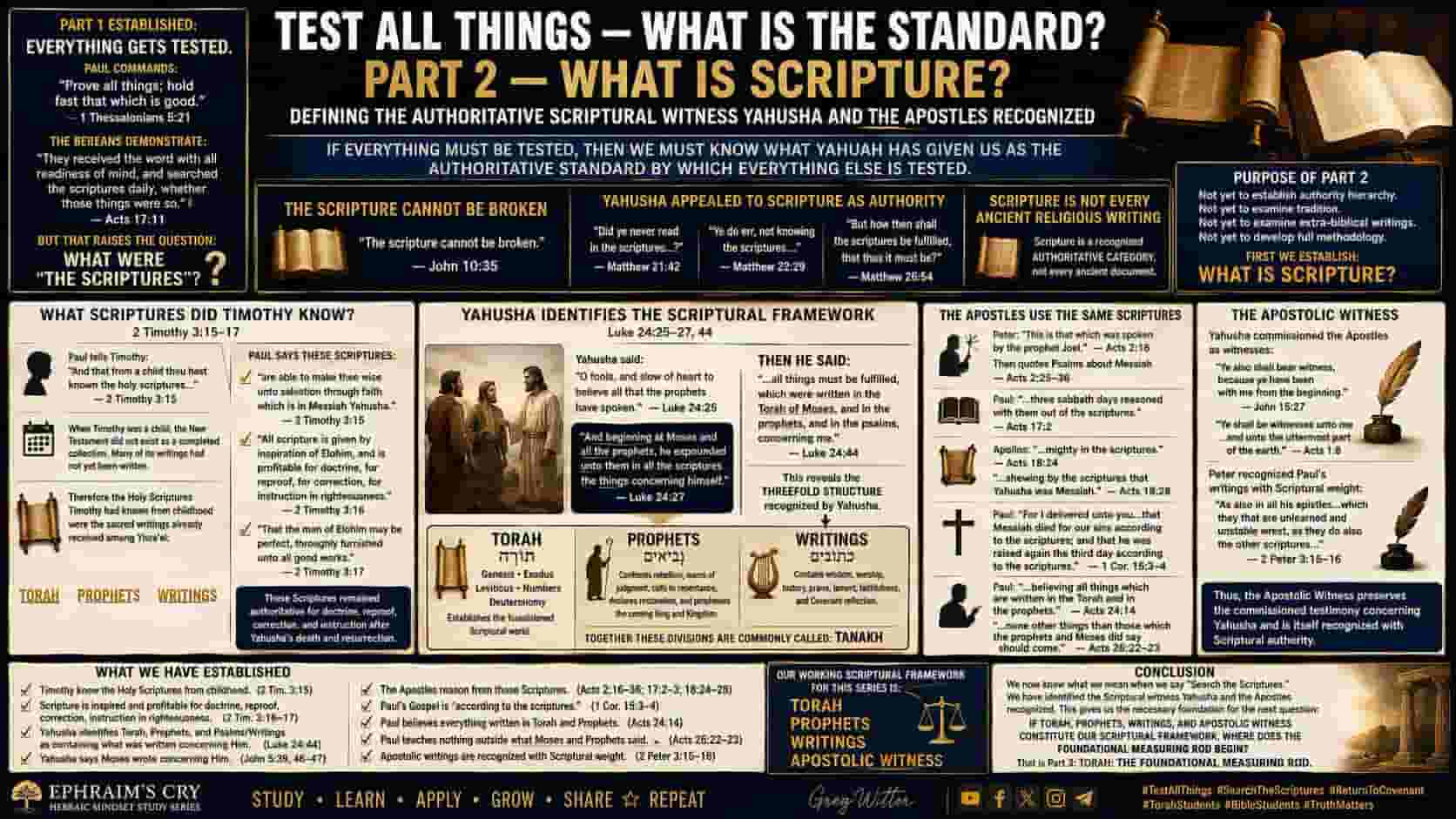
TEST ALL THINGS — WHAT IS THE STANDARD?
Part 2 — What Is Scripture?
Defining the Authoritative Scriptural Witness Yahusha and the Apostles Recognized
Greg Witter | Ephraim’s Cry
Hebraic Mindset Study Series
Study • Learn • Apply • Grow • Share ☆ Repeat
If everything must be tested, then we must know what Yahuah has actually given us as the authoritative standard by which everything else is tested.
In Part 1 we established the foundational principle:
Everything gets tested.
Paul commands:
“Prove all things; hold fast that which is good.” (1 Thessalonians 5:21)
The Bereans demonstrate that principle in practice:
“They received the word with all readiness of mind, and searched the scriptures daily, whether those things were so.” (Acts 17:11)
But that immediately raises the next necessary question:
WHAT WERE “THE SCRIPTURES”?
We cannot tell people to test everything against Scripture without identifying what Scripture is. We cannot establish an authoritative standard while treating every ancient religious writing, tradition, commentary, or historical document as though it carries equal weight.
That is the purpose of Part 2.
Not yet to establish the detailed authority hierarchy—that belongs in the teachings that follow.
Not yet to examine tradition.
Not yet to examine Enoch, Jasher, Jubilees, the Talmud, the Apocrypha, or the Dead Sea Scrolls.
Not yet to establish the complete methodology for interpreting difficult passages.
First we establish:
What is Scripture?
THE MEANING OF “SCRIPTURE”
The Greek word commonly translated Scripture is:
γραφή — graphē
At its basic level, graphē concerns something written. But within the Apostolic Writings, “the Scripture” and “the Scriptures” repeatedly identify recognized sacred writings carrying authority.
Yahusha asks:
“Did ye never read in the scriptures…?” (Matthew 21:42)
Again:
“Ye do err, not knowing the scriptures, nor the power of Elohim.” (Matthew 22:29)
Again:
“But how then shall the scriptures be fulfilled, that thus it must be?” (Matthew 26:54)
And Yahusha makes the extraordinary statement:
“The scripture cannot be broken.” (John 10:35)
Clearly, Yahusha is not using “Scripture” to mean every religious document ever written.
He is referring to an established body of sacred writings carrying recognized authority.
That distinction must remain clear.
WHAT SCRIPTURES DID TIMOTHY KNOW?
Second Timothy 3 is foundational.
Paul tells Timothy:
“And that from a child thou hast known the holy scriptures, which are able to make thee wise unto salvation through faith which is in Messiah Yahusha.” (2 Timothy 3:15)
Then:
“All scripture is given by inspiration of Elohim, and is profitable for doctrine, for reproof, for correction, for instruction in righteousness.” (2 Timothy 3:16)
And:
“That the man of Elohim may be perfect, throughly furnished unto all good works.” (2 Timothy 3:17)
The historical setting matters.
Paul says Timothy had known these sacred writings:
“from a child.” (2 Timothy 3:15)
The completed collection we now call the New Testament did not exist when Timothy was a child.
Many of its writings had not yet been written.
Therefore the Holy Scriptures Timothy had known from childhood necessarily referred to the sacred writings already received among Yisra’el:
Torah.
Prophets.
Writings.
That is an extremely important fact.
THOSE SCRIPTURES REMAINED AUTHORITATIVE AFTER MESSIAH’S RESURRECTION
Paul is writing after Yahusha’s death and resurrection.
Yet he does not tell Timothy that the Scriptures he had known from childhood were obsolete.
He says those Scriptures:
“are able to make thee wise unto salvation through faith which is in Messiah Yahusha.” (2 Timothy 3:15)
Then Paul says Scripture is profitable for:
Doctrine.
Reproof.
Correction.
Instruction in righteousness. (2 Timothy 3:16)
That is not the language of irrelevance.
Those Scriptures remain doctrinal.
They remain corrective.
They remain instructional.
And Paul specifically connects their testimony with understanding salvation through Messiah Yahusha.
Therefore Messiah is not detached from the earlier Scriptures.
The earlier Scriptures provide the framework through which Messiah is understood.
YAHUSHA IDENTIFIES THE SCRIPTURAL FRAMEWORK
Luke 24 gives us one of the clearest statements from Yahusha Himself.
After His resurrection, Yahusha encounters the disciples traveling toward Emmaus.
He says:
“O fools, and slow of heart to believe all that the prophets have spoken.” (Luke 24:25)
Then Luke tells us:
“And beginning at Moses and all the prophets, he expounded unto them in all the scriptures the things concerning himself.” (Luke 24:27)
Notice the sequence:
Moses.
The Prophets.
The Scriptures.
Yahusha does not tell them to abandon the earlier Scriptures in order to understand Him.
He does the opposite.
He begins with those Scriptures to explain Himself.
Later in the same chapter Yahusha makes the framework even clearer:
“These are the words which I spake unto you, while I was yet with you, that all things must be fulfilled, which were written in the Torah of Moses, and in the prophets, and in the psalms, concerning me.” (Luke 24:44)
There is the framework.
THE TORAH OF MOSES.
THE PROPHETS.
THE PSALMS/WRITINGS.
The reference to the Psalms represents the prominent first book of what is traditionally recognized as the third division of the Hebrew Scriptures, the Writings.
This corresponds to the familiar threefold structure:
TORAH — תּוֹרָה
NEVI’IM — נְבִיאִים — PROPHETS
KETUVIM — כְּתוּבִים — WRITINGS
Together these divisions are commonly referred to as the Tanakh.
The later acronym is not the important issue.
The important issue is that Yahusha Himself recognizes and appeals to this established Scriptural framework.
TORAH
The Torah consists of:
Genesis.
Exodus.
Leviticus.
Numbers.
Deuteronomy.
These books establish the foundational Scriptural world.
Creation.
Humanity.
Sin and rebellion.
Promise.
Abraham.
Isaac.
Jacob.
Yisra’el.
Egypt.
Passover.
Redemption.
Sinai.
Covenant.
Torah.
Priesthood.
Tabernacle.
Holiness.
Sacrifice.
Appointed times.
Wilderness.
Judgment.
Inheritance.
Blessing.
Cursing.
Dispersion.
Repentance.
Restoration.
These concepts become foundational vocabulary for everything that follows.
THE PROPHETS
The Prophets continue the testimony.
They confront Covenant rebellion.
They warn of judgment.
They call Yisra’el back.
They announce restoration.
They speak of the coming King.
The Servant.
The Branch.
The gathering of Yisra’el.
The renewed Covenant.
The Kingdom.
The nations.
The Day of Yahuah.
The Prophets do not appear in a theological vacuum.
Their message stands upon what has already been established.
That is why Yahusha can begin with Moses and continue through the Prophets to explain the things concerning Himself (Luke 24:27).
THE WRITINGS
The Writings contain wisdom, worship, history, suffering, kingship, praise, lament, faithfulness, and Covenant reflection.
Psalm 1 begins:
“But his delight is in the Torah of Yahuah; and in his Torah doth he meditate day and night.” (Psalm 1:2)
Psalm 119 declares:
“Thy word is a lamp unto my feet, and a light unto my path.” (Psalm 119:105)
And:
“Thy word is true from the beginning: and every one of thy righteous judgments endureth for ever.” (Psalm 119:160)
The Writings reinforce the continuing Scriptural testimony.
YAHUSHA SAYS THESE SCRIPTURES TESTIFY OF HIM
John 5 makes the relationship unmistakable.
Yahusha says:
“Search the scriptures; for in them ye think ye have eternal life: and they are they which testify of me.” (John 5:39)
Then He says:
“For had ye believed Moses, ye would have believed me: for he wrote of me.” (John 5:46)
And:
“But if ye believe not his writings, how shall ye believe my words?” (John 5:47)
Yahusha does not put Moses on one side and Himself on the other.
He says Moses wrote concerning Him.
That means the Scriptural testimony is continuous.
YAHUSHA’S OWN PRACTICE CONFIRMS THIS
When Yahusha is tempted, He repeatedly responds:
“It is written.” (Matthew 4:4, 7, 10)
And every one of those responses comes from Torah.
Deuteronomy 8:3.
Deuteronomy 6:16.
Deuteronomy 6:13.
When confronting deception, Yahusha appeals to the written Word.
He also repeatedly asks:
“Have ye not read…?” (Matthew 12:3, 5; 19:4)
His expectation is clear.
The Scriptures were known.
The Scriptures could be read.
The Scriptures could settle questions.
THE APOSTLES USE THE SAME SCRIPTURES
The Apostolic Witness follows the same pattern.
Peter explains the outpouring of the Ruach by appealing to Joel:
“This is that which was spoken by the prophet Joel.” (Acts 2:16; Joel 2:28–32)
Peter then appeals to the Psalms concerning David and Messiah (Acts 2:25–36; Psalm 16:8–11; 110:1).
Paul’s practice is described this way:
“And Paul, as his manner was, went in unto them, and three sabbath days reasoned with them out of the scriptures.” (Acts 17:2)
Paul reasons from Scripture to demonstrate Messiah (Acts 17:2–3).
Apollos is described as:
“an eloquent man, and mighty in the scriptures.” (Acts 18:24)
Then:
“For he mightily convinced the Jews, and that publickly, shewing by the scriptures that Yahusha was Messiah.” (Acts 18:28)
Again, Messiah is demonstrated from the established Scriptures.
PAUL’S MESSAGE WAS ACCORDING TO THE SCRIPTURES
Paul summarizes the Gospel:
“Messiah died for our sins according to the scriptures.” (1 Corinthians 15:3)
And:
“He rose again the third day according to the scriptures.” (1 Corinthians 15:4)
The repeated phrase matters:
“According to the Scriptures.”
Paul does not present Messiah as disconnected from the Scriptural testimony.
He presents Messiah according to it.
Paul later testifies:
“So worship I the Elohim of my fathers, believing all things which are written in the Torah and in the prophets.” (Acts 24:14)
And before Agrippa he says he taught:
“none other things than those which the prophets and Moses did say should come.” (Acts 26:22)
That is the Apostolic pattern.
THEN WHAT ABOUT THE APOSTOLIC WRITINGS?
This is the final piece necessary for Part 2.
When Timothy was a child, the Holy Scriptures he knew were the Torah, Prophets, and Writings.
But the Apostolic Witness subsequently develops as authoritative testimony concerning Yahusha, His teachings, His death, His resurrection, His Kingdom proclamation, and the instruction given to the assemblies.
Yahusha commissions His disciples as witnesses.
He tells them:
“Ye also shall bear witness, because ye have been with me from the beginning.” (John 15:27)
After His resurrection He says:
“Ye shall be witnesses unto me both in Jerusalem, and in all Judaea, and in Samaria, and unto the uttermost part of the earth.” (Acts 1:8)
Peter later describes the Apostles as witnesses of Yahusha’s works, death, and resurrection (Acts 10:39–41).
The Apostolic Witness therefore is not merely later religious speculation.
It is testimony concerning Messiah given through those commissioned to bear witness concerning Him.
THE APOSTOLIC WRITINGS THEMSELVES BEGIN TO BE RECOGNIZED WITH SCRIPTURAL WEIGHT
Peter provides an important example concerning Paul’s letters.
He writes that Paul’s epistles contain some things difficult to understand, which unstable people twist:
“as they do also the other scriptures, unto their own destruction.” (2 Peter 3:16)
The phrase:
“the other scriptures”
is significant.
Peter is discussing Paul’s writings and compares their distortion with the distortion of the other Scriptures.
That demonstrates that Apostolic writings were already being treated with Scriptural weight within the first-century community.
Therefore our working authoritative Scriptural framework includes:
TORAH.
PROPHETS.
WRITINGS.
APOSTOLIC WITNESS.
THAT IS THE DEFINITION WE NEED FOR THIS SERIES
We do not need Part 2 to answer every question about canon history.
We do not need Part 2 to examine every disputed ancient writing.
Those questions have their assigned place later in this series.
The purpose here is to establish the standard that Yahusha and the Apostolic Witness themselves give us.
Yahusha points us toward:
Moses.
The Prophets.
The Psalms/Writings. (Luke 24:27, 44)
The Apostles continually reason from those Scriptures and demonstrate Messiah from them (Acts 17:2–3; 18:24–28).
The Apostolic Witness then preserves the commissioned testimony concerning Yahusha and is itself recognized with Scriptural weight (John 15:27; Acts 1:8; 2 Peter 3:15–16).
That gives us the Scriptural framework necessary for everything that follows.
SCRIPTURE IS NOT EVERY ANCIENT RELIGIOUS WRITING
This conclusion must be stated carefully.
There were many ancient writings.
Some may contain valuable information.
Some may preserve important history.
Some may provide cultural background.
Some may help us understand what particular ancient communities believed.
But information and Scriptural authority are not identical categories.
We will examine that distinction in depth in Part 6.
For now, it is enough to establish:
Not everything written is Scripture.
Not everything ancient is Scripture.
Not everything religious is Scripture.
Scripture is a recognized authoritative category.
THE BEREAN TEST NOW MAKES SENSE
Return once more to Acts 17:11.
The Bereans:
“searched the scriptures daily, whether those things were so.”
They had a measuring rod.
They had an established written testimony.
That is why they could test Paul’s proclamation.
They were not comparing Paul’s opinion against their own opinion.
They were comparing what they heard against Scripture.
That is exactly why Part 2 had to follow Part 1.
Part 1 established:
EVERYTHING GETS TESTED.
Part 2 establishes:
THE TEST REQUIRES AN AUTHORITATIVE SCRIPTURAL STANDARD.
And we have now identified that working Scriptural framework:
TORAH • PROPHETS • WRITINGS • APOSTOLIC WITNESS.
WHAT WE HAVE ESTABLISHED
Paul tells Timothy that the Holy Scriptures he had known from childhood could make him wise unto salvation through faith in Messiah Yahusha (2 Timothy 3:15).
Paul declares those Scriptures inspired and profitable for doctrine, reproof, correction, and instruction in righteousness (2 Timothy 3:16–17).
Yahusha begins with Moses and the Prophets to explain the things concerning Himself (Luke 24:27).
Yahusha identifies the Torah of Moses, the Prophets, and the Psalms/Writings as containing what was written concerning Him (Luke 24:44).
Yahusha says the Scriptures testify concerning Him (John 5:39).
Yahusha says Moses wrote concerning Him (John 5:46–47).
The Apostles continually reason from those Scriptures to establish Messiah (Acts 2:16–36; 17:2–3; 18:24–28).
Paul says Messiah’s death and resurrection occurred “according to the scriptures” (1 Corinthians 15:3–4).
Paul says he believes everything written in the Torah and Prophets (Acts 24:14).
Paul says his proclamation taught nothing outside what Moses and the Prophets said would come (Acts 26:22–23).
Yahusha commissions the Apostles as witnesses (John 15:27; Acts 1:8).
And Peter speaks of Paul’s writings in relation to “the other scriptures” (2 Peter 3:15–16).
That is enough to establish the framework required for this lesson.
CONCLUSION
If everything must be tested, then we must know the standard.
And before we can ask whether a doctrine agrees with Scripture, we must know what we mean by Scripture.
The Scriptural testimony recognized and used by Yahusha begins with:
TORAH.
PROPHETS.
WRITINGS.
The Apostolic Witness then testifies concerning Yahusha in continuity with those Scriptures.
Therefore, for the purposes of the testing standard developed throughout this series, we work from:
TORAH • PROPHETS • WRITINGS • APOSTOLIC WITNESS.
That is the framework.
We have not yet established the detailed hierarchy between those witnesses.
That belongs in the teachings ahead.
We have not yet examined the authority of Torah as the foundational measuring rod.
That is Part 3.
We have not yet developed the Four-Witness Standard.
That is Part 4.
We have not yet examined tradition.
That is Part 5.
We have not yet examined extra-biblical writings.
That is Part 6.
We have not yet established the complete methodology for testing teachings.
That is Part 7.
We have not yet dealt with what we do after something has been tested.
That is Part 8.
We have done one thing in Part 2, and one thing only:
WE HAVE IDENTIFIED THE SCRIPTURAL WITNESS THAT WILL FUNCTION AS THE STANDARD FOR THE REST OF THE SERIES.
Now we can move forward without moving the measuring rod.
Part 1 asked:
What gets tested?
Everything.
Part 2 asked:
What is Scripture?
Torah • Prophets • Writings • Apostolic Witness.
That is where Part 2 ends.
We now know what we mean when we say:
“Search the Scriptures.” (John 5:39; Acts 17:11)
We now know why Timothy’s Holy Scriptures remain foundational for doctrine, reproof, correction, and instruction in righteousness (2 Timothy 3:15–17).
We now know why Yahusha could begin with Moses and the Prophets and demonstrate the things concerning Himself (Luke 24:25–27).
We now know why Yahusha could identify the Torah of Moses, the Prophets, and the Psalms/Writings as the established Scriptural testimony concerning Him (Luke 24:44).
We now know why the Apostles repeatedly reasoned from those same Scriptures to establish Yahusha as Messiah (Acts 17:2–3; 18:24–28).
And we now know why the Apostolic Witness does not stand disconnected from those Scriptures but testifies concerning the Messiah whom those Scriptures anticipated (1 Corinthians 15:3–4; Acts 26:22–23).
This gives us the necessary foundation for the next question.
If Torah, Prophets, Writings, and Apostolic Witness constitute our Scriptural framework, where does the foundational measuring rod begin?
That takes us directly into Part 3:
TORAH: THE FOUNDATIONAL MEASURING ROD
Before examining later traditions, later writings, later interpretations, or later theological systems, we must understand something fundamental:
Yahuah spoke first.
What He established first becomes foundational for testing what comes afterward.
That is where we go next.
#GregWitter#EphraimsCry#EphraimsCryAcademy#HebraicMindsetStudySeries#ReturnToCovenant#TorahStudents#
BibleStudents#ScriptureStudents#HebrewStudents#TruthSeekers#CovenantSeekers#BibleTeachers#WhatIsScripture
#BiblicalAuthority#HolyScriptures#SearchTheScriptures#Torah#Prophets#Writings#ApostolicWitness#Luke2444
#SecondTimothy315#SecondTimothy316#Acts1711#John539#ScriptureFirst#ScripturalWitness#StudyScripture
#BiblicalCanon#truthmattersalot
