
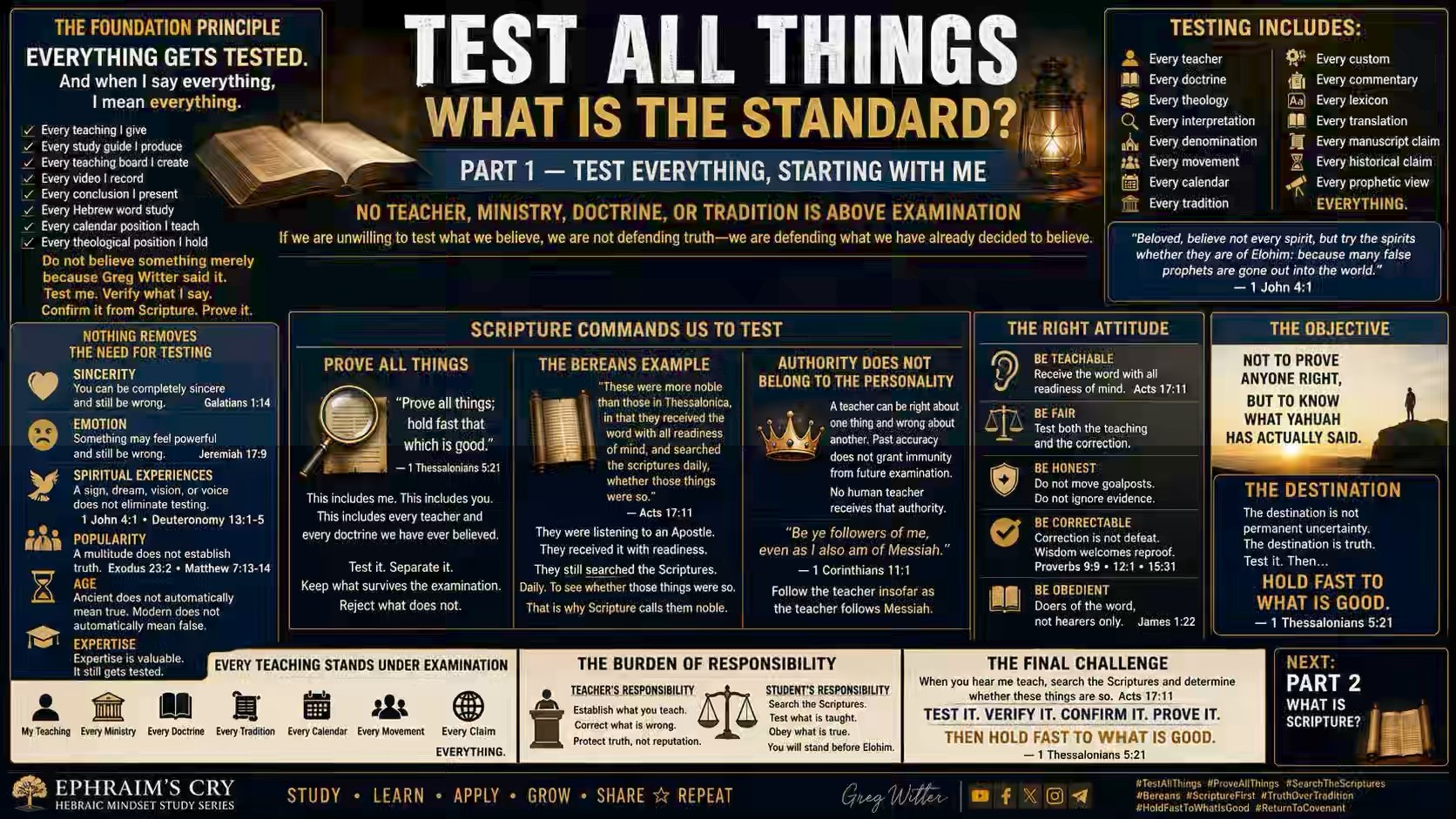
TEST ALL THINGS — WHAT IS THE STANDARD?
Part 1 — Test Everything, Starting With Me
No Teacher, Ministry, Doctrine, or Tradition Is Above Examination
Greg Witter | Ephraim’s Cry
Hebraic Mindset Study Series
Study • Learn • Apply • Grow • Share ☆ Repeat
If we are unwilling to test what we believe, we are not defending truth—we are defending what we have already decided to believe.
There is a principle that must govern every serious student of Scripture:
EVERYTHING GETS TESTED.
And when I say everything, I mean everything.
But before I point toward another teacher, another ministry, another denomination, another tradition, another theological system, another calendar, another ancient writing, or another doctrine, I want to begin in the only responsible place a teacher can begin.
With myself.
Test everything I teach. Test everything I say. Test everything I write. Test everything I publish. Test every study guide I produce. Test every teaching board I create. Test every video I record. Test every conclusion I present. Test every Hebrew word study I give. Test every calendar position I teach. Test every theological position I hold.
Do not believe something merely because Greg Witter said it.
Do not accept something merely because it came from Ephraim’s Cry.
Do not accept my conclusions because I have studied a subject for years. Do not accept them because I teach from a Hebraic mindset. Do not accept them because I can explain Hebrew terminology. Do not accept them because I provide numerous Scripture references. Do not accept them because the argument sounds convincing. Do not accept them because you agree with ninety-nine other things I have taught.
Test me.
Verify what I say.
Confirm it from Scripture.
Prove it.
And if what I teach cannot withstand Scriptural examination, do not accept it.
That is not disrespect toward a teacher. That is the responsibility of the student.
And it is the same standard I apply to everyone else, so it must first be the standard I willingly place upon myself.
Paul writes:
“Prove all things; hold fast that which is good.” (1 Thessalonians 5:21)
Notice that Scripture does not say:
“Prove everything except the teacher you trust.”
It does not say:
“Prove everything except your favorite ministry.”
It does not say:
“Prove everything except the doctrine you have believed for thirty years.”
It says:
“PROVE ALL THINGS.” (1 Thessalonians 5:21)
That includes me.
That includes you.
That includes the teacher who introduced you to Torah.
That includes the teacher who helped you understand the Sabbath.
That includes the teacher who taught you the biblical calendar.
That includes the teacher who taught you about the Name.
That includes the teacher who awakened you to Covenant.
That includes the teacher who has been correct ninety-nine times before.
Past accuracy does not grant anyone immunity from examination on the hundredth teaching.
No human teacher receives that authority.
DO NOT TAKE MY WORD FOR IT
I do not want anyone following me merely because I said something.
I want people opening their Scriptures and asking:
“Is this actually what is written?”
I want people checking the context.
I want people reading what comes before and after the verse.
I want people examining the Hebrew where necessary.
I want people following the references.
I want people asking whether I have actually established something from Scripture or merely presented a conclusion.
If I tell you Scripture explicitly commands something, make me show you the command.
If I tell you a Hebrew word means something, verify it.
If I tell you something occurred historically, verify the history.
If I tell you a doctrine is established throughout Scripture, follow the references and see whether the evidence actually supports what I said.
If I make an inference, I should identify it as an inference rather than pretending Yahuah explicitly said something He did not say.
If I present an observational model, historical reconstruction, calendar conclusion, or theological interpretation, that conclusion remains underneath Scripture.
Scripture does not answer to my theology. My theology answers to Scripture.
That is the order.
THE BEREANS SHOW US HOW THIS IS DONE
Acts 17:11 gives us one of the clearest examples of what responsible examination looks like:
“These were more noble than those in Thessalonica, in that they received the word with all readiness of mind, and searched the scriptures daily, whether those things were so.” (Acts 17:11)
Think about who they were testing.
Paul.
They were listening to an Apostle.
They received what he taught with readiness.
But they did not stop there.
They searched the Scriptures.
Daily.
Why?
To determine:
“Whether those things were so.” (Acts 17:11)
And Scripture calls them noble for doing it.
That is enormously important.
The Bereans did not dishonor Paul by examining what Paul taught.
They demonstrated responsibility.
If Paul’s teaching could be examined against Scripture, mine certainly can.
If an Apostle’s teaching could be examined, no modern teacher gets a free pass.
Neither does a pastor.
Neither does a rabbi.
Neither does a theologian.
Neither does a professor.
Neither does an author.
Neither does a ministry leader.
Neither does an internet personality.
Neither does Greg Witter.
Nobody.
AUTHORITY DOES NOT BELONG TO THE PERSONALITY
A teacher may help you enormously.
Someone may have introduced you to Torah.
Someone may have helped you understand the Sabbath.
Someone may have helped you understand Covenant.
Someone may have helped you understand Yisra’el.
Someone may have helped you understand the biblical calendar.
Someone may have helped you recognize an inherited religious error.
Be thankful for that.
Honor what was good.
But never transfer the authority of Scripture to the person who helped you understand Scripture.
A teacher can be right about one thing and wrong about another.
A teacher can understand Sabbath and misunderstand the calendar.
A teacher can understand Hebrew and misunderstand context.
A teacher can understand Covenant and misunderstand prophecy.
A teacher can possess enormous historical knowledge and still draw an incorrect theological conclusion.
No teacher becomes infallible because he helped you discover something true.
Paul himself said:
“Be ye followers of me, even as I also am of Messiah.” (1 Corinthians 11:1)
There is a limitation built directly into Paul’s statement.
Follow the teacher insofar as the teacher follows Messiah.
The teacher remains accountable.
PAST ACCURACY DOES NOT CREATE FUTURE INFALLIBILITY
Suppose a teacher has taught ninety-nine things correctly.
Teaching number one hundred still gets tested.
Past accuracy does not grant immunity from future examination.
Likewise, discovering that a teacher was wrong about one subject does not automatically mean everything that teacher ever taught was wrong.
That is why Paul does not say:
“If you find one error, throw everything away.”
And he does not say:
“If you find one truth, accept everything.”
He says:
“Prove all things; hold fast that which is good.” (1 Thessalonians 5:21)
Test it.
Separate it.
Keep what survives the examination.
Reject what does not.
That is discernment.
TEST EVERYTHING — NOT JUST WHAT YOU ALREADY DISAGREE WITH
Most people are very good at testing positions they already reject.
It is easy to examine someone else’s doctrine.
It is much harder to examine your own.
It is easy to expose assumptions in another religious system.
It is much harder to recognize assumptions in the system that formed you.
It is easy to demand evidence from someone who disagrees with you.
It is much harder to demand the same quality of evidence from yourself.
But “prove all things” includes the things we desperately want to be true (1 Thessalonians 5:21).
That means your favorite doctrine gets tested.
Your favorite teacher gets tested.
Your favorite interpretation gets tested.
Your inherited beliefs get tested.
Your assumptions get tested.
Your conclusions get tested.
And mine do too.
EVERYTHING REALLY DOES MEAN EVERYTHING
Every teaching.
Every teacher.
Every doctrine.
Every theology.
Every interpretation.
Every denomination.
Every movement.
Every calendar.
Every tradition.
Every custom.
Every commentary.
Every lexicon.
Every translation.
Every manuscript claim.
Every historical claim.
Every archaeological argument.
Every prophetic interpretation.
Every dream.
Every vision.
Every claimed revelation.
Every extra-biblical writing.
Every inherited belief.
Every cherished assumption.
Every position we have held for decades.
EVERYTHING.
John writes:
“Beloved, believe not every spirit, but try the spirits whether they are of Elohim: because many false prophets are gone out into the world.” (1 John 4:1)
Biblical faithfulness therefore is not gullibility.
We are not commanded to believe something merely because a respected teacher said it.
We are not commanded to believe something because it is ancient.
We are not commanded to believe something because millions of people believe it.
We are not commanded to believe something because a religious tradition says it.
We are not commanded to believe something because somebody discovered it in an ancient manuscript.
We are not commanded to believe something because someone claims Yahuah revealed it to him.
We are commanded to test it (1 Thessalonians 5:21; 1 John 4:1).
The detailed question of exactly what constitutes the Scriptural standard belongs to the next teaching. For this first lesson, the foundational principle is simpler:
Nobody gets an exemption from examination.
SINCERITY DOES NOT REMOVE THE NEED FOR TESTING
A person can be completely sincere and still be wrong.
Saul of Tarsus is a powerful example.
Before his encounter with Yahusha, Saul was extraordinarily zealous. He describes himself as being exceedingly zealous for the traditions of his fathers (Galatians 1:14). He persecuted the assembly and genuinely believed he was acting according to what he understood to be righteous zeal (Acts 8:3; 9:1–6; 22:3–4; 26:9–11).
His sincerity did not make his actions correct.
That should sober every one of us.
You can sincerely believe something.
You can passionately defend something.
You can organize your life around something.
You can sacrifice for something.
You can teach something for years.
And you can still be wrong.
Therefore sincerity cannot be the standard.
EMOTION DOES NOT REMOVE THE NEED FOR TESTING
Something may feel powerful and still be wrong.
Something may produce tears and still be wrong.
Something may give us a strong emotional response and still require examination.
Likewise, something may make us uncomfortable and still be true.
Jeremiah warns:
“The heart is deceitful above all things, and desperately wicked: who can know it?” (Jeremiah 17:9)
That does not mean emotion is evil.
It means emotion cannot become our final measuring rod.
Something does not become true because it gives me peace.
Something does not become false because it makes me uncomfortable.
Something does not become Scripture because I feel strongly about it.
Our feelings also come underneath examination.
SPIRITUAL EXPERIENCES DO NOT REMOVE THE NEED FOR TESTING
Someone may say:
“Yahuah showed me.”
“I had a dream.”
“I had a vision.”
“I heard a voice.”
“I felt strongly led.”
The experience may be sincere.
But Scripture still commands:
“Try the spirits whether they are of Elohim.” (1 John 4:1)
Even Torah establishes that a sign or wonder does not automatically authenticate a person’s teaching if that teaching leads away from Yahuah (Deuteronomy 13:1–5).
That means even extraordinary experiences are not exempt.
A sign does not eliminate testing.
A dream does not eliminate testing.
A vision does not eliminate testing.
A claimed revelation does not eliminate testing.
Everything gets tested.
POPULARITY DOES NOT REMOVE THE NEED FOR TESTING
A million followers do not establish truth.
Neither do ten followers.
A teaching does not become true because it is popular.
A teaching does not become true because it is unpopular.
Exodus warns:
“Thou shalt not follow a multitude to do evil.” (Exodus 23:2)
Yahusha also warns concerning the broad and narrow ways (Matthew 7:13–14).
Therefore numbers cannot be our standard.
Majority opinion proves popularity.
It does not prove truth.
Likewise, someone cannot claim:
“Only a tiny remnant understands this, therefore it must be true.”
Minority status does not prove truth either.
Evidence matters.
AGE DOES NOT REMOVE THE NEED FOR TESTING
Something being ancient does not automatically make it true.
Something being modern does not automatically make it false.
Likewise, something being modern does not automatically make it true.
Something being ancient does not automatically make it inspired.
Age tells us how old something is.
It does not automatically establish its authority.
The detailed examination of ancient and extra-biblical writings belongs later in this series.
For now, the principle is simply:
Ancient material gets tested too.
EXPERTISE DOES NOT REMOVE THE NEED FOR TESTING
Experts can be tremendously useful.
A Hebrew scholar may know Hebrew far better than most students.
An archaeologist may understand material evidence.
A historian may understand a historical period.
An astronomer may understand celestial mechanics.
A textual scholar may understand manuscripts.
Their expertise deserves serious consideration.
But expertise does not create infallibility.
The statement:
“Scholars say…”
does not end an argument.
Which scholars?
What evidence?
What methodology?
What assumptions?
Expertise is valuable.
It still gets tested.
THE PURPOSE IS NOT SKEPTICISM
There is an important warning here.
Testing everything does not mean believing nothing.
That is not discernment.
That is skepticism.
Paul does not say:
“Prove all things and reject everything.”
He says:
“Prove all things; hold fast that which is good.” (1 Thessalonians 5:21)
There is a destination to testing.
The destination is not permanent uncertainty.
The destination is truth.
Test it.
Determine whether it survives.
Then hold fast to what is good.
THE BEREANS WERE NOT CYNICS
Return again to Acts 17:11.
The Bereans:
“received the word with all readiness of mind.”
They were teachable.
They were willing to listen.
They were not sitting there waiting to attack Paul.
But neither were they gullible.
They searched the Scriptures:
“whether those things were so.” (Acts 17:11)
That is the balance we need.
Readiness without gullibility.
Examination without cynicism.
Conviction without pride.
Correction without fear.
BEING WRONG IS NOT THE WORST THING
Everyone has been wrong.
I have been wrong.
You have been wrong.
Every teacher has been wrong about something.
The question is not whether we have ever held error.
The question is what we do when error is demonstrated.
Do we protect the teaching because our reputation is attached to it?
Do we defend it because we have taught it publicly?
Do we attack the person who corrected us?
Do we move the goalposts?
Or do we say:
“The evidence corrected me.”
There is no shame in being corrected by truth.
The greater danger is refusing correction after truth has been demonstrated.
THE TEACHER SHOULD WELCOME HONEST EXAMINATION
If a teaching is true, honest examination strengthens it.
If a teaching is false, honest examination exposes it.
Either way, truth benefits.
That is why I am putting myself first.
I cannot demand that you test everyone else while asking you to trust me automatically.
That would be hypocrisy.
So test me.
Not dishonestly.
Not by misquoting me.
Not by attacking something I never said.
Not by refusing to consider the evidence.
Test what I actually teach.
Bring Scripture.
Bring context.
Bring evidence.
If I am wrong:
Show me.
BUT YOUR POSITION GETS TESTED TOO
Testing works in both directions.
Disproving my conclusion does not automatically prove yours.
If you reject my interpretation, establish the alternative.
If you reject my calendar conclusion, establish the one you believe.
If you reject my understanding of a passage, show what the passage actually establishes.
Criticism alone does not establish doctrine.
Everybody’s position stands under examination.
Mine.
Yours.
Everyone’s.
THE STANDARD MUST BE ABLE TO CORRECT US
A standard that never tells us we are wrong is not really a standard.
It is a mirror.
If every time Scripture challenges our theology we reinterpret Scripture until our theology survives, then Scripture is no longer functioning as our authority.
Our theology is.
The Word must be allowed to confront us.
Hebrews says:
“For the word of Elohim is quick, and powerful, and sharper than any twoedged sword… and is a discerner of the thoughts and intents of the heart.” (Hebrews 4:12)
The Word does not merely expose everyone else.
It exposes us.
THE OBJECTIVE IS NOT TO PROVE GREG WITTER RIGHT
This is the central point.
The objective of biblical study is not to prove me right.
It is not to prove your pastor right.
It is not to prove your denomination right.
It is not to prove your movement right.
It is not even to prove yourself right.
The objective is to determine:
WHAT HAS YAHUAH ACTUALLY SAID?
That is the question that matters.
And once we know what He has said, our responsibility is not merely to admire it.
Our responsibility is to submit to it.
THE FIRST PRINCIPLE OF THIS SERIES
Before we determine exactly what writings constitute Scripture, before we establish Torah as the foundational measuring rod, before we develop the Four-Witness Standard, before we examine tradition, before we examine extra-biblical writings, and before we establish the detailed methodology for testing teachings, we must first settle this:
Nothing gets immunity from examination simply because we already believe it.
And nobody gets immunity simply because we respect them.
Not me.
Not you.
Not anybody.
So when you hear me teach, do not say:
“Greg said it.”
Say:
“Let me search the Scriptures and determine whether these things are so.” (Acts 17:11)
When you read something I publish:
Test it.
When you watch one of my teachings:
Test it.
When I make a doctrinal claim:
Test it.
When I teach something you already agree with:
Test it anyway.
When I teach something that challenges you:
Test it before rejecting it.
When another teacher challenges something I teach:
Test both of us.
Then follow Paul’s instruction:
“Prove all things; hold fast that which is good.” (1 Thessalonians 5:21)
That is where this series begins.
Not with blind acceptance.
Not with endless skepticism.
But with responsible examination.
TEST IT.
VERIFY IT.
CONFIRM IT.
PROVE IT.
Then, after it has survived honest examination:
HOLD FAST TO WHAT IS GOOD. (1 Thessalonians 5:21)
That final instruction matters because testing is not intended to leave us wandering endlessly from one possibility to another. Yahuah did not call us to permanent uncertainty. He called us to truth, faithfulness, obedience, and maturity.
There is a difference between being willing to question a doctrine and becoming addicted to questioning everything without ever allowing the evidence to establish anything.
There is a difference between testing and destabilizing.
There is a difference between discernment and cynicism.
There is a difference between asking:
“What has Yahuah actually said?”
and endlessly asking:
“But what if…?”
after Scripture has already answered the question.
Testing must have an objective.
That objective is truth.
WE ARE NOT QUESTIONING FOR THE SAKE OF QUESTIONING
There is nothing inherently righteous about asking questions.
Questions are tools.
A question can expose an assumption.
A question can reveal missing evidence.
A question can force us to examine context.
A question can help us recognize that something we have believed for years was never actually established by Scripture.
Those are good questions.
But Scripture also shows us that questions can be used another way.
Genesis 3:1 records the serpent asking:
“Yea, hath Elohim said…?” (Genesis 3:1)
The problem was not that the serpent used a question mark.
The problem was what the question was designed to accomplish.
Yahuah had spoken.
The serpent used questioning to introduce uncertainty concerning what Yahuah had already said.
That distinction matters.
There is a kind of questioning that searches for truth.
There is another kind of questioning that searches for an escape from truth.
We must know the difference.
HONEST QUESTIONS FOLLOW THE EVIDENCE
If I ask:
“Where does Scripture say that?”
and someone shows me the passage, I now have a responsibility to deal with the passage.
If I ask:
“What is the context?”
and the context is demonstrated, I have a responsibility to deal with the context.
If I ask:
“Does Torah establish that?”
and the command is shown, I have a responsibility to acknowledge it.
I cannot simply ignore the answer and invent another question because I did not like the first answer.
That is no longer investigation.
That becomes avoidance.
The Bereans searched:
“whether those things were so.” (Acts 17:11)
The objective was to reach a conclusion.
Were those things so?
That question can eventually be answered.
DO NOT MOVE THE GOALPOSTS
Testing requires intellectual honesty.
Suppose someone says:
“There is no Scripture that says that.”
A passage is then produced.
The person responds:
“Well, that is not what I meant.”
Then the standard changes.
Another passage is produced.
The standard changes again.
That is not testing.
That is protecting a predetermined conclusion.
If your argument has been answered, acknowledge that it has been answered.
If your evidence has failed, acknowledge that it failed.
If you need to modify your position, modify it.
If you discover that you were wrong, say so.
Truth does not need moving goalposts.
DO NOT IGNORE THE EVIDENCE YOU ASKED FOR
Another common problem occurs when someone demands evidence, receives it, and then simply changes the subject.
That is not honest examination.
If you ask me for Scripture and I provide Scripture, deal with the Scripture.
If I ask you for Scripture and you provide Scripture, I must deal with yours.
Neither of us gets to pretend evidence was never presented simply because it complicates our position.
Responsible study requires argument accountability.
What was claimed?
What evidence was presented?
What was answered?
What remains unanswered?
Did somebody change the subject?
Did somebody repeat the original assertion without addressing the response?
Did somebody move the burden of proof?
Those things matter because our objective is not to win an exchange.
Our objective is truth.
CORRECTION IS NOT DEFEAT
One reason people resist testing is because they have been trained to view correction as losing.
It is not.
If I believed something false yesterday and someone demonstrates the truth today, I did not lose.
I gained truth.
If I taught something incorrectly and Scripture corrects me, the correction is valuable.
Proverbs says:
“Give instruction to a wise man, and he will be yet wiser.” (Proverbs 9:9)
Again:
“Whoso loveth instruction loveth knowledge.” (Proverbs 12:1)
Again:
“The ear that heareth the reproof of life abideth among the wise.” (Proverbs 15:31)
Wisdom is not demonstrated by never needing correction.
Wisdom is demonstrated partly by what we do when correction comes.
A TEACHER MUST BE CORRECTABLE
This is especially important for teachers.
James warns:
“My brethren, be not many masters, knowing that we shall receive the greater condemnation.” (James 3:1)
Teaching carries greater accountability because other people may build upon what we teach.
A student may change his life because of something I say.
A family may change its practice because of something I teach.
Someone may teach my conclusion to somebody else.
That means teachers cannot treat correction casually.
If I discover that I taught something incorrectly, I have a responsibility to correct it.
The fact that I taught it publicly does not make it more true.
The fact that correcting it may be embarrassing does not make the correction less necessary.
Reputation cannot become more important than truth.
DOCTRINAL REPENTANCE IS SOMETIMES NECESSARY
Repentance is not limited to obvious behavioral sin.
Sometimes we must repent of something we believed.
Sometimes we must say:
“I was wrong.”
Sometimes:
“I taught that incorrectly.”
Sometimes:
“I inherited that doctrine and never properly tested it.”
Sometimes:
“I was repeating what someone else taught me.”
Sometimes:
“I read that passage through the theology I already possessed instead of allowing the passage to speak.”
That is not weakness.
That is what happens when truth becomes more important than protecting ourselves.
I HAVE TO BE WILLING TO CORRECT MY OWN WORK
That includes everything associated with this ministry.
If something in one of my teachings is demonstrated to be wrong, it should be corrected.
If something in a study guide is wrong, it should be corrected.
If a Hebrew explanation is wrong, it should be corrected.
If a historical claim is wrong, it should be corrected.
If a calendar conclusion is wrong, it should be corrected.
If something I said in a video is wrong, it should be corrected.
The objective is not to preserve an archive of Greg Witter always being right.
The objective is to preserve and teach truth as faithfully as possible.
BUT CORRECTION MUST ACTUALLY BE PROVEN
There is an equally important other side.
Saying:
“You’re wrong”
does not prove I am wrong.
Calling something false teaching does not prove it is false teaching.
Disagreeing strongly does not constitute evidence.
Posting a meme does not constitute evidence.
Posting a graphic does not constitute evidence.
Repeating the same assertion ten times does not make it stronger.
If someone wants to correct a teaching, bring the evidence.
Show the passage.
Show the context.
Demonstrate the contradiction.
If the correction is valid, it should withstand examination too.
Because:
EVERYTHING GETS TESTED.
Even the correction.
BOTH SIDES STAND UNDER THE SAME STANDARD
This is essential.
The person teaching has a burden to establish what he teaches.
The person challenging the teaching cannot simply assume his alternative is correct.
If you tell me my position is wrong, show me why.
Then show me what Scripture establishes instead.
If I tell you your position is wrong, I carry the same responsibility.
No double standard.
No:
“My position gets assumed while yours must be proven.”
Both positions get tested.
Both teachers get tested.
Both interpretations get tested.
WE MUST BE WILLING TO FOLLOW TRUTH WHERE IT LEADS
This may require leaving a position we once defended.
It may require admitting that a teacher we respect is wrong on a particular subject.
It may require reconsidering something our family practiced for generations.
It may require challenging something our religious community assumes.
It may require revisiting something we ourselves have taught.
That can be costly.
But truth is not obligated to protect our comfort.
Yahusha says:
“Sanctify them through thy truth: thy word is truth.” (John 17:17)
If truth is what we are seeking, then our allegiance must ultimately be to truth rather than to our previous conclusions.
WE SHOULD WANT OUR BELIEFS TESTED
Think about what testing accomplishes.
If your doctrine is false, you should want to know.
If your doctrine is true, testing should strengthen your confidence.
Either result is beneficial.
The only reason to fear honest testing is if preserving the belief has become more important than knowing whether the belief is true.
That is when doctrine begins turning into an idol.
DO NOT CONFUSE CONFIDENCE WITH PRIDE
A person can hold a strong conviction and still remain teachable.
Humility does not mean:
“I can never know anything.”
Humility means:
“I will submit what I believe to the evidence.”
Likewise, conviction does not mean:
“I refuse to listen.”
Conviction means:
“I have examined this carefully and believe the evidence establishes it.”
Those positions can coexist.
Strong conviction.
Open Bible.
Open ears.
Willingness to examine evidence.
Willingness to correct error.
That is maturity.
THE GOAL IS NOT ENDLESS DEBATE
Paul warns Timothy:
“But foolish and unlearned questions avoid, knowing that they do gender strifes.” (2 Timothy 2:23)
Titus likewise warns concerning foolish questions and contentions that become unprofitable and vain (Titus 3:9).
Therefore “test everything” does not mean:
“Argue about everything forever.”
Some discussions become circular.
The same claims are repeated.
The same passages are ignored.
The same objections are answered repeatedly.
At some point, testing has taken place.
Evidence has been presented.
People must decide what they are going to do with it.
TESTING SHOULD LEAD TO OBEDIENCE
Biblical study is not merely an intellectual exercise.
James writes:
“But be ye doers of the word, and not hearers only, deceiving your own selves.” (James 1:22)
If we spend years studying Scripture but refuse to obey what Scripture establishes, we have missed the purpose.
The objective is not merely knowing what is true.
It is walking in truth.
KNOWLEDGE CREATES RESPONSIBILITY
Once truth is established, we become responsible for what we know.
Yahusha teaches the principle of greater accountability corresponding to greater knowledge in Luke 12:47–48.
That means study is serious.
The more we understand, the more responsibility we carry to walk faithfully in what has been revealed.
This should produce humility rather than arrogance.
TESTING BEGINS WITH THE TEACHER AND ENDS WITH THE STUDENT’S RESPONSIBILITY
I can teach.
I can show passages.
I can explain why I believe a conclusion follows.
I can provide evidence.
But I cannot outsource your responsibility before Yahuah.
You must search.
You must test.
You must determine whether the teaching survives Scriptural examination.
And then you must decide whether you are willing to obey what you find.
That is why the Berean example is so powerful:
“They received the word with all readiness of mind, and searched the scriptures daily, whether those things were so.” (Acts 17:11)
They listened.
They searched.
They verified.
Then they acted upon what the evidence established.
SO I PUT MYSELF FIRST
Before this series examines Scripture, authority, Torah, the Four Witnesses, tradition, extra-biblical writings, and the methodology of testing doctrine, I want this foundation firmly established.
Greg Witter gets tested.
Ephraim’s Cry gets tested.
Every teaching gets tested.
Every study guide gets tested.
Every teaching board gets tested.
Every video gets tested.
Every theological conclusion gets tested.
Every calendar conclusion gets tested.
Every Hebrew claim gets tested.
Every historical claim gets tested.
Do not protect my teaching from Scripture.
Put my teaching underneath Scripture.
That is where it belongs.
DO NOT BELIEVE ME BECAUSE I SAID IT
Believe what can be demonstrated to be true.
If what I teach agrees with Scripture, receive it because it agrees with Scripture.
If it does not, reject the error.
That is the relationship I want with anyone who studies with me.
Not followers of Greg.
Students of Scripture.
Not defenders of Ephraim’s Cry.
Defenders of truth.
Not people repeating my conclusions.
Workmen who can examine the evidence themselves.
Paul tells Timothy:
“Study to shew thyself approved unto Elohim, a workman that needeth not to be ashamed, rightly dividing the word of truth.” (2 Timothy 2:15)
That is the objective.
PART ONE ESTABLISHES THE ATTITUDE
Before we can discuss the technical question:
“What is Scripture?”
we first have to establish whether we are willing to let Scripture correct us.
Before we can establish the authority hierarchy, we must decide whether we actually want an authority above ourselves.
Before we can test tradition, we must be willing to discover that one of our traditions may be wrong.
Before we can test extra-biblical writings, we must be willing to let evidence determine their proper place.
Before we can establish the Four-Witness Standard, we must be willing to hear all four witnesses.
Before we can learn how to test a doctrine, we must decide that our own doctrine is eligible to be tested.
That is why this lesson comes first.
THE FOUNDATION OF THE ENTIRE SERIES
Everything that follows rests upon this principle:
TRUTH HAS AUTHORITY. THE TEACHER DOES NOT.
The teacher serves the truth.
The teacher points toward the truth.
The teacher explains the truth.
The teacher should defend the truth.
But the teacher does not own the truth.
And the teacher does not become the standard.
Yahuah remains the authority.
His revealed Word remains the measuring rod.
The next teachings will establish exactly what that means and how that standard operates.
But before we go there, settle this first:
Nobody gets a free pass.
Not the teacher.
Not the student.
Not the tradition.
Not the doctrine.
Not the theology.
Not the interpretation.
Not the experience.
Not the cherished belief.
Not the position we have defended for twenty years.
Not Greg Witter.
EVERYTHING GETS TESTED.
THE FINAL CHALLENGE
So when you hear me teach, do not merely ask:
“Do I agree with Greg?”
Ask:
“Is it true?”
Do not merely ask:
“Does this agree with what I already believe?”
Ask:
“What does Scripture actually establish?”
Do not reject something simply because it challenges you.
Test it.
Do not accept something simply because it comforts you.
Test it.
Do not accept something simply because I taught it.
Test it.
Do not reject something simply because someone you dislike taught it.
Test it.
Do not accept something because it is old.
Test it.
Do not reject something because it is new.
Test it.
Do not accept something because it is popular.
Test it.
Do not accept something because only a few people believe it.
Test it.
Do not accept something because someone claims revelation.
Test it.
Do not even accept your own assumptions without examination.
Test them.
Then follow the complete instruction:
“Prove all things; hold fast that which is good.” (1 Thessalonians 5:21)
That is the balance.
TEST IT.
VERIFY IT.
CONFIRM IT.
PROVE IT.
And when it survives the test:
HOLD FAST TO WHAT IS GOOD.
That is Part 1.
And it prepares us for the question that must come next:
If everything is going to be tested, what exactly is the authoritative standard against which everything must be measured?
That is where Part 2 begins:
WHAT IS SCRIPTURE?
#GregWitter#EphraimsCry#EphraimsCryAcademy#HebraicMindsetStudySeries#ReturnToCovenant#TorahStudents
#BibleStudents#ScriptureStudents#HebrewStudents#TruthSeekers#CovenantSeekers#BibleTeachers#TestAllThings
#BiblicalDiscernment#ScripturalAuthority#StudyScripture#VerifyEverything#TestTheTeacher#TruthOverTradition
#HoldFastToWhatIsGood#StudyToShowThyselfApproved#ScriptureFirst#TruthMatters
