
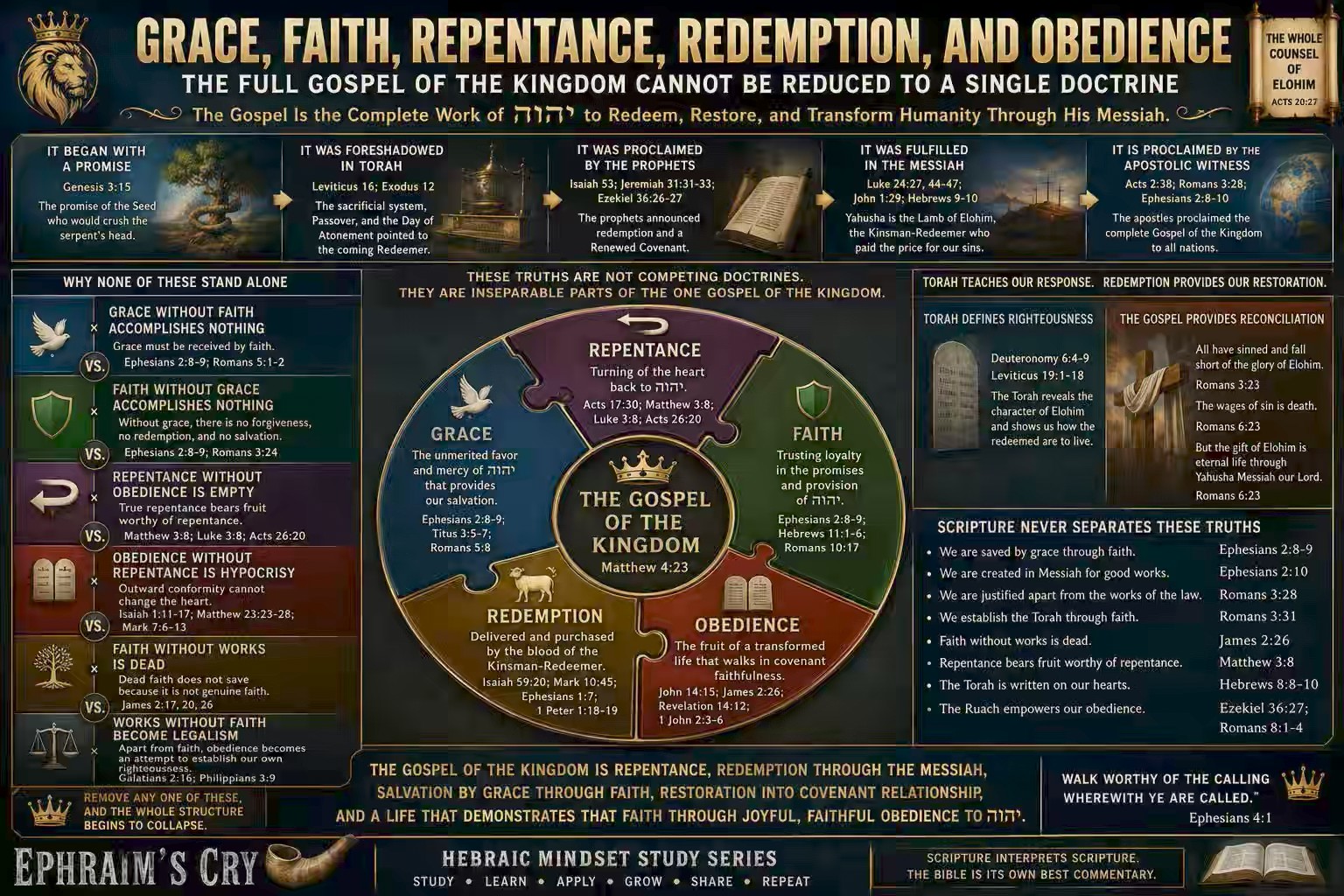
GRACE, FAITH, REPENTANCE, REDEMPTION, AND OBEDIENCE
The Full Gospel of the Kingdom Cannot Be Reduced to a Single Doctrine
Greg Witter | Ephraim’s Cry
Hebraic Mindset Study Series
Study • Learn • Apply • Grow • Share • Repeat
The Gospel Is Not One Truth Standing Alone. It Is the Complete Work of 𐤉𐤄𐤅𐤄 to Restore Fallen Humanity into Covenant Relationship Through His Messiah.
One of the greatest dangers in studying Scripture is not necessarily believing a lie. Often, it is believing a truth while elevating that one truth above all the others. Error frequently begins, not with a complete rejection of Scripture, but by taking one part of Scripture and making it the whole message.
That is exactly what has happened with the Gospel.
Some proclaim grace as though obedience has no place in salvation. Others preach obedience as though grace is unnecessary. Some reduce the Gospel to repentance. Others reduce it to faith alone. Still others insist that simply keeping the commandments is the entire message of Scripture.
Every one of these contains an element of truth.
Every one becomes error when separated from the rest of the counsel of Elohim.
The Gospel of the Kingdom is not one doctrine.
It is the complete work of 𐤉𐤄𐤅𐤄 from Genesis to Revelation to redeem, restore, transform, and reconcile sinful mankind back into covenant relationship with Himself.
That is why no single word can define the Gospel.
Not grace.
Not faith.
Not repentance.
Not obedience.
Not redemption.
Each is essential.
None stands alone.
The first proclamation of the Gospel was never, “Keep the commandments.”
Nor was it, “Believe only.”
Nor was it simply, “Repent.”
The Gospel begins in Genesis immediately after mankind’s fall.
Adam and Eve had sinned.
The covenant relationship had been broken.
Death entered the world.
The curse began.
If obedience alone were sufficient to solve man’s problem, then 𐤉𐤄𐤅𐤄 would simply have told Adam to try harder.
Instead, He promised a Redeemer.
Genesis 3:15 records the first prophetic promise of the coming Seed who would crush the serpent’s head while suffering Himself. Before there was a Tabernacle… before there was a Levitical priesthood… before there was Mount Sinai… before there was a nation called Israel… the Gospel had already begun with the promise of redemption.
That should immediately tell us something.
The Gospel has always been larger than the command to obey.
Obedience was required before Genesis 3.
Redemption became necessary after Genesis 3.
From that moment forward, the entire biblical narrative moves toward one objective: restoring what sin destroyed.
That restoration unfolds progressively throughout Scripture.
The sacrifices established in Torah never removed sin by themselves (Hebrews 10:1–4). They pointed beyond themselves to a greater sacrifice yet to come. Every lamb placed upon the altar declared that sin demanded death, yet every sacrifice also testified that 𐤉𐤄𐤅𐤄 Himself would provide the ultimate Lamb.
The Passover pointed toward redemption (Exodus 12; John 1:29; 1 Corinthians 5:7).
The Day of Atonement pointed toward reconciliation (Leviticus 16; Hebrews 9).
The Kinsman-Redeemer revealed in Torah pointed toward the Messiah who would redeem His covenant family (Leviticus 25; Ruth 4; Isaiah 59:20).
The prophets announced a coming Renewed Covenant in which 𐤉𐤄𐤅𐤄 would write His Torah upon the hearts of His people rather than merely upon tablets of stone (Jeremiah 31:31–33; Ezekiel 36:26–27).
None of these diminish obedience.
They explain why obedience alone could never solve mankind’s greatest problem.
The problem was never that Torah was defective.
The problem was mankind.
Paul writes,
“Wherefore the Torah is holy, and the commandment holy, and just, and good.” (Romans 7:12)
The Torah was never the problem.
The heart of man was.
That is why repentance becomes essential.
Repentance is far more than feeling guilty.
It is far more than admitting we were wrong.
The Hebrew concept of returning and the Greek concept of changing one’s mind both point toward the same reality—a turning of the whole person back toward 𐤉𐤄𐤅𐤄.
Repentance changes direction.
It changes allegiance.
It changes authority.
It changes the course of one’s life.
John the Immerser did not simply tell people to confess their sins.
He declared,
“Bring forth therefore fruits worthy of repentance.” (Matthew 3:8; Luke 3:8)
Repentance that produces no transformation is not biblical repentance.
The fruit demonstrates the reality of the root.
This is where obedience enters the picture.
Obedience is not repentance itself.
Obedience is the evidence that repentance has genuinely occurred.
A man may claim he has repented while continuing to walk in rebellion.
Scripture refuses to recognize such repentance.
Likewise, a man may outwardly conform to commandments while his heart remains proud, self-righteous, and unchanged.
Yahusha repeatedly confronted exactly that condition among many of the religious leaders of His day (Matthew 23:23–28; Mark 7:6–13).
External obedience without inward transformation becomes religious performance.
Repentance without obedient fruit becomes empty profession.
Neither reflects the Gospel of the Kingdom.
Faith stands beside repentance in the same way.
The Gospel repeatedly calls men and women to believe.
Not merely to acknowledge facts.
Not merely to accept historical events.
Biblical faith is trusting loyalty.
It is confidence placed completely in the promises and provision of 𐤉𐤄𐤅𐤄.
Paul declares,
“For by grace are ye saved through faith; and that not of yourselves: it is the gift of Elohim: not of works, lest any man should boast.” (Ephesians 2:8–9)
Notice carefully what Paul does not say.
He does not say we are saved by grace without faith.
Grace is the source.
Faith is the means by which that grace is received.
Without grace there is no salvation.
Without faith that grace is never received.
The two cannot be separated.
Neither can stand alone.
Grace without faith accomplishes nothing.
Faith without grace has nothing to receive.
They function together exactly as 𐤉𐤄𐤅𐤄 designed them.
James then completes the picture.
While some imagine James and Paul disagree, they are actually addressing two different errors.
Paul confronts those attempting to earn salvation through works.
James confronts those claiming faith while refusing obedience.
James writes,
“Faith, if it has not works, is dead, being alone.” (James 2:17)
Again he concludes,
“For as the body without the spirit is dead, so faith without works is dead also.” (James 2:26)
James does not contradict Paul.
He explains what genuine faith looks like.
Living faith produces living obedience.
Dead faith produces nothing.
A tree is known by its fruit (Matthew 7:16–20).
A transformed heart produces a transformed life.
That is why Paul immediately follows Ephesians 2:8–9 with verse 10:
“For we are His workmanship, created in Messiah Yahusha unto good works, which Elohim has before ordained that we should walk in them.”
Grace saves.
Faith receives.
Obedience follows.
Not as the means of earning redemption…
But as the evidence that redemption has taken place.
This is why Paul can also write,
“Do we then make void the Torah through faith? Elohim forbid: yea, we establish the Torah.” (Romans 3:31)
Faith never abolishes obedience.
Grace never authorizes rebellion.
Redemption never eliminates holiness.
Instead, redemption makes obedience possible because the heart has been transformed by the work of 𐤉𐤄𐤅𐤄.
The Gospel of the Kingdom therefore cannot honestly be reduced to a single phrase.
It is not simply:
“Believe.”
It is not simply:
“Repent.”
It is not simply:
“Keep the Law.”
It is not simply:
“Grace.”
It is the complete redemptive work of 𐤉𐤄𐤅𐤄.
He calls us to repentance (Acts 17:30).
He provides redemption through His Messiah (Isaiah 53; Mark 10:45; Ephesians 1:7).
He saves us by grace through faith (Ephesians 2:8–10).
He restores us into covenant relationship (Jeremiah 31:31–33).
He writes His Torah upon our hearts (Ezekiel 36:26–27; Hebrews 8:8–10).
He gives us His Ruach to empower obedience (Ezekiel 36:27; Romans 8:1–4).
And that transformed life bears the fruit of faithful covenant obedience (John 14:15; James 2:26; Revelation 14:12).
None of these truths compete with one another.
They complete one another.
Remove grace, and salvation becomes impossible.
Remove faith, and grace is never received.
Remove repentance, and the heart never turns.
Remove redemption, and sin remains unpaid.
Remove obedience, and faith is shown to be dead.
The Gospel of the Kingdom is the harmony of every one of these truths working together according to the perfect wisdom of 𐤉𐤄𐤅𐤄.
That is the testimony of the Torah.
It is the testimony of the Prophets.
It is the testimony of the Writings.
It is the testimony of the Apostolic Witness.
That is the whole counsel of Elohim.
Want to go deeper? If this study has challenged and encouraged you, consider exploring the resources available through the Hebraic Mindset Study Series, where we examine Scripture through the unified testimony of the Torah, the Prophets, the Writings, and the Apostolic Witness, allowing the Bible to interpret itself and restoring a covenant-first understanding of the Gospel of the Kingdom.
#EphraimsCry#GregWitter#HebraicMindsetStudySeries#KingdomTeaching#ReturnToScripture#CovenantFaithfulness
#StudyLearnApplyGrowShareRepeat#Torah#WholeCounselOfElohim#GospelOfTheKingdom#Grace#Faith#Repentance
#Redemption#Obedience#KinsmanRedeemer#Salvation#TorahObservant#Discipleship#KingdomLife#ScriptureInterpretsScripture
#Truth#Yahusha#KingdomOfYahuah
