
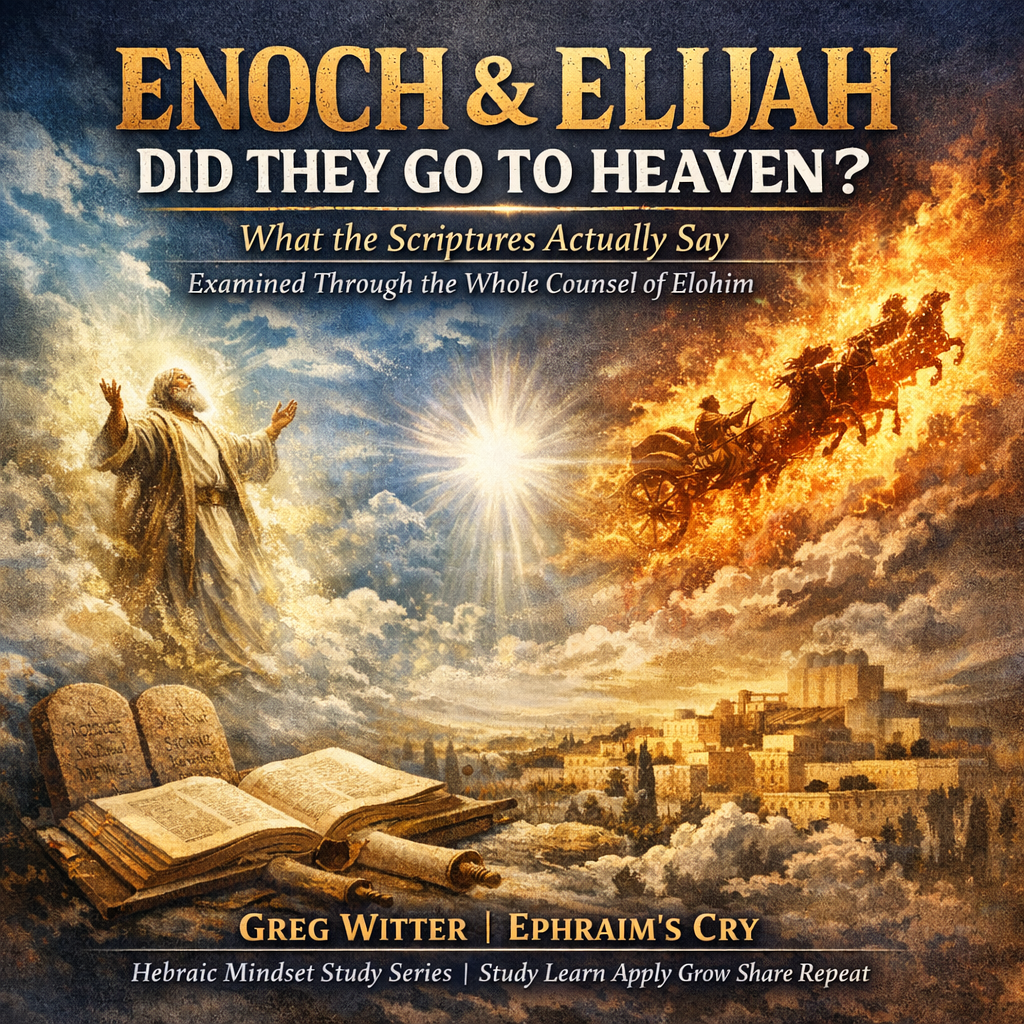
ENOCH AND ELIJAH — DID THEY GO TO HEAVEN?
What the Scriptures Actually Say When Examined Through the Whole Counsel of Elohim
Two Passages Often Misunderstood — Restored to Their Proper Context
Greg Witter | Ephraim’s Cry
Hebraic Mindset Study Series
Study Learn Apply Grow Share Repeat
Someone asked me a very good question recently. And it is actually a question I once asked myself years ago when I began seriously studying the Scriptures.
I love good questions. Good questions force us to slow down, open the text carefully, and test what we have been taught. And the truth is simple: if I once had this question, and someone else has this question now, there are certainly many others who have wondered the same thing.
So this teaching is for everyone who has ever asked:
What about Enoch?
What about Elijah?
Genesis tells us that Enoch “was not, for Elohim took him” (Genesis 5:24).
Second Kings tells us that Elijah “went up by a whirlwind into heaven” (2 Kings 2:11).
Yet Yahusha made a statement that seems to challenge the popular interpretation of those passages. In John 3:13 He said:
“No man has ascended into heaven, but He who came down from heaven, the Son of Man.”
So the question becomes unavoidable.
If no one had ascended into heaven before Messiah, then what exactly happened with Enoch and Elijah?
Did they enter the throne room of Elohim thousands of years earlier?
Were they exceptions to the biblical pattern of death and resurrection?
Or has the story been misunderstood because it was filtered through later theological traditions instead of the Hebrew framework of Scripture?
To answer that question honestly, we must do something that modern theology often fails to do.
We must examine the issue through the whole counsel of Elohim.
Torah.
The Prophets.
The Writings.
The Apostolic witness.
When we do that, the confusion disappears.
But before examining Enoch and Elijah specifically, we first need to understand a very important biblical concept that is often lost in translation.
We need to understand what Scripture means when it uses the word “heaven.”
THE BIBLICAL MEANING OF “HEAVEN”
In English the word “heaven” usually refers to the dwelling place of Elohim.
But the Hebrew word used throughout the Scriptures is shamayim, and it does not refer to just one place.
In the Hebrew Scriptures the word “heavens” can describe multiple realms.
First, it refers to the atmosphere, the sky above the earth.
Genesis 1:20
“Let birds fly above the earth across the face of the firmament of the heavens.”
Second, it refers to the celestial heavens, the realm of the sun, moon, and stars.
Genesis 1:14
“Let there be lights in the firmament of the heavens to divide the day from the night.”
Third, it refers to the dwelling place of Yahuah, the throne room of Elohim.
Psalm 11:4
“Yahuah is in His holy temple; Yahuah’s throne is in heaven.”
So when Scripture uses the word “heaven,” context determines which of these realms is being described.
This distinction becomes extremely important when we examine Elijah’s story.
Because the text says he was taken into the heavens, but it does not specify which heaven.
WHAT ACTUALLY HAPPENED TO ELIJAH
The famous passage describing Elijah’s departure appears in 2 Kings 2.
“And it came to pass, as they still went on and talked, that behold, there appeared a chariot of fire and horses of fire… and Elijah went up by a whirlwind into heaven.”
(2 Kings 2:11)
Most people assume this means Elijah entered the throne room of Elohim.
But the passage does not say that.
It simply says he was taken up into the heavens, and the event itself was clearly visible to those present.
Elisha saw it happen (2 Kings 2:12).
That means Elijah was lifted upward in a physical atmospheric event, a whirlwind.
But something else appears later in the biblical narrative that many readers overlook.
Years after this event, during the reign of King Jehoram of Judah, a letter arrives from Elijah.
2 Chronicles 21:12 records:
“And there came a writing to him from Elijah the prophet…”
This occurs after Elijah had already been taken up in the whirlwind.
That detail changes everything.
It shows that Elijah did not simply disappear into the throne room of heaven permanently. Instead, it strongly suggests that Elohim removed him from one location and relocated him elsewhere.
This type of supernatural relocation is not unique in Scripture.
Ezekiel was lifted by the Spirit and transported to another place (Ezekiel 8:3).
Philip was suddenly carried away by the Spirit after baptizing the Ethiopian (Acts 8:39–40).
The Elohim who created the universe has no difficulty relocating His servants.
So Elijah’s story describes a removal and relocation, not necessarily entry into the heavenly throne room.
WHAT ABOUT ENOCH?
The account of Enoch is even shorter.
Genesis 5:24 says:
“Enoch walked with Elohim; and he was not, for Elohim took him.”
The Hebrew word translated “took” is laqach, which means to take, receive, remove, or transfer.
It does not inherently mean “taken into heaven.”
The New Testament commentary appears in Hebrews.
Hebrews 11:5 says:
“By faith Enoch was taken away so that he should not see death, and was not found, because Elohim had taken him.”
Again the emphasis is on removal, not location.
Enoch was taken away from his generation.
But Scripture never says he was given immortality or transported permanently to the throne of Elohim.
And something very important appears just a few verses later in Hebrews 11.
The chapter summarizes the faithful patriarchs and says:
“These all died in faith, not having received the promises.”
(Hebrews 11:13)
The resurrection and glorification promised to the faithful had not yet occurred.
That promise remains future.
THE BIBLICAL TEACHING ABOUT DEATH
When we step back and look at the entire Bible, we see a consistent teaching.
The dead are described as sleeping.
Daniel 12:2
“Many of those who sleep in the dust of the earth shall awake.”
Job 14:12
“So man lies down and does not rise; till the heavens are no more they will not awake.”
Ecclesiastes 9:5
“The dead know nothing.”
The resurrection occurs when Messiah returns.
1 Thessalonians 4:16
“The dead in Messiah will rise first.”
This teaching appears from Genesis to Revelation.
The ultimate hope of the faithful is not escaping earth to live forever in heaven.
The hope of Scripture is resurrection and the restoration of the kingdom of Elohim on earth.
WHY SO MANY PEOPLE BELIEVE OTHERWISE
If the Bible consistently teaches resurrection, why do so many people believe souls go to heaven immediately after death?
The answer is historical.
Over time Greek philosophical ideas about immortal souls entered Christian theology.
Plato taught that the soul escapes the body and ascends to the spiritual realm.
Those ideas gradually mixed with biblical language and eventually replaced the Hebrew understanding of resurrection.
But when we return to the Hebrew worldview of Scripture, the message becomes clear again.
The faithful wait for the resurrection.
THE REAL LESSON OF ENOCH AND ELIJAH
The stories of Enoch and Elijah are not primarily about escaping death.
They are about faithfulness in corrupt generations.
Genesis says Enoch “walked with Elohim.”
Elijah stood against the idolatry of Ahab and Jezebel when the nation had turned away from the covenant.
Both men remained faithful when the world around them was collapsing.
Their lives point forward to the same kind of faithfulness described in the final generation.
Revelation 12:17 describes the remnant as those who
“keep the commandments of Elohim and hold to the testimony of Yahusha.”
That is the pattern we see in Enoch.
That is the pattern we see in Elijah.
And that is the pattern the faithful are called to walk today.
THE HOPE OF THE KINGDOM
The ultimate promise of Scripture is not escape.
It is restoration.
Isaiah spoke of a renewed creation.
Zechariah described the King reigning from Jerusalem.
Revelation describes the New Jerusalem coming down from heaven to earth.
The story of Scripture moves toward the restoration of the kingdom of Elohim on earth, where He will dwell with His people.
That is the hope the prophets proclaimed.
That is the hope the apostles preached.
And that is the promise every covenant believer awaits.
#GregWitter, #EphraimsCry, #HebraicMindset, #HebraicMindsetStudySeries, #StudyLearnApplyGrowShareRepeat
, #WholeCounselOfElohim, #TorahAndTestimony, #EnochAndElijah, #BiblicalResurrection, #KingdomOfYahuah

One Response
I always wondered! Now I know! Thank you!