
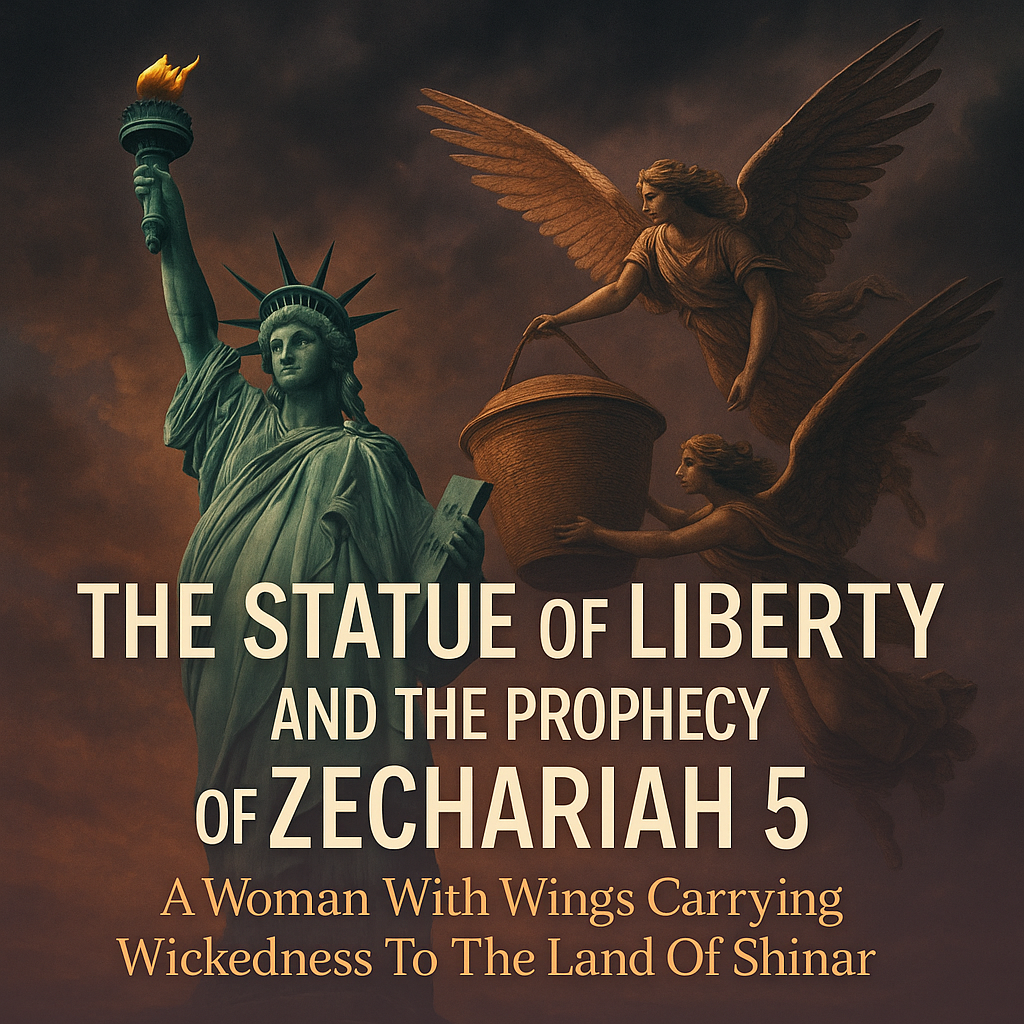
THE VISION OF THE WOMAN IN THE BASKET
The Hebraic Prophetic Warning to the New Babylon
Exposing the Symbols • Revealing the Pattern • Warning the Remnant Before Judgment Falls
Greg Witter | Ephraim’s Cry
Hebraic Mindset Study Series
Study • Learn • Apply • Grow • Share • Repeat
INTRODUCTION — WHY ZECHARIAH’S VISION MATTERS NOW
Zechariah’s fifth vision is one of the most mysterious and neglected prophetic passages in all of Scripture. For more than 2,500 years, it remained largely misunderstood—not because the language is unclear, but because the world had not yet produced the realities necessary for the prophecy to be recognized. The prophets of Israel saw visions that extended far beyond their lifetimes, describing nations, symbols, and systems that would not exist until the end of the age. Zechariah saw something impossible in his day: a global commercial power, a feminine idol representing institutional wickedness, unclean spiritual carriers transporting evil, and a new Babylon rising in a distant land. None of this existed in his world. All of it exists in ours.
This prophecy was never about ancient Babylon. Ancient Babylon had already fallen before Zechariah received this vision. It was never about Israel’s original exile, because Israel had already returned. It was not about Persia, Greece, or Rome. The vision pointed forward to a future civilization that would embody the rebellion of Babel, export wickedness worldwide, enshrine evil into its laws, and build a culture that openly rejects the authority of Yahuah. Only now, in our generation, does every symbol Zechariah described match something concrete on the earth.
Seen through a Hebraic mindset, Zechariah 5:5–11 is not vague, mystical imagery. It is precise covenant indictment:
-
A commercial ephah going forth throughout the whole earth
-
A woman inside the ephah identified as Wickedness
-
A lead cover concealing that wickedness during movement
-
Two women with stork wings carrying the ephah between earth and heaven
-
A clear destination: the land of Shinar
-
A permanent house being built for wickedness in that land
This teaching will walk section by section through the vision, through the Hebrew language, through Paleo-Hebrew letter meanings, through the prophetic patterns of Babel and Babylon, through the rise and corruption of America, and through the warnings of Revelation. Everything will be expanded. Nothing will be removed or shortened. This is a full Hebraic analysis of Zechariah’s warning to the end-time remnant.
SECTION 1 — THE PROPHETIC CONTEXT OF ZECHARIAH
Zechariah ministered around 520 BC, in the second year of Darius (Zechariah 1:1). Judah had already endured seventy years of Babylonian captivity, exactly as prophesied (Jeremiah 25:11–12; Daniel 9:2). A remnant had returned under Zerubbabel. The Temple foundations had been laid, but opposition, weariness, and complacency had stalled the work. The people were back in the land but not fully restored in covenant obedience.
Into this fragile moment, Yahuah raises up Haggai and Zechariah. Haggai rebukes their complacency in rebuilding the Temple. Zechariah is given a sweeping prophetic panorama of Yahuah’s purposes, contained in eight night visions (Zechariah 1–6):
-
Riders among the myrtle trees (Zechariah 1:7–17)
-
Four horns and four craftsmen (Zechariah 1:18–21)
-
The man with the measuring line (Zechariah 2:1–5)
-
Joshua the high priest cleansed (Zechariah 3:1–10)
-
The golden lampstand and two olive trees (Zechariah 4:1–14)
-
The flying scroll of judgment (Zechariah 5:1–4)
-
The woman in the ephah (Zechariah 5:5–11)
-
The four chariots (Zechariah 6:1–8)
The fifth vision—the Woman in the Ephah—is unique. It does not deal with Israel’s internal sin in the land, nor with the immediate rebuilding of the Temple, nor with local enemies. It shows wickedness being removed, contained, transported, and enthroned somewhere else, in a land called Shinar, with a permanent house built specifically for it.
Even Zechariah’s own name carries prophetic weight. In Hebrew, זְכַרְיָה (Zekaryah) means “Yahuah remembers.” The root זכר (zakar) means “to remember,” especially covenant remembrance. The shortened divine name יה (Yah) is attached to it. In Paleo-Hebrew pictographs:
-
Zayin (ז) — a weapon, cutting blade
-
Kaf (כ) — an open hand, authority, covering
-
Resh (ר) — head, leader, chief
The name prophetically pictures: the cutting hand of the Leader bringing to remembrance what Yahuah has decreed and promised. Yahuah remembers Babylon’s rebellion. He remembers the Tower of Babel. He remembers every covenant violation. Through Zechariah, He reveals what will happen to the future manifestation of Babylon—the final, global system of rebellion that Revelation calls “Babylon the Great” (Revelation 17–18).
SECTION 2 — THE EPHAH THAT GOES FORTH THROUGHOUT THE EARTH
Zechariah 5:5–6:
“Then the angel who talked with me came out and said to me, ‘Lift your eyes now, and see what this is that goes forth.’ So I asked, ‘What is it?’ And he said, ‘It is an ephah that is going forth.’ He also said, ‘This is their resemblance throughout the earth.’”
The angel’s first command is, “Lift your eyes now.” Prophetic understanding requires lifting our eyes above our assumptions and seeing what Yahuah is actually showing. What Zechariah sees is not stationary. It is not rooted in Judah. It is not limited to his local history. The ephah is “going forth.” It is being carried. It is moving. It has global scope—“this is their resemblance throughout the earth.”
An ephah is the largest standard dry measure in Israel’s commercial life (Leviticus 19:36; Deuteronomy 25:14–15; Amos 8:5). It is used to measure grain, goods, and commodities. It is directly tied to:
-
Buying and selling
-
Fair or unfair trade
-
Market systems and economic integrity
When Amos rebukes Israel, he mentions those who “make the ephah small and the shekel large, falsifying the scales by deceit” (Amos 8:5). The ephah in prophetic language is an economic symbol. Zechariah is not seeing a random basket. He is seeing a symbol of commerce and global trade being sent forth.
In Hebrew, ephah is spelled אֵיפָה (eiphah):
-
Aleph (א) — ox, strength, leader, source
-
Yod (י) — hand, work, actions
-
Peh (פ) — mouth, opening, boundary, speech
-
Hey (ה) — window, revelation, what is seen
In Paleo-Hebrew picture terms, this yields the idea:
“From the strong source, the works of the hand and mouth are revealed.”
Applied prophetically, the ephah represents the economic and cultural system of a nation whose work and speech – its production and its propaganda, its goods and its messages – are revealed to the world by what it exports. Whatever fills the ephah reveals the heart of the nation’s commerce and culture.
This matches the modern world in a way no ancient empire could:
-
Global shipping and trade routes
-
International finance
-
Worldwide media distribution
-
Digital platforms carrying ideas everywhere
Only in the last century has there been a single dominant commercial empire whose culture, currency, technology, products, and ideas saturate every continent. That empire is the United States. The ephah going forth “throughout the earth” prophetically points to a global commercial power whose economic reach becomes worldwide.
SECTION 3 — THE WOMAN CALLED WICKEDNESS
Zechariah 5:7–8:
“Here is a lead disc lifted up, and this is a woman sitting inside the ephah”; then he said, “This is Wickedness!” And he thrust her down into the ephah, and threw the lead cover over its mouth.”
The vision now narrows. Inside this economic container sits a woman. The angel identifies her explicitly: “This is Wickedness.” This is the personification of moral, legal, and spiritual corruption—not merely a sinful woman, but wickedness itself embodied.
The Hebrew term here is רִשְׁעָה (rishah), from the root רשע (rasha):
-
Wicked
-
Morally guilty
-
Criminal
-
One who violates justice
-
One who breaks covenant and rejects the authority of Elohim
This word is used repeatedly of the wicked in contrast to the righteous (e.g., Psalm 1:1, Psalm 37:12, Proverbs 3:33). This is not general human weakness. This is entrenched, defiant wickedness.
In Paleo-Hebrew:
-
Resh (ר) — head, chief, leader, authority
-
Shin (ש) — teeth, devour, consume, destroy
-
Ayin (ע) — eye, seeing, vision, focus
The picture is:
“An authority that devours through what it sees” or “a devouring head whose eye is set on destruction.”
This woman represents a devouring, nation-shaping wickedness—a principality that consumes cultures, corrupts laws, and destroys generations. She sits inside the ephah—inside the economic system. Wickedness is not incidental to this commerce; it is enthroned within it. The global economic system is not neutral. It carries and protects wickedness.
The angel then forcibly thrusts her down into the ephah and covers it with a lead weight. The Hebrew for lead is עֹפֶרֶת (opheret). Its letters:
-
Ayin (ע) — eye, seeing, witness
-
Peh (פ) — mouth, speech, opening
-
Resh (ר) — head, leader
-
Tav (ת) — mark, sign, covenant, finality
The Paleo picture is:
“The eye and mouth of the head marked in finality.”
Lead is heavy. It seals. It confines. It indicates a fixed decree. The prophetic meaning is that wickedness exists inside the system but is covered, confined under a heavy lid until the appointed time. It is active but hidden. Present but not yet openly displayed.
This perfectly matches America’s first 150–200 years:
-
Public life bathed in Christian language
-
Churches central to communities
-
Scripture commonly read and quoted
-
Biblical morality respected in public
-
Yet deep sins present: slavery, racial oppression, greed, exploitation, pride
The wickedness was there, sealed beneath the lead of outward religion and moral restraint. Only in the mid-20th century and beyond did the lead cover begin to come off, unveiling what was always in the ephah: a devouring wickedness prepared for a house of its own.
SECTION 4 — TWO WOMEN WITH UNCLEAN WINGS
Zechariah 5:9:
“Then I raised my eyes and looked, and there were two women, coming with the wind in their wings; for they had wings like the wings of a stork, and they lifted up the ephah between earth and heaven.”
Now the vision grows even stranger. Zechariah sees two women. They are supernatural carriers, moving with the wind in their wings—which implies spiritual propulsion. Their wings are like those of a stork. According to the Torah, the stork is an unclean bird (Leviticus 11:19; Deuteronomy 14:18). This is a deliberate detail. These are not holy, clean carriers. These are unclean, impure agents.
Key points:
-
There are two women. Feminine spiritual imagery.
-
They have stork wings—unclean.
-
They fly “with the wind in their wings”—they are empowered by spiritual forces.
-
They lift up the ephah “between earth and heaven”—elevating wickedness to a prominent, visible, exalted place.
The vision thus shows us:
-
Unclean spiritual forces (two unclean winged women)
-
Carrying an economic system (the ephah)
-
That contains enthroned wickedness (the woman)
-
And elevating it into a position of global visibility and influence
This is exactly what pagan goddess imagery does in the nations. It feminizes spiritual rebellion, attaches it to ideas of freedom, enlightenment, and progress, and then uses that image to carry wickedness into an elevated place of honor.
In the case of America, the parallel is unmistakable:
-
The Statue of Liberty is a colossal woman.
-
She is modeled after Libertas, the Roman goddess of liberty.
-
Early design sketches by Frédéric Auguste Bartholdi portrayed her as a winged goddess figure before being adjusted for engineering reasons.
-
She stands elevated on a pedestal, rising 305 feet above sea level, visually “between earth and heaven” as she overlooks New York Harbor.
Though she has no visible wings in the final design, the spiritual messaging is the same:
-
A feminine, pagan symbol
-
Connected with enlightenment, liberty, and human rights
-
Elevated above the waters, visible to all who enter the harbor
-
Functioning as a spiritual carrier of the nation’s values
The unclean wings in Zechariah’s vision underscore that the forces carrying this economic-wickedness system are not neutral and not holy. They are spiritually unclean, lifting up a global Babylonian system under the guise of liberty, progress, and illumination.
SECTION 5 — THE DESTINATION: THE LAND OF SHINAR
Zechariah 5:10–11:
“So I said to the angel who talked with me, ‘Where are they carrying the ephah?’ And he said to me, ‘To build a house for it in the land of Shinar; when it is ready, the ephah will be set there on its base.’”
The obvious question is, where is this system going? The angel’s answer is precise: to build a house in the land of Shinar. This immediately ties the vision to the earliest post-flood rebellion.
Shinar appears in three key passages:
-
Genesis 10:10 — “The beginning of his kingdom was Babel… in the land of Shinar.”
-
Genesis 11:2–4 — Humanity settles in the land of Shinar and says, “Let us build ourselves a city, and a tower whose top is in the heavens; let us make a name for ourselves.”
-
Daniel 1:1–2 — Nebuchadnezzar carries vessels from the Temple “into the land of Shinar to the house of his god.”
Shinar is therefore the biblical name for:
-
The region where Babel was built
-
The original post-flood world-center of rebellion against Yahuah
-
The birthplace of organized, centralized, godless world-order
-
The core territory of Babylon
However, there is a crucial chronological detail: Babylon fell to the Medo-Persians in 539 BC (Daniel 5:30–31). Zechariah is prophesying around 520 BC. Ancient Babylon has already been judged and broken as an empire.
Therefore, the vision cannot be speaking about shipping wickedness back to the already fallen Babylon of his day. It speaks of a future Shinar—a new manifestation of the Babel/Babylon system at the end of the age. Revelation calls this entity “Babylon the Great, the mother of harlots and of the abominations of the earth” (Revelation 17:5).
The prophecy says:
-
A house will be built for wickedness in Shinar.
-
When the house is ready, the ephah will be “set there on its base.”
-
This implies a prepared foundation and a permanent placement.
This is not a temporary camp. This is a permanent dwelling place. A civilization that institutionalizes wickedness—politically, economically, legally, culturally, religiously.
From a Hebraic mindset, what matters is not only geography but pattern. The land of Shinar is the archetype of human rebellion against Yahuah:
-
Collective defiance (“let us build ourselves a city and a tower” – Genesis 11:4).
-
Man-centered glory (“let us make a name for ourselves”).
-
Rejection of divine boundaries.
-
Creation of a unified world order apart from Elohim’s authority.
In the end-times, that spirit reappears in a global superpower that fits Babylon the Great:
-
Unmatched commercial wealth (Revelation 18:11–19).
-
Global cultural influence on kings and nations (Revelation 17:2, Revelation 18:3).
-
Religious prostitution and spiritual corruption.
-
Sudden and catastrophic judgment.
Only one modern nation matches all of these descriptors: the United States of America. The ephah of global commerce, carrying a woman called Wickedness, elevated and transported by unclean spiritual forces, is set on its base in the New Shinar: the New Babylon—America.
SECTION 6 — THE PARALLEL TO AMERICA AND THE STATUE OF LIBERTY
When we overlay Zechariah’s vision with what stands in New York Harbor and what America has become, the parallels are too precise to dismiss as coincidence. We are not reading modern events into ancient Scripture. We are honoring what the text says and looking at what exists.
Compare each major element:
-
The woman
-
Zechariah: A woman in the ephah, identified as Wickedness (Zechariah 5:7–8).
-
America: The Statue of Liberty is a woman. Her official name is “Liberty Enlightening the World,” modeled after the Roman goddess Libertas—a pagan deity, not a biblical symbol.
-
-
Pagan goddess imagery
-
Zechariah: Wickedness is personified, female, enthroned inside the commercial container.
-
America: Lady Liberty is a deified, feminized abstraction of liberty, divorced from Yahuah’s Torah, embodying self-governed freedom, self-rule, independence, human rights defined by man, not covenant.
-
-
Wings and elevation
-
Zechariah: Two women with stork wings, unclean carriers, lift the ephah between earth and heaven (Zechariah 5:9).
-
America: Early concepts of the statue included wings; the final design stands massively elevated between sea and sky, serving as a spiritual emblem of national and global identity.
-
-
The ephah and global commerce
-
Zechariah: The ephah is “their resemblance throughout the earth” (Zechariah 5:6) – a global economic pattern.
-
America: New York Harbor and the American financial system became central to global trade for more than a century. Wall Street, the dollar, and American corporations dominate world markets.
-
-
Global reach and enlightenment
-
Zechariah: The ephah’s influence is throughout the earth.
-
America: Liberty’s crown has seven spikes, officially symbolizing the seven continents and seven seas—global reach. The statue’s very name claims to enlighten the world.
-
-
Shinar as the new Babylon
-
Zechariah: The ephah and the woman are taken to Shinar to build a house for wickedness (Zechariah 5:11).
-
Revelation: Babylon the Great corrupts the nations with her fornication and luxury (Revelation 17–18).
-
America: No other nation has so aggressively exported its cultural, moral, economic, and spiritual influence to the entire world.
-
Put simply: Zechariah saw a feminine, pagan, wickedness-infused commercial system carried and elevated by unclean spiritual forces and set permanently in a new Babylon. Today, a pagan goddess image stands in New York Harbor as the spiritual symbol of the most powerful commercial empire in history, embodying a system that has removed Yahuah from public life and enthroned human liberty and rebellion as ultimate values.
The vision was never random. It was waiting for its fulfillment. And now, in our time, the house has been built, the ephah has been set on its base, and the woman called Wickedness is no longer hidden.
SECTION 7 — THE HOUSE BUILT FOR WICKEDNESS
Zechariah 5:11:
“‘To build a house for it in the land of Shinar; when it is ready, the ephah will be set there on its base.’”
This is a process, not an instantaneous event. The house must be built, then the ephah is set upon its base. In other words:
-
Wickedness is transported.
-
The destination is prepared.
-
A structure is built.
-
When the structure is complete, wickedness is enthroned.
America’s history follows this pattern with chilling precision. For roughly the first 150 years:
-
Public rhetoric honored God and Scripture.
-
Prayer and Bible reading were normal in schools.
-
The Ten Commandments were posted in government spaces.
-
Marriage and family structures superficially reflected biblical norms.
But the wickedness was already in the ephah: slavery, racism, genocide of native peoples, greed, materialism, hypocrisy, occultism, and deep moral compromise. The lead cover remained largely in place, keeping wickedness from fully manifesting.
Then, step by step, brick by brick, the house was openly built:
-
1962 — Supreme Court (Engel v. Vitale) bans official prayer in public schools.
-
1963 — Supreme Court (Abington v. Schempp) bans Bible reading in schools.
-
1973 — Roe v. Wade legalizes abortion nationwide. Tens of millions of unborn children are killed.
-
1980s–1990s — Prosperity gospel and false charismatic excess redefine the faith into a tool for wealth, self, and comfort, exported globally via American televangelists.
-
2000s — Pornography becomes ubiquitous; sexual immorality, cohabitation, and divorce become normalized; biblical sexuality collapses.
-
2015 — Obergefell v. Hodges legalizes same-sex “marriage,” redefining what Yahuah instituted in Genesis 2.
-
2020s — Transgender ideology, gender confusion, and child mutilation become mainstream; refusal to affirm this rebellion is punished socially and increasingly legally.
Each of these is not just a bad policy. Each is a structural brick in the house built for wickedness. Each step:
-
Removes Yahuah’s standard from public life.
-
Codifies rebellion into law.
-
Celebrates what Scripture calls abomination.
-
Inverts good and evil (Isaiah 5:20).
The lead cover is no longer on. The wickedness is enthroned and defended. The ephah has been set on its base. The house stands complete.
SECTION 8 — THE EXPORTING OF WICKEDNESS TO THE NATIONS
Revelation 17:2:
“With whom the kings of the earth committed fornication, and the inhabitants of the earth were made drunk with the wine of her fornication.”
Revelation 18:3:
“For all the nations have drunk of the wine of the wrath of her fornication, the kings of the earth have committed fornication with her, and the merchants of the earth have become rich through the abundance of her luxury.”
End-time Babylon does not sin alone. She seduces the nations. She intoxicates kings. She makes the inhabitants of the earth drunk with her immorality and luxury. Her merchants become rich through her abundance. This is a global economic-spiritual system.
America has done exactly this:
-
Through Hollywood films glamorizing sin, rebellion, violence, occultism, and perversion.
-
Through music that normalizes drugs, fornication, adultery, greed, pride, and blasphemy.
-
Through social media platforms that amplify narcissism, self-worship, and rebellion.
-
Through corporate agendas that push abortion, LGBT ideology, and anti-Torah values worldwide.
-
Through foreign policy that ties aid, trade, and cooperation to the acceptance of sexual immorality and secular humanism.
-
Through American “Christian” ministries exporting the prosperity gospel and false doctrines across Africa, Asia, and Latin America.
The nations have drunk the wine. They have adopted American laws, American entertainment, American ideological frameworks, American sexual norms, and American definitions of “freedom.” They have modified their own cultures to match Babylon’s model.
This directly aligns with Zechariah’s phrase, “This is their resemblance throughout the earth” (Zechariah 5:6). The character of the ephah—commerce filled with wickedness—spreads everywhere. The house built in Shinar becomes a pattern for the world.
SECTION 9 — THE LEAD COVER AND THE TIMING OF JUDGMENT
Zechariah 5 emphasizes the lead cover for a reason. The sequence is:
-
Wickedness is identified.
-
Wickedness is thrust down into the ephah.
-
A lead cover seals the ephah.
-
The ephah is carried away.
-
A house is built.
-
The ephah is set on its base in the house.
This reveals a divine timing:
-
Phase 1: Wickedness present but suppressed under a moral-religious veneer.
-
Phase 2: Wickedness in transit while the house is under construction.
-
Phase 3: Wickedness enthroned when the house is ready.
-
Phase 4: Judgment follows when the measure of iniquity is full.
For America:
-
The early centuries: strong public Christian rhetoric, but deep covenant-breaking and hypocrisy. Wickedness present but covered.
-
The mid-20th century: rapid secularization, removal of God from public life, construction of legal and cultural frameworks for outright rebellion.
-
Late 20th and early 21st centuries: open celebration and legal enforcement of what Yahuah calls abomination. Wickedness fully unveiled; the house complete.
-
The next phase, according to Revelation 18: sudden, catastrophic judgment — “in one hour your judgment has come” (Revelation 18:10, 17, 19).
Zechariah shows the transport and enthronement of wickedness. Revelation shows the collapse of the house. America now stands in the narrow gap between enthronement of wickedness and the fall of Babylon the Great.
SECTION 10 — THE WARNING TO THE REMNANT: COME OUT OF BABYLON
Zechariah’s vision is not given for academic curiosity. It is a watchman’s warning. It tells us what wickedness is, where it went, how it was carried, where it was enthroned, and what kind of house was built for it. Revelation completes the picture and adds Yahuah’s command to His people.
Revelation 18:4:
“And I heard another voice from heaven saying, ‘Come out of her, My people, lest you share in her sins, and lest you receive of her plagues.’”
Yahuah still has a people inside Babylon. They must come out—not necessarily by geography first, but spiritually, morally, and covenantally. To remain married to Babylon’s systems is to be swept away when the judgment falls.
To “come out of her” means:
-
Refusing to drink her wine—reject her entertainment, her values, her narratives, her definitions of love, freedom, and identity.
-
Rejecting her idols—money, comfort, fame, national pride, self-worship, liberty without obedience.
-
Breaking spiritual agreements with her—stop justifying what Yahuah condemns.
-
Returning to covenant—embracing Yahuah’s Torah as the standard of righteousness and Yahusha as the returning King.
-
Preparing to endure persecution rather than bow to the beast-system and its mark.
Zechariah saw the woman in the basket. He saw the ephah go forth. He saw the unclean carriers. He saw Shinar. He saw the house built for wickedness. We are now watching the last steps before the house falls.
The vision of the woman in the ephah is not a strange side note in Scripture. It is a prophetic spotlight on America’s role as the New Babylon. It is a call to the remnant to recognize where they live, what system they are surrounded by, and what is about to happen.
Yahuah remembered Babel.
Yahuah remembered Babylon.
Yahuah remembers every act of rebellion and every drop of innocent blood.
Through Zechariah, He warned us. Through Revelation, He commanded us.
The only question left is whether we will obey:
Come out of her, My people.
#GregWitter, #EphraimsCry, #HebraicMindsetStudySeries, #EndTimeWatchman, #Zechariah5, #NewBabylon, #AmericaInProphecy, #BabylonTheGreat, #PropheticWarning, #TruthOverTradition, #BabylonFallen, #EndTimeDeception, #ComeOutOfHerMyPeople, #WatchAndBeReady, #PrepareTheBride, #RemnantRising
