
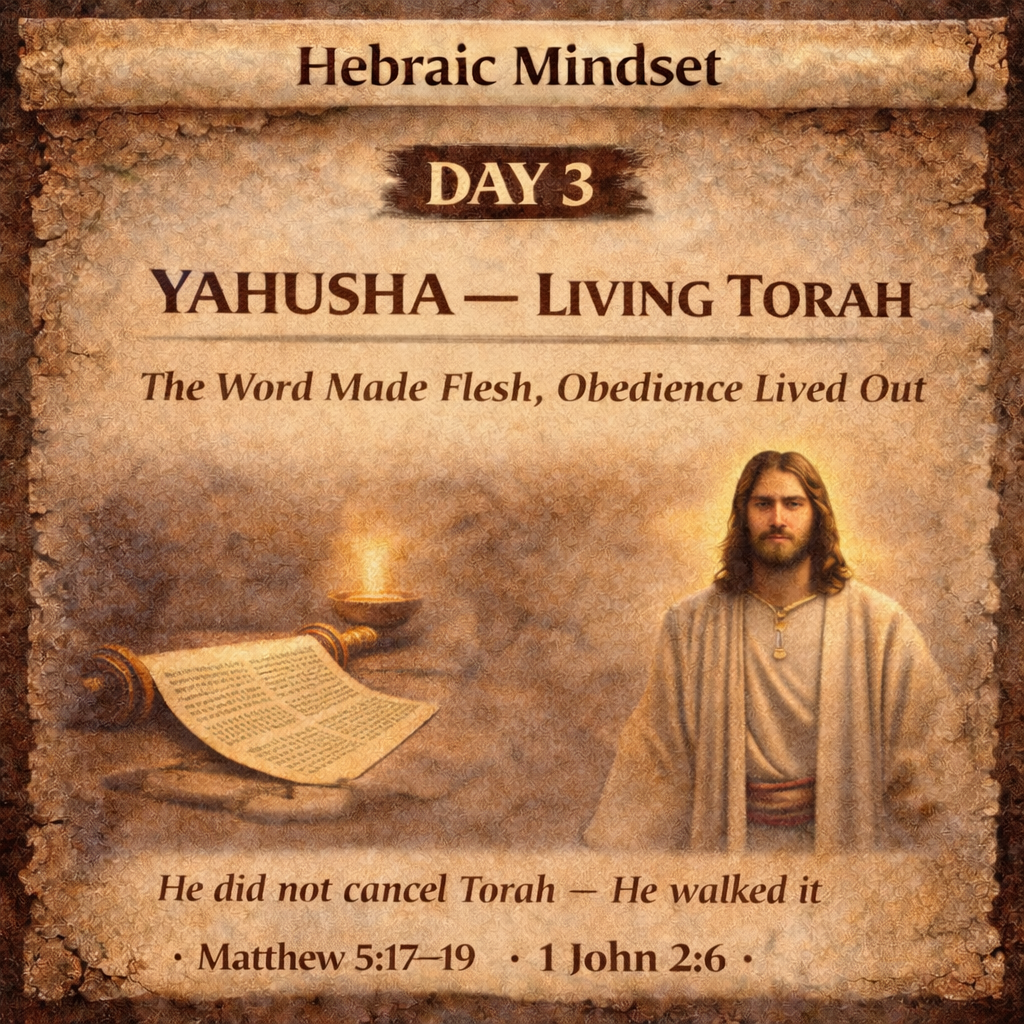
YAHUSHA — LIVING TORAH
The Word Made Flesh, Obedience Lived Out
He did not cancel Torah — He walked it
Greg Witter | Ephraim’s Cry
Hebraic Mindset Study Series
Study Learn Apply Grow Share Repeat
Orientation
Day One established the source of redemption — by Yahuah, through Yahusha the High Priest.
Day Two established the necessity of Yahusha’s priesthood — faithful, unchanging, incorruptible.
Day Three now addresses the most avoided truth in modern faith:
If Yahusha is truly followed, Torah must be lived.
Not theoretically.
Not symbolically.
Not selectively.
But walked out.
This teaching dismantles the false divide between “Jesus” and Torah by letting Scripture define both.
The Word Did Not Disappear — It Became Flesh
John 1:1, 14
Scripture does not say the Word was abolished.
It says the Word became flesh and dwelt among us.
The Word (Logos) is not an abstract concept. It is the expressed will, instruction, and order of Elohim. Psalm 119 defines Torah as truth (Psalm 119:142), and John identifies Yahusha as the embodiment of that truth.
Torah did not end at the incarnation.
Torah walked among men.
To reject Torah while claiming to follow Yahusha is to reject the very thing He is.
“Fulfill” Never Means “Abolish”
Matthew 5:17–19
Yahusha’s own words settle this permanently:
“Do not think that I came to abolish the Torah or the Prophets. I did not come to abolish but to fulfill.”
To fulfill means to bring to full expression, to establish, to live out completely.
Yahusha immediately clarifies that nothing passes from Torah and that greatness in the Kingdom is tied to doing and teaching the commandments.
Fulfillment does not terminate responsibility.
It intensifies accountability.
Walking as He Walked Is the Measure of Truth
1 John 2:3–6
John does not offer a mystical definition of knowing Messiah. He gives a practical one:
Knowing Him = keeping His commandments
Claiming Him while refusing obedience = deception
Abiding in Him = walking as He walked
There is no middle ground offered.
This standard eliminates:
doctrinal loopholes
grace-based excuses
personality-driven faith
Walking as Yahusha walked is not legalism.
It is discipleship.
Yahusha Taught Torah — Not Tradition
Matthew 23:1–3; Mark 7:7–9
Yahusha rebuked religious leaders not for teaching Torah, but for replacing it with tradition.
He affirmed the authority of Moses’ seat while condemning hypocrisy and lawless behavior. His issue was never Torah — it was the misuse of it.
This matters because many today reject Torah for the same reason Yahusha rejected tradition: corruption.
But Yahusha did not respond by abandoning Torah.
He responded by restoring it to its rightful place.
Obedience Reveals Love
John 14:15; 1 John 5:3
Yahusha defines love plainly:
“If you love Me, you will keep My commandments.”
Scripture does not separate love from obedience. Love is not emotional attachment; it is covenant loyalty.
Any message that divorces love from obedience is not biblical love — it is sentiment.
Why This Teaching Is Unavoidable
If Yahusha is:
the Word made flesh
the faithful High Priest
the perfect example
Then discipleship must look like imitation, not abstraction.
The claim “I follow Jesus” has content.
That content is obedience.
Watchman Conclusion
Yahusha did not come to give permission to ignore Torah.
He came to show humanity what faithful obedience looks like.
He lived Torah.
He taught Torah.
He upheld Torah.
And Scripture says those who belong to Him will walk as He walked.
Tomorrow, we will confront the covenant promise that makes this possible: Torah written on the heart, empowered by the Spirit — not abolished by it.
#EphraimsCry #GregWitter #HebraicMindset #HebraicMindsetStudySeries #LivingTorah #Yahusha #WordMadeFlesh #Matthew517 #FirstJohn2 #WalkAsHeWalked #CovenantFaithfulness #TorahTruth #Obedience #Watchman
