
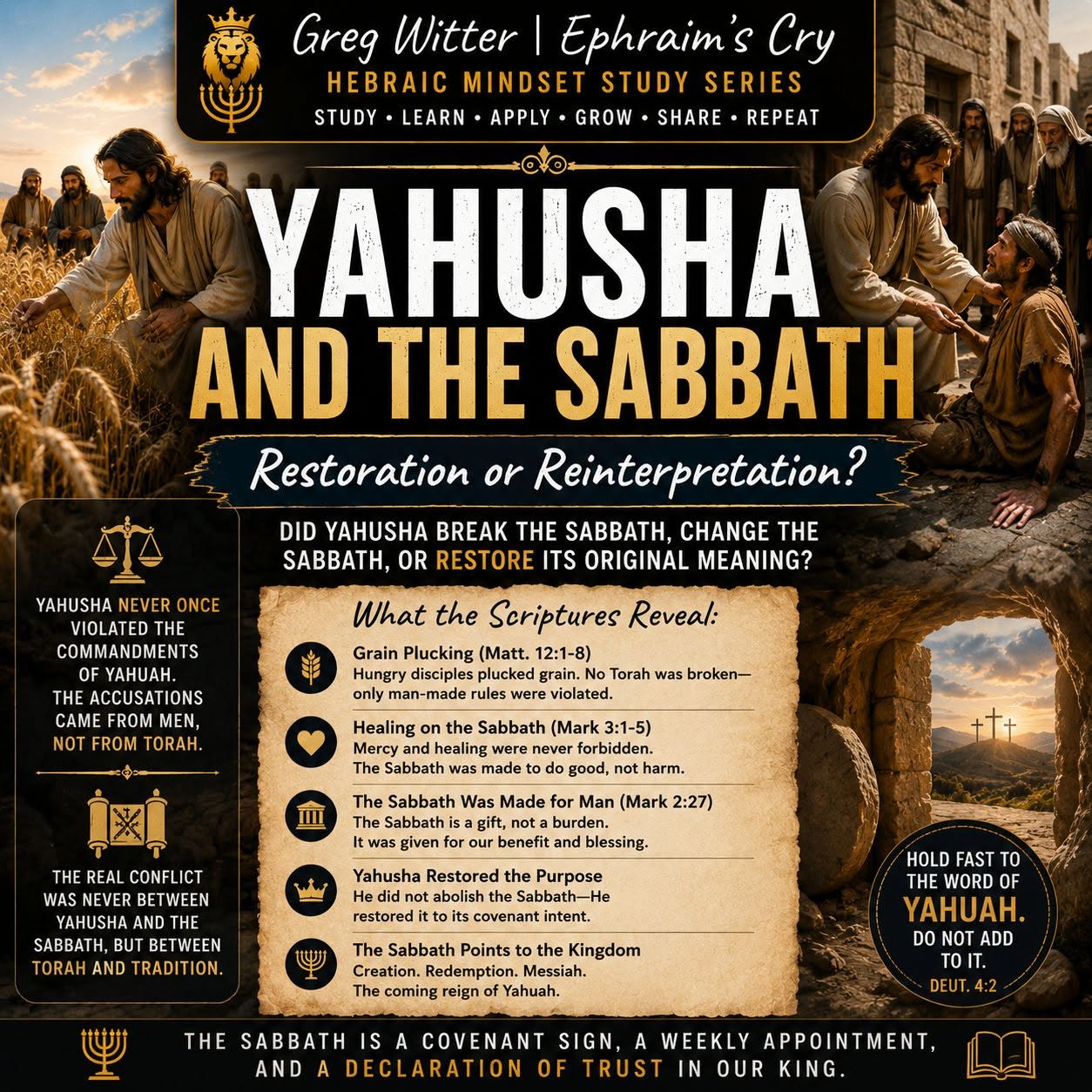
Yahusha and the Sabbath
Restoration or Reinterpretation?
Did Yahusha Break the Sabbath, Change the Sabbath, or Restore Its Original Meaning?
Greg Witter | Ephraim’s Cry
Hebraic Mindset Study Series
Study Learn Apply Grow Share Repeat
Few subjects create more confusion within modern Christianity than the relationship between Yahusha and the Sabbath.
For generations people have been told that Yahusha broke the Sabbath. Others insist that He changed the Sabbath. Still others claim that His actions proved the Sabbath was no longer binding.
Yet when we examine the actual text, something remarkable emerges.
Yahusha never once violated the commandments of Yahuah.
Not once.
If He had, He could not have been the spotless Lamb.
If He had broken Torah, He would have been a sinner.
If He had been a sinner, He could not have been our Redeemer.
This means the issue is not whether Yahusha violated the Sabbath.
The issue is whether the accusations against Him were correct.
That distinction changes everything.
Throughout the Gospel accounts we repeatedly find Yahusha accused of Sabbath violations.
Notice carefully:
The accusations come from men.
The verdict comes from Scripture.
Those are not always the same thing.
The religious leaders continually accused Yahusha because His actions violated their traditions.
But violating a tradition is not the same thing as violating Torah.
This distinction forms the foundation of nearly every Sabbath controversy recorded in the Gospels.
The first major confrontation occurs when the disciples pluck grain on the Sabbath.
Matthew 12:1–2 records:
“At that time Yahusha went on the Sabbath day through the grain fields; and His disciples were hungry, and began to pluck heads of grain and to eat. But when the Pharisees saw it, they said unto Him, Behold, thy disciples do that which is not lawful to do upon the Sabbath day.”
Notice the accusation.
The disciples were hungry.
They plucked grain.
They ate.
The Pharisees immediately declared this unlawful.
But what Torah commandment had they violated?
The Pharisees never quote one.
Not because they forgot.
Because none existed.
The accusation was based upon their interpretation of work.
They classified plucking grain as harvesting.
Rubbing grain as threshing.
Separating grain as winnowing.
Preparing grain as food processing.
In other words, they transformed a simple act of eating into multiple categories of prohibited labor.
Yahusha’s response is profound.
He points to David eating the showbread.
He points to the priests working in the Temple on the Sabbath.
Then He declares:
“The Sabbath was made for man, and not man for the Sabbath.” (Mark 2:27)
This statement is often abused.
Some use it to eliminate Sabbath observance entirely.
But that is not what Yahusha said.
He did not abolish the Sabbath.
He explained its purpose.
The Sabbath was created as a gift.
The Sabbath was established for mankind’s benefit.
The Sabbath was never intended to become a burden of endless human regulations.
The issue was never the Sabbath.
The issue was what men had done to the Sabbath.
The next major confrontation involves healing.
Repeatedly Yahusha heals on the Sabbath.
Again the religious leaders object.
Again the question must be asked:
What commandment was violated?
The Torah nowhere prohibits acts of mercy on the Sabbath.
The Torah nowhere prohibits healing on the Sabbath.
The Torah nowhere prohibits helping someone in need.
Yet the religious leaders condemned Yahusha because their traditions elevated restriction above compassion.
Yahusha responded:
“Is it lawful to do good on the Sabbath days, or to do evil? To save life, or to kill?” (Mark 3:4)
The answer is obvious.
The Sabbath was never designed to prevent righteousness.
The Sabbath was designed to promote it.
Again and again Yahusha exposes the same problem.
The traditions of men had become more important than the commandments of Elohim.
This is why He repeatedly challenged them.
Not because He opposed Torah.
Because He defended Torah.
Not because He opposed the Sabbath.
Because He restored the Sabbath.
Not because He rejected obedience.
Because He rejected man-made additions masquerading as obedience.
The irony is striking.
Many people today accuse Yahusha of breaking the Sabbath for the exact same reason the Pharisees did.
Both assume that violating a tradition equals violating Torah.
Yet Yahusha consistently demonstrated otherwise.
He never abolished the Sabbath.
He never moved the Sabbath.
He never reduced the Sabbath.
He never called it temporary.
Instead, He revealed its true purpose.
The Sabbath is a covenant gift.
The Sabbath is a blessing.
The Sabbath is a day for worship.
The Sabbath is a day for mercy.
The Sabbath is a day for restoration.
The Sabbath is a day for healing.
The Sabbath is a day for delight.
And ultimately, the Sabbath points beyond itself.
Every Sabbath proclaims creation (Genesis 2:1–3).
Every Sabbath proclaims redemption (Deuteronomy 5:15).
Every Sabbath proclaims the coming Kingdom (Hebrews 4:9–11).
Every Sabbath proclaims the reign of Messiah.
This is precisely why the Sabbath remained central throughout Scripture.
The real conflict was never between Yahusha and the Sabbath.
The conflict was between Torah and tradition.
The conflict was between the commandments of Elohim and the commandments of men.
The conflict was between covenant truth and religious systems that had added burdens Yahuah never commanded.
Yahusha did not come to destroy Torah.
He came to fulfill it, establish it, demonstrate it, and restore its proper understanding.
The Sabbath was not the problem.
The traditions surrounding the Sabbath had become the problem.
When Yahusha healed, showed mercy, fed the hungry, and defended His disciples, He was not weakening the Sabbath.
He was restoring it to its covenant purpose.
The Sabbath was made for man.
The Sabbath was given as a blessing.
The Sabbath was designed to reveal the goodness of Yahuah.
The Sabbath was created to point toward the Kingdom.
And every attempt to turn it into a burden of man-made restrictions obscures the very purpose for which it was given.
This leads us naturally into the next study:
Lord of the Sabbath
What did Yahusha actually mean when He declared Himself Master of the Sabbath? Was He claiming authority to abolish it, or authority to define it correctly?
#Sabbath, #Shabbat, #Yahusha, #LordOfTheSabbath, #MasterOfTheSabbath, #Matthew12, #Mark2, #Mark3, #Torah,
#TorahStudy, #HebraicMindset, #WholeCounselOfElohim, #BiblicalSabbath, #CommandmentsOfElohim, #TraditionsOfMen,
#Pharisees, #HealingOnTheSabbath, #SabbathTruth, #KingdomLiving, #ReturnToCovenant, #CovenantFaithfulness,
#HebrewRoots, #StudyScripture, #WalkInTruth, #Yahuah, #EphraimsCry, #GregWitter, #StudyLearnApplyGrowShareRepeat,
#KingdomOfYahuah
