
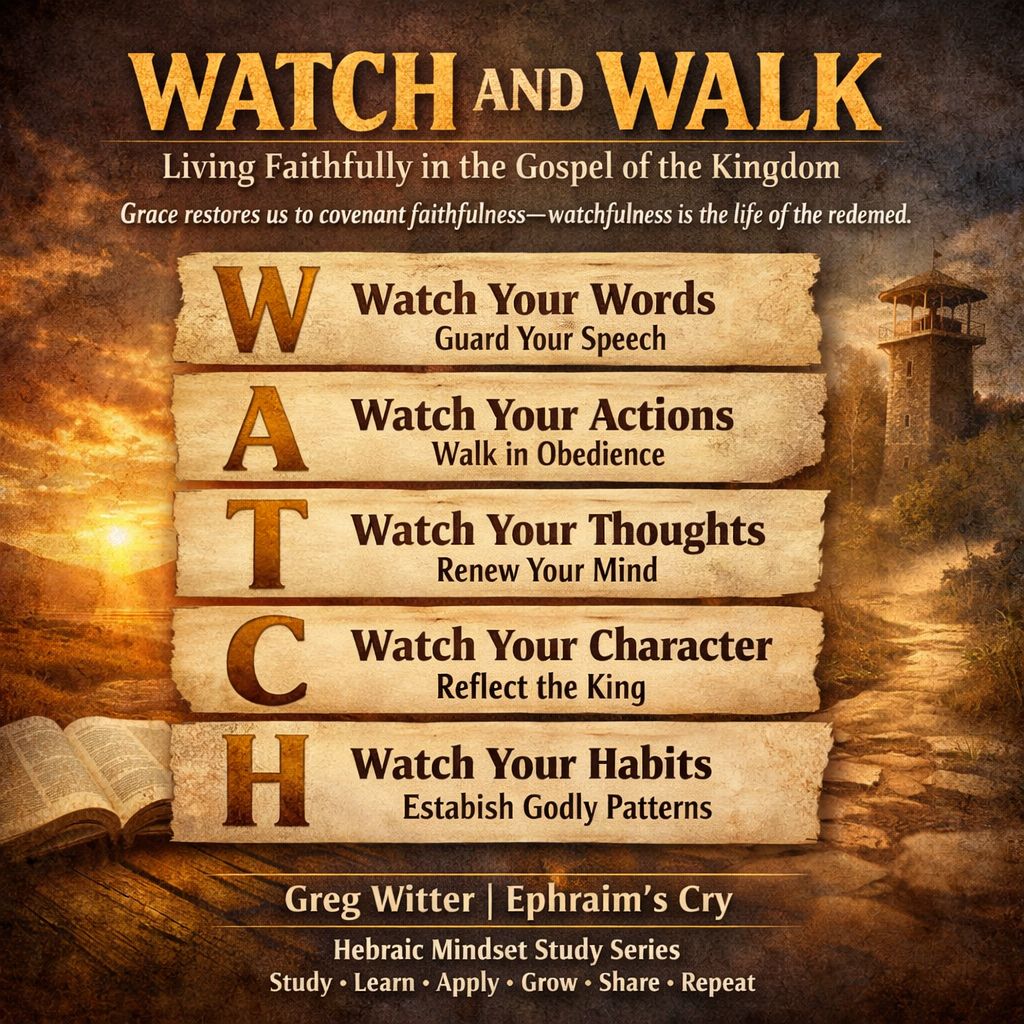
WATCH AND WALK
Living Faithfully in the Gospel of the Kingdom
Grace restores us to covenant faithfulness—watchfulness is the life of the redeemed.
Greg Witter | Ephraim’s Cry
Hebraic Mindset Study Series
Study Learn Apply Grow Share Repeat
THINGS WE MUST ALWAYS WATCH
“Watch ye, stand fast in the faith, quit you like men, be strong.”
1 Corinthians 16:13
INTRODUCTION
From the opening pages of Scripture, Yahuah has always required His people to live watchfully. Adam was commanded to guard the garden. Noah was warned to prepare while the world slept. Abraham walked by faith while watching for the promises of Elohim. Israel was commanded to remain alert lest they forget Yahuah when prosperity came (Deuteronomy 8:11–14). The prophets stood as watchmen on the walls, warning of judgment, calling for repentance, and urging covenant faithfulness (Ezekiel 33:7).
Watchfulness is not anxiety, speculation, or fear-driven obsession. It is covenant alertness. It is the posture of those who understand that life is lived before Elohim, that choices matter, that deception is real, and that faithfulness must be guarded.
Grace does not abolish watchfulness. Grace restores it. Grace is not permission to drift, relax, or disengage. Grace is the power of Elohim that rescues sinners and then trains them to live rightly within the covenant. Scripture is explicit: “The grace of Elohim that brings salvation has appeared to all men, teaching us that, denying ungodliness and worldly lusts, we should live soberly, righteously, and godly in this present age” (Titus 2:11–12).
The Gospel of the Kingdom does not produce passive believers. It produces disciplined disciples. Yahusha did not call people to mental assent; He called them to follow Him, to take up their cross, to endure to the end, and to bear fruit worthy of repentance (Matthew 16:24; Matthew 24:13; Matthew 3:8). Those who truly believe watch their lives, guard their ways, and remain faithful because they know the King will return and give account to every servant (Matthew 25:14–30).
Scripture never presents faith as a momentary decision detached from lifelong obedience. Faith is lived allegiance. “Here are they that keep the commandments of Elohim and the faith of Yahusha” (Revelation 14:12). Watchfulness is therefore practical, daily, and personal. It reaches into how we speak, how we act, how we think, who we are becoming, and what patterns we are forming.
The word WATCH summarizes five covenant areas that must be guarded continually: Words, Actions, Thoughts, Character, and Habits.
WATCH YOUR WORDS
Words are never neutral. Scripture consistently treats speech as a spiritual matter because words reveal the heart and shape the direction of life. Proverbs declares, “Death and life are in the power of the tongue” (Proverbs 18:21). Yahusha taught, “Out of the abundance of the heart the mouth speaks” (Matthew 12:34), and warned that people will give account for every careless word spoken (Matthew 12:36).
Covenant faithfulness therefore requires disciplined speech. Corrupt communication is not limited to profanity. It includes bitterness (Hebrews 12:15), slander (Psalm 101:5), deceit (Psalm 34:13), exaggeration (Proverbs 14:25), and speech that tears down rather than builds. Such speech reflects a heart not fully submitted to Yahuah.
Ephesians commands, “Let no corrupt communication proceed out of your mouth, but that which is good to the use of edifying” (Ephesians 4:29). Speech is to build, not rot. James warns that the tongue, though small, can set an entire life on fire (James 3:5–6). This is why self-control over speech is repeatedly identified as a mark of maturity (James 1:26).
The faithful are called to wise and restrained speech. “He that guards his mouth preserves his soul” (Proverbs 13:3). Colossians instructs that speech should be seasoned with grace and discernment (Colossians 4:6), meaning words are chosen deliberately, not impulsively.
Words are also a matter of witness. Scripture teaches that confession of faith is outward allegiance, not silent belief (Romans 10:9–10). At the same time, covenant speech is worshipful. Thanksgiving acknowledges Yahuah’s sovereignty and provision and guards the heart against bitterness and pride (1 Thessalonians 5:18).
Grace disciplines the tongue because the heart belongs to the King. A guarded mouth reflects a guarded life.
WATCH YOUR ACTIONS
Faith is never abstract. Scripture makes clear that faith without works is dead (James 2:17), not because works save, but because living faith produces obedience. From the beginning, covenant relationship has always been expressed through faithful action. Abraham believed Elohim, and that belief was demonstrated through obedience (Genesis 22; James 2:21–23).
Grace does not oppose action; grace empowers right action. Paul himself taught that believers are “created in Messiah Yahusha unto good works, which Elohim prepared beforehand that we should walk in them” (Ephesians 2:10). Works are not the root of salvation, but they are the fruit of it.
Love in the Kingdom is not theoretical. “Let us not love in word, neither in tongue; but in deed and in truth” (1 John 3:18). Covenant faith expresses itself through service, sacrifice, generosity, and faithfulness. Yahusha taught that those who hear His words and do them are wise, while those who hear and do not act are building on sand (Matthew 7:24–27).
The faithful avoid excess and carelessness, choosing discernment over indulgence. “See then that you walk circumspectly, not as fools but as wise” (Ephesians 5:15). They labor consistently, not seeking recognition, but serving because they belong to Elohim (Colossians 3:23).
Obedience is not legalism. Obedience is loyalty. “If you love Me, keep My commandments” (John 14:15). The redeemed walk because they have been redeemed.
WATCH YOUR THOUGHTS
The mind is a primary battleground of covenant faithfulness. Scripture teaches that transformation begins with renewed thinking. “Be not conformed to this world, but be transformed by the renewing of your mind” (Romans 12:2). If thoughts are left unguarded, behavior will eventually follow deception (Proverbs 4:23).
The faithful anchor their thinking in truth rather than emotion or cultural pressure. Philippians instructs believers to intentionally dwell on what is true, honorable, just, pure, and praiseworthy (Philippians 4:8). Gratitude guards the heart with peace (Philippians 4:6–7), while disciplined thinking resists temptation and refuses mental compromise.
Paul taught that thoughts must be brought into submission to Messiah (2 Corinthians 10:5). This is not passive spirituality. It is active resistance against lies, imaginations, and strongholds that exalt themselves against the knowledge of Elohim.
A Kingdom perspective lifts the mind above temporary concerns and fixes attention on eternal realities. “Set your affection on things above, not on things on the earth” (Colossians 3:2). Renewal of the mind is not a one-time event but an ongoing discipline that shapes discernment, endurance, and faithfulness.
A disciplined mind produces a disciplined life.
WATCH YOUR CHARACTER
Yahuah looks on the heart (1 Samuel 16:7). Kingdom faith is not performative; it is formational. Elohim is not interested in appearances alone but in who a person is becoming over time.
True humility is submission to Yahuah rather than self-promotion (Micah 6:8; Philippians 2:3–5). Integrity means consistency—faithfulness in private as well as in public (Psalm 15:1–2). Compassion flows from truth rather than sentimentality and is governed by righteousness rather than emotion (Ephesians 4:32).
Controlled conduct reflects a life led by the Spirit rather than by the flesh (Galatians 5:16). Scripture repeatedly teaches that those who belong to Elohim are being conformed into the image of Messiah (Romans 8:29). This process produces patience, endurance, and steadfastness.
Such lives become credible witnesses, testifying not merely through words but through faithful endurance. “You are our epistle written in our hearts, known and read of all men” (2 Corinthians 3:2).
Character is Messiah formed within a covenant people.
WATCH YOUR HABITS
Daily patterns shape spiritual direction. What is practiced repeatedly becomes normal, and what becomes normal eventually defines character. Scripture emphasizes the importance of daily discipline because long-term faithfulness is built in ordinary moments.
The faithful redeem time rather than waste it (Ephesians 5:16). Discipline is embraced as training rather than punishment (1 Timothy 4:7–8). The Word is allowed to dwell richly, shaping thought and behavior (Colossians 3:16). Prayer becomes habitual communion rather than emergency response (1 Thessalonians 5:17).
Hope-filled living keeps the eyes fixed on the return of the King. “Looking for that blessed hope, and the glorious appearing of the great Elohim and our Savior Yahusha Messiah” (Titus 2:13). Watchfulness is sustained by expectation rather than fear.
Grace does not remove discipline. Grace restores it to its rightful place.
CONCLUSION
We are not saved by watching, but those who are saved watch. Grace restores us to covenant loyalty rather than spiritual carelessness. Faith produces obedience, and right teaching produces faithful living.
A watchful people are a prepared people.
FINAL SUMMARY
Words reveal allegiance.
Actions reveal faith.
Thoughts determine direction.
Character reflects the King.
Habits shape destiny.
Endurance requires support. Help keep the light burning. — 99¢ per month keeps it going.
#gospelOfTheKingdom, #covenantFaithfulness, #watchAndWalk, #wholeCounselOfElohim, #biblicalDiscipleship, #kingdomLiving, #faithAndObedience, #graceThatTrains, #watchmanCall, #truthWithoutCompromise
