
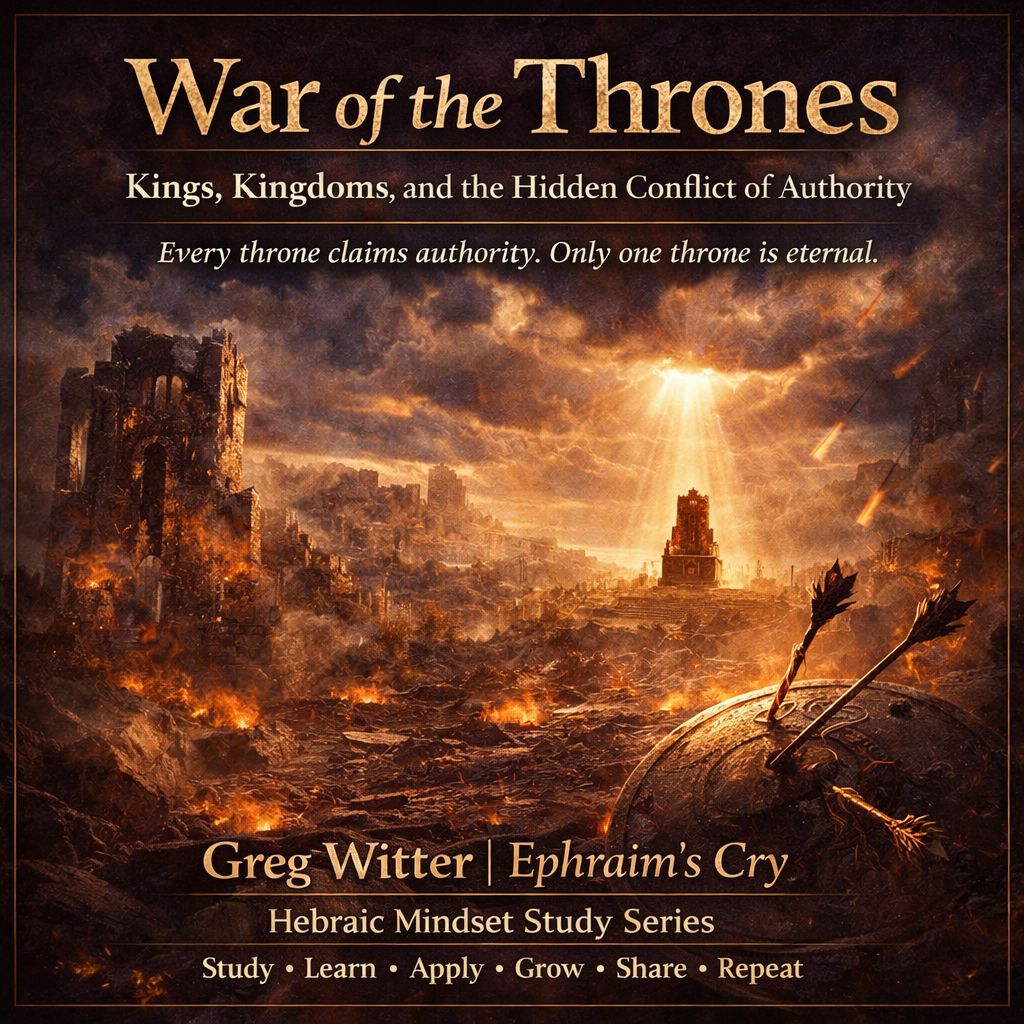
War of the Thrones
Kings, Kingdoms, and the Hidden Conflict of Authority
Every throne claims authority. Only one throne is eternal.
Greg Witter | Ephraim’s Cry
Hebraic Mindset Study Series
Study Learn Apply Grow Share Repeat
From the opening chapters of Scripture to the final pages of Revelation, the story of humanity unfolds as a struggle over authority. What often appears as political conflict, military struggle, or national rivalry is frequently something deeper. Beneath the visible movements of history lies a recurring pattern—the clash of thrones.
Kings rise. Kings fall. Empires expand and collapse. But behind these movements stands a question that Scripture repeatedly forces us to confront: who truly rules?
The wars between kings recorded throughout Scripture are rarely just about land or power. They reveal allegiance. They expose rebellion. They uncover the deeper battle between human authority and divine sovereignty.
This is the war of the thrones.
And the conflict did not begin with earthly kings.
It began in Eden.
THE FIRST WAR OF AUTHORITY — EDEN
Before any kingdom was built on earth, Yahuah established His order in creation. Humanity was placed within that order as steward and representative under divine authority.
Adam was not a king in the political sense, but he was given dominion. Genesis declares that humanity was instructed to rule over the earth under the authority of the Creator.
The structure was clear.
Yahuah was King.
Humanity ruled under His covenant authority.
But in Genesis 3 a rival voice appears.
The serpent does not merely question the command of Yahuah. The temptation is deeper.
“You shall be as Elohim…” (Genesis 3:5)
The offer is authority without submission.
The temptation is the establishment of a throne independent of the Creator.
In that moment the first war over authority begins. Humanity chooses autonomy instead of covenant alignment. The result is exile from Eden and the beginning of a long history of competing claims to power.
From that point forward, human history becomes a battlefield of thrones—some aligned with Yahuah, others built in rebellion.
THE FIRST KINGDOM SYSTEM — BABEL
The next major expression of this conflict appears in Genesis 11 with the construction of Babel.
After the flood humanity gathers and begins building a centralized system of power.
“Come, let us build ourselves a city and a tower whose top reaches to heaven…” (Genesis 11:4)
This is not merely architecture. It is an attempt to construct a unified human authority structure independent of divine governance.
The tower represents human ambition seeking to establish dominion without submission to Yahuah.
Babel is the birth of organized kingdom systems that attempt to replace covenant authority with human authority.
Yahuah responds by scattering the nations and confusing their languages. The centralized system collapses, and humanity spreads across the earth.
From that moment forward, multiple nations and kingdoms arise—each forming its own thrones, rulers, and systems of power.
But the deeper conflict remains the same.
Who rules?
THE FIRST WAR OF KINGS — GENESIS 14
The first recorded war between kings appears in Genesis 14. Four kings wage war against five.
At the surface level the conflict appears political. Territories are contested, cities are captured, and alliances are tested.
But the text reveals something more.
For twelve years the five kings had served Kedorlaomer. In the thirteenth year they rebelled. The rebellion triggers the war.
The pattern is clear.
Rebellion against authority produces conflict.
Yet the most important figure in this narrative appears after the battle.
Malak-Tsadaq, the king of Salem and priest of El Elyon, suddenly enters the story. He blesses Abraham and receives a tithe from him.
This moment reveals something profound.
Earthly kings have been fighting for land and control. Then suddenly a king-priest appears representing a higher authority.
Melchizedek stands as a representa
tive of heavenly order in the midst of earthly conflict.
His appearance reveals that above every throne on earth stands another throne.
The true authority belongs to Yahuah.
THE CLASH OF REPRESENTATIVES — DAVID AND GOLIATH
Another powerful illustration of the war of thrones appears in the confrontation between David and Goliath.
At first glance this is a battle between two individuals. But David himself clarifies what is truly happening.
“The battle is Yahuah’s.” (1 Samuel 17:47)
Goliath represents military power, intimidation, and human confidence in strength. David represents covenant loyalty and trust in the authority of Yahuah.
The shepherd faces the giant not with armor or weapons but with covenant allegiance.
And the giant falls.
This moment reveals a pattern repeated throughout Scripture: human power cannot ultimately stand against covenant authority.
The true throne is not established by strength of arms but by submission to the Most High.
KINGS AND COVENANT ALIGNMENT
As the history of Israel unfolds, the pattern becomes even clearer. The books of Samuel and Kings record the reigns of leaders whose success or failure is determined not merely by political strategy but by covenant alignment.
Some kings seek the counsel of prophets. Others reject the word of Yahuah.
Some trust in divine guidance. Others trust in horses, chariots, and alliances.
The outcome is consistent.
Kings who walk in humility and obedience experience stability. Kings who pursue pride and idolatry eventually collapse.
The war between kings reveals the condition of the throne within the heart of the ruler.
THE FRACTURE OF THE KINGDOM
One of the most tragic examples of this pattern appears after the reign of Solomon.
Under Rehoboam and Jeroboam the kingdom divides. Two thrones emerge where there should have been one.
This division produces internal conflict among covenant people.
The northern kingdom and southern kingdom become rivals. Brother fights against brother. Tribe contends with tribe.
The division weakens the nation and opens the door for external threats.
The prophet Ezekiel later addresses this fracture through the vision of the two sticks.
“Take one stick and write on it, ‘For Judah.’ Then take another stick and write on it, ‘For Joseph.’ Join them together into one stick…” (Ezekiel 37:16–17)
The message is clear.
Unity among covenant people must be restored under one shepherd and one authority.
Division among the people of Yahuah creates internal war and vulnerability.
THE UNSEEN LAYER — SPIRITUAL POWERS
Scripture occasionally lifts the veil and reveals that earthly kingdoms may be influenced by unseen spiritual powers.
In Daniel 10 the messenger sent to Daniel explains that he was resisted by the “prince of Persia.”
This passage suggests that behind earthly empires there may exist spiritual authorities influencing political systems.
The visible world and the unseen world often intersect.
But Scripture also makes one truth unmistakable: these powers are not sovereign.
Yahuah alone establishes and removes kings.
“He removes kings and sets up kings.” (Daniel 2:21)
The Most High governs history even when earthly rulers imagine themselves to be autonomous.
THE INNER WAR OF THRONES
The war between kings is not limited to nations. It also takes place within the human heart.
Every person carries internal thrones—areas of influence that attempt to rule decisions, desires, and loyalties.
Pride attempts to rule.
Fear attempts to rule.
Self-will attempts to rule.
When Yahuah begins transforming a person’s life, these internal thrones begin to fall.
That process can feel like conflict. But it is purification.
The dethroning of false authority within the heart is the beginning of true covenant alignment.
THE KING-PRIEST AND THE FINAL THRONE
The brief appearance of Melchizedek in Genesis becomes fully revealed through the coming of Messiah.
Psalm 110 declares:
“You are a priest forever according to the order of Melchizedek.”
Messiah embodies the ultimate union of kingship and priesthood.
Earthly kings often rule without righteousness. Priests often serve without authority.
But the King-Priest unites both.
Messiah represents the final and eternal throne.
THE FINAL WAR OF KINGS
Scripture concludes with a final gathering of kings.
The book of Revelation describes earthly rulers assembling in resistance to divine authority.
The systems of the world unite against the Anointed.
But the outcome is already written.
Messiah returns as King of kings and Master of masters.
Every temporary throne collapses. Every rebellious system is exposed.
The war of thrones ends when the true King appears.
THE THREAD THROUGH HISTORY
From Eden to Babel, from the wars of Genesis to the divided kingdom, from David’s victory to Daniel’s visions, Scripture reveals the same pattern.
Human authority repeatedly attempts to establish itself apart from Yahuah.
But every throne that resists divine authority eventually falls.
The wars between kings expose the deeper reality of history.
They reveal allegiance.
They expose pride.
They test covenant loyalty.
And they remind us that the final authority does not belong to any human throne.
It belongs to Yahuah alone.
#GregWitter#EphraimsCry#HebraicMindsetStudySeries#WarOfTheThrones#KingdomAuthority#Covenant#PropheticWatchman
#Daniel#Genesis#Revelation#KingOfKings#Discernment#EndTimes
