
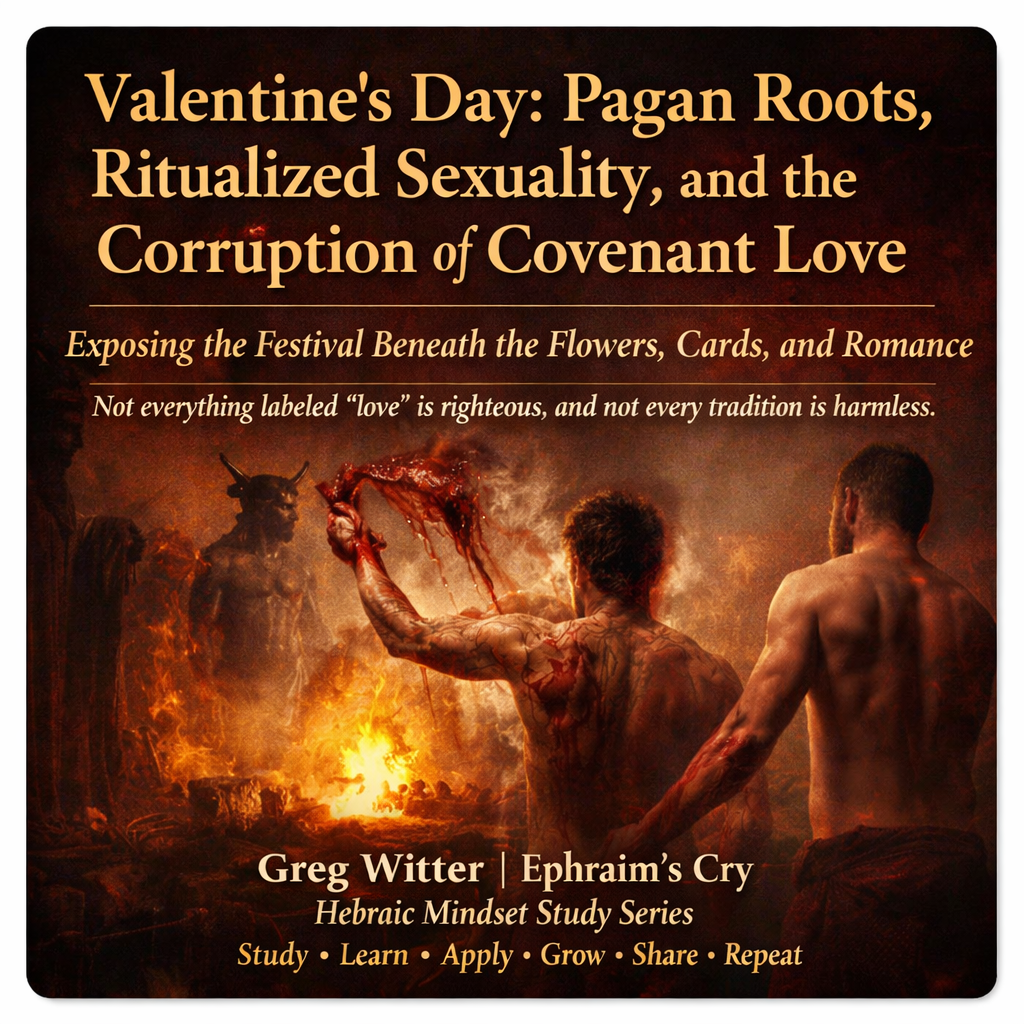
Valentine’s Day: Pagan Roots, Ritualized Sexuality, and the Corruption of Covenant Love
Exposing the Festival Beneath the Flowers, Cards, and Romance
Not everything labeled “love” is righteous, and not every tradition is harmless
Greg Witter | Ephraim’s Cry
Hebraic Mindset Study Series
Study Learn Apply Grow Share Repeat
Valentine’s Day is not merely a harmless cultural expression of affection. Beneath the surface-level imagery of hearts, flowers, and sentimentality lies a festival with deeply pagan, ritualistic, and morally corrosive roots. What modern culture celebrates as “love” is, in origin and function, something very different—something Scripture consistently warns against.
To understand Valentine’s Day honestly, it must be stripped of its modern marketing and examined at its source.
The earliest and clearest root of Valentine’s Day is the Roman festival Lupercalia, held annually in mid-February. This was not a celebration of covenant love, marriage, or faithfulness. It was a fertility rite, centered on animal sacrifice, ritual blood, and sexual symbolism. Goats and dogs were slaughtered, their skins cut into strips, and young men—often naked or partially clothed—would run through the streets striking women with these blood-soaked hides. This act was believed to increase fertility, ease childbirth, and promote sexual potency.
This was not symbolic. It was physical, ritualized, and intentionally sexual.
Lupercalia was dedicated to Roman deities associated with fertility, lust, and animal instinct. It celebrated unrestrained desire, not disciplined love. It honored impulse, not covenant. The goal was not holiness or fidelity, but procreation and pleasure divorced from moral accountability.
When Rome later adopted institutional Christianity, these pagan festivals were not eradicated. Rome’s strategy was assimilation, not repentance. Pagan observances were renamed, sanitized, and absorbed into a Christian veneer so the population could retain familiar customs without overtly abandoning them.
This is where “Valentine” enters the story.
There is no solid historical evidence connecting any historical Valentine to romance, marriage, or biblical teaching on love. Multiple figures named Valentine appear in Roman records, with conflicting stories and no consistent narrative. The romantic association was added centuries later, long after the apostolic era, as a way to reframe an already-existing pagan festival under a Christian-sounding name.
In other words, Valentine’s Day did not evolve from biblical truth into culture.
It evolved from pagan ritual into religious camouflage.
The darker layer does not end there.
During the Middle Ages, Valentine’s Day was further reshaped by the rise of courtly love, a concept that had little to do with marriage or covenant faithfulness. Courtly love idealized emotional obsession, longing, fantasy, and often adulterous desire. It elevated feelings above responsibility and passion above permanence. This framework deeply influenced Western romantic ideology and still shapes how “love” is understood today.
Modern Valentine’s Day is the commercialized descendant of this lineage: pagan fertility rites repackaged through medieval romanticism and sold through consumer culture. The result is a holiday that encourages emotional excess, sensuality, sexual pressure, and comparison—often detached from marriage, discipline, or holiness.
Scripture defines love very differently.
Biblical love is not seasonal, performative, or emotion-driven. Love in Scripture is covenantal. It is patient, disciplined, faithful, and rooted in obedience to Yahuah. Love is demonstrated over time through responsibility, sacrifice, self-control, and alignment with Yahuah’s commands.
Valentine’s Day inverts this.
It trains people to associate love with: • impulse rather than commitment
• emotion rather than obedience
• desire rather than discipline
• performance rather than faithfulness
It also subtly sexualizes affection, normalizing physical intimacy and emotional entanglement outside the boundaries Scripture establishes. This is not accidental. That trajectory traces directly back to its fertility-rite origins.
Scripture repeatedly warns against adopting the practices of the nations and then attempting to sanctify them by intent or rebranding. The issue is not whether people “mean well.” The issue is authority. Did Yahuah establish this? Did He command it? Did He model it? Did He bless it?
The answer is no.
Valentine’s Day is not an appointed time.
It is not a memorial of Yahuah’s acts.
It is not tied to repentance, obedience, or covenant renewal.
It is a man-made tradition rooted in paganism, reshaped by romantic fantasy, and sustained by commercial manipulation.
Calling it “just about love” ignores both its origins and its fruit.
Biblical love does not require a festival.
Biblical love does not borrow from paganism to feel meaningful.
Biblical love is lived daily, quietly, faithfully, and in submission to Yahuah’s order.
The real danger of Valentine’s Day is not chocolates or cards—it is conditioning. It conditions hearts to confuse desire with love, emotion with truth, and tradition with righteousness.
For those returning to a Hebraic, covenantal mindset, the question is not whether something is popular or culturally accepted. The question is whether it aligns with Yahuah’s ways.
Valentine’s Day does not.
It is not biblical.
It is not neutral.
And it is not harmless.
#ValentinesDay #PaganRituals #ComeOutOfBabylon #HebraicMindset #CovenantLove #TraditionsOfMen #SetApart #EphraimsCry
