
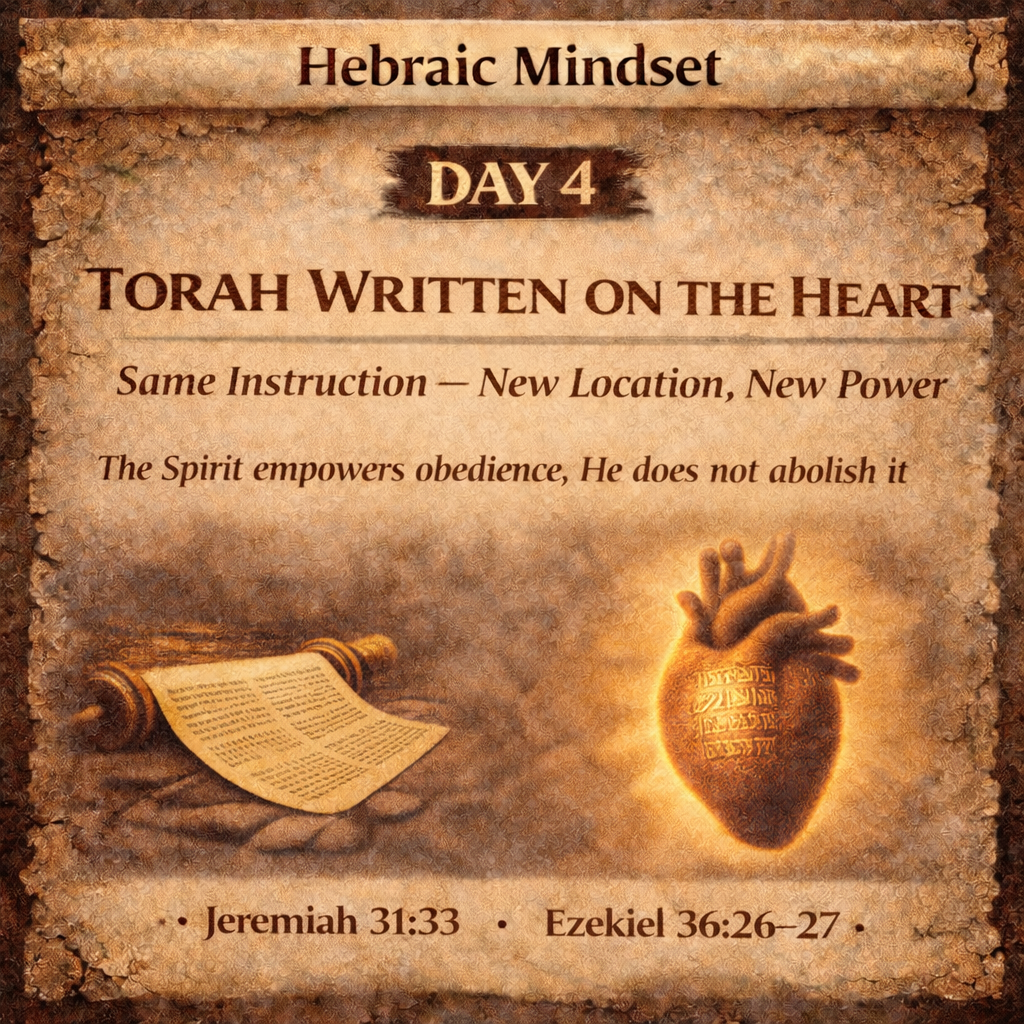
TORAH WRITTEN ON THE HEART
Same Instruction — New Location, New Power
The Spirit empowers obedience, He does not abolish it
Greg Witter | Ephraim’s Cry
Hebraic Mindset Study Series
Study Learn Apply Grow Share Repeat
Orientation
Day One established the source: redemption is by Yahuah, through Yahusha the High Priest.
Day Two established the priesthood: faithful, unchangeable, incorruptible.
Day Three established the standard: Yahusha is the Living Torah, and disciples walk as He walked.
Day Four now addresses how this obedience becomes possible.
This is where most modern theology collapses—because it mistakes the role of the Spirit and misrepresents the renewed covenant.
Scripture does not teach that Torah was removed.
It teaches that Torah was relocated.
The Renewed Covenant Promise Is Explicit
Jeremiah 31:31–33
Yahuah defines the renewed covenant in unmistakable terms:
“I will put My Torah within them”
“I will write it on their hearts”
“I will be their Elohim, and they shall be My people”
The promise is not a new law.
The promise is not lawlessness.
The promise is internalization.
If Torah were abolished, this promise would be meaningless. You cannot write something on the heart that no longer exists.
The renewed covenant does not change the content of instruction.
It changes where obedience is formed.
The Problem Was Never Torah — It Was the Heart
Ezekiel 36:26–27
Ezekiel explains the real issue:
hearts of stone cannot obey
fleshly hearts can
the Spirit enables obedience
Yahuah says plainly:
“I will cause you to walk in My statutes.”
The Spirit is not given to innovate morality.
He is given to empower covenant faithfulness.
Any teaching that claims the Spirit frees believers from obedience directly contradicts Yahuah’s own words.
External Law Exposed Sin — Internal Law Transforms
Romans 7:7; Romans 8:3–4
Paul does not condemn Torah. He explains its function.
Torah:
exposes sin
defines righteousness
reveals the need for redemption
Messiah accomplished what the flesh could not, so that the righteous requirement of the Torah might be fulfilled in us (Romans 8:4).
Fulfilled in us, not discarded for us.
The Spirit and Torah Are Never Opposed
Psalm 119:142; John 16:13
Truth is defined by Torah.
The Spirit leads into truth.
That means the Spirit leads into Torah faithfulness, not away from it.
Scripture knows nothing of:
Spirit-led rebellion
grace-powered disobedience
faith that contradicts instruction
Those ideas come from theology, not Scripture.
What “Freedom” Actually Means Biblically
James 1:25; Psalm 119:45
Scripture defines Torah as the law of liberty.
Freedom is not the absence of boundaries.
Freedom is the ability to walk rightly without bondage to sin.
The Spirit does not remove boundaries.
He removes slavery.
Why This Teaching Matters So Much
This truth dismantles two dangerous errors at once:
Legalism — obedience without the Spirit
Lawlessness — Spirit language without obedience
Yahuah offers neither.
He offers:
Torah written on the heart
obedience empowered by the Spirit
covenant faithfulness from the inside out
This is the only model Scripture supports.
Watchman Conclusion
The renewed covenant is not a new moral system.
It is the restoration of covenant obedience through transformation.
Torah remains.
The heart is changed.
The Spirit empowers.
Anything else is not renewal — it is rebellion dressed as spirituality.
Tomorrow, we will conclude the series by addressing the final balance Scripture demands: Spirit and Truth, one Mediator, and the line Yahusha Himself drew.
#EphraimsCry #GregWitter #HebraicMindset #HebraicMindsetStudySeries #TorahOnTheHeart #RenewedCovenant #Jeremiah31 #Ezekiel36 #SpiritEmpowered #FaithAndObedience #TorahTruth #LawOfLiberty #Watchman
