
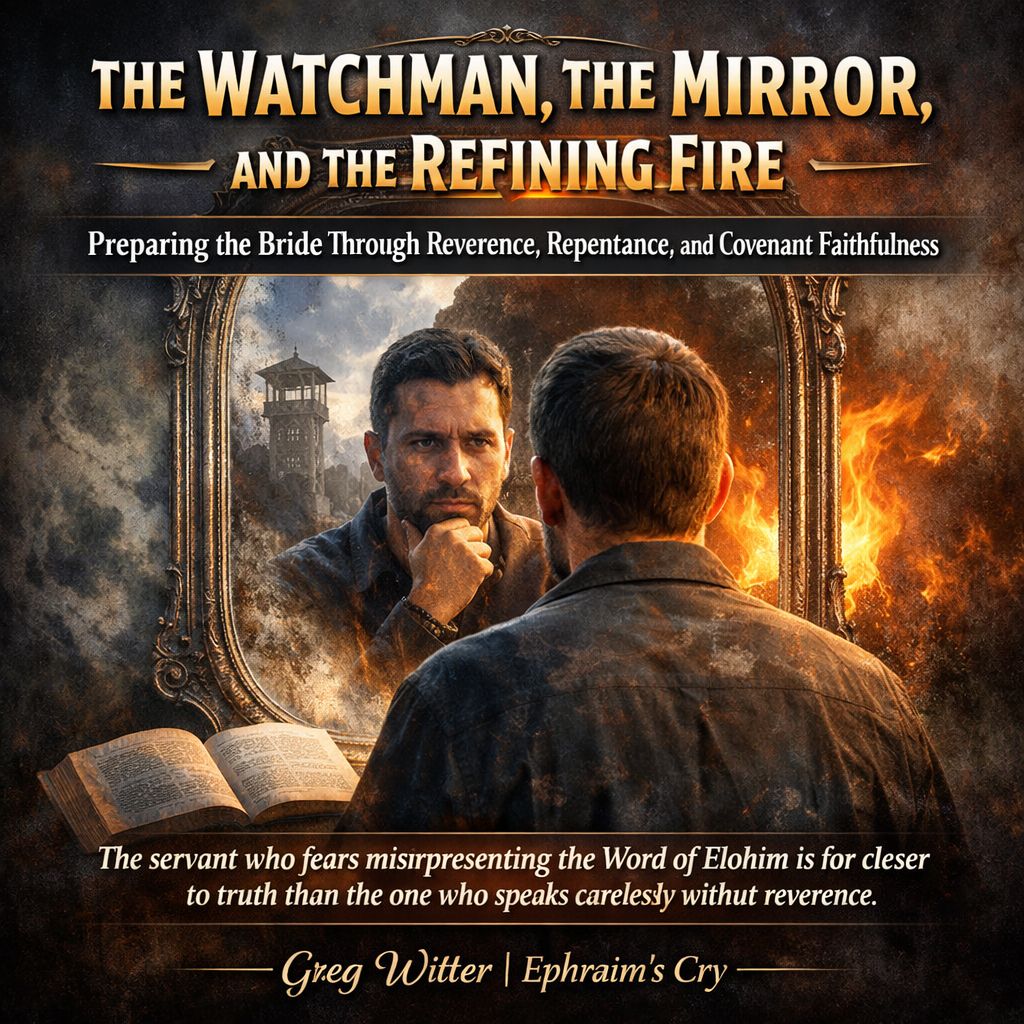
THE WATCHMAN, THE MIRROR, AND THE REFINING FIRE
Preparing the Bride Through Reverence, Repentance, and Covenant Faithfulness
The servant who fears misrepresenting the Word of Elohim is far closer to truth than the one who speaks carelessly without reverence.
Greg Witter | Ephraim’s Cry
Hebraic Mindset Study Series
Study Learn Apply Grow Share Repeat
Before going any further, I want to be clear about something.
This is not a message I speak from a place of arrival or perfection. It is something I have been wrestling with, examining, studying, and testing against the Scriptures for many years. Almost every day I find myself standing in front of the same mirror the Word of Elohim places before every servant.
I know Greg. I know my own heart. I know the battle between flesh and Spirit that every disciple faces. That is exactly why this subject matters so much to me.
And the truth is, those who examine themselves in this way stand in very good company.
David prayed:
Psalm 139:23–24
“Search me, O Elohim, and know my heart: try me, and know my thoughts: and see if there be any wicked way in me, and lead me in the way everlasting.”
The prophet Jeremiah understood the danger of the human heart.
Jeremiah 17:9–10
“The heart is deceitful above all things, and desperately wicked: who can know it? I Yahuah search the heart, I try the reins, even to give every man according to his ways.”
Paul openly acknowledged the struggle within the flesh.
Romans 7:18
“For I know that in me (that is, in my flesh) dwells no good thing.”
Peter warned believers about those who twist and distort the Scriptures.
2 Peter 3:16
“In which are some things hard to understand, which those who are unlearned and unstable twist, as they do also the other Scriptures, unto their own destruction.”
James warned teachers about the weight of speaking for Elohim.
James 3:1
“My brethren, be not many teachers, knowing that we shall receive the greater judgment.”
These were not weak men. They were servants who understood the seriousness of standing before the Word of Elohim.
None of them claimed perfection.
But all of them walked in humility, repentance, and reverence for the truth.
That is the posture every servant must carry.
Because the mirror of the Word does not exist to flatter us.
It exists to reveal us.
And as the age draws closer to its conclusion, the bride of Messiah must make herself ready.
That preparation begins with the same question for every one of us:
When we stand before the mirror of the Word… what do we see?
The closer the age moves toward its appointed conclusion, the more serious the handling of the Word of Elohim must become. We are living in a time when information is everywhere, teaching is everywhere, opinions are everywhere, and yet true reverence for the Word is becoming increasingly rare.
Many speak about Scripture with confidence. Many quote verses. Many build doctrines. But very few approach the Word with the posture the Scriptures themselves require: fear, humility, and trembling before the One who spoke it.
The Scriptures are not merely a religious text. They are the covenant constitution of the Kingdom of Elohim. To teach them is to handle the words of the Creator of heaven and earth. That responsibility is not light. It carries weight, accountability, and consequence.
This is why the apostles warned that teaching is not something to pursue casually.
James 3:1
“My brethren, be not many teachers, knowing that we shall receive the greater condemnation.”
Every person who steps into the role of teacher enters into a higher level of accountability. Words spoken publicly about the Word of Elohim influence lives, shape understanding, and can either lead people toward truth or toward deception. For that reason, the servant who teaches must approach the Scriptures with sobriety and reverence.
The modern religious world often celebrates confidence and charisma. But Scripture praises something different: fear of Elohim.
Psalm 111:10
“The fear of Yahuah is the beginning of wisdom.”
Proverbs 9:10
“The fear of Yahuah is the beginning of wisdom, and the knowledge of the Holy is understanding.”
This fear is not terror. It is reverence. It is the sober awareness that the words we speak about Elohim must align with what He has actually spoken. It produces humility. It produces caution. It produces a refusal to twist Scripture to support personal opinion, tradition, or religious systems.
The servant who understands this approaches the Scriptures carefully, prayerfully, and with the understanding that the One who gave the Word is also the One who judges how it is handled.
WORKING OUT SALVATION WITH FEAR AND TREMBLING
The apostles repeatedly called believers to take their walk with Elohim seriously.
Philippians 2:12
“Work out your own salvation with fear and trembling.”
This does not mean living in panic or anxiety. It means recognizing that the covenant relationship with Elohim is not casual. It requires sincerity, humility, repentance, and obedience.
Faith is not merely intellectual agreement. It is covenant loyalty expressed through life and conduct.
The servant of Elohim must continually examine themselves in light of the Word.
2 Corinthians 13:5
“Examine yourselves, whether you be in the faith; prove your own selves.”
Psalm 139:23–24
“Search me, O Elohim, and know my heart; try me, and know my thoughts.”
Lamentations 3:40
“Let us search and try our ways, and turn again to Yahuah.”
These passages reveal a principle that has largely been lost in modern religion: the Word of Elohim is a mirror.
James 1:22–24
“But be doers of the word, and not hearers only, deceiving your own selves… For if any be a hearer of the word and not a doer, he is like a man beholding his natural face in a mirror.”
The Word exposes the true condition of the heart. It reveals where repentance is needed. It reveals where correction must take place.
The purpose of Scripture is not merely to inform the mind. It is to transform the life.
THE DAILY WAR BETWEEN FLESH AND SPIRIT
Anyone who truly examines themselves will quickly discover the same battle the apostle Paul described.
Romans 7:18–19
“For I know that in me (that is, in my flesh) dwelleth no good thing… For the good that I would I do not: but the evil which I would not, that I do.”
The war between flesh and Spirit is not a sign of failure. It is the reality of spiritual transformation.
Galatians 5:17
“For the flesh lusts against the Spirit, and the Spirit against the flesh.”
Those who belong entirely to the flesh feel no conflict. But those who desire righteousness experience the refining tension between the old nature and the new.
This struggle produces humility. It produces dependence on Elohim. And it produces the refining process that prepares the servants of the Kingdom.
THE REFINING FIRE
Scripture repeatedly describes the purification of Elohim’s people as a refining fire.
Malachi 3:2–3
“He is like a refiner’s fire… He will sit as a refiner and purifier of silver.”
1 Peter 1:6–7
“That the trial of your faith, being much more precious than gold that perishes, though it be tried with fire.”
Zechariah 13:9
“I will bring the third part through the fire, and will refine them as silver is refined.”
Refinement is not comfortable. It exposes pride. It burns away compromise. It removes the impurities that prevent the servant from walking in truth.
But refinement has a purpose: purification.
The bride of Messiah is not formed through comfort. She is formed through purification.
THE BRIDE MUST MAKE HERSELF READY
Scripture declares that the end of the age will culminate in a prepared bride.
Revelation 19:7
“The marriage of the Lamb has come, and His wife has made herself ready.”
Preparation involves repentance, cleansing, and alignment with the Word.
Ephesians 5:25–27
“That He might sanctify and cleanse her… that He might present her to Himself a glorious assembly, not having spot or wrinkle.”
2 Corinthians 11:2
“I have espoused you to one husband, that I may present you as a pure virgin to Messiah.”
The bride is not prepared by religious systems. She is prepared by purification and obedience.
THE AGE OF LAWLESSNESS
One of the most sobering warnings Messiah gave concerns lawlessness.
Matthew 7:22–23
“Many will say to me in that day, Lord, Lord… and then I will declare to them, depart from me, you who practice lawlessness.”
Lawlessness is not merely sin in general. The apostle John defines it precisely.
1 John 3:4
“Sin is the transgression of the law.”
In other words, rejecting the commandments of Elohim while claiming devotion to Him is the very definition of lawlessness.
This is why Messiah warned that lawlessness would increase in the last days.
Matthew 24:12
“Because lawlessness shall abound, the love of many shall grow cold.”
The prophets also warned of a power that would attempt to change Elohim’s appointed order.
Daniel 7:25
“He shall think to change times and law.”
The rise of lawlessness is not merely moral decline. It is the rejection of the covenant authority of Elohim.
THE ROLE OF THE WATCHMAN
Scripture also reveals the responsibility of the watchman.
Ezekiel 33:7
“So you, son of man, I have set you as a watchman… therefore you shall hear the word at my mouth and warn them.”
Ezekiel 33:8–9 explains the seriousness of this responsibility.
If the watchman fails to warn, the blood of the people is required from him.
The watchman does not invent truth. The watchman proclaims what the Word already says.
Whether people receive the warning or reject it does not change the responsibility.
The watchman must speak faithfully.
DISCERNING FALSE TEACHING
Scripture repeatedly warns about deception.
Matthew 7:15
“Beware of false prophets.”
Acts 20:29–30
“Grievous wolves shall enter in among you.”
2 Peter 2:1
“There shall be false teachers among you.”
Discernment requires comparing all teaching with the whole counsel of Elohim.
Torah establishes the covenant foundation.
The Prophets call the people back to that covenant.
The Writings provide wisdom and testimony.
The Apostolic witness reveals Messiah and confirms the covenant promises.
Luke 24:27
“Beginning at Moses and all the prophets, He expounded to them the things concerning Himself.”
Messiah did not separate Himself from the Scriptures. He revealed that all Scripture testified about Him.
THE FINAL ACCOUNTABILITY
Scripture ends with a simple but powerful summary.
Ecclesiastes 12:13–14
“Fear Elohim and keep His commandments: for this is the whole duty of man. For Elohim shall bring every work into judgment.”
Revelation 22:12
“Behold, I come quickly; and my reward is with me, to give every man according as his work shall be.”
Romans 2:13
“For not the hearers of the law are just before Elohim, but the doers of the law shall be justified.”
The question each person must ask is not whether they attend a religious system, but whether they are walking in covenant faithfulness.
THE MIRROR QUESTION
This teaching is not about pointing fingers.
It is about standing before the mirror of the Word and asking the questions every servant must eventually face.
Am I living according to the Word of Elohim?
Am I aligning my life with the commandments of the covenant?
Am I walking in repentance, humility, and obedience?
Am I preparing myself as part of the bride?
Because the age is moving forward.
The Kingdom is approaching.
And every servant will stand before the Judge of all the earth.
The question is simple.
Will we hear:
“Well done, good and faithful servant.”
Or will we hear:
“Depart from me, you who practice lawlessness.”
The time for preparation is now.
#GregWitter, #EphraimsCry, #HebraicMindset, #WholeCounselOfElohim, #TorahProphetsWritingsApostolic, #WatchmanWarning,
#BrideMakeReady, #FearOfYahuah, #CovenantFaithfulness, #ScriptureInterpretsScripture, #RefinersFire, #PrepareTheBride,
#ExposeLawlessness, #ReturnToTheCovenant, #TruthNotTradition, #FaithfulServant, #EndTimePreparation, #KingdomOfElohim, #StudyLearnApplyGrowShareRepeat
