
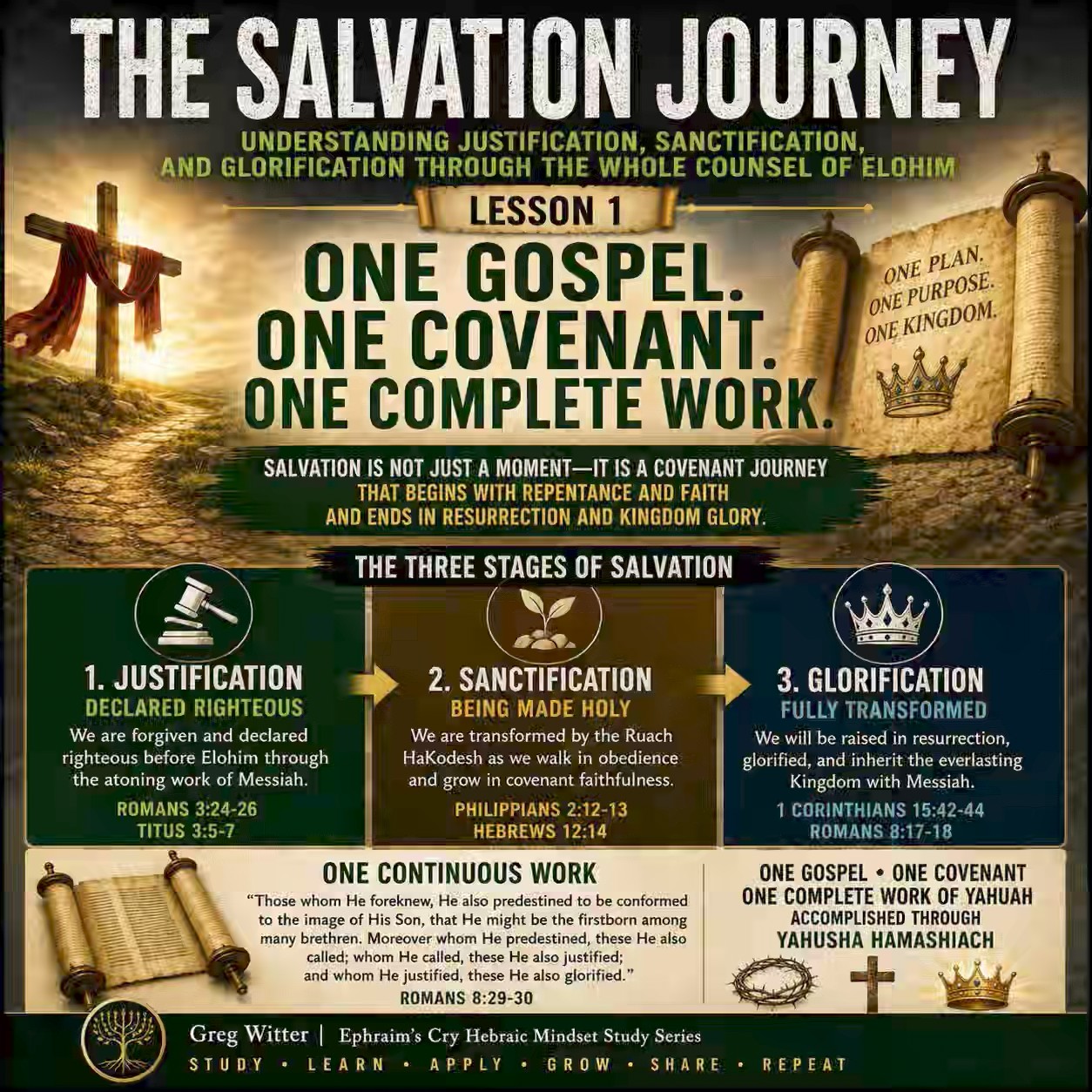
THE SALVATION JOURNEY
Understanding Justification, Sanctification, and Glorification Through the Whole Counsel of Elohim
Lesson 1
One Gospel. One Covenant. One Complete Work.
The Bible is not a collection of disconnected stories, isolated doctrines, or competing theological systems. From the opening words of B’reshit (Genesis) to the closing chapters of Revelation, the Scriptures reveal one continuous covenant story unfolding according to the eternal purpose of 𐤄𐤅𐤄𐤉 (Yahuah). It is the story of creation, rebellion, redemption, restoration, and the establishment of His everlasting Kingdom. Every covenant, every sacrifice, every prophet, every king, every promise, and every act of divine intervention moves this single story toward its appointed fulfillment through 𐤏𐤔𐤅𐤄𐤉 (Yahusha) HaMashiach.
One of the greatest weaknesses within modern theology is the tendency to divide what Scripture presents as one unified work. Salvation is often reduced to a single moment in time, as though its entire purpose is fulfilled the instant a person believes. Others focus almost exclusively on Christian living while neglecting the foundation upon which that life is built. Still others speak only of heaven, resurrection, or eternity while overlooking the covenant journey that prepares the people of Elohim for His Kingdom. When these truths are separated from one another, the Gospel itself becomes fragmented.
The Scriptures present something far greater. Salvation is not merely an event. It is not merely a prayer. It is not merely a profession of faith. It is not merely forgiveness. Salvation is the complete covenant work of 𐤄𐤅𐤄𐤉, beginning with His call to repentance, accomplished through the redemptive work of Messiah, worked out through a life of covenant faithfulness, and completed in the resurrection when the Kingdom is fully revealed.
This covenant journey did not begin in the Apostolic Writings. Its foundation was established from the very beginning. Immediately after mankind’s rebellion in the Garden, 𐤄𐤅𐤄𐤉 promised that the Seed of the woman would crush the head of the serpent. From that moment forward, every generation looked toward the fulfillment of that promise. The patriarchs, the Exodus, the covenant at Sinai, the sacrificial system, the priesthood, the feasts, the prophets, the kingdom of David, and the promises of restoration all pointed toward the coming Redeemer and the restoration of His Kingdom.
Throughout the Scriptures, redemption has never been an end in itself. Redemption always serves restoration. The purpose of deliverance is covenant relationship. The purpose of forgiveness is holiness. The purpose of grace is transformation. The purpose of transformation is preparing a people fit for the Kingdom of Elohim. The Gospel, therefore, is not simply about escaping judgment. It is about restoring what sin destroyed and bringing humanity back into covenant fellowship with its Creator.
The Four Witnesses of Scripture proclaim this message with one voice. The Torah establishes the covenant foundation, revealing both the holiness of Elohim and mankind’s need for redemption. The Prophets call the covenant people to repentance while proclaiming the coming restoration. The Writings demonstrate covenant life through worship, wisdom, suffering, endurance, and faithful obedience. The Apostolic Witness reveals the fulfillment of these promises through 𐤏𐤔𐤅𐤄𐤉 while looking forward to His return and the consummation of the Kingdom. Together they proclaim one Gospel, not many gospels; one covenant, not competing covenants; one plan of redemption, not multiple plans for different peoples.
Understanding this covenant journey requires recognizing that salvation unfolds in three inseparable stages. These stages are not different methods of salvation, nor are they separate works. They are different aspects of the same redemptive work of Elohim.
The first stage is justification. Here the guilty sinner stands before the righteous Judge and is declared righteous through the atoning work of Messiah. The penalty of sin is removed. Reconciliation with Elohim is established. The believer is brought into covenant relationship, not because of personal merit but because of the grace of 𐤄𐤅𐤄𐤉 received through faith.
The second stage is sanctification. Having been brought into covenant relationship, the believer begins the lifelong process of transformation. The Ruach HaKodesh writes the Torah upon the heart, renews the mind, produces holy character, and teaches the disciple to walk in faithful obedience. Sanctification is not an attempt to earn salvation. It is the evidence that salvation is alive and active within the believer. The covenant is no longer merely written upon tablets of stone but becomes the governing principle of the inner person.
The third stage is glorification. This is the completion of redemption when Messiah returns, the dead are raised, the living are transformed, mortality puts on immortality, and the redeemed inherit the everlasting Kingdom. Sin, death, corruption, and the curse are finally removed forever. What began with redemption reaches its perfect completion in resurrection and eternal covenant fellowship with Elohim.
These three stages explain why the Scriptures speak of salvation in different tenses. The believer has been saved from the guilt and condemnation of sin through justification. The believer is being saved from the power and dominion of sin through sanctification. The believer will be saved from the presence of sin through glorification at the resurrection. These are not contradictions. They are different dimensions of the same covenant work viewed from different points within the journey.
The Apostle Paul summarizes this progression in Romans 8:29–30. Those whom Elohim foreknew, He also predestined to be conformed to the image of His Son. Those He predestined, He also called. Those He called, He also justified. Those He justified, He also glorified. Notice that Paul presents salvation as one uninterrupted work of Elohim. The One who begins the work is the One who completes it. Nothing in Paul’s words suggests isolated acts disconnected from one another. Instead, they reveal the faithfulness of Elohim in bringing His covenant purpose to completion.
This covenant pattern is visible throughout Scripture. Israel was redeemed from Egypt before being brought to Sinai. Redemption came first, but it was followed by covenant instruction. The people were not delivered in order to remain as they were. They were delivered so they might become a holy nation and a kingdom of priests. In the same way, believers are redeemed through Messiah, not so they may continue in sin, but so they may become a holy people prepared for every good work and ready for the coming Kingdom.
The misunderstanding of this progression has produced many false conclusions. Some conclude that because salvation begins by grace, obedience is unnecessary. Others attempt to earn what can only be received through faith. Some treat sanctification as optional, while others ignore the future hope of resurrection and glorification altogether. Each error results from isolating one portion of the covenant journey from the whole counsel of Elohim.
The Scriptures never present grace and obedience as enemies. Grace is the unmerited favor of Elohim that makes redemption possible. Obedience is the covenant response of a heart transformed by that grace. Faith establishes covenant relationship, and faithful obedience demonstrates that relationship before the world. As James declares, faith without works is dead—not because works produce salvation, but because genuine faith produces a transformed life.
From Genesis to Revelation, the purpose of Elohim has remained unchanged. He is forming a covenant people who know Him, love Him, walk in His ways, reflect His character, and inherit His Kingdom. The Gospel is therefore far larger than forgiveness alone. It is the complete restoration of mankind into covenant relationship with its Creator, culminating in the resurrection, the renewal of all things, and the everlasting reign of the King.
As we journey through this study, we will examine each of these stages in greater depth. We will discover what it means to be justified before Elohim, how sanctification transforms the daily life of every disciple, and why glorification remains the blessed hope of all who belong to Messiah. When viewed together through the Torah, the Prophets, the Writings, and the Apostolic Witness, these truths reveal one magnificent reality: one Gospel, one covenant, and one complete work of redemption accomplished through 𐤏𐤔𐤅𐤄𐤉 HaMashiach for the glory of 𐤄𐤅𐤄𐤉.
Greg Witter | Ephraim’s Cry
Hebraic Mindset Study Series
Study • Learn • Apply • Grow • Share • Repeat
#TheSalvationJourney#Justification#Sanctification#Glorification#GospelOfTheKingdom#WholeCounselOfElohim
#HebraicMindset#Covenant#Torah#Prophets#Writings#ApostolicWitness#KingdomOfElohim#Faith#Obedience
#Restoration#Discipleship#EphraimsCry#BibleStudy#KingdomPreparation
