
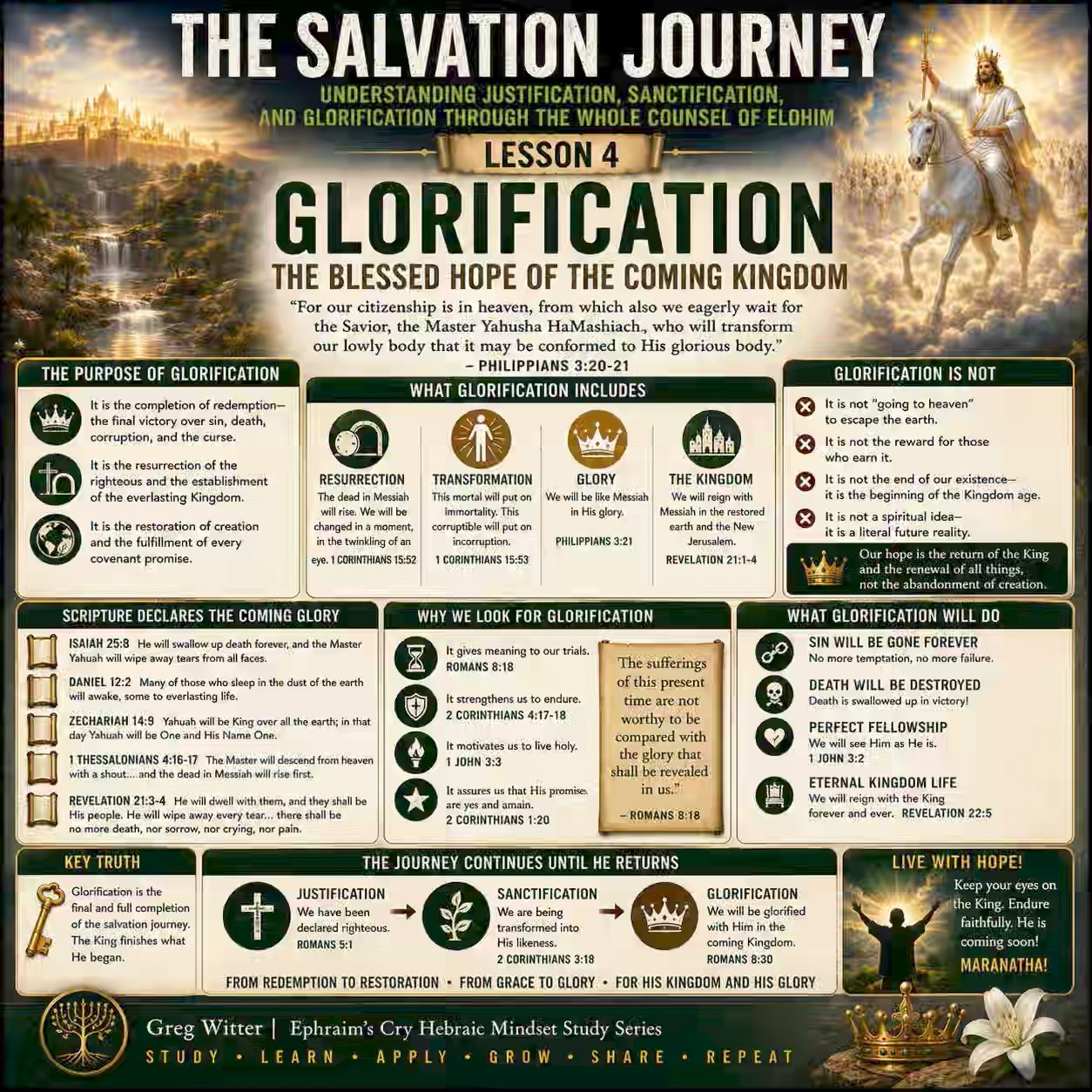
THE SALVATION JOURNEY
Understanding Justification, Sanctification, and Glorification Through the Whole Counsel of Elohim
Lesson 4
GLORIFICATION
The Blessed Hope of the Coming Kingdom
The covenant journey does not end with justification, nor does it end with sanctification. Both are essential works of Elohim, but neither represents the final destination of redemption. The believer’s ultimate hope is glorification, the completion of the work that 𐤄𐤅𐤄𐤉 (Yahuah) began when He first called us to Himself. Glorification is the final victory over sin, death, corruption, and the curse. It is the fulfillment of every covenant promise, the resurrection of the righteous, and the full establishment of the Kingdom of Elohim upon the earth.
From the beginning, the purpose of redemption has never been merely to forgive sin. Redemption has always looked forward to complete restoration. The Garden of Eden was lost through rebellion, but the Kingdom will restore far more than was lost. The Scriptures move steadily from creation to new creation, from exile to restoration, from death to life, from corruption to incorruption. Glorification is the final act in this magnificent covenant story.
Many believers speak of “going to heaven” as though that were the final goal of salvation. Yet the Scriptures consistently direct our hope toward the resurrection of the dead, the return of Messiah, the restoration of all things, and the coming Kingdom. The hope of the believer is not escape from the earth but the renewal of the earth under the righteous reign of the King. The Kingdom comes to earth just as the prophets declared, and the redeemed inherit the promises made from the beginning.
The prophets repeatedly looked beyond the present age toward a time when righteousness would cover the earth, the nations would come to learn the ways of 𐤄𐤅𐤄𐤉, swords would be beaten into plowshares, death would be swallowed up, and the glory of Elohim would fill the earth as the waters cover the sea. Isaiah, Ezekiel, Daniel, Zechariah, and the other prophets consistently proclaimed the coming Kingdom. The Apostolic Witness simply confirms what the prophets had already declared.
The resurrection stands at the very center of glorification. Death entered the world through sin, but death will not have the final word. Because Messiah conquered death through His resurrection, those who belong to Him have the assurance that they too will be raised. Paul declares in 1 Corinthians 15 that if Messiah has not been raised, our faith is empty. But because He has been raised as the Firstfruits, those who belong to Him will likewise be raised at His coming.
The resurrection is not merely the continuation of our present existence. It is transformation. This mortal body will put on immortality. This corruptible body will put on incorruption. Weakness will be replaced by power. Dishonor will give way to glory. What was sown in corruption will be raised in incorruption. The image marred by sin will be fully restored to reflect the glory that 𐤄𐤅𐤄𐤉 intended from the beginning.
Paul describes this hope in Philippians by declaring that Messiah will transform our lowly bodies to be like His glorious body according to the power by which He is able to subject all things to Himself. This is not symbolic language describing spiritual improvement. It is the promise of an actual resurrection and transformation that will occur at the return of the King.
The Scriptures never present glorification as something believers accomplish through personal effort. Justification is the work of Elohim. Sanctification is the work of Elohim within us as we faithfully walk in covenant obedience. Glorification is likewise the work of Elohim, completed when Messiah returns. The One who declared us righteous and has been transforming us throughout our lives will complete His work in the resurrection. Salvation from beginning to end belongs to 𐤄𐤅𐤄𐤉.
This future hope gives meaning to present endurance. The trials of this life are not meaningless. Paul declares that the sufferings of this present time are not worthy to be compared with the glory that shall be revealed in us. Every act of faithful obedience, every trial endured, every temptation overcome, every sacrifice made for the Kingdom is preparing the believer for an eternal weight of glory beyond comparison.
The entire creation is waiting for this day. Paul explains that creation itself was subjected to futility because of mankind’s rebellion. It groans under the weight of corruption, waiting for the revealing of the sons of Elohim. When the redeemed are glorified, creation itself will be delivered from the bondage of corruption into the freedom of the glory of the children of Elohim. Redemption therefore extends beyond individuals to the restoration of the entire created order.
The book of Revelation brings this covenant journey to its glorious conclusion. The King returns. The dead are raised. Evil is judged. Death is destroyed. The New Jerusalem descends. The dwelling place of Elohim is with mankind. He wipes away every tear. There is no more death, sorrow, crying, or pain because the former things have passed away. What began in Genesis reaches its fulfillment in Revelation. Paradise lost becomes paradise restored.
This is why the believer lives with hope. Our confidence is not rooted in the circumstances of this present age but in the certainty of the promises of Elohim. We do not labor merely for temporary rewards. We look for a Kingdom that cannot be shaken, a city whose Builder and Maker is Elohim, and an inheritance that is incorruptible, undefiled, and reserved for those who remain faithful.
Glorification also reminds us that sanctification has a purpose. Every lesson learned, every act of obedience, every refinement through suffering, and every victory over sin is preparing us for the day when we shall see Messiah as He is. John writes that everyone who has this hope purifies himself because the expectation of glorification motivates present holiness. Future glory shapes present obedience.
This hope also guards us against discouragement. We still struggle against the flesh. We still experience weakness, sickness, sorrow, persecution, and death. Yet none of these has the final word. The resurrection is coming. The King is returning. The covenant promises will be fulfilled exactly as spoken. The faithful will inherit the Kingdom prepared from the foundation of the world.
Glorification is therefore the completion of the salvation journey. Justification removed the penalty of sin. Sanctification is removing the power of sin. Glorification will forever remove the presence of sin. The redeemed will dwell in perfect covenant fellowship with 𐤄𐤅𐤄𐤉, reflecting His glory throughout the endless ages of His everlasting Kingdom.
The salvation journey reaches its fulfillment not in death but in resurrection, not in escape but in restoration, not in abandoning creation but in its renewal. This has been the promise proclaimed by the Torah, anticipated by the Prophets, celebrated in the Writings, and confirmed by the Apostolic Witness. The work that began with redemption will end in glory, and every promise of Elohim will stand fulfilled through 𐤏𐤔𐤅𐤄𐤉 HaMashiach, to whom belongs all honor, all authority, and all glory forever.
Greg Witter | Ephraim’s Cry
Hebraic Mindset Study Series
Study • Learn • Apply • Grow • Share • Repeat
#TheSalvationJourney#Glorification#Resurrection#KingdomOfElohim#BlessedHope#NewCreation#WholeCounselOfElohim
#HebraicMindset#Torah#Prophets#Writings#ApostolicWitness#Faith#Endurance#Restoration#KingdomPreparation
#Messiah#EphraimsCry#BibleStudy#EverlastingKingdom
