
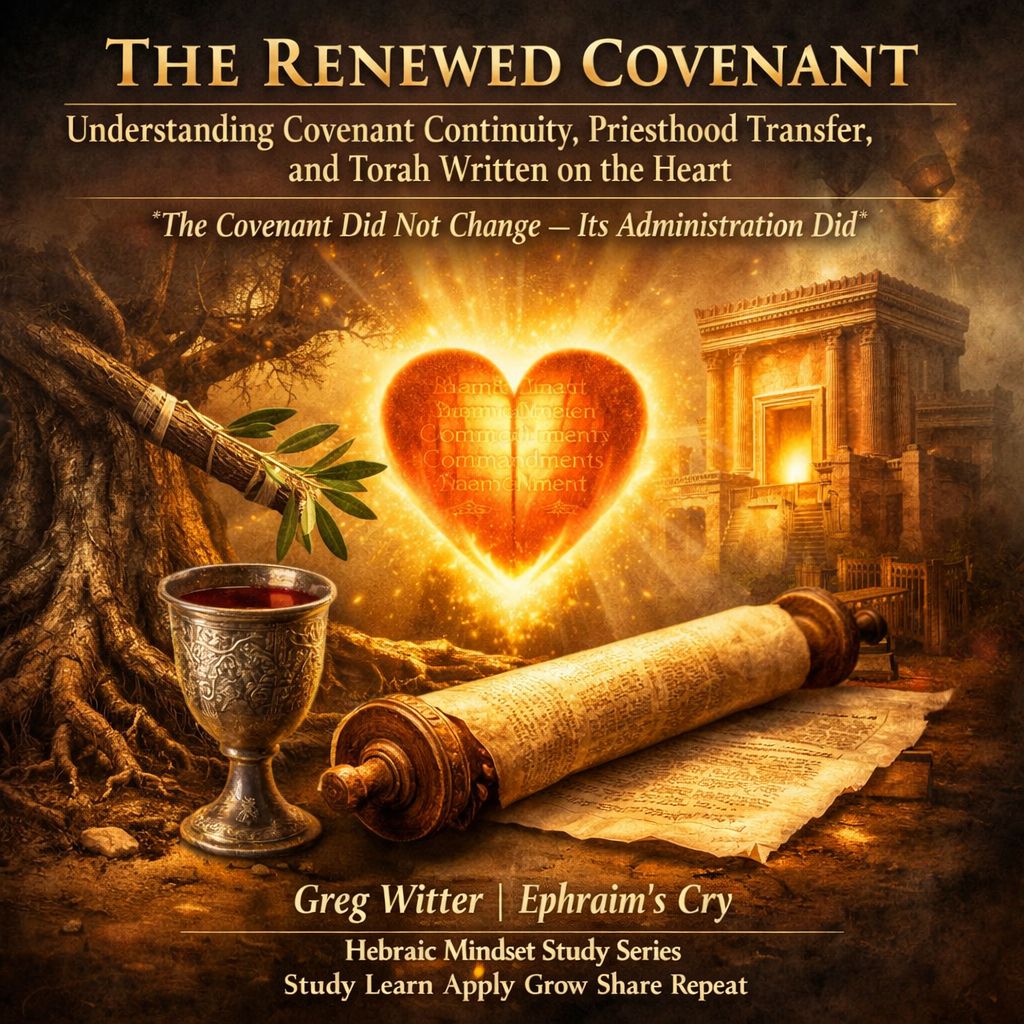
THE RENEWED COVENANT
Understanding Covenant Continuity, Priesthood Transfer, and Torah Written on the Heart
The Covenant Did Not Change — Its Administration Did
Greg Witter | Ephraim’s Cry
Hebraic Mindset Study Series
Study Learn Apply Grow Share Repeat
The question was asked:
“What laws are applicable under the New Covenant, and where do we see that in Scripture?”
That is actually a very good question. But the question itself must first be framed correctly. Because much of the confusion surrounding the “New Covenant” comes from a misunderstanding of what Scripture actually says about covenant renewal.
The first thing we must understand is this: Scripture never teaches that Elohim abandoned His covenant and started a completely different one. The covenant was not replaced. It was restored, renewed, and reinforced through the blood of the Messiah.
The Last Supper is where this becomes clear.
Luke 22:20 records Messiah’s words during the Passover meal:
“This cup is the new covenant in My blood, which is poured out for you.”
The Greek word translated “new” here is kainos. That word does not primarily mean “brand new and unrelated.” It means renewed, restored, or made new in quality. It describes something brought into a renewed state.
Messiah was not announcing a completely different covenant. He was confirming the covenant through His own blood.
To understand this properly, we must go back to the original covenant pattern.
The Covenant Pattern Established at Sinai
Exodus 24 records the covenant ceremony between Yahuah and Israel.
Moses read the Book of the Covenant before the people, and they responded:
“All that Yahuah has spoken we will do, and we will be obedient.”
Exodus 24:7
Then Moses sealed that covenant with blood.
Exodus 24:8 says:
“Behold the blood of the covenant which Yahuah has made with you according to all these words.”
From the beginning, the covenant was a blood covenant. Blood confirmed and sealed the agreement.
This pattern matters, because Messiah deliberately repeats it at the Last Supper.
When He says, “This cup is the covenant in My blood,” He is invoking the exact same covenant language used at Sinai. The difference is not the covenant itself — the difference is the blood that confirms it.
At Sinai the covenant was confirmed with the blood of animals. At the Last Supper the covenant is confirmed with the blood of the Messiah Himself.
The covenant did not change.
The sacrifice confirming it did.
The Promise of Covenant Renewal
Long before Messiah came, the prophets foretold that Yahuah would renew the covenant with His people.
Jeremiah 31:31–33 says:
“Behold, the days are coming, declares Yahuah, when I will make a new covenant with the house of Israel and the house of Judah… I will put My Torah within them and write it on their hearts.”
Notice carefully what is written on the heart.
It does not say a different law.
It says My Torah.
The covenant instruction is not abolished. It is internalized.
But even Jeremiah was not introducing something completely new. This promise goes back even earlier — to Torah itself.
Deuteronomy 30:6 says:
“Yahuah your Elohim will circumcise your heart and the heart of your offspring, to love Yahuah your Elohim with all your heart and with all your soul, that you may live.”
From the beginning the covenant plan included a transformed heart.
The problem was never the Torah.
The problem was the human heart.
That is why Ezekiel expands the promise.
Ezekiel 36:26–27 declares:
“I will give you a new heart and put a new spirit within you… I will put My Spirit within you and cause you to walk in My statutes and be careful to obey My judgments.”
The Spirit is not given to replace obedience.
The Spirit is given to enable obedience.
The covenant instruction remains the same. What changes is the power within the believer to live it out.
The Priesthood Transfer
One of the biggest areas of confusion comes from Hebrews chapters 7–10.
Many people read Hebrews and assume it teaches that the covenant itself was abolished. But that is not what the text says.
Hebrews explains that the priesthood changed.
Hebrews 7:12 says:
“For when the priesthood is changed, there is of necessity a change in the administration of the law as well.”
The priesthood under the Sinai covenant was the Levitical priesthood — descendants of Aaron serving in the earthly temple.
But Messiah did not come from the tribe of Levi.
He came from the tribe of Judah.
Therefore He could not serve as a Levitical priest. Instead, Scripture declares that He is a priest after the order of Melchizedek — a higher and eternal priesthood.
This means the administration of the covenant changed.
The covenant itself did not.
The Levitical priesthood required continual sacrifices for sin.
Messiah offered one perfect sacrifice for all time.
Hebrews 10:12 says:
“But this man, after offering one sacrifice for sins forever, sat down at the right hand of Elohim.”
Because the sacrifice is now complete, there is no longer a need for repeated animal offerings.
But the covenant structure itself remains intact.
Torah Still Defines Sin
Another key point must be addressed.
If Torah were abolished, sin would no longer exist. Because Scripture defines sin in relation to Torah.
1 John 3:4 says:
“Sin is lawlessness.”
Lawlessness literally means violation of Torah.
If there is no law, there is no definition of sin. Yet the apostles clearly continue to teach about sin.
Therefore Torah cannot be abolished.
Paul makes this explicit in Romans.
Romans 3:31 says:
“Do we then overthrow the law through faith? Certainly not! On the contrary, we establish the law.”
Faith does not destroy Torah.
Faith establishes Torah.
The Spirit Enables Covenant Obedience
Paul continues this explanation in Romans 8.
Romans 8:3–4 says:
“What the law could not do, weak as it was through the flesh, Elohim did by sending His own Son… so that the righteous requirement of the law might be fulfilled in us who walk not according to the flesh but according to the Spirit.”
The weakness was not the Torah.
The weakness was human flesh.
Through the Messiah and the Spirit, the righteous requirement of Torah is now fulfilled in those who walk according to the Spirit.
Acts 15 and the Entry Point for the Nations
Another passage often misunderstood is Acts 15.
When Gentiles began turning to Messiah, the apostles did not demand they learn the entire Torah instantly.
Instead they gave four foundational instructions so that new believers could enter fellowship immediately.
Then James explains why.
Acts 15:21 says:
“For Moses has been preached in every city from ancient generations and is read in the synagogues every Sabbath.”
In other words, they would continue learning Torah week by week.
The apostles never taught the abolition of Torah.
They taught a process of growth and discipleship.
The Covenant and the Kingdom
Finally, we must remember that the covenant is tied to the coming Kingdom of Elohim.
Isaiah 2:3 prophesies:
“Out of Zion shall go forth the Torah, and the word of Yahuah from Jerusalem.”
This prophecy describes the future Messianic Kingdom.
Torah is not temporary.
It is the constitution of the Kingdom.
What Then Are We Called to Obey?
So when we ask, “What laws are applicable under the renewed covenant?” the answer becomes clear.
The covenant instruction of Yahuah remains the foundation.
The difference is that Messiah has fulfilled the sacrificial system and now serves as our eternal High Priest.
The covenant is confirmed by His blood.
The Spirit is given to transform the heart.
And through that transformation, the Torah is written within us.
The covenant did not change.
Its administration did.
The blood confirming it changed.
The priesthood overseeing it changed.
But the covenant itself remains the same covenant Yahuah established with His people from the beginning.
And through Messiah, both Israel and the nations are invited to walk in that covenant life.
#EphraimsCry, #GregWitter, #HebraicMindset, #CovenantRestored, #RenewedCovenant, #TorahWrittenOnTheHeart,
#Jeremiah31 , #Ezekiel36, #Luke22, #Hebrews8, #Hebrews9, #Hebrews10, #MelchizedekPriesthood,
#TorahEstablished, #Romans331, #Romans8, #Acts15,
#KingdomTorah, #Isaiah2, #BiblicalCovenant, #WholeCounselOfElohim
