
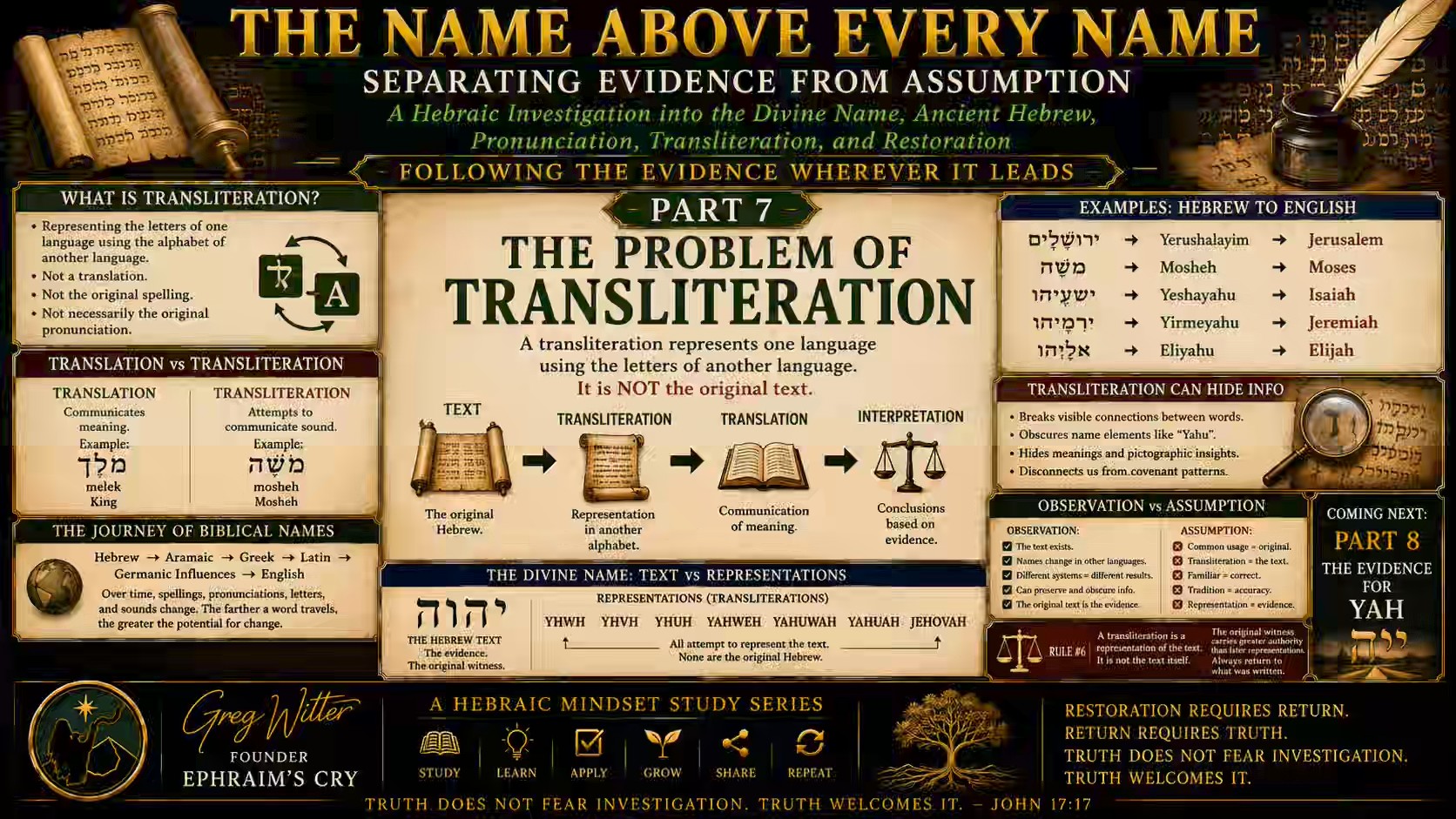
The Name Above Every Name
Part 7: The Problem of Transliteration
Separating Evidence from Assumption
A Hebraic Investigation into the Divine Name, Ancient Hebrew, Pronunciation, Transliteration, and Restoration
Following the Evidence Wherever It Leads
Greg Witter | Ephraim’s Cry
A Hebraic Mindset Study Series
Study • Learn • Apply • Grow • Share • Repeat
Throughout this series we have repeatedly returned to a single principle:
The text comes first.
Evidence comes second.
Conclusions come last.
That principle now brings us to one of the most misunderstood subjects in biblical study:
Transliteration.
Many believers assume that when they read a biblical name in English, they are reading the original name.
That assumption is often incorrect.
In many cases, what people are reading is not the original Hebrew word at all.
They are reading a transliteration.
Understanding the difference is essential if we are going to separate evidence from assumption.
What Is Transliteration?
A transliteration is the process of representing the letters of one language using the alphabet of another language.
It is not a translation.
It is not the original spelling.
It is not necessarily the original pronunciation.
It is an attempt to approximate one language using another language’s writing system.
For example:
Mosheh becomes Moses.
Yeshayahu becomes Isaiah.
Yirmeyahu becomes Jeremiah.
Yerushalayim becomes Jerusalem.
None of those English forms are the original Hebrew spellings.
They are transliterations that have passed through multiple languages before arriving in English.
This distinction is critical.
Many believers unknowingly treat transliterations as though they are the original text.
They are not.
Translation Versus Transliteration
These two concepts are often confused.
A translation communicates meaning.
A transliteration attempts to communicate sound.
For example:
The Hebrew word:
מֶלֶךְ
means:
King.
That is a translation.
The Hebrew name:
מֹשֶׁה
may become:
Mosheh.
That is a transliteration.
The goal of a translation is meaning.
The goal of a transliteration is representation.
The two are not the same thing.
Understanding this distinction eliminates many common misunderstandings.
Why Transliteration Creates Problems
Every language contains sounds that do not exist in other languages.
This creates unavoidable difficulties.
When a word moves from Hebrew into Greek, certain sounds must be approximated.
When that Greek form moves into Latin, additional changes often occur.
When the Latin form moves into English, more changes may follow.
Each step introduces another layer between the modern reader and the original text.
The farther a word travels, the greater the potential for change.
This does not automatically mean the word becomes useless.
It simply means we must recognize what has happened.
The original form and the modern form may not be identical.
The Journey of Biblical Names
Consider how many biblical names reached modern English.
Hebrew.
Aramaic.
Greek.
Latin.
Germanic influences.
English.
That journey often spans centuries.
During that process, spellings change.
Pronunciations change.
Letters change.
Sounds change.
The original Hebrew form may become difficult to recognize.
This is one reason many people are surprised when they discover the Hebrew forms of familiar biblical names.
The English forms often conceal the original structure.
The Example of Yerushalayim
Consider:
ירושלים
In Hebrew:
Yerushalayim.
In English:
Jerusalem.
These are not identical.
The English form has undergone centuries of linguistic development.
The city did not change.
The name changed as it moved through languages.
The same reality affects many biblical names.
This demonstrates an important principle:
A transliteration is not the original text.
The Example of Mosheh
The Hebrew name:
משה
appears as:
Mosheh.
In English it becomes:
Moses.
The person remains the same.
The spelling changes.
The language changes.
The transliteration changes.
Again, the transliteration is not the original Hebrew.
It is an attempt to represent the Hebrew.
The Example of Yeshayahu
The Hebrew name:
ישעיהו
becomes:
Yeshayahu.
In English:
Isaiah.
Notice how dramatically the form changes.
Many English readers never realize the Hebrew name contains the element:
Yahu.
The transliteration process often obscures information present in the original Hebrew.
This is one reason restoration-minded believers frequently return to the Hebrew forms.
The original forms often preserve details that later transliterations conceal.
The Divine Name and Transliteration
This issue becomes even more significant when discussing the Divine Name.
The Name appears in Scripture as:
𐤉𐤄𐤅𐤄
or
יהוה
Those letters are the evidence.
Everything else is an attempt to represent those letters.
YHWH.
YHVH.
YHUH.
Yahweh.
Yahuwah.
Yahuah.
Yehovah.
Jehovah.
All of these represent attempts to communicate something about the Hebrew text.
None of them are the original Paleo-Hebrew letters themselves.
This does not mean all forms are equally supported.
It simply means we must distinguish between the Hebrew text and later representations of the Hebrew text.
The Danger of Confusing Representation with Evidence
One of the greatest mistakes people make is treating a transliteration as though it were evidence.
It is not.
The evidence is the Hebrew text.
The transliteration is an interpretation of the text.
That distinction matters.
If someone presents:
YHWH
they have already made transliteration decisions.
If someone presents:
YHVH
they have already made transliteration decisions.
If someone presents:
Jehovah
they have made even more transliteration decisions.
The underlying evidence remains:
𐤉𐤄𐤅𐤄
The text comes first.
The transliteration comes afterward.
Transliteration Can Preserve Truth
This does not mean transliterations are bad.
Without transliteration, many people would be unable to discuss Hebrew words at all.
Transliterations are valuable tools.
They help readers engage with unfamiliar languages.
They help communicate ideas.
They help facilitate study.
The problem arises when the tool becomes confused with the evidence.
A transliteration is useful.
But it should never replace the original witness.
Transliteration Can Also Hide Information
While transliterations can help, they can also obscure important information.
The Hebrew text may preserve patterns.
Letter relationships.
Word connections.
Name elements.
Pictographic insights.
Covenant themes.
Many of these become difficult to see once the text is filtered through multiple languages.
This is why serious study often returns to the Hebrew whenever possible.
The closer we get to the original text, the more information becomes visible.
Observation Versus Assumption
Observation:
The Hebrew text exists.
Observation:
Names often change when they move between languages.
Observation:
Transliterations attempt to represent sounds.
Observation:
Different transliteration systems produce different results.
Assumption:
Therefore a transliteration automatically equals the original text.
That conclusion does not follow.
The transliteration is a representation.
The text remains the evidence.
The Four Witnesses Remain Our Standard
Throughout Scripture, the emphasis remains consistent.
Torah.
Prophets.
Writings.
Apostolic Witness.
Yahusha repeatedly appealed to what was written.
The apostles appealed to what was written.
The prophets appealed to what was written.
The written witness remains the foundation.
Not tradition.
Not familiarity.
Not popularity.
The text remains the standard.
Why This Matters for Restoration
Many believers are rediscovering the importance of returning to original sources.
That does not mean rejecting every transliteration.
It means understanding what a transliteration is.
It means recognizing its strengths.
It means recognizing its limitations.
It means refusing to confuse a representation with the evidence itself.
Restoration requires careful thinking.
Restoration requires humility.
Restoration requires investigation.
Most importantly, restoration requires returning to the text.
A Watchman’s Warning
One of the greatest dangers in biblical study is becoming attached to a familiar form while neglecting the underlying evidence.
People often defend the names they inherited.
They defend the spellings they inherited.
They defend the pronunciations they inherited.
But the faithful student must remain committed to evidence.
The question is not:
“What am I familiar with?”
The question is:
“What does the evidence support?”
Truth does not fear investigation.
Truth welcomes examination.
Truth survives testing.
Summary
Transliteration is the process of representing one language using the alphabet of another language. It is not translation, and it is not the original text. Biblical names have often passed through Hebrew, Greek, Latin, and English before reaching modern readers. As a result, many familiar names differ significantly from their original Hebrew forms. This becomes especially important when discussing the Divine Name. The Hebrew text remains the evidence. Transliterations are tools that help represent that evidence. They are valuable, but they should never be confused with the original witness itself.
Rule #6
A transliteration is a representation of the text.
It is not the text itself.
The original witness carries greater authority than later representations.
Always return to the evidence.
Continue the Journey
The Name Above Every Name — Orientation Booklet
Pay What You Want
This resource is offered on a Pay-What-You-Want basis. Download it completely free or support the ongoing work of Ephraim’s Cry through a voluntary contribution.
Your support helps fund future study guides, charts, teachings, broadcasts, discipleship resources, and the ongoing proclamation of the Gospel of the Kingdom.
Suggested Contribution: $19.95
Coming Next
Part 8: The Evidence for Yah
Having examined letters, sounds, vowel points, Waw versus Vav, and transliteration, we now begin examining the positive evidence that points toward the first portion of the Divine Name: Yah.
Following the Evidence Wherever It Leads.
This is an introduction to the topic. For deeper, more detailed teachings from a Hebraic covenant perspective, consider becoming a subscriber. Your subscription helps support the creation of additional teachings, videos, study guides, live broadcasts, and discipleship resources. Join our subscriber community for exclusive content, special broadcasts, and more—all for just $0.99 per month.
#GregWitter #EphraimsCry #HebraicMindset #HebraicMindsetStudySeries #GospelOfTheKingdom #KingdomOfElohim #Remnant #Covenant #ReturnToCovenant #ScriptureStudy #BibleStudy #StudyLearnApplyGrowShareRepeat #TruthMatters #TestEverything #ProveAllThings #AncientPaths #Restoration #RestorationOfAllThings #TheNameAboveEveryName #SeparatingEvidenceFromAssumption #FollowingTheEvidence #DivineName #SacredName #Tetragrammaton #Transliteration #BiblicalHebrew #AncientHebrew #EvidenceOverTradition #ObservationBeforeInterpretation #RuleNumberSix
The Name Above Every Name
Part 7: The Problem of Transliteration
Separating Evidence from Assumption
A Hebraic Investigation into the Divine Name, Ancient Hebrew, Pronunciation, Transliteration, and Restoration
Following the Evidence Wherever It Leads
Greg Witter | Ephraim’s Cry
A Hebraic Mindset Study Series
Study • Learn • Apply • Grow • Share • Repeat
Throughout this series we have repeatedly returned to a single principle:
The text comes first.
Evidence comes second.
Conclusions come last.
That principle now brings us to one of the most misunderstood subjects in biblical study:
Transliteration.
Many believers assume that when they read a biblical name in English, they are reading the original name.
That assumption is often incorrect.
In many cases, what people are reading is not the original Hebrew word at all.
They are reading a transliteration.
Understanding the difference is essential if we are going to separate evidence from assumption.
What Is Transliteration?
A transliteration is the process of representing the letters of one language using the alphabet of another language.
It is not a translation.
It is not the original spelling.
It is not necessarily the original pronunciation.
It is an attempt to approximate one language using another language’s writing system.
For example:
Mosheh becomes Moses.
Yeshayahu becomes Isaiah.
Yirmeyahu becomes Jeremiah.
Yerushalayim becomes Jerusalem.
None of those English forms are the original Hebrew spellings.
They are transliterations that have passed through multiple languages before arriving in English.
This distinction is critical.
Many believers unknowingly treat transliterations as though they are the original text.
They are not.
Translation Versus Transliteration
These two concepts are often confused.
A translation communicates meaning.
A transliteration attempts to communicate sound.
For example:
The Hebrew word:
מֶלֶךְ
means:
King.
That is a translation.
The Hebrew name:
מֹשֶׁה
may become:
Mosheh.
That is a transliteration.
The goal of a translation is meaning.
The goal of a transliteration is representation.
The two are not the same thing.
Understanding this distinction eliminates many common misunderstandings.
Why Transliteration Creates Problems
Every language contains sounds that do not exist in other languages.
This creates unavoidable difficulties.
When a word moves from Hebrew into Greek, certain sounds must be approximated.
When that Greek form moves into Latin, additional changes often occur.
When the Latin form moves into English, more changes may follow.
Each step introduces another layer between the modern reader and the original text.
The farther a word travels, the greater the potential for change.
This does not automatically mean the word becomes useless.
It simply means we must recognize what has happened.
The original form and the modern form may not be identical.
The Journey of Biblical Names
Consider how many biblical names reached modern English.
Hebrew.
Aramaic.
Greek.
Latin.
Germanic influences.
English.
That journey often spans centuries.
During that process, spellings change.
Pronunciations change.
Letters change.
Sounds change.
The original Hebrew form may become difficult to recognize.
This is one reason many people are surprised when they discover the Hebrew forms of familiar biblical names.
The English forms often conceal the original structure.
The Example of Yerushalayim
Consider:
ירושלים
In Hebrew:
Yerushalayim.
In English:
Jerusalem.
These are not identical.
The English form has undergone centuries of linguistic development.
The city did not change.
The name changed as it moved through languages.
The same reality affects many biblical names.
This demonstrates an important principle:
A transliteration is not the original text.
The Example of Mosheh
The Hebrew name:
משה
appears as:
Mosheh.
In English it becomes:
Moses.
The person remains the same.
The spelling changes.
The language changes.
The transliteration changes.
Again, the transliteration is not the original Hebrew.
It is an attempt to represent the Hebrew.
The Example of Yeshayahu
The Hebrew name:
ישעיהו
becomes:
Yeshayahu.
In English:
Isaiah.
Notice how dramatically the form changes.
Many English readers never realize the Hebrew name contains the element:
Yahu.
The transliteration process often obscures information present in the original Hebrew.
This is one reason restoration-minded believers frequently return to the Hebrew forms.
The original forms often preserve details that later transliterations conceal.
The Divine Name and Transliteration
This issue becomes even more significant when discussing the Divine Name.
The Name appears in Scripture as:
𐤉𐤄𐤅𐤄
or
יהוה
Those letters are the evidence.
Everything else is an attempt to represent those letters.
YHWH.
YHVH.
YHUH.
Yahweh.
Yahuwah.
Yahuah.
Yehovah.
Jehovah.
All of these represent attempts to communicate something about the Hebrew text.
None of them are the original Paleo-Hebrew letters themselves.
This does not mean all forms are equally supported.
It simply means we must distinguish between the Hebrew text and later representations of the Hebrew text.
The Danger of Confusing Representation with Evidence
One of the greatest mistakes people make is treating a transliteration as though it were evidence.
It is not.
The evidence is the Hebrew text.
The transliteration is an interpretation of the text.
That distinction matters.
If someone presents:
YHWH
they have already made transliteration decisions.
If someone presents:
YHVH
they have already made transliteration decisions.
If someone presents:
Jehovah
they have made even more transliteration decisions.
The underlying evidence remains:
𐤉𐤄𐤅𐤄
The text comes first.
The transliteration comes afterward.
Transliteration Can Preserve Truth
This does not mean transliterations are bad.
Without transliteration, many people would be unable to discuss Hebrew words at all.
Transliterations are valuable tools.
They help readers engage with unfamiliar languages.
They help communicate ideas.
They help facilitate study.
The problem arises when the tool becomes confused with the evidence.
A transliteration is useful.
But it should never replace the original witness.
Transliteration Can Also Hide Information
While transliterations can help, they can also obscure important information.
The Hebrew text may preserve patterns.
Letter relationships.
Word connections.
Name elements.
Pictographic insights.
Covenant themes.
Many of these become difficult to see once the text is filtered through multiple languages.
This is why serious study often returns to the Hebrew whenever possible.
The closer we get to the original text, the more information becomes visible.
Observation Versus Assumption
Observation:
The Hebrew text exists.
Observation:
Names often change when they move between languages.
Observation:
Transliterations attempt to represent sounds.
Observation:
Different transliteration systems produce different results.
Assumption:
Therefore, a transliteration automatically equals the original text.
That conclusion does not follow.
The transliteration is a representation.
The text remains the evidence.
The Four Witnesses Remain Our Standard
Throughout Scripture, the emphasis remains consistent.
Torah.
Prophets.
Writings.
Apostolic Witness.
Yahusha repeatedly appealed to what was written.
The apostles appealed to what was written.
The prophets appealed to what was written.
The written witness remains the foundation.
Not tradition.
Not familiarity.
Not popularity.
The text remains the standard.
Why This Matters for Restoration
Many believers are rediscovering the importance of returning to original sources.
That does not mean rejecting every transliteration.
It means understanding what a transliteration is.
It means recognizing its strengths.
It means recognizing its limitations.
It means refusing to confuse a representation with the evidence itself.
Restoration requires careful thinking.
Restoration requires humility.
Restoration requires investigation.
Most importantly, restoration requires returning to the text.
A Watchman’s Warning
One of the greatest dangers in biblical study is becoming attached to a familiar form while neglecting the underlying evidence.
People often defend the names they inherited.
They defend the spellings they inherited.
They defend the pronunciations they inherited.
But the faithful student must remain committed to evidence.
The question is not:
“What am I familiar with?”
The question is:
“What does the evidence support?”
Truth does not fear investigation.
Truth welcomes examination.
Truth survives testing.
Summary
Transliteration is the process of representing one language using the alphabet of another language. It is not translation, and it is not the original text. Biblical names have often passed through Hebrew, Greek, Latin, and English before reaching modern readers. As a result, many familiar names differ significantly from their original Hebrew forms. This becomes especially important when discussing the Divine Name. The Hebrew text remains the evidence. Transliterations are tools that help represent that evidence. They are valuable, but they should never be confused with the original witness itself.
Rule #6
A transliteration is a representation of the text.
It is not the text itself.
The original witness carries greater authority than later representations.
Always return to the evidence.
Continue the Journey
The Name Above Every Name — Orientation Booklet
Pay What You Want
This resource is offered on a Pay-What-You-Want basis. Download it completely free or support the ongoing work of Ephraim’s Cry through a voluntary contribution.
Your support helps fund future study guides, charts, teachings, broadcasts, discipleship resources, and the ongoing proclamation of the Gospel of the Kingdom.
Suggested Contribution: $19.95
Coming Next
Part 8: The Evidence for Yah
Having examined letters, sounds, vowel points, Waw versus Vav, and transliteration, we now begin examining the positive evidence that points toward the first portion of the Divine Name: Yah.
Following the Evidence Wherever It Leads.
#GregWitter #EphraimsCry #HebraicMindset #HebraicMindsetStudySeries #GospelOfTheKingdom #KingdomOfElohim #Remnant #Covenant #ReturnToCovenant #ScriptureStudy #BibleStudy #StudyLearnApplyGrowShareRepeat #TruthMatters #TestEverything #ProveAllThings #AncientPaths #Restoration #RestorationOfAllThings #TheNameAboveEveryName #SeparatingEvidenceFromAssumption #FollowingTheEvidence #DivineName #SacredName #Tetragrammaton #Transliteration #BiblicalHebrew #AncientHebrew #EvidenceOverTradition #ObservationBeforeInterpretation #RuleNumberSix
