
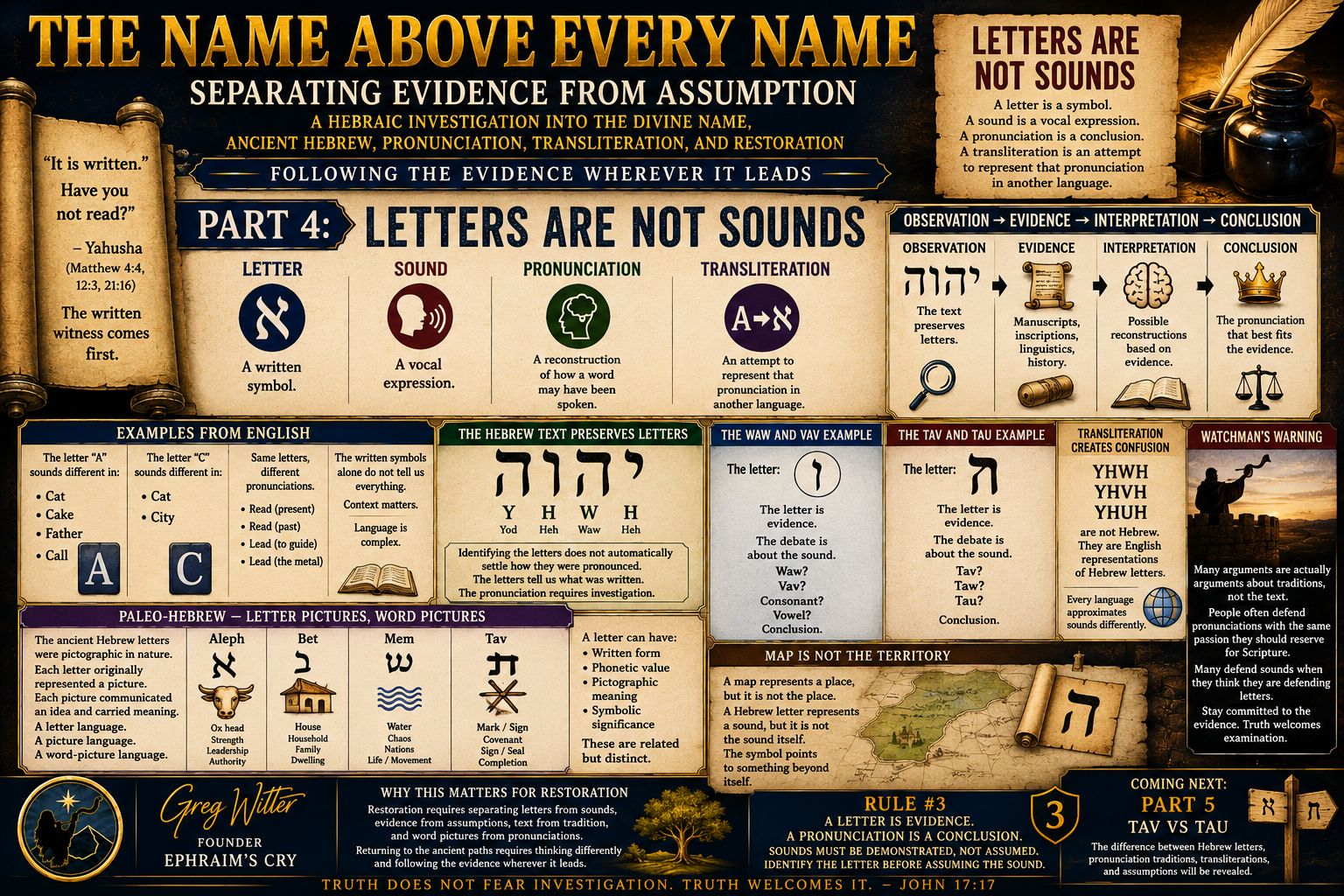
The Name Above Every Name, Part 4
Part 4: Letters Are Not Sounds
Separating Evidence from Assumption
A Hebraic Investigation into the Divine Name, Ancient Hebrew, Pronunciation, Transliteration, and Restoration
Following the Evidence Wherever It Leads
Greg Witter | Ephraim’s Cry
A Hebraic Mindset Study Series
Study • Learn • Apply • Grow • Share • Repeat
One of the most common mistakes people make when discussing the Divine Name is assuming that identifying a Hebrew letter automatically tells us how it was pronounced.
It does not.
Letters and sounds are related, but they are not the same thing.
A letter is a written symbol.
A sound is a spoken expression.
A pronunciation is an attempt to vocalize a word.
A transliteration is an attempt to represent that word in another language.
These distinctions may seem small, but they are at the heart of many debates surrounding the Divine Name.
If we fail to distinguish between letters and sounds, confusion becomes inevitable.
Before we can discuss Tav versus Tau, Waw versus Vav, Yah versus Yahu, vowel points, transliterations, or proposed pronunciations of the Divine Name, we must first understand a foundational truth:
Letters are not sounds.
A letter is a symbol.
A sound is a vocal expression.
A pronunciation is a reconstruction of how a word may have been spoken.
A transliteration is an attempt to represent that pronunciation in another language.
These things are related.
But they are not the same thing.
Much of the confusion surrounding the Divine Name exists because people unknowingly combine all four categories into one.
The result is assumption replacing evidence.
Why This Matters
Many people approach the Divine Name as though identifying the letters automatically settles the pronunciation.
For example, once someone identifies:
𐤉𐤄𐤅𐤄
they may immediately conclude they know exactly how the Name sounded.
But the letters themselves do not contain an audio recording.
The letters preserve the written form.
The pronunciation must be investigated.
That distinction is critical.
The text preserves evidence.
Pronunciation is a conclusion drawn from that evidence.
The Four Witness Principle
Notice how Scripture consistently appeals to the written witness.
Yahusha repeatedly said:
“It is written.”
He did not say:
“It is pronounced.”
He did not say:
“My tradition says.”
He did not say:
“My rabbis teach.”
He continually pointed people back to the written testimony.
Likewise, He often asked:
“Have you not read?”
The emphasis was on what was written.
Not what people assumed.
Not what traditions developed.
Not what later interpretations concluded.
The written witness came first.
That same principle must govern our investigation of the Divine Name.
The text preserves letters.
The letters are evidence.
The sounds must be investigated.
Ancient Languages Preserved Writing, Not Audio
Modern people often forget how different the ancient world was.
Today we have:
Audio recordings.
Video recordings.
Digital archives.
Voice samples.
Pronunciation databases.
Ancient people had none of these things.
When an ancient scribe wrote a document, he preserved writing.
He did not preserve sound.
He preserved symbols.
Not audio.
This means that when we encounter:
𐤉𐤄𐤅𐤄
we possess the written witness.
We do not possess a recording of Mosheh speaking the Name.
We do not possess a recording of Dawid singing the Name.
We do not possess a recording of Yeshayahu proclaiming the Name.
The text preserves letters.
The pronunciation must be reconstructed.
This reality is unavoidable.
Letters and Sounds Are Not the Same Thing
Consider the English language.
The letter “A” appears in:
Cat
Cake
Father
Call
The same letter appears in all four words.
Yet it is pronounced differently in each one.
Likewise, the letter “C” appears in:
Cat
City
The letter remains the same.
The sound changes.
Consider these examples:
Read (present tense)
Read (past tense)
Same letters.
Different pronunciation.
Or:
Lead (to guide)
Lead (the metal)
Same letters.
Different pronunciation.
The written symbols alone do not tell us everything.
Context matters.
Language is more complex than many people assume.
Ancient Hebrew is no different.
The Difference Between Four Separate Categories
One of the biggest sources of confusion in the Divine Name discussion is that people unknowingly combine four separate categories into a single discussion.
They speak as though all four are identical.
They are not.
A Hebrew letter has:
A letter form.
The visual symbol itself.
For example:
𐤅
or
ו
A letter name.
Waw.
Vav.
Or another proposed designation.
A letter sound.
The phonetic value assigned to the letter.
A letter meaning.
Particularly in Paleo-Hebrew where letters originated as pictographic symbols carrying conceptual meaning.
These four categories are related.
But they are not identical.
The letter form is not the letter name.
The letter name is not the sound.
The sound is not the meaning.
The meaning is not the pronunciation.
Confusing these categories creates many of the errors found throughout the Divine Name debate.
The Hebrew Text Preserves Letters
When we encounter the Divine Name in Scripture, the text preserves four letters:
𐤉𐤄𐤅𐤄
Yod
Heh
Waw
Heh
Those letters are part of the evidence.
But identifying the letters does not automatically settle how they were pronounced.
The letters tell us what was written.
The pronunciation requires further investigation.
What the Text Actually Preserves
When we open a Hebrew manuscript, what exactly are we looking at?
We are looking at visible symbols.
We are not looking at audio recordings.
We are not looking at spoken sounds.
We are not looking at phonetic certainty.
We are looking at letters.
The manuscript preserves the form.
The student attempts to reconstruct the sound.
This distinction cannot be overstated.
The text gives us evidence.
The reader attempts to determine pronunciation.
Evidence and conclusions are not the same thing.
The Divine Name Demonstrates the Principle Perfectly
Virtually everyone agrees the Hebrew text contains:
𐤉𐤄𐤅𐤄
or
יהוה
The disagreement begins when people attempt to assign sounds to those letters.
One person says:
Yahweh.
Another says:
Yahuwah.
Another says:
Yahuah.
Another says:
Yehovah.
Another says:
Jehovah.
Notice what happened.
Nobody is debating the letters.
The debate concerns the sounds.
The letters are evidence.
The pronunciations are conclusions.
This distinction is one of the most important principles in the entire series.
The Divine Name debate itself proves the lesson.
Why This Matters So Much
The Divine Name discussion is not unique.
It simply exposes a problem that exists throughout language.
Most people never notice this problem because they grew up hearing words spoken.
Hebrew presents a different challenge.
The farther removed we become from the original speakers, the more dependent we become upon evidence rather than direct observation.
No one living today heard Mosheh pronounce the Name.
No one living today heard Dawid sing the Name.
No one living today heard Yeshayahu proclaim the Name.
Therefore, every proposed pronunciation must ultimately appeal to evidence rather than personal experience.
That reality should encourage humility.
Observation, Evidence, Interpretation, Conclusion
Every honest investigation follows a sequence.
Observation:
𐤉𐤄𐤅𐤄
Evidence:
Ancient manuscripts.
Ancient inscriptions.
Linguistic data.
Historical witnesses.
Interpretation:
Possible reconstructions.
Conclusion:
The pronunciation that appears most consistent with the evidence.
Many people reverse the process.
They begin with a conclusion.
Then they search for evidence supporting the conclusion they already hold.
This series seeks to reverse that process.
We begin with observation.
Then evidence.
Then interpretation.
Then conclusions.
The order matters.
The Waw and Vav Example
Consider the third letter:
𐤅
Many scholars identify this letter as Waw in ancient Hebrew.
Others refer to it as Vav based on later Hebrew pronunciation.
Notice what is happening.
The debate is not over the existence of the letter.
Everyone agrees the letter exists.
The debate concerns the sound associated with that letter.
The letter remains the same.
The pronunciation becomes the subject of investigation.
This distinction will become increasingly important as we move forward.
The letter is evidence.
The sound is a conclusion.
The Tav and Tau Example
The same principle applies to:
𐤕
The Hebrew letter remains the same.
Different languages and traditions may represent it differently.
Tav.
Taw.
Tau.
The question is not whether the letter exists.
The question is how various languages attempt to represent the sound associated with that letter.
Again, the letter and the pronunciation are not identical.
The letter remains unchanged.
The sound becomes the subject of investigation.
Again:
Letter first.
Sound second.
Conclusion last.
The Problem with Transliteration
Another source of confusion is transliteration.
Transliteration is not translation.
Nor is transliteration the original language.
Transliteration is simply an attempt to represent one language using the letters of another language.
For example:
YHWH
YHVH
YHUH
are not Hebrew.
They are English attempts to represent Hebrew letters.
Every transliteration system has limitations.
Every language approximates sounds differently.
This is why transliterations should never be confused with the original text itself.
The Hebrew text remains the primary witness.
Everything else is an attempt to represent it.
The Same Object Can Have Different Labels
Consider a city.
One language may call it one thing.
Another language may call it something else.
The city itself has not changed.
Only the label has changed.
For example:
Yerushalayim.
Jerusalem.
Hierosolyma.
Different languages.
Different labels.
Same city.
The same principle applies to Hebrew letters.
Different traditions may apply different labels.
The underlying letter remains the same.
Labels alone do not establish truth.
The underlying evidence must be examined.
Paleo-Hebrew Adds Another Layer
The discussion becomes even more interesting when we examine Paleo-Hebrew.
Many people discover Paleo-Hebrew and immediately focus on pronunciation.
But Paleo-Hebrew reveals something else that is equally important.
The ancient Hebrew letters were pictographic in nature.
Each letter originally represented a picture.
Each picture communicated an idea.
Each idea carried meaning.
The language functioned not only as a written alphabet but also as a picture language.
A letter language.
A picture language.
A word-picture language.
For example:
𐤀 Aleph originally represented an ox head.
Strength.
Leadership.
Authority.
𐤁 Bet represented a house.
Household.
Family.
Dwelling.
𐤌 Mem represented water.
Chaos.
Nations.
Life.
Movement.
𐤕 Tav represented a mark, sign, seal, or covenant mark.
These pictographic concepts do not determine pronunciation.
But they do demonstrate an important reality.
Hebrew letters communicate more than sounds.
They communicate meaning.
They communicate ideas.
They communicate concepts.
A letter can simultaneously possess:
A written form.
A phonetic value.
A pictographic meaning.
A symbolic significance.
These are related but distinct categories.
Understanding this principle becomes important later when examining Hebrew words, names, themes, and covenant concepts.
The Map Is Not the Territory
Imagine holding a map.
The map represents a place.
But the map is not the place itself.
Likewise, a Hebrew letter represents a sound.
But the letter is not the sound itself.
The written symbol points toward something beyond itself.
Confusing the symbol with the thing it represents creates misunderstanding.
This is precisely what often happens in discussions surrounding the Divine Name.
People confuse the written evidence with the spoken reconstruction.
The two must be distinguished.
Why This Matters for Restoration
Much of the confusion surrounding the Divine Name exists because people often collapse several different categories into one.
Letter.
Sound.
Pronunciation.
Transliteration.
Tradition.
Meaning.
Word picture.
These are related.
But they are not identical.
The restoration movement is forcing many believers to ask questions they have never asked before.
What does the text actually say?
What assumptions have been inherited?
What traditions have become accepted without examination?
What conclusions are supported by evidence?
Returning to the ancient paths requires more than changing conclusions.
It requires learning how to think differently.
It requires learning how to separate:
Letters from sounds.
Evidence from assumptions.
Observations from conclusions.
Text from tradition.
Word pictures from pronunciations.
That process is often uncomfortable.
But it is necessary.
Restoration without precision often creates new traditions while claiming to reject old ones.
The goal is not simply to replace one assumption with another.
The goal is to follow the evidence wherever it leads.
A Watchman’s Warning
Many arguments that appear to be arguments about Scripture are actually arguments about traditions attached to Scripture.
People often defend pronunciations with the same certainty they should reserve for the text itself.
The problem is that pronunciations are conclusions.
The text is evidence.
The two should never be confused.
A faithful student must remain committed to the evidence even when the evidence challenges long-held assumptions.
Truth does not fear investigation.
Truth welcomes examination.
Truth survives testing.
Many sincere believers defend sounds when they think they are defending letters.
Many defend traditions when they think they are defending Scripture.
Teachers inherit traditions from teachers.
Students inherit traditions from teachers.
Generations inherit traditions from previous generations.
Eventually repetition is mistaken for proof.
But repetition does not create truth.
Popularity does not create truth.
Tradition alone does not create truth.
Truth must be tested.
Truth must be examined.
Truth must be demonstrated.
This is why careful distinctions matter.
Summary
Letters are not sounds.
A letter is a written symbol.
A sound is a vocal expression.
A pronunciation is a conclusion drawn from evidence.
A transliteration is an attempt to represent that pronunciation in another language.
Ancient Hebrew preserves letters, not audio recordings. The Divine Name debate itself demonstrates this reality. While the letters are largely agreed upon, the discussion concerns the sounds assigned to those letters. Paleo-Hebrew further demonstrates that Hebrew letters can communicate pictographic meaning, symbolic significance, and conceptual ideas in addition to phonetic value. Understanding these distinctions is essential if we are going to separate evidence from assumption.
Rule #3
A letter is evidence. A pronunciation is a conclusion.
Sounds must be demonstrated, not assumed.
Do not confuse the letter form, the letter name, the letter sound, and the letter meaning.
Identify the letter before assuming the sound.
Continue the Journey
The Name Above Every Name — Orientation Booklet
Pay What You Want
This resource is offered on a Pay-What-You-Want basis. Download it completely free, or support the ongoing work of Ephraim’s Cry through a voluntary contribution.
Your support helps fund future study guides, charts, teachings, broadcasts, discipleship resources, and the ongoing proclamation of the Gospel of the Kingdom.
Suggested Contribution: $19.95
Coming Next
Part 5: Tav vs Tau
If letters are not sounds, then why do some insist on Tav while others insist on Tau? The answer reveals the difference between Hebrew letters, pronunciation traditions, transliterations, and the assumptions many people bring to the text.
Following the Evidence Wherever It Leads.
#GregWitter #EphraimsCry #HebraicMindset #HebraicMindsetStudySeries #GospelOfTheKingdom #KingdomOfElohim #Remnant #Covenant #ReturnToCovenant #ScriptureStudy #BibleStudy #StudyLearnApplyGrowShareRepeat #TruthMatters #TestEverything #ProveAllThings #AncientPaths #Restoration #RestorationOfAllThings #TheNameAboveEveryName #SeparatingEvidenceFromAssumption #FollowingTheEvidence #DivineName #SacredName #Tetragrammaton #YHWH #Yahuah #Yahusha #PaleoHebrew #AncientHebrew #BiblicalHebrew #LettersAreNotSounds #WordPictures #PaleoHebrewMeaning #Transliteration #WawVsVav #TavVsTau #ObservationBeforeInterpretation #EvidenceBeforeAssumption #RuleNumberThree
