
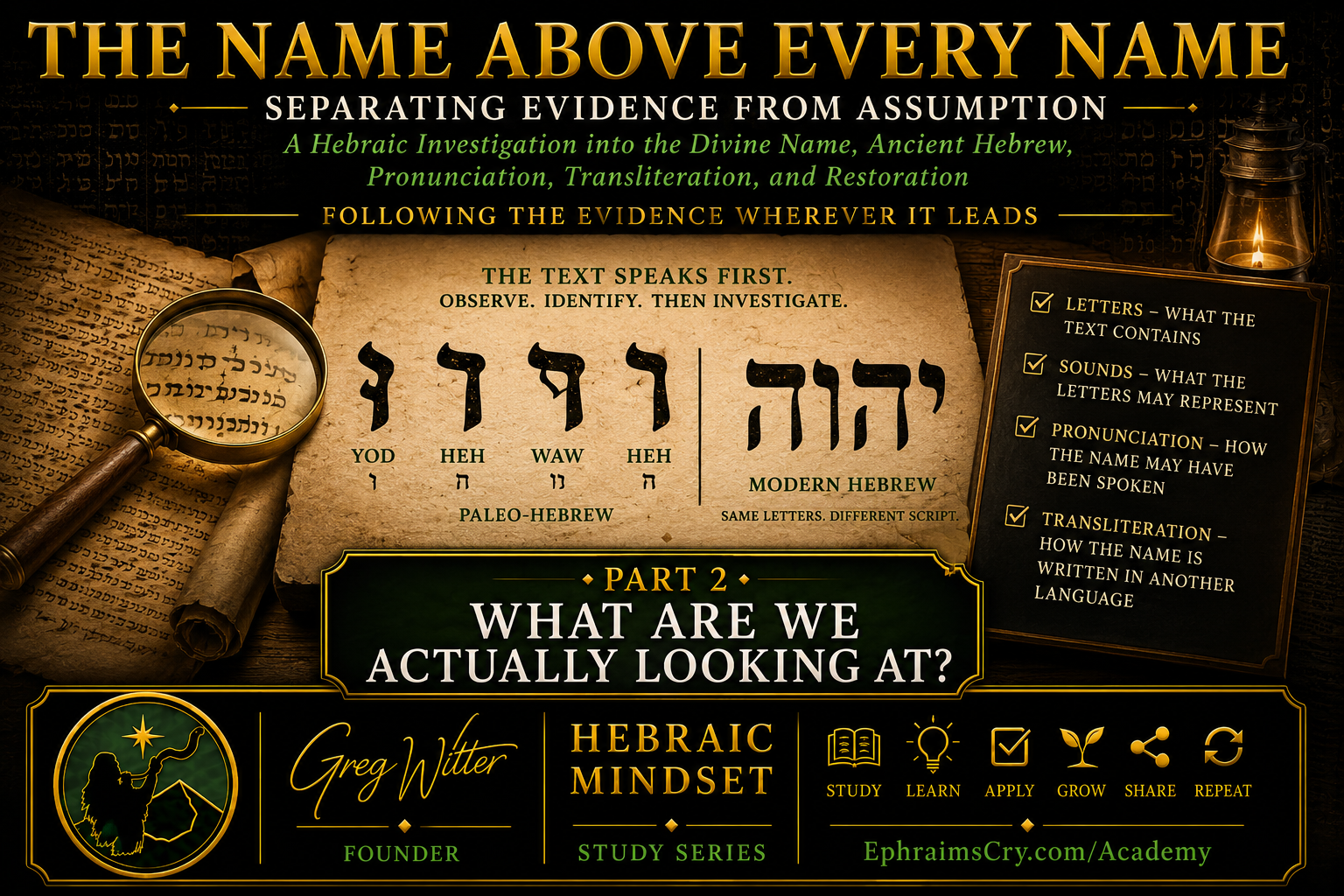
The Name Above Every Name
Part 2: What Are We Actually Looking At?
Separating Evidence from Assumption
A Hebraic Investigation into the Divine Name, Ancient Hebrew, Pronunciation, Transliteration, and Restoration
Following the Evidence Wherever It Leads
Greg Witter | Ephraim’s Cry
A Hebraic Mindset Study Series
Study • Learn • Apply • Grow • Share • Repeat
If we are going to have an honest discussion about the Divine Name, we must first answer a question that many people never stop to ask:
What are we actually looking at?
This may seem obvious, but much of the confusion surrounding the Divine Name begins because people skip this foundational step.
Instead of starting with the text itself, many begin with conclusions.
One person says Yahweh.
Another says Yahuwah.
Another says Yahuah.
Another says Yehovah.
Another says Jehovah.
Another says the Name cannot be known.
Another says the Name does not matter.
Before long, everyone is debating conclusions while very few are examining the actual evidence.
That approach reverses the proper order of investigation.
Before conclusions come observations.
Before interpretations come evidence.
Before assumptions come facts.
That principle forms the foundation of this entire series.
Rule #1 of This Series
Start with what the text actually says before discussing what you think the text means.
This sounds simple.
Yet countless doctrinal errors begin when people violate this principle.
Instead of allowing the text to speak first, they allow tradition, assumptions, theology, denominational teachings, preferred scholars, or personal opinions to speak first.
The result is often confusion rather than clarity.
Truth begins with observation.
Only then can interpretation follow.
The Example Set by Yahusha
When Yahusha taught, He continually appealed to the written witness.
He did not say:
“It is my opinion.”
He did not say:
“My tradition teaches.”
He did not say:
“The rabbis have concluded.”
Instead,He repeatedly said:
“It is written.”
When confronting temptation in the wilderness, He appealed to the written text.
When confronting religious leaders, He appealed to the written text.
When correcting false assumptions, He appealed to the written text.
Likewise, He repeatedly asked:
“Have you not read?”
Notice what Yahusha was doing.
He was directing people back to the written witness.
Not to speculation.
Not to assumptions.
Not to traditions.
The written text came first.
The same principle must govern our investigation of the Divine Name.
The Problem with Most Name Debates
Most Name debates begin at the wrong end of the discussion.
People begin with pronunciation.
But pronunciation is not the first question.
The first question is:
What does the text actually contain?
Imagine four archaeologists uncovering an ancient stone inscription.
The inscription contains four letters.
One archaeologist immediately says:
“I know exactly how this was pronounced.”
Another disagrees.
A third proposes a different pronunciation.
A fourth proposes yet another.
What should they do first?
Should they debate pronunciation?
No.
The first responsibility is to identify the letters correctly.
Only after identifying the letters can they begin discussing pronunciation.
That is exactly where we find ourselves with the Divine Name.
The first task is not pronunciation.
The first task is identification.
The Four Letters
The Divine Name appears thousands of times throughout the Hebrew Scriptures.
In modern Hebrew script it appears as:
יהוה
In Paleo-Hebrew it appears as:
𐤉𐤄𐤅𐤄
These four letters are commonly called the Tetragrammaton.
The term simply means:
“Four letters.”
The letters are:
𐤉 — Yod
𐤄 — Heh
𐤅 — Waw
𐤄 — Heh
When represented using English transliteration conventions, they are commonly written:
Y-H-W-H
Notice what we have done.
We have identified the letters.
We have not yet pronounced them.
We have not inserted vowels.
We have not inserted traditions.
We have not inserted conclusions.
We have simply identified what the text contains.
This is the starting point.
Observation Versus Interpretation
This distinction is critical.
Observation:
The text contains:
𐤉𐤄𐤅𐤄
Interpretation:
The Name must be pronounced ______.
Those are not the same thing.
Observation is what the evidence presents.
Interpretation is what we conclude from the evidence.
Many people unknowingly confuse the two.
They state an interpretation as though it were an observation.
But the text itself does not contain:
Yahweh
Yahuwah
Yahuah
Jehovah
Yehovah
The text contains:
𐤉𐤄𐤅𐤄
Everything beyond that requires investigation.
That does not mean all interpretations are equally valid.
It simply means we must distinguish between what the text says and what we conclude from it.
The Hebrew Text Preserves Letters, Not Audio
One of the most important realities in this discussion is often overlooked.
The Hebrew Scriptures preserve written letters.
They do not preserve audio recordings.
No manuscript exists containing a recording of Mosheh speaking the Name.
No scroll preserves an audio pronunciation.
The text preserves letters.
The pronunciation must be reconstructed from evidence.
This is why the investigation becomes necessary.
If the pronunciation had been directly preserved, there would be little debate.
The fact that debate exists is evidence that reconstruction is required.
Paleo-Hebrew and Why It Matters
Many students eventually discover Paleo-Hebrew and immediately assume they have found the answer to every question.
Paleo-Hebrew is important.
But it must be understood correctly.
Paleo-Hebrew preserves the ancient form of the letters.
It helps us understand how the letters were originally written.
It provides valuable historical insight.
It reveals pictographic origins.
It helps us trace the development of Hebrew writing.
What Paleo-Hebrew does not provide is an audio recording.
Paleo-Hebrew can show us the form of the letters.
It cannot directly prove their pronunciation.
This distinction becomes very important later when we discuss Tav versus Tau and Waw versus Vav.
The script preserves the letter.
It does not automatically preserve the sound.
The Difference Between Letters and Pronunciations
Consider the English language.
The letter “A” can appear in dozens of fonts.
Yet regardless of appearance, it remains the same letter.
Likewise, Hebrew transitioned from Paleo-Hebrew to later square Hebrew script.
The appearance changed.
The underlying letters remained.
Thus:
𐤉𐤄𐤅𐤄
and
יהוה
represent the same four letters written in different script styles.
The form changed.
The identity remained.
This is another reason we must separate letters from sounds.
Letters are visual symbols.
Pronunciations are spoken reconstructions.
The two are related but not identical.
Why This Matters Beyond the Name Debate
This lesson is about far more than the Divine Name.
It is about how we approach Scripture itself.
Many people approach the Bible carrying assumptions.
They assume they already know what the text says.
They assume tradition has already settled the matter.
They assume their denomination has already answered every question.
But restoration requires something different.
Restoration requires returning to the text itself.
The text must be allowed to speak before tradition speaks.
The text must be allowed to speak before assumptions speak.
The text must be allowed to speak before conclusions speak.
That principle applies not only to the Divine Name but to Sabbath, covenant, Torah, prophecy, salvation, discipleship, and every other doctrine.
A Watchman’s Warning
One of the greatest dangers facing believers is becoming more committed to inherited conclusions than to evidence.
Many sincere people defend positions they have never personally investigated.
They inherit a conclusion.
They accept it as fact.
They repeat it for years.
Then they defend it as though they personally examined the evidence.
This happens in every theological camp.
The remedy is simple.
Return to the text.
Observe carefully.
Examine honestly.
Test thoroughly.
Then draw conclusions.
The order matters.
When the order is reversed, error becomes almost inevitable.
Summary
The Divine Name appears in Scripture as four Hebrew letters:
𐤉𐤄𐤅𐤄
Yod, Heh, Waw, Heh.
Before discussing pronunciation, transliteration, traditions, or theories, we must first identify the letters preserved in the text. The Hebrew Scriptures preserve letters, not audio recordings. Therefore, every honest investigation must begin with observation before interpretation, evidence before assumptions, and the text before tradition.
Rule #1 of this series remains:
Start with what the text actually says before discussing what you think the text means.
Continue the Journey
The Name Above Every Name — Orientation Booklet
Pay What You Want
This resource is offered on a Pay-What-You-Want basis. Download it completely free or support the ongoing work of Ephraim’s Cry through a voluntary contribution.
Your support helps fund future study guides, charts, teachings, broadcasts, discipleship resources, and the ongoing proclamation of the Gospel of the Kingdom.
Suggested Contribution: $19.95
Coming Next
Part 3: Hebrew Was Originally Written Without Vowels
Many assumptions about the Divine Name begin with later vowel traditions. Before we can discuss pronunciation, we must first understand how ancient Hebrew was originally written and why the absence of vowel points is one of the most important facts in the entire discussion.
Following the Evidence Wherever It Leads.
#GregWitter #EphraimsCry #HebraicMindset #HebraicMindsetStudySeries #GospelOfTheKingdom #KingdomOfElohim #Remnant #Covenant#ReturnToCovenant #ScriptureStudy #BibleStudy #StudyLearnApplyGrowShareRepeat #TruthMatters #TestEverything #ProveAllThings #AncientPaths #Restoration #RestorationOfAllThings #TheNameAboveEveryName #SeparatingEvidenceFromAssumption #FollowingTheEvidence #DivineName #SacredName #Tetragrammaton#YHWH #Yahuah #Yahusha #PaleoHebrew #AncientHebrew #BiblicalHebrew #EvidenceOverTradition #ScriptureOverTradition #CovenantIdentity #KingdomTeaching #WhatAreWeActuallyLookingAt #StartWithTheText #TextBeforeTradition #ObservationBeforeInterpretation #EvidenceBeforeAssumption #LettersBeforePronunciation #HebrewLetters #PaleoHebrewLetters #ReturnToTheText #ItIsWritten #HaveYouNotRead #TruthBeforeTradition #FoundationsMatter
