
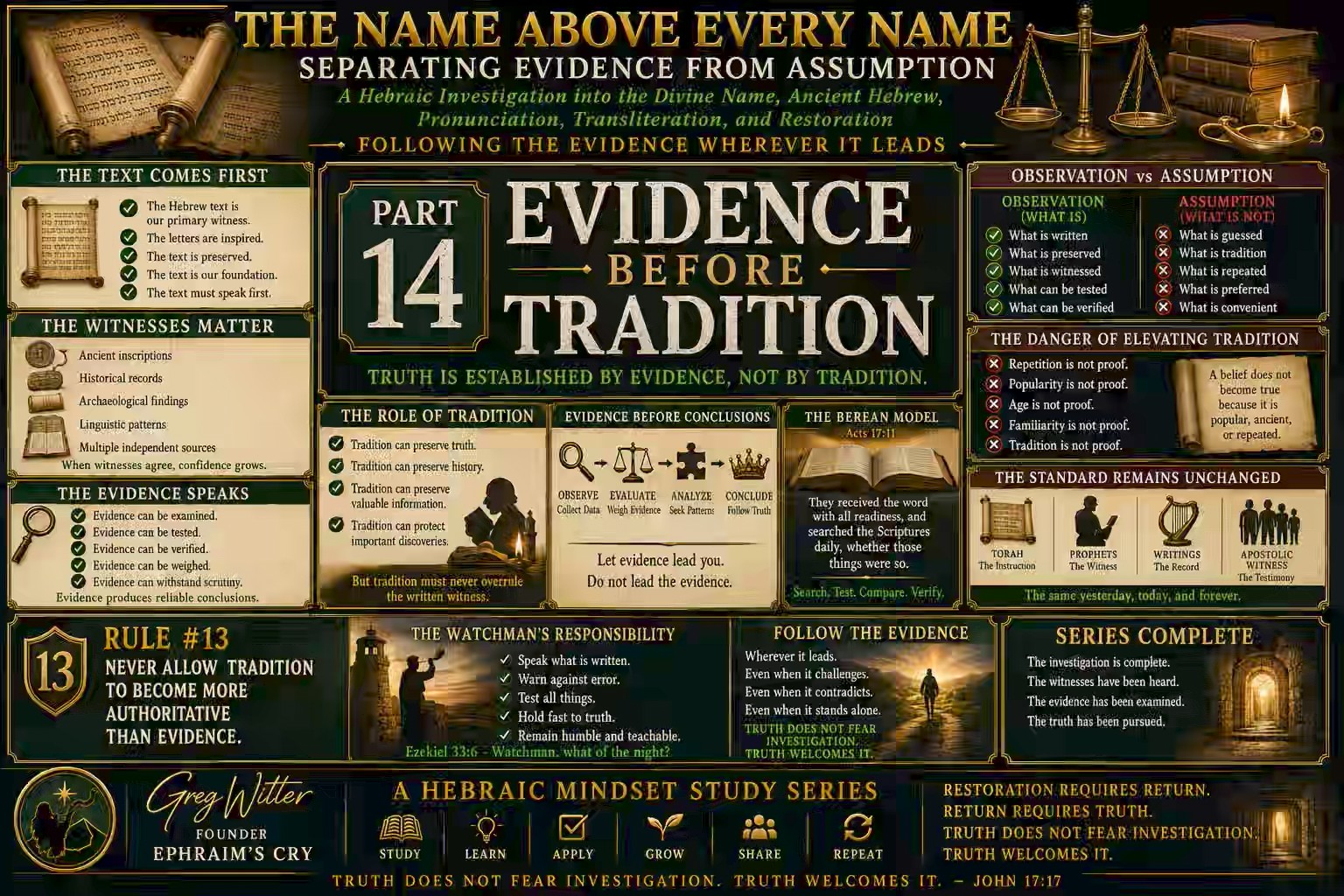
The Name Above Every Name
Part 14: Evidence Before Tradition
Separating Evidence from Assumption
A Hebraic Investigation into the Divine Name, Ancient Hebrew, Pronunciation, Transliteration, and Restoration
Following the Evidence Wherever It Leads
Greg Witter | Ephraim’s Cry
A Hebraic Mindset Study Series
Study • Learn • Apply • Grow • Share • Repeat
Throughout this series we have followed a deliberate path.
We began with the Hebrew text.
We examined the letters.
We examined Paleo-Hebrew.
We examined the absence of original vowel points.
We separated letters from sounds.
We separated sounds from pronunciations.
We separated pronunciations from transliterations.
We examined the evidence for Yah.
We examined the evidence for Yahu.
We examined ancient external witnesses.
We examined the vowel point controversy.
We examined the limits of historical proof.
We examined what can be known with confidence.
At every stage of this investigation, one principle remained unchanged.
The evidence comes before the conclusion.
Now we arrive at the final lesson.
Evidence Before Tradition.
In many ways, this may be the most important lesson in the entire series.
Because the Divine Name debate is not ultimately about Hebrew.
It is not ultimately about pronunciation.
It is not ultimately about transliteration.
It is not ultimately about Yahweh, Yehovah, Jehovah, Yahuwah, Yahuah, or any other proposed reconstruction.
At its core, the debate concerns a much deeper question.
How do we determine truth?
Do we begin with tradition?
Or do we begin with evidence?
That question affects far more than the Divine Name.
It affects every area of biblical study.
It affects doctrine.
It affects prophecy.
It affects covenant.
It affects discipleship.
It affects restoration.
It affects how we approach Scripture itself.
The answer matters.
Every Person Has Traditions
One of the greatest mistakes people make is assuming that only other people have traditions.
Everyone has traditions.
Some traditions come from churches.
Some traditions come from denominations.
Some traditions come from seminaries.
Some traditions come from teachers.
Some traditions come from sacred-name movements.
Some traditions come from anti-sacred-name movements.
Some traditions come from family.
Some traditions come from culture.
Some traditions come from repetition.
Some traditions come from assumptions inherited over generations.
No one begins with a completely blank slate.
Every student brings something with him.
Every investigator carries assumptions.
Every reader approaches the text with prior beliefs.
The question is not whether traditions exist.
The question is whether traditions are allowed to overrule evidence.
That is where the real battle begins.
Why Traditions Become Powerful
Traditions become powerful because they become familiar.
People hear them repeatedly.
Parents teach them.
Pastors teach them.
Teachers teach them.
Communities reinforce them.
Books repeat them.
Videos repeat them.
Eventually repetition creates familiarity.
Familiarity creates comfort.
Comfort creates confidence.
Confidence becomes certainty.
Yet none of those things establish truth.
A belief does not become true because it is familiar.
A belief does not become true because it is ancient.
A belief does not become true because it is popular.
A belief does not become true because millions of people repeat it.
Truth is established by evidence.
Not repetition.
Not popularity.
Not familiarity.
Not tradition alone.
This is one of the hardest lessons for many people to learn.
Because traditions often feel true long before they are examined.
The Danger Of Starting With Conclusions
Many investigations fail before they begin.
Why?
Because the conclusion is already chosen.
Someone begins with:
“It must be Yahweh.”
Another begins with:
“It must be Jehovah.”
Another begins with:
“It must be Yehovah.”
Another begins with:
“It must be Yahuwah.”
Another begins with:
“It must be Yahuah.”
The specific conclusion is not the problem.
The methodology is.
When conclusions come first, evidence becomes secondary.
The investigator no longer follows the evidence.
The investigator protects the conclusion.
Evidence that agrees is accepted.
Evidence that disagrees is rejected.
Investigation stops.
Confirmation begins.
This is one of the greatest dangers in biblical study.
Truth cannot be discovered if conclusions are protected from examination.
The faithful student must be willing to follow evidence even when evidence challenges cherished assumptions.
That requires humility.
That requires courage.
That requires honesty.
The Pattern Found Throughout Scripture
This principle is not unique to the Divine Name discussion.
It appears throughout Scripture.
Again and again, the prophets called the people back to the original witness.
Back to the covenant.
Back to the Torah.
Back to what had actually been written.
Israel repeatedly accumulated traditions.
Israel repeatedly accumulated assumptions.
Israel repeatedly accumulated practices that drifted from the original instruction.
The role of the prophet was not to create new truth.
The role of the prophet was to call the people back to truth.
Back to what had already been revealed.
Back to what had already been established.
Back to the written witness.
We see the same pattern in the ministry of Yahusha.
Repeatedly He asked:
“Have ye not read?”
Again and again He pointed people back to Scripture.
Not to popular opinion.
Not to religious traditions.
Not to majority consensus.
To what was written.
The written witness remained the standard.
The written witness remained the authority.
The written witness remained the measure by which claims were tested.
The same principle appears among the Bereans.
They did not simply accept claims because someone spoke with confidence.
They did not simply accept claims because someone possessed authority.
They searched the Scriptures daily.
They tested what they heard.
They examined the evidence.
They compared claims against the witness.
This remains the model for faithful investigation today.
Tradition Can Preserve Truth
At this point an important balance must be maintained.
Some people hear criticism of tradition and assume all traditions are false.
That conclusion would be an error.
Tradition is not automatically wrong.
Tradition often preserves valuable information.
Tradition often preserves history.
Tradition often preserves language.
Tradition often preserves customs.
Tradition often preserves memories that might otherwise be lost.
The problem is not tradition itself.
The problem occurs when tradition becomes immune from examination.
The problem occurs when tradition becomes untouchable.
The problem occurs when tradition is elevated above evidence.
A tradition may be correct.
A tradition may be partially correct.
A tradition may be incorrect.
The only way to determine which is true is through investigation.
Tradition must be tested.
Tradition must be examined.
Tradition must be weighed against the evidence.
This principle applies to every position.
Without exception.
The Divine Name Debate Illustrates The Problem
The Divine Name discussion provides a perfect example.
Different traditions have preserved different conclusions.
Some traditions favor Jehovah.
Some traditions favor Yahweh.
Some traditions favor Yehovah.
Some traditions favor Yahuwah.
Some traditions favor Yahuah.
Others favor different forms.
Each tradition presents arguments.
Each tradition presents evidence.
Each tradition presents assumptions.
The question is not:
“Which tradition is oldest?”
The question is not:
“Which tradition is most popular?”
The question is not:
“Which tradition has the most followers?”
The question is:
“Which conclusions are best supported by the available evidence?”
That question changes everything.
The focus shifts from defending traditions to evaluating evidence.
The focus shifts from protecting conclusions to examining witnesses.
The focus shifts from assumptions to investigation.
This is the heart of the entire series.
The Difference Between Loyalty And Truth
Many people become emotionally attached to conclusions.
This is understandable.
People invest time.
People invest study.
People invest energy.
People invest identity.
Over time a conclusion can become part of a person’s sense of certainty.
The danger arises when loyalty shifts from truth to conclusions.
The faithful student must remain loyal to truth.
Not merely loyal to positions.
Not merely loyal to traditions.
Not merely loyal to teachers.
Not merely loyal to movements.
Truth must remain supreme.
If evidence strengthens a conclusion, rejoice.
If evidence challenges a conclusion, examine it.
If evidence corrects a conclusion, accept correction.
Truth loses nothing through investigation.
Only error fears examination.
Truth welcomes examination.
Truth survives scrutiny.
Truth survives questions.
Truth survives testing.
That is why honest investigation is never a threat to truth.
It is a servant of truth.
Why Evidence Matters
Evidence matters because evidence anchors us to reality.
Without evidence, conclusions become speculation.
Without evidence, traditions become assumptions.
Without evidence, confidence becomes dogmatism.
Evidence provides boundaries.
Evidence provides accountability.
Evidence provides discipline.
Evidence reminds us where observation ends and interpretation begins.
This distinction is essential.
Observation:
The Divine Name appears in the Hebrew text.
Observation:
Yah appears in Scripture.
Observation:
Yahu appears in Hebrew names.
Observation:
Ancient witnesses preserve related forms.
Observation:
The earliest Hebrew manuscripts lacked vowel points.
Those are observations.
Those are witnesses.
Those are evidence.
The conclusions we draw must remain connected to those observations.
The evidence must lead.
The conclusions must follow.
Never the reverse.
The Responsibility Of The Investigator
Every investigator carries a responsibility.
That responsibility is not merely to gather information.
It is not merely to memorize facts.
It is not merely to defend positions.
The responsibility is to pursue truth.
Truth requires honesty.
Truth requires humility.
Truth requires discipline.
Truth requires a willingness to separate what we know from what we assume.
Many debates become confused because assumptions are treated as facts.
Possibilities become certainties.
Traditions become evidence.
Opinions become doctrine.
The faithful student must resist this temptation.
Evidence must remain evidence.
Assumptions must remain assumptions.
Interpretations must remain interpretations.
The categories matter.
When categories become confused, clarity disappears.
When categories remain clear, understanding grows.
Throughout this series we have repeatedly returned to this principle.
Observation is not the same as interpretation.
Evidence is not the same as conclusion.
Witness is not the same as assumption.
The faithful investigator learns to distinguish between them.
Why Intellectual Honesty Matters
Intellectual honesty is one of the rarest qualities in modern discussions.
Many people approach evidence seeking confirmation.
Few approach evidence seeking truth.
Confirmation asks:
“How can I prove what I already believe?”
Investigation asks:
“What does the evidence actually demonstrate?”
Those are not the same question.
One protects conclusions.
The other pursues truth.
The faithful student must continually ask:
Am I following the evidence?
Or am I defending a conclusion?
Am I examining witnesses?
Or am I protecting assumptions?
Am I willing to change my understanding if the evidence requires it?
Or have I already decided what the answer must be?
These questions are uncomfortable.
But they are necessary.
Because truth demands honesty.
The student who fears correction will eventually stop learning.
The student who welcomes correction continues growing.
The Difference Between Dogmatism And Conviction
Some people confuse conviction with dogmatism.
They are not identical.
Conviction is confidence built upon evidence.
Dogmatism is certainty that refuses examination.
Conviction welcomes questions.
Dogmatism fears questions.
Conviction welcomes investigation.
Dogmatism resists investigation.
Conviction grows stronger when evidence accumulates.
Dogmatism remains unchanged regardless of evidence.
The faithful student should possess conviction.
Strong conviction.
Evidence-based conviction.
Truth-based conviction.
Yet that conviction must remain humble.
The student must never claim more than the evidence supports.
The student must never exaggerate conclusions.
The student must never confuse probability with certainty.
The student must never elevate assumptions to the level of established fact.
This balance protects integrity.
This balance protects credibility.
This balance protects the investigation itself.
Why Restoration Requires Investigation
Restoration has never occurred through blind acceptance.
Restoration has always required examination.
The prophets examined.
The apostles examined.
The Bereans examined.
The faithful throughout history examined.
They tested.
They weighed.
They compared.
They investigated.
The Divine Name discussion exists because people began asking questions.
Questions led to investigation.
Investigation led to evidence.
Evidence led to conclusions.
Conclusions led to further questions.
This process is not a weakness.
It is a strength.
The willingness to investigate demonstrates a desire for truth.
The willingness to examine demonstrates a desire for understanding.
The willingness to test demonstrates a desire for accuracy.
Restoration advances when people are willing to revisit assumptions.
Restoration advances when people are willing to examine traditions.
Restoration advances when evidence is allowed to speak.
The goal is not change for the sake of change.
The goal is truth.
The goal is faithfulness.
The goal is alignment with what can actually be demonstrated.
What This Series Has Attempted To Do
From the very beginning, this series has pursued a simple objective.
Separate evidence from assumption.
That has been the central theme.
Not proving a particular pronunciation.
Not promoting a particular camp.
Not defending a particular movement.
But separating evidence from assumption.
We examined the Hebrew letters.
We examined ancient writing systems.
We examined pronunciation issues.
We examined transliteration issues.
We examined Yah.
We examined Yahu.
We examined historical witnesses.
We examined archaeological evidence.
We examined vowel points.
We examined certainty.
We examined confidence.
At every step we asked the same question:
What does the evidence actually support?
That question remains the heart of honest investigation.
The answer may not always satisfy everyone.
The answer may challenge assumptions.
The answer may challenge traditions.
But the answer must always remain anchored to evidence.
Because evidence remains the foundation.
Evidence remains the witness.
Evidence remains the path that leads us closer to truth.
A Watchman’s Warning
One of the greatest dangers facing believers today is not a lack of information.
It is misplaced confidence.
Many people are absolutely certain about things they have never personally investigated.
They repeat conclusions.
They repeat traditions.
They repeat assumptions.
They repeat what they have been told.
But repetition is not investigation.
Repetition is not evidence.
Repetition is not proof.
The watchman must warn against this danger.
Because error often survives through repetition.
Error often survives through tradition.
Error often survives because few people are willing to ask difficult questions.
The faithful student must never fear questions.
The faithful student must never fear investigation.
The faithful student must never fear evidence.
Truth has nothing to fear from examination.
Truth survives scrutiny.
Truth survives testing.
Truth survives investigation.
Error fears investigation.
Error fears scrutiny.
Error fears questions.
That distinction is important.
When people become angry at evidence rather than examining evidence, something is wrong.
When people become defensive before investigation has even begun, something is wrong.
When people refuse to consider witnesses that challenge their assumptions, something is wrong.
The watchman must continually call people back to the evidence.
Back to the witnesses.
Back to the text.
Back to what can actually be demonstrated.
The Goal Was Never Certainty
Throughout this series we have repeatedly encountered the desire for certainty.
People want final answers.
People want complete answers.
People want absolute proof.
These desires are understandable.
But they can also become obstacles.
The goal of this investigation was never absolute certainty.
The goal was honest investigation.
The goal was not proving what we wanted to believe.
The goal was discovering what the evidence supports.
The goal was not defending a tradition.
The goal was not attacking a tradition.
The goal was following the evidence wherever it leads.
Sometimes evidence produces strong confidence.
Sometimes evidence produces moderate confidence.
Sometimes evidence leaves questions unanswered.
The faithful investigator accepts all three realities.
He does not exaggerate certainty.
He does not deny evidence.
He does not pretend unanswered questions do not exist.
He remains faithful to the evidence.
He remains faithful to truth.
Bringing The Witnesses Together
As we bring this series to its conclusion, consider the witnesses we have examined.
The Hebrew text stands as a witness.
The preserved letters stand as a witness.
Ancient Hebrew writing practices stand as a witness.
Yah stands as a witness.
Yahu stands as a witness.
Ancient Hebrew names stand as a witness.
Ancient inscriptions stand as a witness.
Historical references stand as a witness.
Archaeological discoveries stand as a witness.
Ancient external documents stand as a witness.
The absence of original vowel points stands as a witness.
The vowel point controversy stands as a witness.
The limitations of historical reconstruction stand as a witness.
What happens when all of these witnesses are examined together?
Patterns emerge.
Evidence accumulates.
Assumptions are exposed.
Traditions are tested.
Conclusions become stronger.
Not because any single witness settles the question.
But because multiple independent witnesses begin pointing toward similar conclusions.
This is how serious investigation works.
This is how evidence is weighed.
This is how conclusions are formed.
Not through isolated arguments.
Not through selective evidence.
Not through protected traditions.
But through the cumulative weight of the witnesses.
The Final Lesson
If there is one lesson that stands above all others in this series, it is this:
Truth must remain greater than tradition.
Truth must remain greater than assumptions.
Truth must remain greater than preferences.
Truth must remain greater than camps.
Truth must remain greater than personalities.
Truth must remain greater than movements.
Truth must remain greater than pride.
The faithful student does not belong to a conclusion.
The faithful student belongs to truth.
And because he belongs to truth, he remains willing to examine.
He remains willing to learn.
He remains willing to grow.
He remains willing to follow the evidence wherever it leads.
That principle applies to the Divine Name.
It applies to the Sabbath.
It applies to covenant.
It applies to prophecy.
It applies to doctrine.
It applies to every area of Scripture.
Evidence before tradition.
Witness before assumption.
Truth before preference.
The text before the argument.
The evidence before the conclusion.
That is the lesson.
That is the methodology.
That is the foundation.
That is the conclusion.
Summary
The purpose of this series has never been to force a conclusion.
The purpose has never been to defend a tradition.
The purpose has never been to promote speculation.
The purpose has never been to attack those who disagree.
The purpose has been to follow the evidence wherever it leads.
We began with the Hebrew text.
We began with what was preserved.
We began with what could be examined.
We began with what could be tested.
From there we followed the evidence step by step.
We examined the Hebrew letters.
We examined the ancient writing systems.
We examined the absence of original vowel points.
We separated letters from sounds.
We separated sounds from pronunciations.
We separated pronunciations from transliterations.
We examined the evidence for Yah.
We examined the evidence for Yahu.
We examined ancient external witnesses.
We examined the vowel point controversy.
We examined the limitations of certainty.
We examined what can be known with confidence.
And now we have examined the relationship between evidence and tradition.
Throughout the entire investigation, one lesson has remained constant.
Evidence must come before conclusions.
Evidence must come before assumptions.
Evidence must come before traditions.
This does not mean traditions are worthless.
It means traditions must remain subject to examination.
It means traditions must remain subject to testing.
It means traditions must never become greater than the witnesses themselves.
The Hebrew text remains the primary witness.
The preserved letters remain the primary witness.
The evidence remains the primary witness.
The faithful student returns to the text.
Returns to the witnesses.
Returns to what has actually been preserved.
Returns to what can actually be demonstrated.
That is the path of restoration.
That is the path of investigation.
That is the path of truth.
Rule #13
Never allow tradition to become more authoritative than evidence.
Traditions may preserve truth.
Traditions may preserve history.
Traditions may preserve valuable information.
But traditions must always remain subject to examination.
Follow the text.
Follow the witnesses.
Follow the evidence.
Follow the truth.
Follow the evidence wherever it leads.
Continue the Journey
The Name Above Every Name — Orientation Booklet
Pay What You Want
This resource is offered on a Pay-What-You-Want basis. Download it completely free, or support the ongoing work of Ephraim’s Cry through a voluntary contribution.
Your support helps fund future study guides, charts, teachings, broadcasts, discipleship resources, and the ongoing proclamation of the Gospel of the Kingdom.
Suggested Contribution: $19.95

Series Conclusion
The investigation is complete.
The witnesses have been heard.
The evidence has been examined.
The assumptions have been tested.
The traditions have been weighed.
The conclusions have been measured.
Now the responsibility belongs to the reader.
Will we follow assumptions?
Or will we follow evidence?
Will we follow traditions blindly?
Or will we test them honestly?
Will we defend conclusions?
Or will we pursue truth?
The answer to those questions reaches far beyond the Divine Name.
Those questions ultimately determine how we approach all of Scripture.
The faithful student remains humble.
The faithful student remains teachable.
The faithful student remains willing to learn.
The faithful student remains willing to examine.
The faithful student remains willing to follow the evidence wherever it leads.
Because truth does not fear investigation.
Truth welcomes investigation.
Truth survives scrutiny.
Truth survives testing.
Truth survives examination.
And wherever the evidence leads, that is where the faithful student must be willing to follow.
Following the Evidence Wherever It Leads.
#GregWitter #EphraimsCry #HebraicMindset #HebraicMindsetStudySeries #TheNameAboveEveryName #SeparatingEvidenceFromAssumption #EvidenceBeforeTradition #FollowingTheEvidence #DivineName #SacredName #AncientHebrew #BiblicalHebrew #HebrewLanguage #TruthMatters #EvidenceMatters #Restoration #Yah #Yahu #ScriptureStudy #BibleStudy #StudyLearnApplyGrowShareRepeat #RuleNumberThirteen #TruthDoesNotFearInvestigation
