
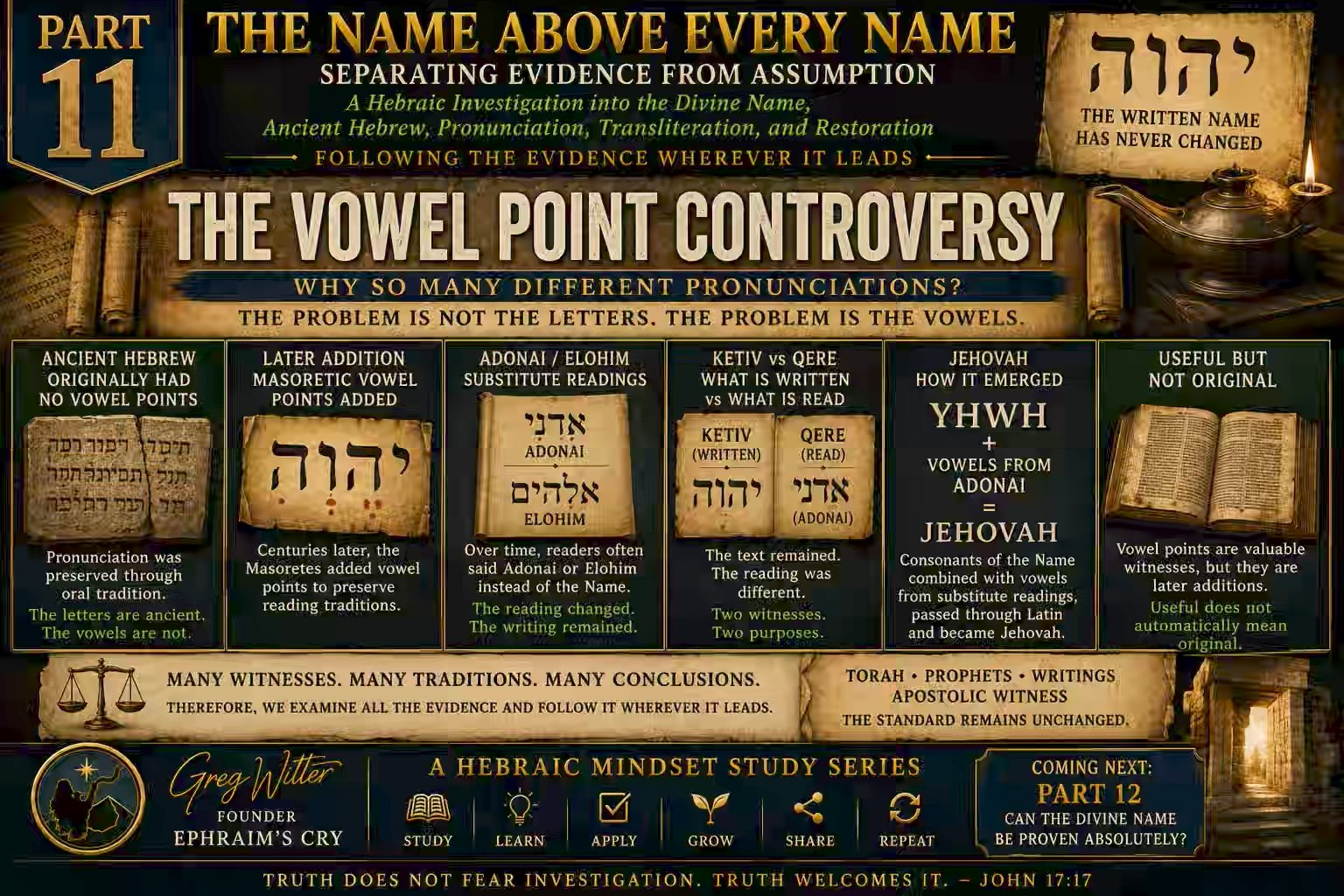
The Name Above Every Name
Part 11: The Vowel Point Controversy
Separating Evidence from Assumption
A Hebraic Investigation into the Divine Name, Ancient Hebrew, Pronunciation, Transliteration, and Restoration
Following the Evidence Wherever It Leads
Greg Witter | Ephraim’s Cry
A Hebraic Mindset Study Series
Study • Learn • Apply • Grow • Share • Repeat
Throughout this series we have carefully followed the evidence.
We examined the Hebrew letters.
We examined the ancient writing system.
We examined the absence of original vowel points.
We separated letters from sounds.
We separated sounds from pronunciations.
We examined transliteration.
We examined the evidence for Yah.
We examined the evidence for Yahu.
We examined ancient external witnesses.
Now we arrive at one of the most important discussions in the entire series.
The vowel point controversy.
This controversy sits at the center of nearly every debate surrounding the Divine Name.
Why do sincere people arrive at completely different conclusions while looking at the same Hebrew text?
Why do some conclude Yahweh?
Others conclude Yehovah.
Others conclude Jehovah.
Others conclude Yahuwah.
Others conclude Yahuah.
Others conclude forms that differ even further.
How can so many conclusions emerge from the same four Hebrew letters?
The answer requires understanding the history of the Hebrew text itself.
The Written Name Never Changed
The first thing we must establish is that the written Name never changed.
The Divine Name remains:
יהוה or even better HWHY or hwhy
Yod.
Heh.
Waw.
Heh.
These letters are preserved throughout the Hebrew Scriptures.
The controversy does not concern the letters.
The controversy concerns the vowels.
That distinction is critical.
The letters are evidence.
The vowels are interpretation.
The letters are ancient.
Many vowel traditions are later.
Understanding that difference changes the entire discussion.
Ancient Hebrew Originally Had No Vowel Points
One of the most important facts in this entire investigation is that ancient Hebrew was originally written without vowel points.
The earliest Hebrew manuscripts did not contain the dots and marks found in many modern Hebrew texts.
Readers learned pronunciation through oral transmission.
The language was read.
The language was spoken.
The language was memorized.
The language was passed from generation to generation.
The written text preserved consonants.
The spoken language preserved pronunciation.
This system functioned for centuries.
In fact, it functioned for well over a thousand years before vowel points appeared.
That fact alone should immediately influence how we approach the pronunciation debate.
The evidence is clear.
Moses did not write vowel points.
Joshua did not write vowel points.
Samuel did not write vowel points.
David did not write vowel points.
Isaiah did not write vowel points.
Jeremiah did not write vowel points.
The prophets did not write vowel points.
The original inspired text existed before the vowel system existed.
That fact cannot be ignored.
What Are Vowel Points?
Vowel points are small marks placed above, below, or within Hebrew letters.
Their purpose is to assist readers.
They indicate how a word was traditionally pronounced.
They help preserve pronunciation traditions.
They help standardize reading.
They help prevent confusion.
They are valuable tools.
They are useful.
They are important.
But they are not the original text.
The original text existed long before vowel points were added.
That distinction matters.
The question is not whether vowel points are useful.
The question is whether they preserve the original pronunciation of every word they accompany.
Those are two different questions.
Many people mistakenly combine them.
Who Added The Vowel Points?
The vowel point system was developed by Jewish scribes known as the Masoretes.
These scholars worked diligently to preserve the Hebrew Scriptures.
Their contribution was significant.
Without their work, much of the traditional pronunciation of Hebrew might have been lost.
The Masoretes did not create the Scriptures.
They preserved them.
They did not invent the Hebrew language.
They sought to safeguard it.
Their work deserves respect.
However, recognizing their contribution does not mean their traditions are beyond examination.
Every witness must be tested.
Every witness must be weighed.
Every witness must be examined.
Respect does not remove the need for investigation.
The Masoretic Text
Most modern Hebrew Bibles are based upon the Masoretic Text.
When people look at a Hebrew Bible today, they are usually looking at:
Ancient consonants.
Later vowel points.
This combination often creates confusion.
Many readers assume both elements originated together.
They did not.
The consonantal text is much older.
The vowel markings were added centuries later.
This does not make them wrong.
It simply means they are a separate witness.
And separate witnesses must be evaluated.
The Torah Warning
Before proceeding further, another principle must be considered.
Torah repeatedly warns against adding to or taking away from what has been given.
The issue is not whether the Masoretes intended harm.
The issue is whether later additions should automatically be granted the same authority as the original text.
That question matters.
A reading aid may be useful.
A commentary may be useful.
A translation may be useful.
A study note may be useful.
But usefulness and inspiration are not the same thing.
Usefulness and originality are not the same thing.
The written text remains primary.
Everything else remains secondary.
The Problem With The Divine Name
The controversy becomes more complicated when we reach the Divine Name.
Because something unusual happened.
Over time many Jewish communities developed a practice of not speaking the Divine Name aloud.
Instead substitute words were used.
Most commonly:
Adonai.
Meaning:
Master.
Or:
Elohim.
Meaning:
Mighty One.
When readers encountered יהוה in the text, they often read Adonai instead.
The written Name remained.
The spoken substitution changed.
This distinction becomes extremely important.
Because the moment the spoken reading differs from the written text, new questions emerge.
What exactly were the Masoretes preserving?
The written Name?
The spoken substitute?
Or both?
That question sits at the center of the controversy.
The Ketiv And Qere Tradition
Ancient Jewish scribes developed what became known as the Ketiv and Qere system.
Ketiv means:
What is written.
Qere means:
What is read.
Sometimes a word would remain written one way while readers were instructed to pronounce something different.
The Divine Name became one of the most significant examples of this practice.
The Name remained written.
The substitute reading was spoken.
Understanding this tradition is essential to understanding the vowel point controversy.
Without understanding Ketiv and Qere, much of the confusion surrounding the Divine Name becomes almost impossible to untangle.
The written witness says one thing.
The reading tradition says another.
The student must recognize the difference.
Why Adonai And Elohim Matter
This is where many discussions become confused.
When someone points to the vowel markings attached to יהוה, they often assume those vowels must belong to the Name itself.
But what if those vowels were placed there to remind readers to say Adonai?
What if they were intended to preserve the reading tradition rather than the original pronunciation?
Suddenly the entire discussion changes.
The question is no longer:
“What vowels are attached to the Name?”
The question becomes:
“What were those vowels intended to communicate?”
That distinction is enormous.
The answer affects every pronunciation theory built upon the Masoretic pointing.
Why The Vowel Points Matter
When the Masoretes added vowel points to the Hebrew text, they faced a challenge.
How should they mark the Divine Name?
Should they preserve the original pronunciation?
Or should they preserve the reading tradition that had become common?
In many cases the vowel points associated with יהוה appear to reflect the substitute reading rather than the original pronunciation.
This is one of the central issues in the entire debate.
Because if the vowel points reflect Adonai or Elohim, they may not reveal the original pronunciation of the Name itself.
They may instead preserve the reading tradition.
That distinction is enormous.
Why Jehovah Emerged
One of the most well-known examples of this controversy is the form:
Jehovah.
Many people sincerely believe Jehovah represents the original pronunciation.
However historically the situation is more complex.
The form emerged when readers combined the consonants of the Divine Name with vowel markings associated with substitute readings.
As the Name passed through Latin and later European languages, additional changes occurred.
The Hebrew Yod became associated with the letter J.
The Waw became associated with V-based pronunciation traditions.
The resulting form eventually became Jehovah.
This does not make Jehovah meaningless.
Nor does it make those who use it insincere.
But historical investigation requires asking how the form developed.
The evidence deserves examination.
Does This Automatically Prove Another Pronunciation?
No.
And this is where many discussions go wrong.
Demonstrating that one pronunciation is uncertain does not automatically prove another pronunciation.
Removing one possibility does not establish a different one.
Evidence must stand on its own.
Every proposed pronunciation must be tested.
Every conclusion must be supported.
The goal is not to replace one assumption with another assumption.
The goal is to follow the evidence.
This is one of the greatest weaknesses in many Divine Name debates.
Someone discovers a problem with one theory.
They immediately assume a competing theory must therefore be correct.
That is not how investigation works.
Exposing a weakness is not the same thing as proving an alternative.
Each proposal must stand upon its own evidence.
Reading Aid Or Interpretive Addition?
This question deserves careful consideration.
The Masoretic vowel points undoubtedly function as reading aids.
They help readers understand how words were traditionally pronounced.
They assist with reading and comprehension.
They preserve valuable linguistic information.
However, another question must be asked.
At what point does a reading aid become an interpretive addition?
The moment a later tradition influences how a text is read, interpreted, or understood, interpretation has entered the process.
This does not automatically make the interpretation wrong.
But it does mean the interpretation should be recognized as interpretation.
The original text remains the authority.
The reading tradition becomes a witness.
A valuable witness.
But still a witness.
The distinction matters.
Many debates arise because people confuse the witness with the evidence itself.
Useful Does Not Mean Original
One of the most important principles in this entire discussion is this:
Useful does not mean original.
A commentary may be useful.
A concordance may be useful.
A lexicon may be useful.
A translation may be useful.
A study guide may be useful.
Yet none of those are the original text.
Likewise, vowel points may be useful.
They may preserve valuable traditions.
They may preserve important information.
But usefulness alone does not prove originality.
The student must continually separate those categories.
The original text.
The later witness.
The original evidence.
The later interpretation.
Failure to make that distinction creates confusion.
Why So Many Different Conclusions Exist
At this point the reason becomes easier to understand.
People begin with:
The same consonants.
But they use:
Different traditions.
Different assumptions.
Different linguistic models.
Different historical witnesses.
Different weighting of evidence.
As a result multiple conclusions emerge.
The disagreement is often not about the letters.
The disagreement is about how the evidence should be interpreted.
Some place primary weight upon the Masoretic vowels.
Others place primary weight upon ancient Hebrew names.
Others place primary weight upon external witnesses.
Others attempt to combine all available evidence.
Different methodologies often produce different conclusions.
This explains why sincere students can study the same text and arrive at different answers.
Why Sincere Students Reach Different Conclusions
Not every disagreement originates from rebellion.
Not every disagreement originates from deception.
Sometimes disagreement emerges because people begin with different assumptions.
One student begins with tradition.
Another begins with historical linguistics.
Another begins with ancient inscriptions.
Another begins with Hebrew names.
Another begins with external witnesses.
Each believes he is following the evidence.
Yet each begins at a different starting point.
The purpose of this series is not to attack sincere students.
The purpose is to encourage careful examination of every witness.
Truth does not fear scrutiny.
Truth survives investigation.
Truth becomes stronger when tested.
What The Vowel Points Can Tell Us
The vowel points are not worthless.
Far from it.
They preserve important historical information.
They preserve reading traditions.
They preserve pronunciation traditions.
They preserve scribal understanding.
They preserve valuable evidence.
The mistake is treating them as though they automatically settle every question.
They do not.
They contribute evidence.
They are not the entire case.
They are one witness among many witnesses.
That distinction must remain clear.
What The Vowel Points Cannot Tell Us
The vowel points cannot transport us back in time.
They cannot provide an audio recording of Moses.
They cannot provide an audio recording of Joshua.
They cannot provide an audio recording of Samuel.
They cannot provide an audio recording of David.
They cannot provide an audio recording of Isaiah.
They cannot provide an audio recording of Jeremiah.
They cannot eliminate every uncertainty.
They cannot answer every question.
They cannot function independently of all other evidence.
They must be considered alongside:
The Hebrew text.
Ancient Hebrew.
Biblical witnesses.
Hebrew names.
Ancient inscriptions.
Historical witnesses.
And other relevant evidence.
The student who relies exclusively upon vowel points risks ignoring other witnesses.
The student who completely rejects vowel points risks ignoring an important witness.
Wisdom avoids both extremes.
Why This Controversy Matters
This discussion is not merely academic.
The vowel point controversy explains why people arrive at different conclusions while honestly attempting to study the same Hebrew text.
Understanding the controversy removes confusion.
It helps explain the debate.
It helps explain the history.
It helps explain why sincere students often disagree.
Most importantly it reminds us that conclusions should never be assumed.
They should be examined.
They should be tested.
They should be weighed.
They should be compared against all available evidence.
Only then should conclusions be reached.
The Four Witnesses Remain Our Standard
Throughout this discussion our standard remains unchanged.
Torah.
Prophets.
Writings.
Apostolic Witness.
These remain the foundation.
Every tradition.
Every pronunciation.
Every theory.
Every historical claim.
Every linguistic proposal.
Must ultimately be measured against the written witness.
The text remains primary.
The written witness remains supreme.
Everything else remains secondary.
A Watchman’s Warning
Many people place absolute trust in traditions they have never investigated.
Others reject traditions they have never examined.
Both approaches are dangerous.
Some defend vowel-point traditions as though they were part of the original inspired text.
Others reject every later witness simply because it is later.
Both positions can produce error.
The faithful student does neither.
Examine the evidence.
Study the history.
Understand the process.
Test every claim.
Weigh every witness.
Compare every source.
Separate assumption from evidence.
Separate tradition from proof.
Separate interpretation from the original text.
Then follow the evidence wherever it leads.
Truth does not fear investigation.
Truth welcomes it.
Truth survives testing.
Summary
Ancient Hebrew was originally written without vowel points. The later Masoretic vowel system was developed to preserve reading traditions and assist pronunciation. While these vowel points provide valuable historical information, they were added centuries after the original consonantal text was written. The Divine Name presents a unique challenge because substitute readings such as Adonai and Elohim were often used in place of speaking the Name itself. As a result, the vowel markings associated with יהוה may preserve reading traditions rather than the original pronunciation. This reality explains why sincere students examining the same Hebrew text often arrive at different conclusions. The controversy is not primarily about the letters of the Name, but about how later traditions interact with the written text. Understanding the vowel point controversy is essential to understanding the broader debate surrounding the Divine Name. This lesson does not attempt to settle the pronunciation question. Rather, it explains why the question exists and why different conclusions continue to emerge. By understanding the history of the text, the role of the Masoretes, the Ketiv/Qere tradition, the use of substitute readings, and the distinction between original evidence and later witnesses, the student becomes better equipped to follow the evidence wherever it leads.
Rule #10
The consonants are ancient evidence.
The vowel points are later witnesses.
Useful does not automatically mean original.
Every witness deserves examination.
The text remains primary.
Follow the evidence wherever it leads.

Continue the Journey
The Name Above Every Name — Orientation Booklet
Pay What You Want
This resource is offered on a Pay-What-You-Want basis. Download it completely free, or support the ongoing work of Ephraim’s Cry through a voluntary contribution.
Your support helps fund future study guides, charts, teachings, broadcasts, discipleship resources, and the ongoing proclamation of the Gospel of the Kingdom.
Suggested Contribution: $19.95

Coming Next
Part 12: Can the Divine Name Be Proven Absolutely?
Can any proposed pronunciation be proven with absolute certainty? What level of confidence does the evidence actually support? Where does the evidence become strong, and where must intellectual honesty acknowledge uncertainty? In the next lesson we examine the limits of historical investigation and explore what can—and cannot—be proven beyond reasonable doubt.
Following the Evidence Wherever It Leads.
#GregWitter #EphraimsCry #HebraicMindset #HebraicMindsetStudySeries #TheNameAboveEveryName #SeparatingEvidenceFromAssumption #FollowingTheEvidence #DivineName #SacredName #VowelPoints #MasoreticText #HebrewLanguage #AncientHebrew #PaleoHebrew #BiblicalHebrew #Ketiv #Qere #Adonai #Elohim #Jehovah #Yahweh #Yahuwah #Yahuah #TruthMatters #ScriptureStudy #BibleStudy#StudyLearnApplyGrowShareRepeat #RuleNumberTen
