
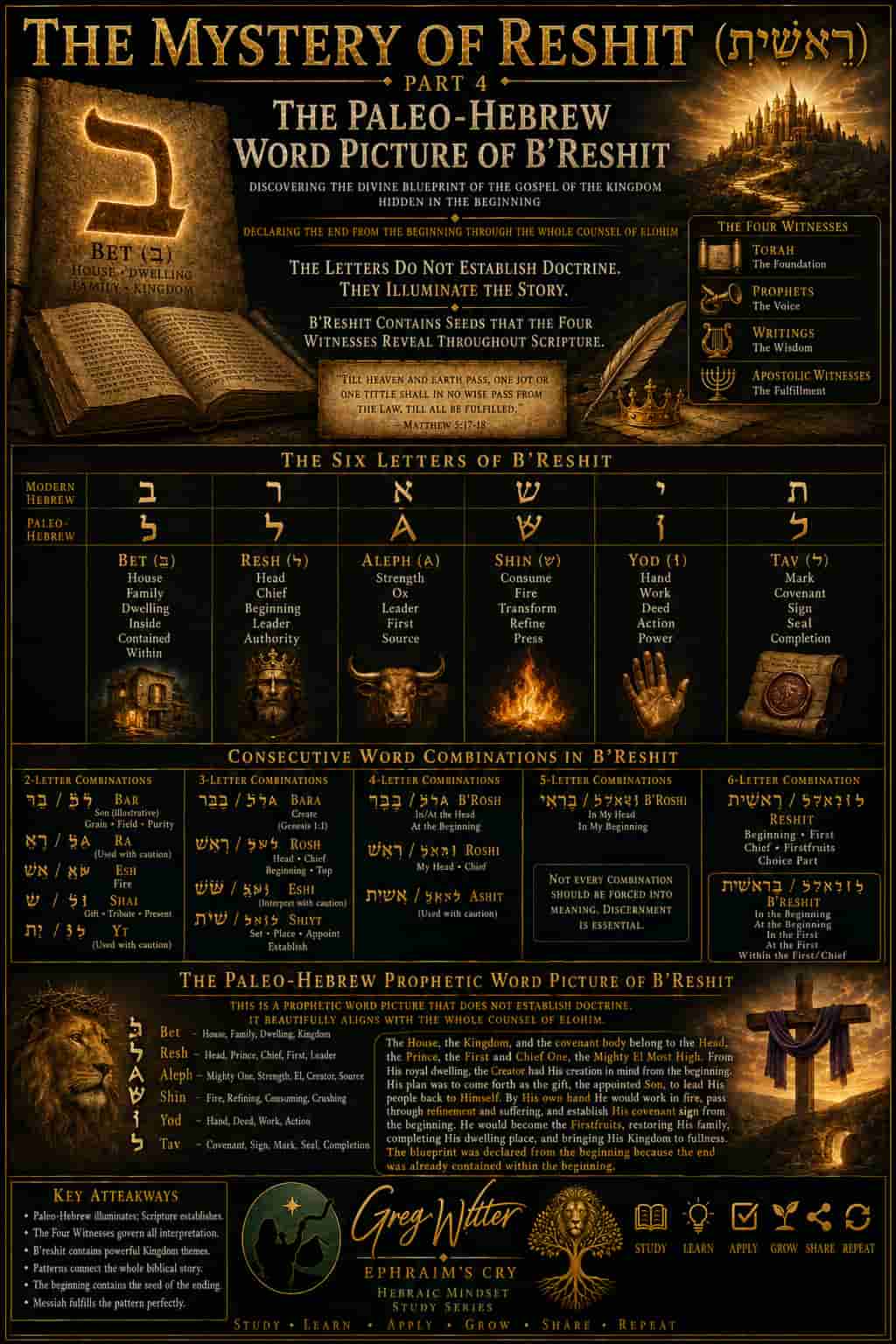
THE MYSTERY OF RESHIT (רֵאשִׁית)
PART 4
THE PALEO-HEBREW WORD PICTURE OF B’RESHIT
Discovering the Divine Blueprint of the Gospel of the Kingdom Hidden in the Beginning
Declaring the End from the Beginning Through the Whole Counsel of Elohim
The Letters Do Not Establish Doctrine. They Illuminate The Story.
B’reshit Contains Seeds That The Four Witnesses Reveal Throughout Scripture.
Greg Witter | Ephraim’s Cry
Hebraic Mindset Study Series
Study • Learn • Apply • Grow • Share • Repeat
Now we arrive at a chapter that requires both excitement and discipline.
Excitement, because what we are about to investigate is powerful, beautiful, and deeply connected to the way Scripture begins. Discipline, because this is also one of the most abused areas of biblical study today. The moment people hear the words Paleo-Hebrew, many run in one of two directions. Some dismiss it entirely, as if the older forms of the letters have no value at all. Others become obsessed with it and begin building doctrines from pictures, symbols, and forced meanings. Both extremes are dangerous.
We will do neither.
Throughout this entire series, we will remain anchored to one unchanging rule: Paleo-Hebrew may illuminate Scripture, but the whole counsel of Elohim establishes doctrine. The letters may help us see patterns, but they do not create the pattern. The pictographs may help us recognize beauty, but they do not carry authority over the written Word. The Torah, the Prophets, the Writings, and the Apostolic Witnesses are the governing witnesses. If an interpretation cannot stand under those four witnesses, we do not teach it as doctrine.
This must be said plainly before we go any further. This teaching is not a license for mysticism. This teaching is not an invitation to create secret codes. This teaching is not permission to make the letters say anything we want them to say. We are not practicing numerology. We are not practicing Jewish mysticism. We are not turning pictographs into doctrine. We are investigating the beginning through a Hebraic covenant lens and allowing the whole counsel of Elohim to govern the entire conversation.
Now let us return to the very first word of Scripture.
Modern Hebrew:
בְּרֵאשִׁית
Paleo-Hebrew:
𐤁𐤓𐤀𐤔𐤉𐤕
B’reshit.
Six root letters.
One word.
And this word stands at the doorway of all Scripture.
The question is not, “What secret code is hidden here?” That is the wrong question. The question is, “Why did Elohim choose this word to stand at the entrance of His entire written revelation?” That question is fair. That question is disciplined. That question does not require mysticism. It requires attention.
Because words matter.
Letters matter.
Order matters.
Patterns matter.
And according to Yahusha, not one jot or one tittle is insignificant.
Matthew 5:17-18 says:
“Think not that I am come to destroy the law, or the prophets: I am not come to destroy, but to fulfil. For verily I say unto you, Till heaven and earth pass, one jot or one tittle shall in no wise pass from the law, till all be fulfilled.”
That statement should sober us. Yahusha did not treat the written Word casually. He did not treat the smallest markings as meaningless. He did not speak as though the details were disposable. So when the very first word of Scripture stands before us, we should not race past it like it is nothing more than a calendar marker.
B’reshit is commonly translated “In the beginning.” That is not wrong. But if we stop there, we may miss the greater pattern. The beginning in Scripture is not merely about chronology. It is about priority, authority, pattern, seed, headship, and the foundation that governs what follows.
That is why this word matters.
Let us now look at each letter in both Modern Hebrew and Paleo-Hebrew.
ב / 𐤁 — Bet
Bet carries the idea of house, household, dwelling, family, inside, or what is contained within. The Hebrew word bayit means house. This is powerful because Scripture begins not with Aleph, but with Bet. It begins with the idea of house. Before we ever arrive at verse two, we are already being introduced to a dwelling concept.
That should not surprise us, because from Genesis to Revelation, Elohim is building a house. Eden is a dwelling place. The Tabernacle is a dwelling place. The Temple is a dwelling place. The covenant people become a dwelling place. Messiah speaks of His Father’s house. New Jerusalem becomes the final dwelling of Elohim with man. The first letter does not establish that doctrine by itself, but it beautifully illuminates a doctrine the whole counsel already establishes.
ר / 𐤓 — Resh
Resh carries the idea of head, chief, first, beginning, leader, authority, or highest one. This becomes extremely important because B’reshit is not merely about time. It is about headship and priority. Scripture will repeatedly teach that what is first governs what follows. The firstborn carries inheritance. The firstfruits belong to Elohim. The head governs the body. The beginning establishes the pattern.
When we see Resh within B’reshit, we are not forcing doctrine into the letter. We are recognizing that the concept of headship appears throughout Scripture and is later fulfilled in Messiah, who is called the head of the body and the beginning.
Colossians 1:18 says:
“And he is the head of the body, the assembly: who is the beginning, the firstborn from the dead; that in all things he might have the preeminence.”
That is Reshit language.
א / 𐤀 — Aleph
Aleph carries the idea of strength, ox, leader, first, source, or mighty one. It is the first letter of the Hebrew alphabet, yet Scripture does not begin with Aleph. That alone is worth noticing. Elohim could have begun His written revelation with Aleph, but He chose Bet. The strength is present, but it is within the house-word. The source is present, but it is not isolated from the house, headship, and covenant pattern.
This reminds us that Elohim’s strength is not chaotic power. His strength builds, orders, governs, and establishes. His authority is covenantal. His power is purposeful. His creation is not random. It is ordered according to His design.
ש / 𐤔 — Shin
Shin carries the idea of tooth, consume, destroy, fire, press, refine, or transform. This is where the pattern becomes very interesting because Scripture repeatedly connects fire with refining, judgment, purification, and transformation. Fire can destroy what is corrupt, but it can also purify what belongs to Elohim.
This does not mean Shin proves a doctrine of fire in B’reshit. It means the letter picture aligns with a pattern Scripture later reveals openly. Elohim’s work includes separation, testing, refining, judgment, and purification. From the fiery presence at Sinai to the refining language of the Prophets, the fire pattern is not foreign to Scripture.
י / 𐤉 — Yod
Yod carries the idea of hand, work, deed, action, power expressed, or what is accomplished. This is important because the beginning is not abstract. Elohim acts. Elohim speaks. Elohim forms. Elohim separates. Elohim fills. Elohim blesses. Elohim rests. The opening chapter of Scripture is filled with divine action.
Yod reminds us that the blueprint is not theory. It becomes work. The plan of Elohim moves into action. The Kingdom is not merely imagined. It is built. His hand accomplishes His purpose.
ת / 𐤕 — Tav
Tav carries the idea of mark, sign, covenant, seal, or completion. This is a powerful final letter in the word because Scripture moves from beginning to completion. What Elohim begins, He finishes. What He establishes in seed form, He brings to harvest. What He declares from the beginning, He completes at the end.
Again, Tav does not establish the doctrine by itself. But the pattern is undeniable across Scripture. Covenant signs matter. Marks matter. Completion matters. The end is already connected to the beginning.
Now step back and observe the full letter flow.
Modern Hebrew:
ב ר א ש י ת
Paleo-Hebrew:
𐤁 𐤓 𐤀 𐤔 𐤉 𐤕
Bet • Resh • Aleph • Shin • Yod • Tav
House.
Head.
Strength.
Fire.
Hand.
Covenant mark.
Do not force a sentence.
Do not force a code.
Do not force a mystical formula.
Simply observe the themes.
House. Headship. Authority. Strength. Refining. Work. Covenant. Completion.
Now ask the honest question: do those themes appear throughout the whole counsel of Elohim?
Yes, they do.
That is the point.
The letters are not inventing the story. They are reflecting the story. The pictographs are not the foundation. They are a witness of beauty to what the foundation already reveals.
Now we need to examine the consecutive word combinations inside B’reshit. This must be done carefully. We are not randomly pulling letters out of order. We are looking at consecutive sequences that appear within the word itself.
The full word:
Modern Hebrew:
בְּרֵאשִׁית
Paleo-Hebrew:
𐤁𐤓𐤀𐤔𐤉𐤕
B’reshit.
Two-letter consecutive combinations:
בּר / 𐤁𐤓 — BR / Bar
This combination can be associated with “son” in Aramaic usage, and it also carries ideas related to grain, purity, or field-related language in Hebrew contexts depending on vocalization and usage. We must be careful here. We should not overstate this as though the Hebrew word B’reshit is secretly declaring “Son” as a doctrine by itself. However, the sonship theme is absolutely established throughout the whole counsel of Scripture. The Son is not forced into Genesis. The Son is progressively revealed from the beginning through pattern, promise, seed, inheritance, and covenant fulfillment.
רא / 𐤓𐤀 — RA
As a stand-alone Hebrew form, this combination is not where we should build meaning carelessly. Depending on pointing, roots, and context, Hebrew meaning must be handled responsibly. We do not force a doctrine from two letters simply because they appear beside each other. This is a guardrail. Not every letter combination must be turned into a sermon.
אש / 𐤀𐤔 — Esh
This is a clear Hebrew word meaning fire. Fire is one of the recurring biblical symbols connected to presence, judgment, purification, testing, and refining. In the B’reshit sequence, Aleph-Shin appears consecutively, and it is legitimate to observe that the word “fire” is present within the sequence. But again, the doctrine of refining fire comes from the whole counsel, not from this embedded observation alone.
שי / 𐤔𐤉 — Shai
This can relate to the idea of gift, tribute, or present in Hebrew usage. That becomes interesting because the entire biblical story moves toward gift, offering, tribute, and what is brought before the King. Yet we must again remain disciplined. We observe. We do not force.
ית / 𐤉𐤕 — YT
This combination by itself should not be forced into a major doctrine. We may observe the letters, but we do not pretend every combination automatically carries a strong independent meaning. This is where many people go wrong.
Three-letter consecutive combinations:
ברא / 𐤁𐤓𐤀 — Bara
This is one of the most important words in the opening verse of Scripture. Bara means create, and in Genesis 1:1 it is used of Elohim’s creative act. This is not speculation. This is directly in the text.
Genesis 1:1 says:
“B’reshit bara Elohim…”
“In the beginning Elohim created…”
This matters because within B’reshit itself, the consecutive letters ברא / 𐤁𐤓𐤀 form bara, create. The first word contains the root that immediately follows it as the first verb of Scripture. That is not something to ignore. Creation is not detached from the beginning. The beginning introduces the creative work of Elohim.
ראש / 𐤓𐤀𐤔 — Rosh
Rosh means head, chief, top, beginning, or leader. This is a major word and a major biblical concept. It appears naturally within B’reshit. This is important because Reshit itself is related to the concept of first, chief, beginning, or firstfruits. The headship principle is not an invention. It is woven throughout Scripture.
אשי / 𐤀𐤔𐤉 — Eshi / Ishi-related caution
This sequence must be handled carefully. Depending on spelling, pointing, and context, one may be tempted to connect this to “my fire” or related ideas. But we should not force it. The letters are present, but this is not where we build doctrine. We can note that the fire theme is already present in אש / 𐤀𐤔, but we do not need to force every extended form.
שית / 𐤔𐤉𐤕 — Shit / Shiyt
This root can carry the idea of setting, placing, appointing, or putting. That becomes very interesting within the larger B’reshit theme because the beginning is where Elohim sets things in order. He appoints boundaries. He places lights. He sets man in the garden. He orders creation according to His purpose. This is a legitimate theme to observe, but again the doctrine comes from the text, not from the letter cluster alone.
Four-letter consecutive combinations:
בראש / 𐤁𐤓𐤀𐤔 — B’rosh / Berosh
This can communicate “in/at the head” or “in the beginning/head” conceptually when understood through the ב prefix and ראש. This is closely related to the function of B’reshit itself. The idea of “in the head,” “at the chief,” or “at the beginning” aligns with the larger meaning of the word.
ראשי / 𐤓𐤀𐤔𐤉 — Roshi
This can carry the sense of “my head” or “chief/principal” depending on usage and pointing. The headship concept remains central. Again, we do not need to overstate it. The point is that the head, chief, beginning pattern is deeply embedded in the word family.
אשית / 𐤀𐤔𐤉𐤕 — Eshit / Ashit
This one must be handled with caution. It is a letter sequence, but not one we should use to establish a major teaching point. We can observe the sequence, but we should not force doctrine from it.
Five-letter consecutive combinations:
בראשי / 𐤁𐤓𐤀𐤔𐤉 — B’roshi
This can carry the idea of “in my head” or “in my beginning/chief” depending on how one handles the components. But this should remain secondary. It is not the main teaching point.
ראשית / 𐤓𐤀𐤔𐤉𐤕 — Reshit
This is the major word inside B’reshit. Reshit means beginning, first, chief, first part, choice part, or firstfruits depending on context. This is the core of the series. B’reshit contains Reshit. The “in” or “at” prefix is attached to a word carrying beginning, first, chief, and firstfruits concepts.
This is not speculation.
This is the heart of the word.
And this is why this series exists.
Reshit is not merely about chronology. It is about priority, headship, firstfruits, and governing order. That is why Messiah can later be identified with beginning, firstborn, firstfruits, headship, and preeminence without being artificially inserted into Genesis. He fulfills the pattern already established from the beginning.
The full word:
בראשית / 𐤁𐤓𐤀𐤔𐤉𐤕 — B’reshit
In beginning.
At the beginning.
In first.
At first.
Within the first/chief principle.
This is the word that opens all of Scripture.
Now we must bring these parts together into the Paleo-Hebrew prophetic word picture. This is the section that must be understood correctly. This does not establish doctrine. This is not a hidden code. This is not Jewish mysticism. This is not numerology. This is not a secret prophecy hidden in the letters. This is a Paleo-Hebrew prophetic word picture that beautifully aligns with the story already established throughout the whole counsel of Elohim.
The letters are not creating the story.
The letters are reflecting the story.
When we take the pictographic concepts, the Kingdom themes, the legitimate word relationships, and the Four Witnesses together, an extraordinary picture begins to emerge.
ב / 𐤁 — Bet: house, family, dwelling place, what is inside, what is built
ר / 𐤓 — Resh: head, chief, first, prince, leader, authority
א / 𐤀 — Aleph: strength, mighty one, El, source, first power
ש / 𐤔 — Shin: fire, consuming, refining, crushing, transformation
י / 𐤉 — Yod: hand, deed, work, action, what is accomplished
ת / 𐤕 — Tav: covenant, sign, mark, seal, completion
Then we observe the strongest embedded Kingdom themes.
בר / 𐤁𐤓 — Bar: son, used cautiously and illustratively because of Aramaic usage and broader sonship patterns
ברא / 𐤁𐤓𐤀 — Bara: create
ראש / 𐤓𐤀𐤔 — Rosh: head, chief, beginning
אש / 𐤀𐤔 — Esh: fire
שי / 𐤔𐤉 — Shai: gift, tribute, present
שית / 𐤔𐤉𐤕 — Shiyt: set, place, appoint
ראשית / 𐤓𐤀𐤔𐤉𐤕 — Reshit: beginning, first, chief, firstfruits
Now the word picture begins to speak as a unified prophetic paragraph, not as doctrine created from letters, but as a beautiful illumination of the doctrine already established by the whole counsel of Elohim.
The house, the Kingdom, and the covenant body belong to the Head, the Prince, the First and Chief One, the Mighty El and Creator, who had His creation in mind from the beginning. From the Father’s royal dwelling, the Mighty One established His house, formed His creation, and set His purpose in motion. The Head of the House would come forth as the Son, the gift, the appointed One, and the Firstfruits, working by His own hand to lead His covenant family back to the Father. Through fire, crushing, refinement, suffering, and transformation, He would accomplish the work of restoration, bearing the mark of the covenant, fulfilling the sign from the beginning, and completing what was declared before the foundation was ever laid. In B’reshit, the house is seen, the Head is seen, the Mighty One is seen, the Creator is seen, the fire is seen, the hand is seen, the gift is seen, the covenant sign is seen, the firstfruits are seen, and the completion is seen. The beginning contains the seed of the harvest, and the harvest reveals the Kingdom that Elohim was declaring from the beginning.
Now step back and ask yourself something.
Does that paragraph establish doctrine?
No.
Does that paragraph align with the doctrine already established by the Four Witnesses?
Absolutely.
Because who is Messiah according to the whole counsel?
He is the Seed promised in Genesis 3:15.
He is the Son spoken of in Psalm 2.
He is the Head of the body in Colossians 1:18.
He is the Beginning in Colossians 1:18.
He is the Firstborn from the dead in Colossians 1:18.
He is the Firstfruits of those who sleep in 1 Corinthians 15:20.
He is the Builder of the Father’s house in Hebrews 3:3-6.
He is the Mediator of the covenant in Hebrews 8:6.
He is the King of kings and Master of masters in Revelation 19:16.
The letters did not invent those truths.
The whole counsel revealed those truths.
The letters simply illuminate the beauty of the story Elohim was telling all along.
This is why we must be careful, but not afraid. We must be disciplined, but not blind. We must not run into mysticism, but neither should we despise the beauty of the language Elohim chose to reveal His Word. The danger is not in seeing patterns. The danger is in giving patterns authority they do not have. The pattern is a witness. The whole counsel is the authority.
Now bring the pieces together.
Within B’reshit we see the house concept in Bet. We see headship in Resh and Rosh. We see strength and source in Aleph. We see fire and refining in Shin and Esh. We see hand and work in Yod. We see mark, covenant, sign, and completion in Tav. We see bara, creation. We see rosh, head. We see shai, gift. We see shiyt, appointment or setting in place. We see reshit, beginning, first, chief, and firstfruits.
That is not random noise.
But neither is it permission to invent doctrine.
This is where discipline matters.
The Western mind wants either to dismiss all of this or turn it into a mathematical code. The Hebraic mind recognizes pattern, but submits the pattern to the whole counsel of Elohim.
So what do we actually have?
We have the first word of Scripture introducing themes that later become major themes across the entire biblical story.
House.
Creation.
Headship.
Beginning.
First.
Firstfruits.
Sonship.
Fire.
Gift.
Work.
Appointment.
Covenant.
Completion.
Kingdom order.
And what does the whole counsel reveal?
Elohim creates a dwelling place.
He appoints man to rule under His authority.
Man rebels.
The house is corrupted.
The covenant story begins moving toward restoration.
The firstborn and firstfruits principles emerge.
The seed promise is given.
The covenant line is preserved.
The Tabernacle and Temple reveal dwelling.
The Prophets announce restoration.
Messiah comes as the Son, the Head, the Beginning, the Firstborn, and the Firstfruits.
The Apostolic Witnesses confirm that the pattern was always moving toward Him.
The Kingdom comes to fullness when Elohim dwells with His people again.
That is not mysticism.
That is the whole counsel of Elohim.
This is why B’reshit matters.
Not because we are hunting secrets.
Not because we are forcing letters to say whatever we want.
Not because we are building doctrine from pictographs.
But because the first word of Scripture beautifully reflects the very story the rest of Scripture openly reveals.
The Bible was never hiding the Kingdom from us.
We simply lost the ability to recognize the pattern.
And now we are learning to see again.
And perhaps that is one of the greatest discoveries we will make in this entire series.
B’reshit was never hiding secrets.
B’reshit was introducing the Kingdom.
The House.
The Head.
The Mighty One.
The Creator.
The Son.
The Fire.
The Gift.
The Hand.
The Covenant.
The Firstfruits.
The Restoration.
The Completion.
The Kingdom.
The entire story was being introduced before we ever arrived at verse two.
And that is why The Mystery of Reshit is not a Hebrew word study.
It is a Kingdom hermeneutic.
Because the beginning was never just about creation.
The beginning was always about the Kingdom.
Key Takeaways
• Modern Hebrew and Paleo-Hebrew should both be shown when teaching this series.
• Modern Hebrew preserves readable textual recognition.
• Paleo-Hebrew reveals the older letter-picture layer.
• Paleo-Hebrew does not establish doctrine.
• The Four Witnesses establish doctrine.
• B’reshit contains legitimate consecutive word patterns that must be handled responsibly.
• Not every letter combination should be forced into meaning.
• The strongest embedded words are bara, rosh, esh, shai, shiyt, and reshit.
• The letters illuminate themes already established throughout Scripture.
• The prophetic word picture does not create doctrine; it reflects the Kingdom story already revealed by the whole counsel of Elohim.
• The beginning contains the seed of the story the whole counsel reveals.
#TheMysteryOfReshit #Bereshit #Reshit #TheGospelOfTheKingdom #WholeCounselOfElohim #FourWitnesses
#PatternRecognition #Genesis #Firstfruits #Firstborn #Messiah #KingdomOfElohim #HebraicMindset
#EphraimsCry #StudyLearnApplyGrowShareRepeat
