
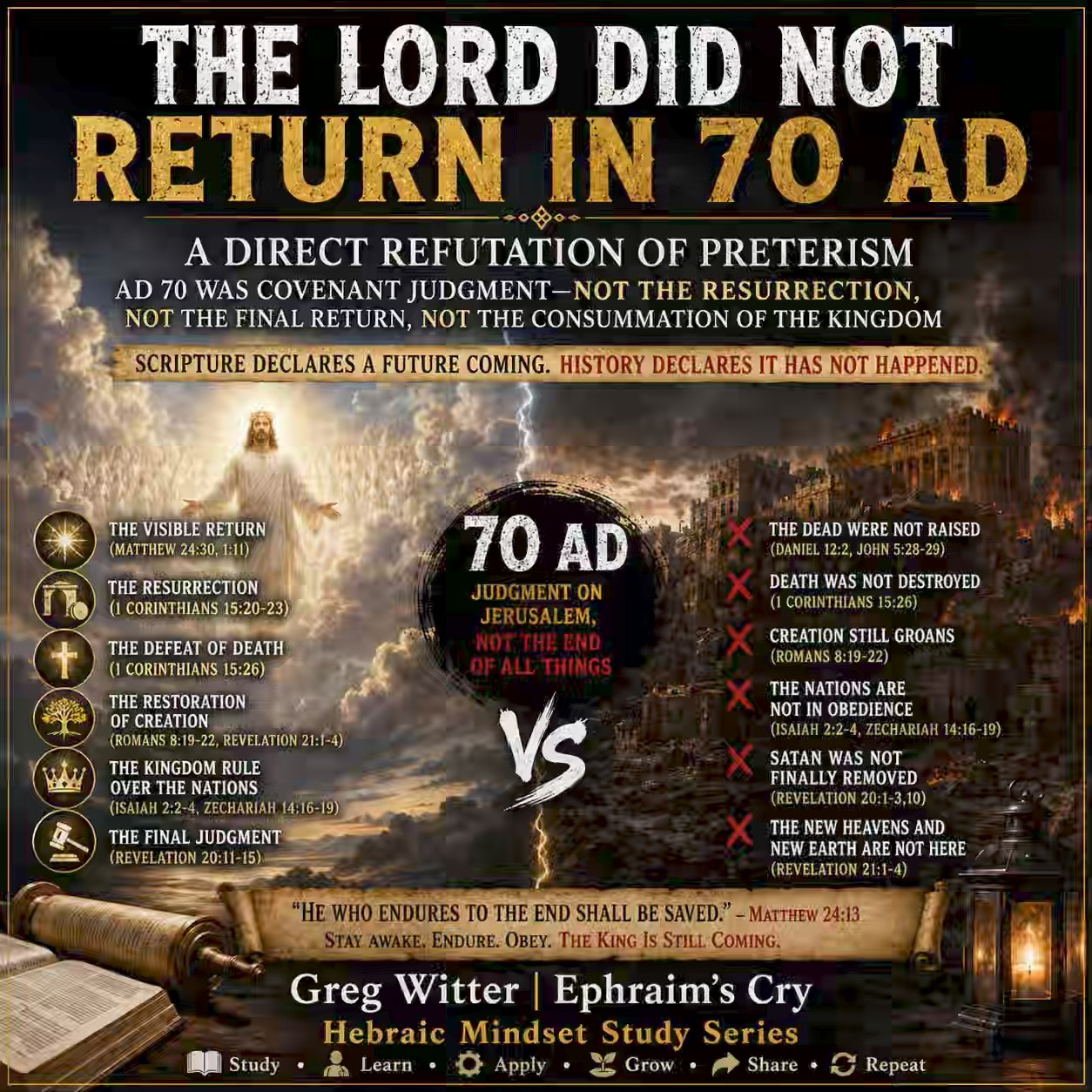
THE LORD DID NOT RETURN IN 70 AD
A Full Refutation of Preterism, the Finished-End Doctrine, and the Claim That the Day of Yahuah Is Already Past
AD 70 Was Covenant Judgment Against Jerusalem — Not the Final Return, Not the Resurrection, Not the Consummation of the Kingdom
Greg Witter | Ephraim’s Cry
Hebraic Mindset Study Series
Study • Learn • Apply • Grow • Share • Repeat.
The claim that Yahusha returned in 70 AD is not merely a difference in prophetic interpretation. It is a doctrine that reaches into the resurrection, the Kingdom, the restoration of creation, the future judgment, the hope of the saints, and the credibility of the apostles.
AD 70 was real. Jerusalem was judged. The Temple was destroyed. Yahusha’s warnings concerning that generation were vindicated. But a covenant judgment against Jerusalem is not the same thing as the final return of the King.
That is where preterism collapses. It takes one historical judgment and stretches it until it becomes the end of all things. It turns Jerusalem’s destruction into the resurrection, the Day of Yahuah, the coming of the Kingdom in fullness, the defeat of death, the binding of Satan, the final judgment, and the new heavens and new earth. Scripture does not allow that.
If Yahusha returned in 70 AD, then the dead should have been raised. Daniel 12:2 says that many who sleep in the dust of the earth shall awake, some to everlasting life and some to shame and everlasting contempt. Yahusha said in John 5:28–29 that all who are in the graves will hear His voice and come forth. Paul teaches in 1 Corinthians 15 that the resurrection is bodily, future, and tied to the defeat of death. Graves are still full. Death still reigns. Therefore, the promised resurrection has not yet occurred.
If Yahusha returned in 70 AD, then death should have been destroyed. Paul says plainly, “The last enemy that shall be destroyed is death” (1 Corinthians 15:26). Death was not destroyed in 70 AD. People continued to die after Jerusalem fell. Believers died. Unbelievers died. The world continued under mortality. Therefore, the end had not come.
If Yahusha returned in 70 AD, then creation should no longer be groaning. Romans 8:19–22 says creation waits for deliverance from the bondage of corruption. Creation is still groaning. The earth is still under corruption. The curse is still evident. Therefore, the restoration has not yet arrived in fullness.
If Yahusha returned in 70 AD, then the nations should be openly governed under the righteous rule of the King. Isaiah 2:2–4 says the nations will come to the mountain of Yahuah, receive His instruction, and beat swords into plowshares. Zechariah 14:16–19 says the nations will be required to come up and worship the King and keep Sukkot. That is not the condition of the world. The nations still rage. War continues. Rebellion continues. Therefore, the Kingdom has not yet been consummated.
If Yahusha returned in 70 AD, then Satan should have been bound, released for a little while, judged, and removed according to Revelation 20. But the final removal of Satan has not occurred. The final judgment has not occurred. Death and Hades have not been cast into the lake of fire. Revelation 21 has not arrived in its fullness. Therefore, the preterist claim fails.
The apostles warned against this exact kind of error. Paul condemned Hymenaeus and Philetus because they said the resurrection had already passed and were overthrowing the faith of some (2 Timothy 2:17–18). That is not a small warning. That is apostolic indictment. Any doctrine that says the resurrection is already past is not merely mistaken. It is dangerous.
Preterism survives by redefining words until nothing means what Scripture says. Resurrection becomes “covenantal transition.” Coming becomes “invisible judgment.” Kingdom becomes “spiritual status.” New creation becomes “the church age.” The defeat of death becomes “legal victory.” Satan’s binding becomes “limited influence.” The new heavens and new earth become “a theological condition.” That is not interpretation. That is escape.
Scripture does not define the return of Yahusha as invisible. It does not define the resurrection as metaphor. It does not define the end of death as death continuing. It does not define the restoration of creation as creation still groaning. It does not define the Kingdom as the nations continuing in rebellion.
The Day of Yahuah is not a private theological transition. It is public, decisive, disruptive, and covenantally final. Isaiah 13, Joel 2, Zephaniah 1, Zechariah 14, Matthew 24, 1 Thessalonians 4, 2 Thessalonians 1, 1 Corinthians 15, Revelation 19–22 all testify that the final Day brings visible judgment, deliverance, resurrection, restoration, and the removal of evil.
AD 70 did not do that.
AD 70 judged Jerusalem.
It did not raise the dead.
It did not destroy death.
It did not restore creation.
It did not remove Satan.
It did not bring the nations into obedience.
It did not end the curse.
It did not wipe away every tear.
It did not bring the new heavens and new earth.
Therefore, Yahusha did not return in final fullness in 70 AD.
The preterist system confuses “judgment coming” with “final coming.” Scripture uses coming language for historical judgments, yes. Yahuah “came” against nations in judgment many times through armies, calamity, and covenant enforcement. But that does not mean every coming is the final return of Messiah. To flatten all coming language into one category is careless and destructive.
Matthew 24 contains judgment language concerning Jerusalem, but it also points beyond Jerusalem. Yahusha speaks of tribulation, deception, endurance, cosmic signs, the gathering of the elect, and the coming of the Son of Man. Some elements had first-century relevance. That does not mean every element was exhausted in 70 AD. Prophecy often has layered fulfillment: immediate judgment, pattern fulfillment, and final consummation.
The prophets did this repeatedly. The Day of Yahuah could fall on Babylon, Egypt, Edom, Jerusalem, and still point forward to a final Day. Historical judgments are previews. They are not the whole end.
That is the key distinction preterism refuses to honor.
AD 70 was a Day of Yahuah judgment.
It was not the final Day of Yahuah.
Jerusalem was judged.
The world was not restored.
The Temple fell.
Death did not fall.
Rome destroyed the city.
Messiah did not visibly descend, raise the dead, judge the nations, remove Satan, and renew creation.
Preterism also mishandles “near,” “soon,” and “at hand.” Prophetic urgency does not automatically mean immediate exhaustive fulfillment. The prophets often used urgent language to call people to repentance, watchfulness, and covenant faithfulness. “Near” means the matter is certain, pressing, and not to be ignored. It does not give anyone permission to erase every unfulfilled promise.
Peter directly addresses this issue. Scoffers ask, “Where is the promise of His coming?” (2 Peter 3:4). Peter does not answer by saying, “It already happened in 70 AD.” He points to Yahuah’s patience and declares that the Day of Yahuah will come, bringing judgment and renewal (2 Peter 3:8–13). That passage alone destroys the finished-end doctrine.
Paul also preserves future expectation. In 2 Thessalonians 1:7–10, he speaks of Yahusha being revealed from heaven with mighty messengers, in flaming fire, taking vengeance on those who do not know Elohim and do not obey the Good News. That is not AD 70. That is not merely Rome destroying Jerusalem. That is the revelation of the King in judgment.
In 1 Thessalonians 4:16–17, Paul speaks of the Master descending from heaven, the dead in Messiah rising first, and the living being gathered. That did not happen in 70 AD. There is no historical record of graves opening worldwide, saints being raised, and the living being gathered to the returning King.
In 1 Corinthians 15, Paul gives the order: Messiah the firstfruits, afterward those who are Messiah’s at His coming, then the end, when He delivers the Kingdom to the Father and destroys every rule, authority, and power. The last enemy destroyed is death. That order has not been completed.
This is not complicated. If death remains, the final end has not come.
Preterism must spiritualize death, resurrection, judgment, and restoration because the plain meaning destroys its system. But once a doctrine must redefine every major promise in order to survive, the doctrine is already exposed.
The resurrection is not merely “covenant status.” It is the raising of the dead. Daniel says those sleeping in the dust awake. Yahusha says those in the graves hear His voice. Paul says the mortal puts on immortality. That is resurrection. Anything less is not the resurrection Scripture promises.
The Kingdom is already inaugurated, but not yet consummated. Yahusha is King. He has authority. He is seated at the right hand. His people are called to live under His reign now. But the open rule over the nations, the correction of the world, the defeat of death, and the restoration of all things remain future.
This already/not-yet framework is Scripture’s own design. Messiah has come, yet He will come. The Kingdom has broken in, yet we still pray, “Your Kingdom come.” Redemption has begun, yet we await the redemption of the body. Satan is defeated in principle, yet still active until final removal. The Spirit is given as firstfruits, yet fullness remains ahead.
Preterism destroys this tension by declaring the whole thing finished.
That is false closure.
And false closure produces rotten fruit. It weakens watchfulness. It dulls endurance. It mocks future hope. It tells the saints the battle is already over while Scripture tells them to endure until the end. Yahusha said, “He who endures to the end shall be saved” (Matthew 24:13). Revelation identifies the saints as those who keep the commandments of Elohim and the witness of Yahusha (Revelation 12:17; 14:12). That is endurance language. That is not finished-end language.
The whole counsel of Elohim stands against the 70 AD return doctrine.
Torah gives the pattern of creation, Sabbath rest, covenant judgment, exile, repentance, and restoration. The Sabbath itself declares that ultimate rest remains. Hebrews 4:9 says there remains a Sabbath rest for the people of Elohim.
The Prophets speak of a coming Kingdom where the nations are corrected, righteousness fills the earth, the wolf dwells with the lamb, Israel is restored, the nations come to worship, and Yahuah reigns over all the earth.
The Writings preserve the cry for justice, the expectation of vindication, and the promise that the meek will inherit the earth.
The Apostolic Witnesses teach the future appearing of Messiah, the resurrection of the dead, the judgment of the wicked, the reward of the righteous, and the restoration of creation.
Preterism cannot survive the Four Witnesses. It survives only by isolating selected time-statements and using them to overthrow the rest of Scripture.
That is not rightly dividing the Word.
That is cutting the Word into pieces.
The return of Yahusha will not be something historians have to explain happened invisibly. It will not be something only theologians can detect. It will not be reduced to the Roman army burning Jerusalem. It will be the revelation of the King.
Matthew 24:30 says all the tribes of the earth will mourn and see the Son of Man coming on the clouds of heaven with power and great esteem.
Acts 1:11 says Yahusha will return in the same manner as He went into heaven.
Revelation 1:7 says every eye will see Him.
That did not happen in 70 AD.
No preterist chart can make it happen.
No symbolic gymnastics can make it happen.
No appeal to “near” can make it happen.
No claim of hidden fulfillment can make it happen.
The King has not yet returned in final glory.
The resurrection has not yet occurred.
Death has not yet been destroyed.
The nations have not yet been brought under righteous rule.
Satan has not yet been finally removed.
The curse has not yet been lifted.
The new heavens and new earth have not yet arrived.
Therefore, the Day of Yahuah has not yet come in its final fullness.
AD 70 was judgment.
Not consummation.
Not resurrection.
Not restoration.
Not the final coming.
The preterist doctrine is a counterfeit ending. It declares the race finished while the saints are still running. It declares the war over while the enemy still deceives. It declares death defeated while graves are still being filled. It declares restoration complete while creation still groans.
That is not hope.
That is delusion.
The remnant must reject it.
The watchman must expose it.
The saints must endure.
The King is still coming.
And when He comes, nobody will need a preterist to explain that it happened.
#TheDayOfYahuah#TheLordDidNotReturnIn70AD#RefutingPreterism#FullPreterism#TheReturnOfTheKing
#TheComingKingdom#ResurrectionOfTheDead#TheKingdomOfElohim#WholeCounselOfElohim#HebraicMindset
#HebraicMindsetStudySeries#ScriptureInterpretsScripture#TheFourWitnesses#TorahProphetsWritingsApostolic
#Watchman#EnduranceOfTheSaints#KingdomRestoration#FutureHope#TestEveryDoctrine#TruthMatters
#SoundDoctrine#EphraimsCry#GregWitter
