
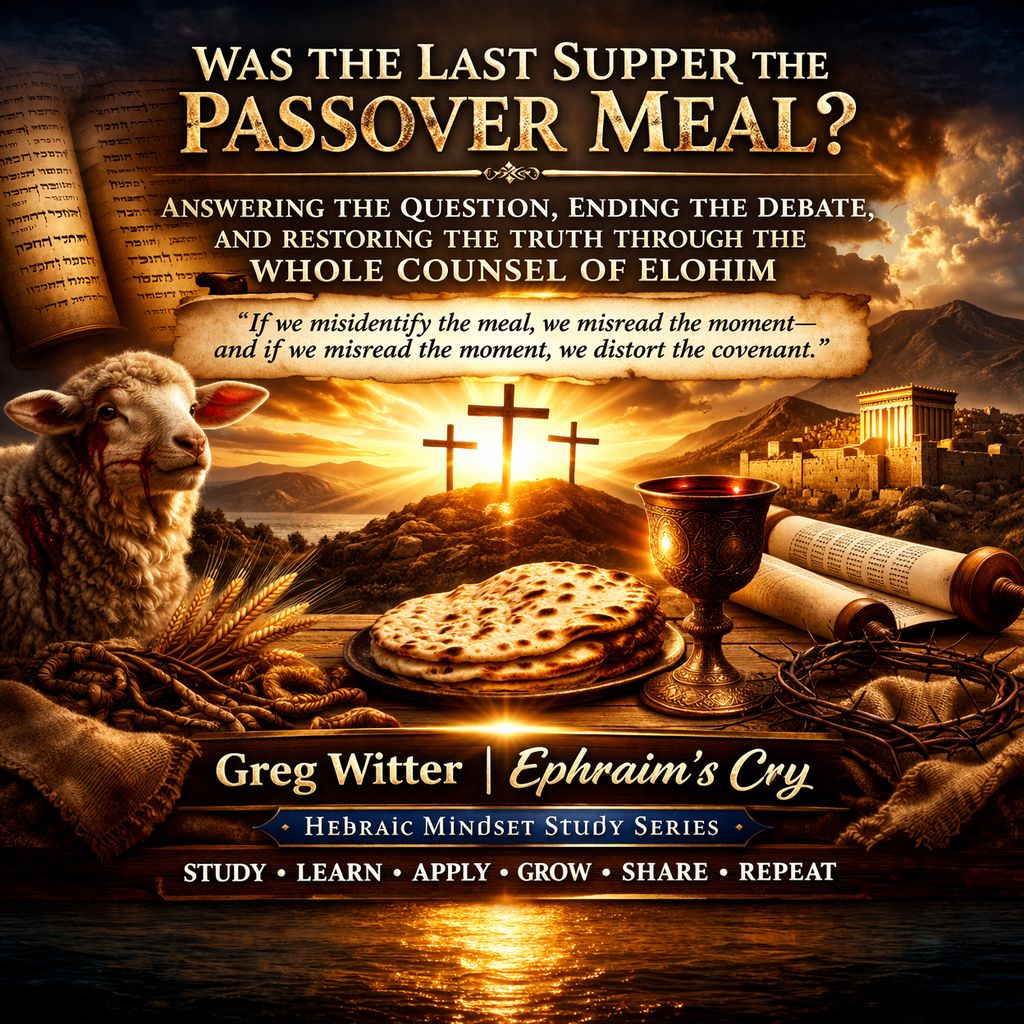
The Last Supper Is Not Passover
Distinguishing the Covenant Meal from the Covenant Sacrifice
When Timing, Torah, and Testimony Are Aligned, the Pattern Becomes Clear
Greg Witter | Ephraim’s Cry
Hebraic Mindset Study Series
Study Learn Apply Grow Share Repeat
The confusion between the Last Supper and Passover is not a minor disagreement—it is a structural error that affects timing, covenant understanding, and the identity of Yahusha as the Lamb. When these two events are merged into one, the text is forced into contradictions. When they are separated according to Scripture, the pattern becomes consistent, precise, and covenantally aligned.
Torah establishes Passover with exact timing and definition. Exodus 12 is explicit. The lamb is selected on the tenth day (Exodus 12:3), kept until the fourteenth (Exodus 12:6), and slaughtered “between the evenings.” That slaughter is the Passover. Then, beginning on the fifteenth day, the Feast of Unleavened Bread starts and continues seven days (Leviticus 23:5–6). Scripture itself separates these events. Passover is not a vague season. It is the sacrifice on the fourteenth. Unleavened Bread is the feast beginning the fifteenth. Lose that distinction, and you lose the entire framework.
Now bring in the Gospel accounts. Many immediately appeal to Matthew, Mark, and Luke, which speak of “the first day of unleavened bread when they sacrificed the Passover” (Matthew 26:17; Mark 14:12; Luke 22:7). But this must be understood in Second Temple usage. During that time, “Passover” and “Unleavened Bread” were often spoken of together as a single festival period. This is language usage, not a redefinition of Torah timing. If you force those phrases to override Exodus 12 and Leviticus 23, you create contradictions instead of resolving them.
John’s Gospel provides the chronological anchor. John 18:28 states that the accusers avoided entering the Praetorium “so that they would not be defiled, but might eat the Passover.” That means after Yahusha’s final meal, Passover had not yet been eaten by all. John 19:14 identifies the day of His sentencing as “the Preparation of the Passover.” That places His death in direct alignment with the preparation and slaughter period—not after a completed national Passover meal.
This cannot be ignored. It defines the timeline.
Yahusha’s final meal, therefore, is not the Torah-defined Passover sacrifice event. It is a covenant meal within Passover season that anticipates and interprets what is about to occur.
The content of the meal confirms this.
At the table, the emphasis is not on a lamb being eaten. The Gospel accounts highlight bread and the cup. Yahusha says, “This is My body” (Matthew 26:26), and “This is My blood of the covenant” (Matthew 26:28; Luke 22:20). The focus has shifted. It is no longer lamb-on-the-table—it is Lamb-about-to-be-slain.
The absence of a clear lamb emphasis in the narrative is not incidental. It is theological. The Lamb is not being served. The Lamb is speaking.
Then Yahusha adds a forward-looking statement: “I will not eat it again until it is fulfilled in the Kingdom of Elohim” (Luke 22:16). This is critical. The meal is not presented as the completed fulfillment of Passover. It is anticipatory. It points forward to what is about to take place. That alone prevents this meal from being treated as the final Passover fulfillment event.
Now return to Torah timing.
Exodus 12:6 commands that the lamb be slain “between the evenings.” Yahusha’s death aligns with this window. He is not simply remembering the lamb—He is dying as the Lamb in alignment with the slaughter period. This is why John emphasizes that not one of His bones was broken (John 19:36), directly fulfilling Exodus 12:46 and Numbers 9:12. The fulfillment is located in His death, not merely in the meal.
The priestly and legal structure reinforces the distinction further.
Deuteronomy 16 commands that Passover sacrifice take place at the location Yahuah chooses—centralized, not private (Deuteronomy 16:2, 5–6). This raises an unavoidable question: how does a private upper room meal function as the official Passover sacrifice? It does not. The Last Supper is not operating within the Temple sacrificial system. It is functioning as a covenant declaration before the offering.
Now bring in the covenant pattern.
Exodus 24 establishes the structure of covenant ratification: blood is shed, covenant is declared, and a meal is shared. At the Last Supper, Yahusha declares the covenant—“This is My blood of the covenant.” The shedding of blood follows in His death. The meal is not the sacrifice—it is the covenant declaration before the sacrifice. This is not just Passover language. This is covenant ratification language.
This also clarifies the instruction, “Do this in remembrance of Me” (Luke 22:19). Remembrance in Scripture is not casual repetition. It is covenant memorial tied to appointed times (Exodus 12:14). It is not a free-form ritual detached from Torah structure. It is anchored in covenant context.
Paul’s instruction in 1 Corinthians 11 confirms that this meal became a covenant remembrance practice among believers—but also shows it was being mishandled. His correction demonstrates that the focus is on rightly discerning the body and covenant significance, not recreating a Temple Passover sacrifice in scattered communities.
Now the logical conclusion must be faced directly.
If the Last Supper is the Passover meal in full completion, then Yahusha’s death is no longer aligned with the Passover slaughter timing.
If Yahusha’s death is aligned with the Passover slaughter timing, then the Last Supper must be distinct from the official Passover sacrifice event.
It cannot be both.
Scripture does not contradict itself. Systems force contradictions. The text does not.
So the pattern stands:
Yahusha gathers with His disciples for a covenant meal.
He declares His body and blood as the covenant.
He announces what is about to occur.
He is then delivered up during Passover preparation.
He is slain in alignment with the lamb pattern.
He fulfills what Passover always pointed to.
The meal interprets the sacrifice.
The sacrifice fulfills the pattern.
They are connected—but they are not the same event.
The Last Supper is not Passover.
Passover is not the Last Supper.
The Last Supper is the covenant declaration before the offering.
Passover is the covenant pattern fulfilled in the offering.
Yahusha did not merely participate in Passover.
He became the Passover Lamb.
Once that distinction is restored, the timeline holds, the covenant structure aligns, and the testimony of Scripture stands without contradiction.
Truth stands where the text stands.
Error begins where events are merged beyond what is written.
#GregWitter, #EphraimsCry, #HebraicMindset, #HebraicMindsetStudySeries, #PassoverTruth, #LastSupper,
#CovenantMeal, #PassoverLamb, #TorahAndMessiah, #CovenantFulfillment, #BiblicalTiming, #Exodus12,
#JohnGospel, #YahushaTheLamb, #CovenantPattern, #ScriptureContext, #GuardTheWord,
#WholeCounselOfElohim, #FeastsOfYahuah, #TruthOverTradition
