
The I AM Statements of יְשׁוּעָה (Y’shu’ah/Jesus) and Their Connection to the Great I AM of the Torah and Tanakh
Greg Witter | Ephraim’s Cry
Hebraic Mindset Study Series
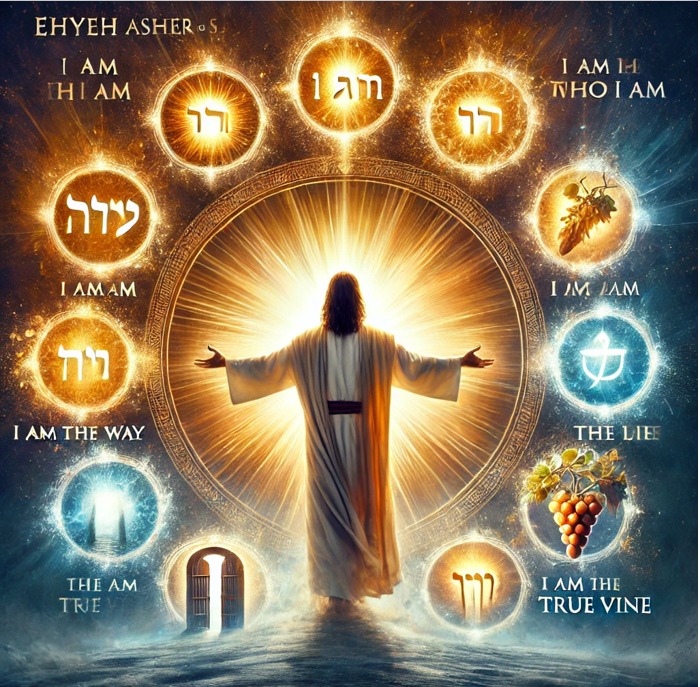
Y’shu’ah’s seven “I AM” statements in the Gospel of John are deeply rooted in the revelation of Elohim as the Great I AM in the Torah and Tanakh. When Y’shu’ah declares, “I AM,” He is not only identifying Himself as the Messiah, but He is also directly connecting Himself to the divine name of Yahûah revealed to Moses in Exodus 3:14. This connection reveals that Y’shu’ah is the eternal Elohim, the self-existent One, who has been present and active in every part of the redemptive history, from the Torah to the New Covenant.
The Great I AM: Ehyeh Asher Ehyeh
In Exodus 3:13-14, Moses encounters Elohim at the burning bush. When Moses asks Elohim for His name, He responds, “I AM WHO I AM” (Hebrew: Ehyeh Asher Ehyeh). Elohim continues, “Say this to the people of Israel: ‘I AM has sent me to you.’” The phrase “I AM” (Hebrew: Ehyeh) emphasizes Elohim’s eternal and self-existent nature. He is the One who is, who was, and who will be. His existence is independent of time or space, and He alone defines existence.
This moment is foundational in the Torah because it reveals the divine name that will be used throughout the Tanakh to identify Elohim’s relationship with His people. The I AM statement is Elohim’s declaration of His absolute sovereignty and eternal nature. Every time Elohim speaks through the prophets or declares His divine will in the Torah, the I AM echoes through history as the voice of the Creator and Redeemer.
Y’shu’ah’s “I AM” Statements in the Gospel of John
When Y’shu’ah declares “I AM” in the Gospel of John, He directly connects Himself to the Great I AM of Exodus 3:14. By doing so, Y’shu’ah affirms His identity as the eternal Elohim and the manifestation of Elohim’s presence in the world. His “I AM” statements are more than metaphors—they are revelations of His divine nature and mission, fulfilling the promises made in the Torah and Tanakh.
Here are the seven “I AM” statements from the Gospel of John and their connections to the Torah and Tanakh:
1. I AM the Bread of Life
o John 6:35, 48: “I am the bread of life. Whoever comes to me shall not hunger.”
o Connection to the Torah and Tanakh: In Exodus 16, Elohim provided manna (bread from heaven) to sustain the Israelites in the wilderness. Y’shu’ah, in declaring Himself the Bread of Life, is connecting to this manna—the divine provision from Elohim that sustains both physically and spiritually. Deuteronomy 8:3 also emphasizes that man does not live by bread alone, but by every word that comes from Elohim, and Y’shu’ah is revealed as the Word (John 1:1).
2. I AM the Light of the World
o John 8:12: “I am the light of the world. Whoever follows me will not walk in darkness, but will have the light of life.”
o Connection to the Torah and Tanakh: In Genesis 1:3, Elohim declared, “Let there be light,” and light entered into the chaos, bringing order to creation. Throughout the Tanakh, light is a symbol of Elohim’s presence, guidance, and revelation. Psalm 27:1 declares, “The Lord is my light and my salvation.” Y’shu’ah, as the Light of the World, embodies the divine presence and guidance that leads humanity out of the darkness of sin and death.
3. I AM the Door (or Gate) of the Sheep
o John 10:7, 9: “I am the door. If anyone enters by me, he will be saved and will go in and out and find pasture.”
o Connection to the Torah and Tanakh: In Exodus 12:7, the blood of the Passover lamb was placed on the doorposts of the Israelites’ homes to protect them from the angel of death. Y’shu’ah, in calling Himself the Door, connects to this moment of deliverance and protection, signifying that He is the only way to salvation and the gateway to eternal life, just as the door of the Passover lamb was a sign of Elohim’s protection.
4. I AM the Good Shepherd
o John 10:11, 14: “I am the good shepherd. The good shepherd lays down his life for the sheep.”
o Connection to the Torah and Tanakh: Psalm 23 begins with the declaration, “The Lord is my shepherd; I shall not want.” Throughout the Tanakh, Elohim is portrayed as the Shepherd of Israel, guiding and protecting His people. Ezekiel 34 speaks of Elohim Himself becoming the Shepherd of His flock. Y’shu’ah, in declaring Himself the Good Shepherd, fulfills this prophetic imagery, revealing that He is the divine Shepherd who sacrifices His life for the protection and redemption of His sheep.
5. I AM the Resurrection and the Life
o John 11:25: “I am the resurrection and the life. Whoever believes in me, though he die, yet shall he live.”
o Connection to the Torah and Tanakh: Job 19:25-26 contains the prophetic declaration: “I know that my Redeemer lives, and at the last He will stand upon the earth. And after my skin has been thus destroyed, yet in my flesh I shall see God.” Y’shu’ah fulfills this promise of resurrection and eternal life, demonstrating that He is the One who holds power over death and the grave. The Tanakh is filled with resurrection imagery and hope in Elohim’s ultimate deliverance, which Y’shu’ah embodies and fulfills.
6. I AM the Way, the Truth, and the Life
o John 14:6: “I am the way, and the truth, and the life. No one comes to the Father except through me.”
o Connection to the Torah and Tanakh: Proverbs 14:12 teaches that there is a way that seems right to a man but leads to death. In contrast, Y’shu’ah declares Himself to be the Way that leads to life, the Truth that guides all understanding, and the Life that grants eternal salvation. In the Torah, Deuteronomy 30:19 speaks of choosing life through obedience to Elohim. Y’shu’ah is the fulfillment of the Torah’s way to life, the path that brings believers to the Father.
7. I AM the True Vine
o John 15:1, 5: “I am the true vine, and my Father is the vinedresser.”
o Connection to the Torah and Tanakh: In Isaiah 5, Israel is portrayed as Elohim’s vineyard that was expected to bear fruit but instead produced wild grapes. Psalm 80 also describes Israel as a vine brought out of Egypt. Y’shu’ah, as the True Vine, declares that He is the fulfillment of Israel’s calling, the source of spiritual fruit and life. Through abiding in Him, believers become part of the true vine, producing fruit that glorifies Elohim.
Conclusion: The Divine Connection of “I AM” in Y’shu’ah
The seven “I AM” statements of Y’shu’ah in the Gospel of John reveal His identity as the Great I AM of Exodus 3:14. These statements show that Y’shu’ah is not just a teacher or prophet but the eternal Elohim who has been present from the beginning. His declarations fulfill the promises and revelations of the Torah and Tanakh, revealing Him as the Bread of Life, the Light of the World, the Door, the Good Shepherd, the Resurrection, the Way, and the True Vine.
By connecting His “I AM” statements to the Great I AM, Y’shu’ah affirms His divinity and His role as the fulfillment of Elohim’s plan for redemption, stretching from the Torah to the New Covenant. Understanding these connections deepens our appreciation for the continuity of Elohim’s plan through Scripture and strengthens our faith in Y’shu’ah as the eternal I AM, who has always been and always will be.
