
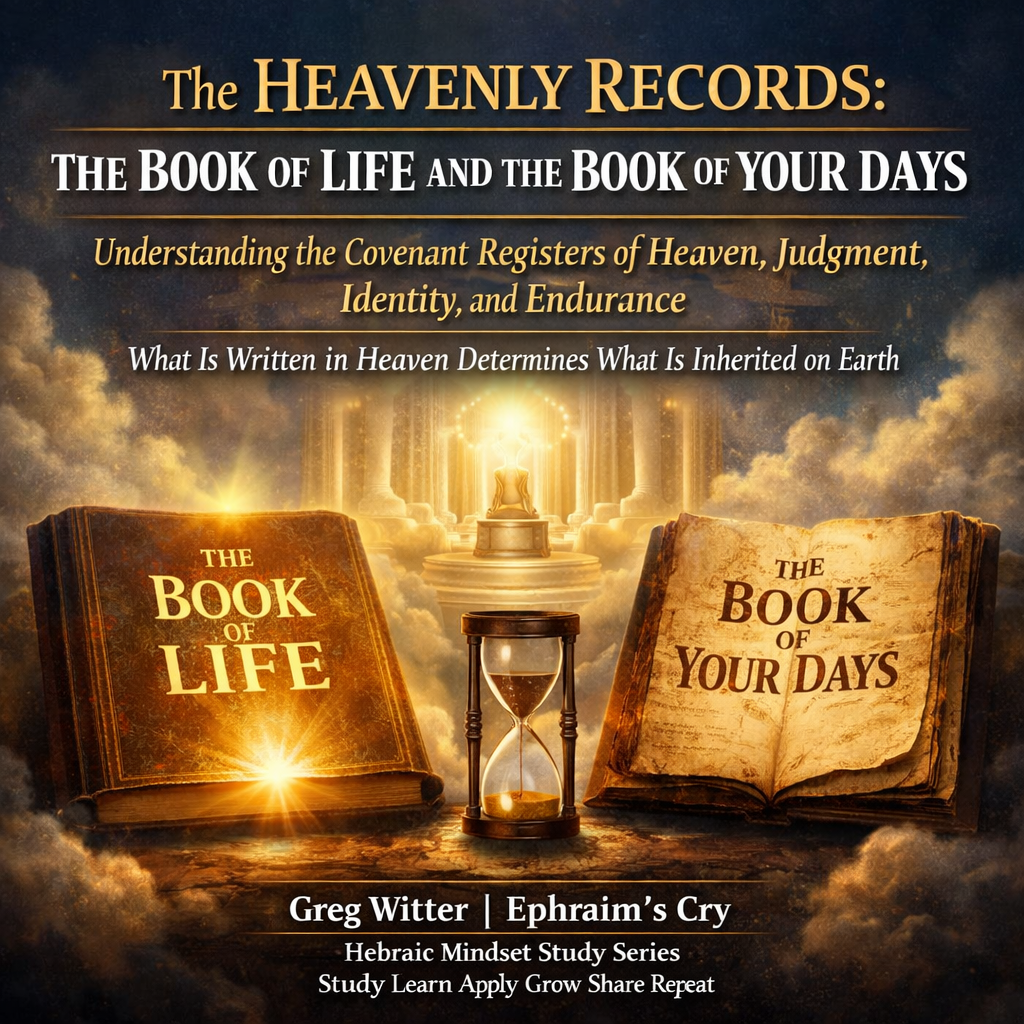
THE HEAVENLY RECORDS: THE BOOK OF LIFE AND THE BOOK OF YOUR DAYS
Understanding the Covenant Registers of Heaven, Judgment, Identity, and Endurance
What Is Written in Heaven Determines What Is Inherited on Earth
Greg Witter | Ephraim’s Cry
Hebraic Mindset Study Series
Study Learn Apply Grow Share Repeat
INTRODUCTION — THE HEAVENS KEEP RECORDS
One of the most overlooked realities in Scripture is that heaven keeps records. The Scriptures repeatedly reveal that Yahuah governs His creation through covenant order, witnesses, testimony, and judgment. The language used throughout Torah, the Prophets, the Writings, and the Apostolic testimony reflects the structure of a kingdom — and every kingdom keeps records.
Modern religious teaching often reduces salvation to a moment, a confession, or a feeling. Many people today believe that if they once made a statement of belief, their eternal destiny is settled regardless of how they live afterward. Yet the Scriptures present a far more serious and structured picture.
Heaven maintains books.
These books testify concerning identity, covenant loyalty, judgment, and inheritance. When these passages are examined together, we discover that Scripture speaks of multiple heavenly records. Among them are two that are particularly significant:
The Book of Life — the registry of those who belong to Yahuah and will inherit eternal life.
The Book of Your Days or the record of your life — the testimony of how a person lived, what they did with the life entrusted to them, and the course they walked before the throne of heaven.
Understanding these records reveals the true nature of covenant life, exposes the errors of both lawless grace and works-based religion, and restores the biblical understanding of salvation as a covenant relationship with Yahuah through Yahusha.
THE KINGDOM CONTEXT OF HEAVENLY RECORDS
In the ancient world, kings maintained official registries of their citizens. These records identified who belonged to the kingdom and who possessed legal standing within it.
To have one’s name written in the royal register meant protection, inheritance, and recognized identity within the realm.
To have one’s name removed meant exile, loss of citizenship, or judgment.
Scripture uses this familiar royal structure to describe the Kingdom of Yahuah.
Yahuah is the King.
His Kingdom is real.
His people are citizens.
And their names are recorded in His register.
This concept appears early in the covenant story.
THE TORAH FOUNDATION — THE BOOK OF YAHUAH
The first explicit reference to this heavenly registry appears during the crisis of the golden calf.
Exodus 32:32–33 records Moses interceding for Israel after their rebellion:
“Yet now, if You will forgive their sin—but if not, blot me out of Your book which You have written.”
Yahuah responds:
“Whoever has sinned against Me, I will blot him out of My book.”
This passage establishes several critical truths.
First, Yahuah keeps a book containing the names of His people.
Second, covenant identity is not treated casually.
Third, removal from that book is possible.
This statement stands in direct tension with the modern teaching that salvation can never be forfeited regardless of a person’s life afterward. The Torah itself shows that covenant rebellion can lead to removal from the record of life.
THE BOOK OF THE LIVING IN THE WRITINGS
The Psalms reinforce the same concept.
Psalm 69:28 declares:
“Let them be blotted out of the book of the living, and not be written with the righteous.”
The phrase “book of the living” shows that the book identifies those counted among the righteous — those who share in the life that comes from Yahuah.
Those who reject Him ultimately remove themselves from that standing.
THE PROPHETIC WITNESS — DELIVERANCE AND THE BOOK
The prophets confirm the same reality.
Daniel 12:1 declares:
“At that time your people shall be delivered, everyone who is found written in the book.”
Daniel is describing the time of the end, a time of unprecedented distress. Deliverance during that time is directly connected to the heavenly record.
Those whose names are written in the book are delivered.
THE TESTIMONY OF YAHUSHA
Yahusha confirms the existence of this heavenly registry.
In Luke 10:20 He tells His disciples:
“Do not rejoice that the spirits submit to you, but rejoice that your names are written in heaven.”
The disciples had experienced miracles and authority over evil spirits, yet Yahusha directs their focus toward something far greater.
Their names were written in heaven.
Spiritual experiences come and go. Covenant identity is what truly matters.
THE LAMB’S BOOK OF LIFE
The Book of Life reaches its fullest explanation in the book of Revelation.
Revelation identifies the record as the Lamb’s Book of Life, revealing that Messiah is the mediator through whom covenant identity is secured.
Revelation 3:5 says:
“He who overcomes shall be clothed in white garments, and I will not blot out his name from the Book of Life.”
The promise is given to those who overcome.
This statement also contains a warning: endurance matters.
Revelation 20:12–15 provides the clearest description of the final judgment.
“And I saw the dead, small and great, standing before the throne, and books were opened. And another book was opened, which is the Book of Life.”
Notice the distinction.
There are multiple books.
Then there is another book — the Book of Life.
The dead are judged according to what is written in the books, according to their works.
But the decisive factor determining eternal destiny is whether a person’s name appears in the Book of Life.
THE BOOK OF YOUR DAYS — THE RECORD OF YOUR LIFE
Scripture also speaks of another kind of heavenly record.
Psalm 139:16 declares:
“Your eyes saw my substance being yet unformed. And in Your book they all were written, the days fashioned for me, when as yet there were none of them.”
This statement does not mean that human beings are robotic creatures with no responsibility for their actions. Scripture consistently affirms human accountability, repentance, and the ability to choose obedience or rebellion. Rather, what Psalm 139 reveals is that Yahuah’s knowledge of human life precedes human existence.
He sees the end from the beginning.
The book mentioned here appears to represent the record of a person’s life — the span of days entrusted to them, the life given to them, and the course that life ultimately takes.
In other words, while the Book of Life records covenant identity and citizenship in the Kingdom, the record of a person’s life contains the testimony of how that life was lived.
This distinction becomes clearer when we return to the description of the final judgment in Revelation.
THE BOOKS OPENED BEFORE THE THRONE
Revelation 20:12–13 describes the great judgment scene:
“I saw the dead, small and great, standing before Elohim, and books were opened. And another book was opened, which is the Book of Life. And the dead were judged according to their works, by the things which were written in the books.”
Notice again the language carefully.
Books — plural — are opened.
Then another book is opened — the Book of Life.
The books record the works of individuals. These books contain the testimony of their deeds, their choices, their lives, and their response to the truth they were given.
These records reveal what each person did with the life entrusted to them.
This is consistent with many other passages throughout Scripture that emphasize accountability.
Ecclesiastes 12:14 declares that Elohim will bring every work into judgment, including every hidden thing, whether good or evil.
Matthew 12:36 records Yahusha saying that every idle word people speak will be accounted for in the day of judgment.
Romans 14:12 reminds believers that each person will give account of himself to Elohim.
These statements make clear that heaven records the testimony of a person’s life.
Nothing is forgotten.
Nothing is hidden.
Nothing is lost.
The books contain the record of what was done with the life Yahuah entrusted to each person.
THE RELATIONSHIP BETWEEN THE BOOKS
Understanding the relationship between these records is crucial.
The Book of Life identifies those who belong to Yahuah.
The books of works testify concerning how each person lived.
One concerns identity.
The other concerns accountability.
Both together form the full picture presented at the final judgment.
If a person’s name is not written in the Book of Life, the judgment recorded in the books of works confirms their rebellion and separation from Yahuah.
If a person’s name is written in the Book of Life, the record of their life demonstrates the fruit of their covenant relationship.
This does not mean that salvation is earned through perfect behavior. Scripture clearly teaches that all human beings fall short and depend upon the mercy of Yahuah.
But it does mean that a genuine covenant relationship produces a transformed life.
Faith produces fruit.
Obedience grows out of love.
Repentance follows failure.
Faithfulness characterizes those who remain in covenant with Yahuah.
The books of works testify to these realities.
THE ERROR OF LAWLESS SALVATION
One of the most widespread errors in modern religious teaching is the idea that salvation requires nothing beyond an initial confession of belief.
Many people today believe that if they once accepted a doctrine or repeated a prayer, their eternal destiny is permanently settled regardless of their life afterward.
But the Scriptures consistently warn against this mindset.
Yahusha Himself said:
“Not everyone who says to Me, ‘Master, Master,’ shall enter the kingdom of heaven, but he who does the will of My Father in heaven.”
(Matthew 7:21)
He also warned that lawlessness would cause many people’s love to grow cold.
Matthew 24:12–13 says:
“Because lawlessness will increase, the love of many will grow cold. But he who endures to the end shall be saved.”
Endurance is a defining characteristic of genuine covenant faith.
Revelation repeatedly describes the people of Yahuah as those who overcome.
Revelation 14:12 describes the saints as those who keep the commandments of Elohim and hold to the testimony of Yahusha.
The Scriptures never portray salvation as a license for rebellion.
Rather, salvation restores the covenant relationship that leads people to walk in obedience to Yahuah.
THE ERROR OF WORKS-BASED RELIGION
At the same time, Scripture rejects the opposite error: the idea that salvation must be earned by human effort.
No one earns entrance into covenant through personal merit.
Human beings are reconciled to Yahuah through His mercy and through the work of Yahusha.
The sacrifice of Messiah provides the atonement that makes reconciliation possible.
Yet the Scriptures consistently show that covenant grace does not eliminate covenant responsibility.
Grace restores the relationship.
The Spirit transforms the heart.
Obedience becomes the natural expression of love for Yahuah.
Faith without works, James writes, is dead.
THE COVENANT PATTERN OF SALVATION
When the full witness of Scripture is considered, a consistent pattern emerges.
Salvation begins with grace.
Yahuah calls and redeems.
Faith responds to that calling.
The covenant relationship begins.
The Spirit writes the Torah on the heart.
Life begins to change.
Obedience grows out of love.
Faithfulness continues through trials.
And those who endure remain written in the Book of Life.
The record of their lives becomes a testimony of the transforming power of covenant relationship.
THE FINAL JUDGMENT
At the end of the age, the heavenly records will testify concerning every life.
The books of works will reveal what each person did with the life entrusted to them.
The Book of Life will reveal whether that person truly belonged to Yahuah.
Revelation 21:27 declares that nothing unclean will enter the New Jerusalem — only those whose names are written in the Lamb’s Book of Life.
This is the ultimate inheritance of the righteous.
Not merely survival.
Not merely forgiveness.
But entrance into the restored Kingdom of Yahuah.
CONCLUSION — WHAT IS WRITTEN IN HEAVEN MATTERS
The teaching of the heavenly books should not lead to fear for those who are walking faithfully with Yahuah.
Rather, it should awaken seriousness about the covenant relationship.
Life is not random.
Our days are known to Yahuah.
Our lives are recorded.
Our choices matter.
And our covenant loyalty matters.
The Book of Life records those who belong to the Kingdom.
The books of works testify concerning the lives they lived.
Those who walk with Yahuah, who repent when they stumble, who remain faithful to the testimony of Yahusha, and who endure in covenant loyalty will discover that their names remain written in the Book of Life.
This is the hope and promise given to those who follow Him.
May we walk in humility, repentance, reverence, and faithfulness so that when the books are opened, the testimony of our lives will reflect the covenant relationship we claim.
HalleluYah.
#GregWitter, #EphraimsCry, #HebraicMindset, #BookOfLife, #LambsBookOfLife, #CovenantFaithfulness, #KingdomCitizenship, #HeavenlyBooks, #FinalJudgment, #Daniel12, #Revelation20, #Psalm139, #Exodus32, #EndureToTheEnd, #Overcome, #KeepTheCommandments, #TorahAndTestimony, #FaithAndObedience, #WatchmanTeaching, #WholeCounselOfScripture
