
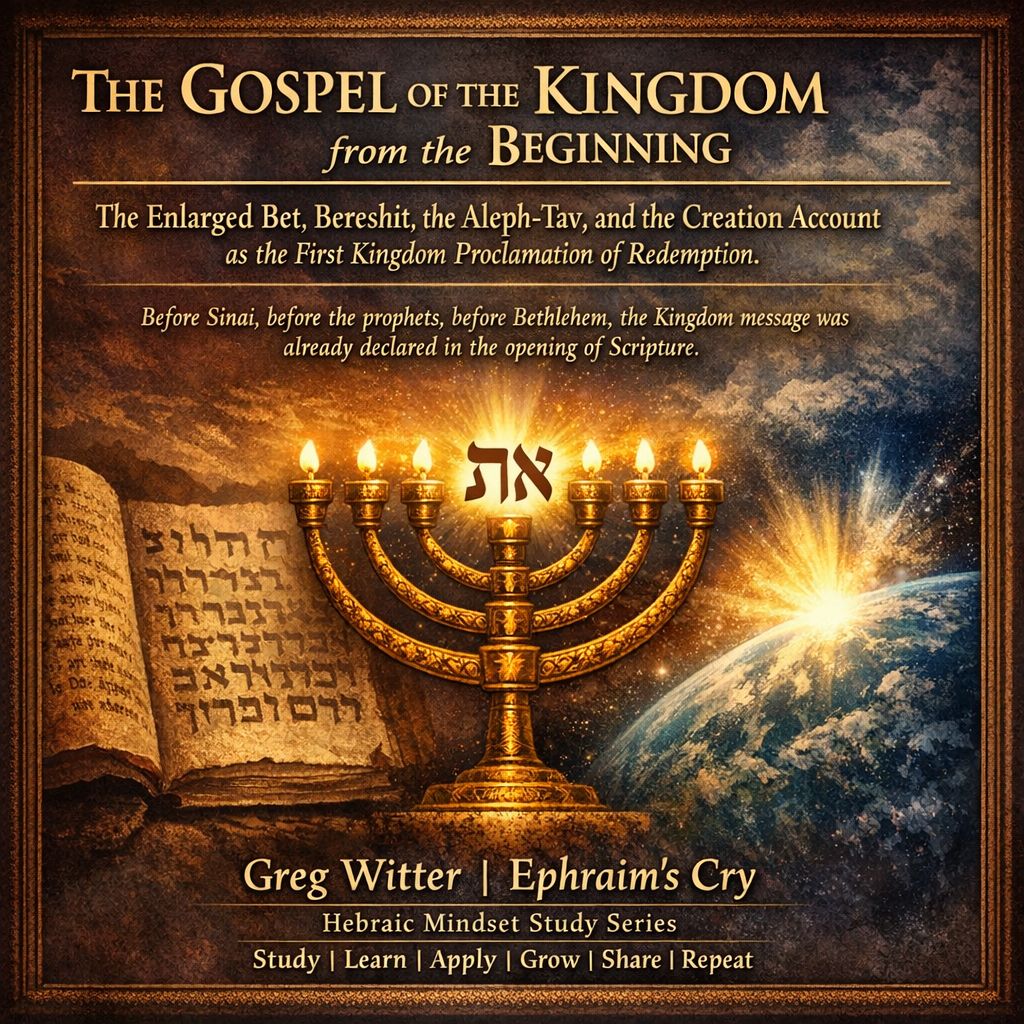
The Gospel of the Kingdom from the Beginning
The Enlarged Bet, Bereshit, the Aleph-Tav, and the Creation Account as the First Kingdom Proclamation of Redemption
Before Sinai, before the prophets, before Bethlehem, the Kingdom message was already declared in the opening of Scripture.
Greg Witter | Ephraim’s Cry
Hebraic Mindset Study Series
Study Learn Apply Grow Share Repeat
Genesis 1 is not merely the beginning of history. It is the beginning of revelation. It is the beginning of covenant order. It is the beginning of Kingdom proclamation. What many have been taught to read as only a creation account is, in truth, the first great declaration of Yahuah’s authority, Yahuah’s order, Yahuah’s dwelling, Yahuah’s government, and Yahuah’s redemptive purpose. The gospel of the Kingdom did not suddenly appear in Matthew. It did not begin at Bethlehem. It did not start when Yahusha stepped into public ministry. It was embedded from the beginning, declared in the first letter, the first word, the first sentence, and the first chapter.
That matters because if the gospel begins only in the Apostolic Writings, redemption appears to be reaction. It appears to be a late answer to an unexpected problem. But if the gospel of the Kingdom is present from the beginning, then redemption is not reaction. It is design. It is not improvisation. It is purpose. It is not an emergency plan. It is woven into the structure of Scripture itself. That means Genesis does not merely tell us how the world began. It tells us who rules, what order is, what man was made for, what was lost, and how Yahuah will restore all things under righteous authority.
The opening line of Scripture must therefore be handled with reverence and with depth.
Bereshit bara Elohim et hashamayim ve’et haaretz.
“In the beginning Elohim created the heavens and the earth” (Genesis 1:1).
That sentence is not simple in the shallow sense. It is simple in the way a seed is simple. Everything is there in concentrated form. The house is there. The headship is there. The covenant is there. The beginning is there. The end is there. The heavenly-earthly structure is there. The Kingdom pattern is there. The redemptive arc is there. The Messiah witness is there. The future restoration is there in seed form, waiting to unfold through the rest of Scripture.
Begin with the first letter: Bet.
The first letter of the Bible is not Aleph. It is Bet, and in the traditional Hebrew text of Genesis 1:1 that Bet is enlarged. That enlarged Bet has long invited meditation because it is not there without meaning. In Hebraic reading, enlarged letters are not accidents. They call attention. They say, “Stop. Look. Do not rush past this.”
The letter Bet carries the idea of house, dwelling, habitation, household, interior space. It is the picture of a contained realm, a dwelling place, a house prepared for ordered life under authority. That alone is already profound. Scripture does not begin with abstract philosophy. It begins with a house. The Kingdom message begins with a house because the Kingdom is not merely abstract power. It is ordered dwelling under rightful authority.
And that must be pressed further.
The Bet does not only point to a house in the sense of a building. It also points to the body. The body is a dwelling. The body is a house. The body is a vessel. The body is the space where life is carried and expressed. This matters because Scripture repeatedly develops the theme of Yahuah dwelling in what He has formed. Adam is formed from the ground and receives breath. The tabernacle is built as a dwelling. The temple becomes a dwelling. The body of the believer is called a temple. Messiah Himself takes on a body. And the final restoration ends with the dwelling of Elohim with men.
So the enlarged Bet at the beginning of Bereshit points not only to a cosmic house, but also prophetically toward the body as dwelling. It points toward habitation. It points toward incarnation. It points toward temple. It points toward a Kingdom expressed in formed, ordered, inhabited reality. Yahuah’s purpose was never a disembodied religion. It was ordered dwelling. It was embodied obedience. It was a house aligned with His presence.
This is why the enlarged Bet can be seen as declaring at the very threshold of Scripture: the Kingdom will concern the house, the body, the dwelling, the habitation, the ordered vessel in which Yahuah’s rule will be manifested. The gospel of the Kingdom therefore begins with the reality that Yahuah is establishing a dwelling for His glory and a body through which His purposes will be expressed.
This runs through all Scripture.
“Let them make Me a sanctuary, that I may dwell among them” (Exodus 25:8).
“Destroy this temple, and in three days I will raise it up” (John 2:19), speaking of the body of Yahusha.
“Do you not know that your body is the temple of the Ruach HaKodesh?” (1 Corinthians 6:19).
“Behold, the dwelling of Elohim is with men” (Revelation 21:3).
So the first letter already preaches. The Bet tells you the story is about dwelling, body, house, temple, Kingdom habitation, and ordered life under divine headship.
Now move into the first word: Bereshit.
Bereshit is usually translated “In the beginning,” and that is right. But it must not be flattened into mere chronology. Reshit carries the sense of beginning, first, chief, firstfruits, principal, head. It is not merely temporal. It is governing. The beginning is where order is established. The first determines the pattern of what follows. The head governs the body. The firstfruits define the harvest. The beginning establishes the nature of the story.
So when Scripture begins with Bereshit, it is not merely telling us when things started. It is declaring that Yahuah Himself establishes the beginning, and therefore Yahuah alone defines the order that flows from it. That is Kingdom language. Whoever defines the beginning defines the structure. Whoever defines the structure defines authority. Whoever defines authority defines righteousness. Whoever defines righteousness defines transgression. Whoever defines transgression defines redemption. The gospel of the Kingdom is therefore inseparable from Bereshit because the beginning establishes the order that redemption later restores.
Now press deeper into the word itself.
Hebrew often contains layers that invite meditation. Bereshit is not to be mangled carelessly, but it is right to observe that within the word there are thematic layers that align with the whole counsel of Scripture. Bet points toward house and body. Resh points toward head, chief, beginning, authority. Aleph points toward strength, leader, ox, first. Shin points toward fire, pressing, consuming, transformation. Tav points toward covenant sign, mark, completion.
So even at the pictographic level, the first word of Scripture can be read as a deeply suggestive witness to the house under headship, the body under authority, the beginning under covenant purpose, the dwelling being shaped by the consuming work of Elohim. This is not license for fantasy. It is a call to recognize that the opening word is saturated with Kingdom architecture.
There are also widely observed internal Hebrew word elements within Bereshit that many Hebraic teachers note. Among them are associations with bar or ben as son-language in broader Semitic usage, rosh as head or chief, and covenantal beginning themes rooted in reshit language. Taken together, the teaching force is clear: the story begins with a dwelling, under headship, moving toward covenant fulfillment. It is not illegitimate to see in that opening word a seed-witness that the Kingdom will be restored through the Son under rightful headship.
And this must be said plainly: the first word does not merely begin a book. It begins a Kingdom story.
Now move to the first sentence as a whole. Genesis 1:1 consists of seven Hebrew words:
Bereshit
Bara
Elohim
Et
Hashamayim
Ve’et
Haaretz
Seven words. This is not trivial. Seven throughout Scripture is the number of completion, fullness, covenant order, sacred completeness, ordered wholeness. Before Scripture even begins to narrate the details of the six days and the sanctified seventh, the first sentence itself is structured in covenantal completeness. The opening line is built as an ordered whole. It does not begin in literary chaos because the Kingdom of Yahuah is not chaos. It is ordered fullness.
And here one of the strongest structural observations must be made: Genesis 1:1 also contains twenty-eight Hebrew letters. That is four times seven. Four is repeatedly associated with the created order: four directions, four corners, four winds, earthward totality. Seven is covenant completion. So the very opening verse stands as a structural witness of creation brought into covenant order. Twenty-eight is not random noise. It is architectural precision. The first verse says in its structure what it says in its meaning: Yahuah is bringing the created realm into ordered, complete, covenantal form.
That is one of the powerful structures in Genesis 1:1 that many pass over too quickly. But there is another that must be brought out with force.
The verse is not only seven words and twenty-eight letters. It also presents a striking ordered pattern that many have compared to a menorah structure. In this teaching pattern, the seven words function like the seven lamps, with the central testimony drawing the eye. The opening line of Scripture is thus not merely informational. It is liturgical and revelatory. It is a lamp-structure. It is a witness-structure. It presents truth with symmetry and centeredness, as a Kingdom testimony set before the reader like a lampstand.
And here the Aleph-Tav must be brought fully into view.
The Hebrew object marker את appears in Genesis 1:1, and it appears centrally in the seven-word structure as part of the core witness of the verse. It appears again with the earth. There are therefore two Aleph-Tav witnesses in the opening line: one with the heavens and one with the earth.
That is not a small observation.
The Aleph-Tav stands with the heavens.
The Aleph-Tav stands with the earth.
The One who is the Aleph and the Tav spans both. The authority of Messiah is not partial. It is heavenly and earthly. It is total. It is the beginning and the end. It is the fullness of the redemptive arc. What is revealed openly later is already being witnessed at the opening threshold of Scripture.
Yahusha says, “I am the Aleph and the Tav, the first and the last, the beginning and the end” (Revelation 22:13).
He also says, “All authority in heaven and on earth has been given to Me” (Matthew 28:18).
That is not disconnected from Genesis 1:1. It opens Genesis 1:1. The opening line already testifies that the story from heaven to earth, from beginning to end, from creation to consummation, stands under the authority of the One who spans the whole.
And here is the further structure that almost nobody notices but should not be missed: the two Aleph-Tav witnesses bind heaven and earth together under one beginning-to-end authority. The verse is not merely saying that Elohim made two realms. It is witnessing that from the start both realms stand under the same total covenant authority that Messiah later openly claims. Heaven and earth are not two unrelated theaters. They are one Kingdom story under one Aleph-Tav Head.
This means Genesis 1:1 is already telling you, in seed form, the scope of the gospel of the Kingdom: the restoration of heaven and earth under the authority of the One who stands at the beginning and at the end.
Now go further into the menorah witness.
The seven-word form invites the mind to see not chaos but ordered illumination. In the pattern you have emphasized, the center testimony focuses on the Aleph-Tav, drawing the whole verse toward the One who is beginning and end. Whether one maps the words visually as a menorah or meditates on their symmetry, the teaching force remains: the opening verse is structured as a lamp of witness, and the center lamp testifies to the One through whom all creation comes and in whom all creation will be restored.
This fits perfectly with later revelation. The menorah is not merely furniture. It is a light-bearing testimony in the holy place. The center shaft governs the lampstand’s unified structure. The opening of Scripture, framed in ordered witness, points toward the centered reality that creation itself is not self-explaining. It is Messiah-centered.
John 1:1–3 makes this explicit. “In the beginning was the Word, and the Word was with Elohim, and the Word was Elohim. All things were made through Him.”
Colossians 1:16–17 confirms it. “For by Him all things were created, in heaven and on earth, visible and invisible… and in Him all things hold together.”
So the opening line of Scripture is not merely compatible with Messiah-centered proclamation. It demands it. The gospel of the Kingdom is there because the Kingdom is there, and the King’s authority is there in witness form from the start.
Now move to the first chapter as a whole.
Genesis 1 begins with the earth in a state of tohu and bohu, unformed and unfilled, with darkness over the face of the deep, and the Ruach of Elohim hovering over the waters (Genesis 1:2). That is not evil in itself, but it is unfinished. It is unstructured. It is unordered in the sense that it has not yet been brought into its appointed arrangement. Then Yahuah speaks, and the chapter unfolds by a repeated pattern: speech, separation, naming, ordering, filling, blessing, and commissioning.
This is the first proclamation of the gospel of the Kingdom because the gospel of the Kingdom is the good news that Yahuah brings all things into righteous order under His rule.
First, light pierces darkness.
“And Elohim said, ‘Let there be light,’ and there was light” (Genesis 1:3).
That is not just material description. It is theological pattern. Light enters darkness because Yahuah speaks. Paul later makes this explicit when he writes, “For Elohim, who said, ‘Let light shine out of darkness,’ has shined in our hearts” (2 Corinthians 4:6). The apostle himself reads Genesis 1:3 as gospel-pattern. Creation light becomes redemption light. What Yahuah did in the world physically, He does in the heart covenantally. The opening chapter is already proclaiming that darkness does not have the first word. Yahuah does.
Second, separation and distinction govern the chapter.
Light from darkness.
Day from night.
Waters above from waters below.
Sea from dry land.
The Kingdom of Yahuah is not confusion. It is holy distinction. Order depends on boundaries. Holiness depends on separation. Covenant life always involves rightly ordered distinctions. Genesis 1 establishes this before Sinai ever speaks it explicitly. The later Torah does not invent distinction. It extends the creation pattern into covenant life.
Third, the chapter shows realms being formed and then filled. Days one through three establish kingdoms of habitation. Days four through six place rulers and inhabitants into those realms. Light and darkness are established; sun, moon, and stars are set as governing lights. Sky and sea are ordered; birds and fish fill them. Land is made fruitful; animals and man are placed within it. This is enthronement language. It is Kingdom architecture.
Creation is therefore not merely a machine. It is a cosmic temple-kingdom. It is a realm prepared and then populated under ordered governance. This is why many have rightly noted the temple pattern in Genesis 1. The world is Yahuah’s ordered house. The chapter is the inauguration of His cosmic dwelling. The seventh day then becomes the sanctified completion, the royal rest of the enthroned Creator over the ordered world He has prepared.
That is why the Bet matters so much. House. Body. Temple. Dwelling. Kingdom domain.
Fourth, humanity is brought forth in the image of Elohim and given dominion (Genesis 1:26–28). This is explicit Kingdom language. Image and dominion belong together. Humanity is not made as random biological life. Man is made as a representative ruler under divine authority. Dominion is delegated, not autonomous. It is rule under rule. It is government under headship. This is the original Kingdom pattern.
And here the gospel becomes clearer. Redemption is not merely about extracting souls from earth. It is about restoring image-bearing humanity to rightful alignment under Yahuah’s reign. The Kingdom message was therefore present from the beginning because man’s original calling was Kingdom stewardship under divine order.
Fifth, the chapter embeds divine time into creation. “Let them be for signs, and for appointed times, and for days, and years” (Genesis 1:14). The lights are not random objects. They are appointed within a calendar of divine order. Time itself belongs to Yahuah. The moedim are not later religious inventions. They are rooted in creation structure. The Creator ordered time with sacred purpose from the beginning. So the gospel of the Kingdom includes restoration to divine time, not merely abstract inward belief detached from Yahuah’s calendar and order.
Sixth, the chapter culminates in blessing, fruitfulness, and rest. “Be fruitful and multiply” is Kingdom expansion language (Genesis 1:28). The sanctified seventh day is Kingdom completion and rest (Genesis 2:1–3). The story begins with ordered life under blessing and ends in sanctified rest. That pattern is later broken by rebellion, but the gospel restores what rebellion disrupted.
This is why Genesis 1 must not be treated as only origins. It is the original Kingdom constitution in seed form.
Now, to bring out the fullness of the gospel pattern, Genesis 1 must also be read in relation to the rest of Scripture.
Creation begins with heaven and earth. Revelation ends with a new heaven and new earth (Revelation 21:1).
Creation begins with light. Revelation ends with a city needing no sun because the glory of Elohim illumines it and the Lamb is its lamp (Revelation 21:23).
Creation begins with the waters ordered. Revelation ends with the river of the water of life flowing from the throne (Revelation 22:1).
Creation begins with the tree-bearing earth. Revelation ends with the tree of life restored (Revelation 22:2).
Creation begins with man given dominion. Revelation ends with the servants of Elohim reigning forever and ever (Revelation 22:5).
This is the same story from beginning to end. Genesis 1 is not background material. It is the opening proclamation of the Kingdom arc that Scripture will carry all the way to restoration.
And we must say plainly what this means for the gospel.
The gospel is not merely that Messiah died and rose, though that is central and indispensable. The gospel is that through Messiah’s death and resurrection, Yahuah is restoring all things under His Kingdom authority. The apostolic proclamation of Messiah crucified and raised is the redemptive center of a much larger Kingdom story that begins in Genesis 1. The opening chapter tells you what the Kingdom is. The cross tells you how the rebellious are redeemed back into it. The resurrection tells you that the new creation has begun. The final restoration tells you where the whole story is going.
So when someone says the gospel is in Genesis 1, that is not exaggeration if it is handled rightly. It is true. The beginning already preaches the Kingdom. The enlarged Bet preaches the house, the body, the dwelling. Bereshit preaches the governed beginning. The seven-word structure preaches covenant completeness. The twenty-eight-letter structure preaches creation brought into covenant order. The Aleph-Tav preaches the One who spans beginning and end. The two Aleph-Tav witnesses preach His authority over heaven and earth. The menorah pattern preaches a centered testimony. The creation account preaches light over darkness, order over chaos, life over emptiness, dominion under headship, sacred time, fruitful blessing, and sanctified rest.
Nothing about that is accidental.
And this is where the falsehood must be exposed. The falsehood is not merely that the post saw something in Genesis 1. The falsehood is that many stop too early. Many say there are “hidden patterns” and leave the matter vague, mystical, and undefined. But the truth is stronger than vague mystery. The truth is covenantal. The truth is textual. The truth is canonical. The truth is Kingdom-focused. Genesis 1 is not inviting men into endless speculative puzzles. It is announcing the ordered reign of Yahuah from the beginning and witnessing to the One through whom all things were made and by whom all things will be restored.
That means the first gospel is not a gospel of private mystical discovery. It is the gospel of the Kingdom.
The Creator rules.
Creation is His house.
Man was made in His image to rule under Him.
Darkness is overcome by His word.
Time belongs to Him.
The heavens and the earth stand under His beginning-to-end authority.
The body is part of His dwelling purpose.
The story moves toward restoration, not chaos.
And the One who stands at the center is the Aleph and the Tav.
So yes, the gospel of the Kingdom was presented from the beginning. It was declared in the first letter. It was announced in the enlarged Bet. It was embedded in Bereshit. It was structured in the seven words. It was witnessed in the Aleph-Tav. It was displayed in the creation account. It was moving already toward the full revelation of Messiah and the final restoration of all things under Yahuah’s reign.
From Bereshit to Revelation, the message remains the same: Yahuah establishes His house, orders His world, forms His image-bearers, judges rebellion, redeems through His Anointed, and restores heaven and earth under the authority of the One who is the beginning and the end.
That is the gospel of the Kingdom from the beginning.
#GregWitter, #EphraimsCry, #HebraicMindset, #HebraicMindsetStudySeries, #TheGospelOfTheKingdom, #GenesisOne, #Bereshit, #EnlargedBet, #BetIsTheHouse, #BetIsTheBody, #AlephTav, #MessiahInGenesis, #KingdomFromTheBeginning, #CreationAndKingdom, #PaleoHebrew, #WordStudy, #CovenantOrder, #SevenWords, #TwentyEightLetters, #MenorahPattern, #HeavenAndEarth, #LightOutOfDarkness, #CreationPattern, #TemplePattern, #CosmicTemple, #DominionMandate, #SacredTime, #MoedimInCreation, #SabbathRest, #WholeCounselOfElohim, #TorahAndTestimony, #RestoreTheAncientPaths, #TruthOverTradition, #StudyLearnApplyGrowShareRepeat
